Morocco Apiculture Market Size, Share & Growth Rate
The Morocco Apiculture Market was estimated at USD 413 Million in 2025 and is projected to reach USD 582 Million by 2032, growing at a CAGR of 5.0% from 2026 to 2032. This growth is largely driven by heightened consumer awareness regarding the health benefits of honey and other bee products, alongside a commitment to organic and sustainable farming practices. Moreover, the favorable climatic conditions and rich floral diversity in Morocco are enabling beekeepers to thrive and innovate in their methods.
Morocco Apiculture Market Year-wise Growth Rate and Key Drivers
This graph highlights how the Morocco Apiculture Market has steadily grown over the years, supported by major growth factors.
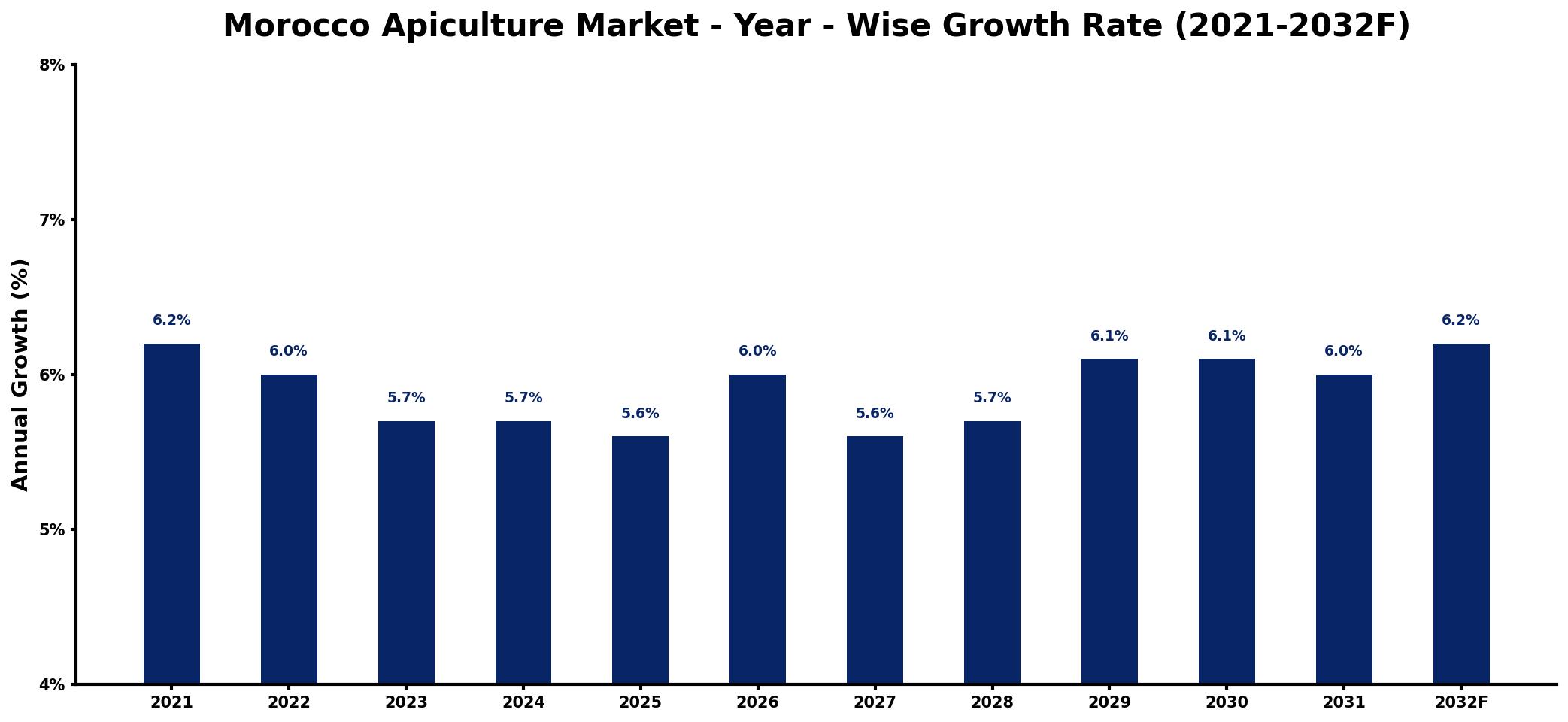
The table below presents the year‑wise growth rates along with the key drivers influencing the market
| Year | Growth Rate | Major Drivers |
| 2021 | 6.2% | Increased demand for organic honey |
| 2022 | 6.0% | Expansion of local beekeeping initiatives |
| 2023 | 5.7% | Rising popularity of natural sweeteners |
| 2024 | 5.7% | Growth in eco-tourism related activities |
| 2025 | 5.6% | Investment in sustainable farming practices |
| 2026 | 6.0% | Enhanced distribution networks established |
| 2027 | 5.6% | Collaboration with agricultural cooperatives |
| 2028 | 5.7% | Emerging health trends supporting consumption |
| 2029 | 6.1% | Technological advancements in beekeeping |
| 2030 | 6.1% | Increased awareness of pollinator importance |
| 2031 | 6.0% | Supportive government policies enacted |
| 2032 | 6.2% | Diversification of agricultural product offerings |
Note: Market size estimations and growth projections presented in this report are based on 6Wresearch's proprietary forecasting methodology, utilizing the latest available industry data, government publications, and primary research inputs.
Morocco Apiculture Market Synopsis
The Morocco Apiculture Market has recently gained momentum, buoyed by increasing local and international demand for honey. However, looking forward, the market is expected to experience expansion through modernization and value addition, as beekeepers increasingly adopt advanced techniques to improve productivity and quality.
While traditional practices remain influential, there is a marked shift towards embracing contemporary beekeeping technologies. This transition is further supported by government initiatives aimed at strengthening the apiculture sector, promising a favorable outlook for producers and investors alike.
Morocco Apiculture Market Key Takeaways
- The market is experiencing steady growth due to rising demand for honey and hive products.
- Morocco's unique climate and biodiversity provide a natural advantage for beekeeping.
- Government support through training programs and financial incentives is fostering industry development.
- There is increasing interest in sustainable and organic beekeeping practices among consumers.
- Investment opportunities abound in modern equipment and value-added bee products.
Evaluation of Restraints in Morocco Apiculture Market
Despite its potential, the Morocco Apiculture Market faces several challenges that could impede its growth. Climate change remains a significant threat, with unpredictable weather patterns adversely affecting honey production. Additionally, the prevalence of diseases that impact bee colonies poses a risk to sustainability. Access to modern beekeeping techniques and equipment is limited for many local producers, hindering their competitiveness. Furthermore, a lack of standardized quality control measures complicates the ability of Moroccan honey to compete on the global stage, necessitating investment in research and development to enhance industry resilience.
Morocco Apiculture Market Trends
A key trend within the Morocco Apiculture Market is the growing consumer preference for locally sourced, organic honey. This is fueled by an increasing awareness of health benefits associated with natural products. In parallel, there is a marked shift toward modern beekeeping methods that incorporate technology to maximize efficiency and honey quality. As sustainability becomes a paramount concern, both producers and consumers are leaning towards eco-friendly practices that enhance environmental stewardship.
Morocco Apiculture Market Opportunities
Investment opportunities in the Morocco Apiculture Market are robust, particularly in the domains of honey production and export. The unique combination of favorable climatic conditions and diverse flora can support an expanded production base. Beyond honey, there is potential for growth in value-added products such as beeswax, propolis, and royal jelly, which are garnering increasing attention. By adopting modern beekeeping technologies and leveraging digital platforms for marketing, stakeholders can tap into the surging consumer demand for natural products.
Government Initiatives in the Morocco Apiculture Market
The Moroccan government plays an active role in fostering the growth of the apiculture industry through various policies and support programs. These include financial incentives such as subsidies for equipment and hive maintenance, aimed at enhancing production capabilities. Additionally, the government prioritizes quality control through strict standards for honey production, ensuring safety and consumer trust. Initiatives for research and development are also in place to promote bee health and sustainable practices, thereby ensuring a thriving environment for beekeepers.
Future Insights of the Morocco Apiculture Market
Looking ahead to 2026-2032, the Morocco Apiculture Market is set for promising growth, driven by an increasing appetite for natural and organic bee products. The continuous awareness of honey's health benefits, coupled with its applications across various industries, including food and cosmetics, will further accelerate market expansion. Government support through subsidies and training will likely enhance the productivity and sustainability of beekeeping operations, positioning Morocco as a key player in the global honey market.
Morocco Apiculture Market Latest Developments (2025 - 2026)
In recent months, the Morocco Apiculture Market has witnessed significant developments geared towards enhancing production capabilities. Innovations in beekeeping technologies have been introduced, allowing local producers to improve efficiency. Furthermore, increasing collaboration between governmental bodies and beekeeping associations has resulted in more comprehensive training programs, equipping beekeepers with modern techniques to boost their productivity. The focus on sustainable practices continues to drive interest among consumers, establishing a strong foundation for future growth.
Morocco Apiculture Market - Key Attractiveness of the Report
- 10 Years of Market Numbers
- Historical Data Starting from 2022 to 2025
- Base Year: 2025
- Forecast Data until 2032
- Key Performance Indicators Impacting the Market
- Major Upcoming Developments and Projects
Key Highlights of the Report:
- Morocco Apiculture Market Outlook
- Market Size of Morocco Apiculture Market, 2025
- Forecast of Morocco Apiculture Market, 2032
- Historical Data and Forecast of Morocco Apiculture Revenues & Volume for the Period 2022-2032F
- Morocco Apiculture Market Trend Evolution
- Morocco Apiculture Market Drivers and Challenges
- Morocco Apiculture Price Trends
- Morocco Apiculture Porter's Five Forces
- Morocco Apiculture Industry Life Cycle
- Historical Data and Forecast of Morocco Apiculture Market Revenues & Volume By Product Type for the Period 2022-2032F
- Historical Data and Forecast of Morocco Apiculture Market Revenues & Volume By Honey for the Period 2022-2032F
- Historical Data and Forecast of Morocco Apiculture Market Revenues & Volume By Beeswax for the Period 2022-2032F
- Historical Data and Forecast of Morocco Apiculture Market Revenues & Volume By Live-bees for the Period 2022-2032F
- Historical Data and Forecast of Morocco Apiculture Market Revenues & Volume By Others for the Period 2022-2032F
- Historical Data and Forecast of Morocco Apiculture Market Revenues & Volume By Application for the Period 2022-2032F
- Historical Data and Forecast of Morocco Apiculture Market Revenues & Volume By Medical for the Period 2022-2032F
- Historical Data and Forecast of Morocco Apiculture Market Revenues & Volume By Food Beverages for the Period 2022-2032F
- Historical Data and Forecast of Morocco Apiculture Market Revenues & Volume By Cosmetics for the Period 2022-2032F
- Historical Data and Forecast of Morocco Apiculture Market Revenues & Volume By Others for the Period 2022-2032F
- Morocco Apiculture Import Export Trade Statistics
- Market Opportunity Assessment By Product Type
- Market Opportunity Assessment By Application
- Morocco Apiculture Top Companies Market Share
- Morocco Apiculture Competitive Benchmarking By Technical and Operational Parameters
- Morocco Apiculture Company Profiles
- Morocco Apiculture Key Strategic Recommendations






































