Morocco Apparel Accessories Market Size, Share & Growth Rate
The Morocco Apparel Accessories Market was estimated at USD 274 Million in 2025 and is projected to reach USD 368 Million by 2032, growing at a CAGR of 4.3% from 2026 to 2032. This growth trajectory is underpinned by a surge in fashion consciousness among consumers and an increasing disposable income level, particularly within the burgeoning youth demographic. As Moroccan consumers become more style-savvy, the appetite for unique apparel accessories is set to rise, reinforcing the market's promising outlook.
Morocco Apparel Accessories Market Year-wise Growth Rate and Key Drivers
This graph highlights how the Morocco Apparel Accessories Market has steadily grown over the years, supported by major growth factors.
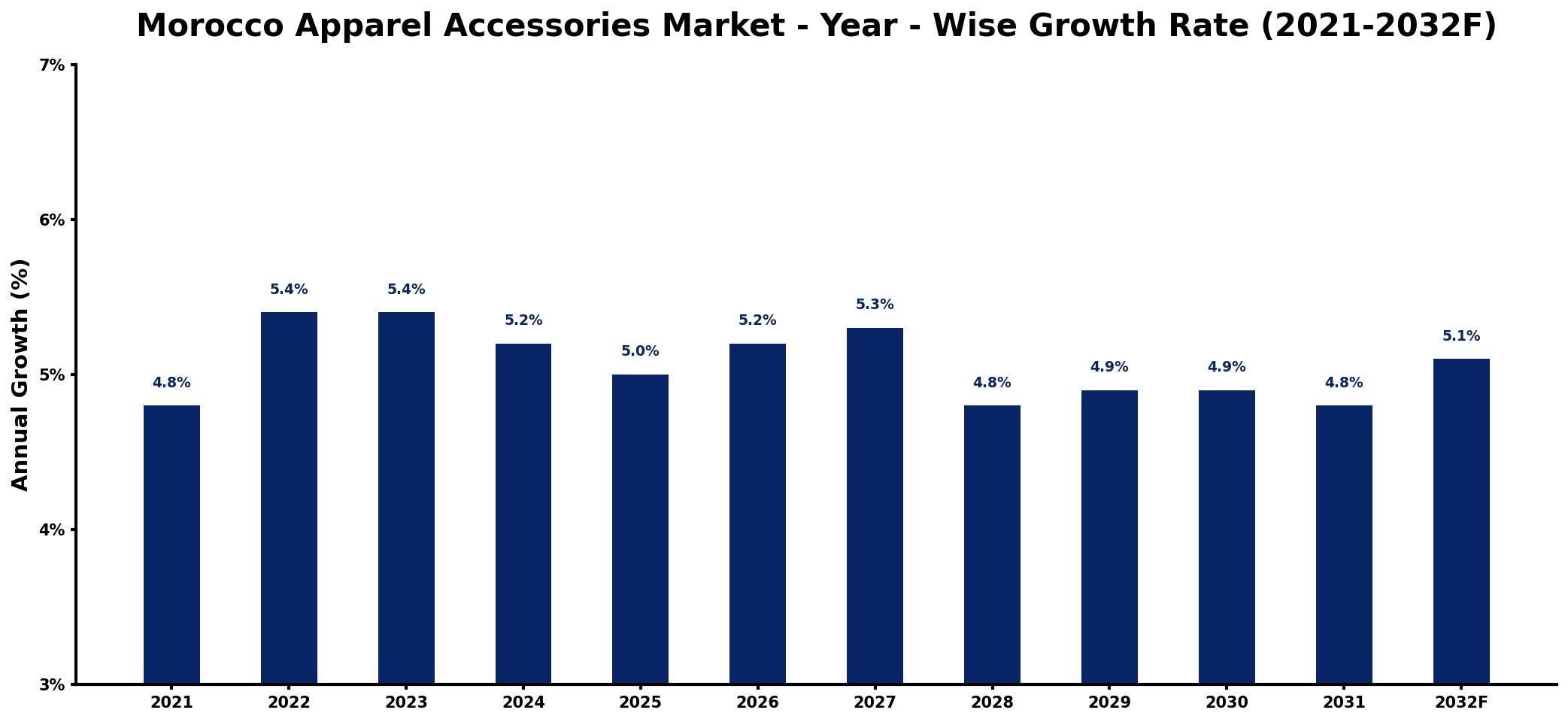
The table below presents the year‑wise growth rates along with the key drivers influencing the market
| Year | Growth Rate | Major Drivers |
| 2021 | 4.8% | Rising consumer spending trends |
| 2022 | 5.4% | Increased tourism boosting demand |
| 2023 | 5.4% | Growing e-commerce retail channels |
| 2024 | 5.2% | Expansion of local manufacturing capacity |
| 2025 | 5.0% | Emergence of new fashion trends |
| 2026 | 5.2% | Strengthened international trade agreements |
| 2027 | 5.3% | Higher disposable income levels |
| 2028 | 4.8% | Popularity of sustainable materials |
| 2029 | 4.9% | Diversification of product offerings |
| 2030 | 4.9% | Technological advancements in production |
| 2031 | 4.8% | Strengthened online shopping platforms |
| 2032 | 5.1% | Growth in fashion-related events |
Note: Market size estimations and growth projections presented in this report are based on 6Wresearch's proprietary forecasting methodology, utilizing the latest available industry data, government publications, and primary research inputs.
Morocco Apparel Accessories Market Synopsis
A primary force currently shaping the Morocco Apparel Accessories Market is the youthful population's growing demand for fashion-forward accessories. As individuals seek to enhance their personal style, products like scarves, belts, hats, and jewelry are increasingly becoming essential components of their wardrobes.
The competitive landscape is equally vibrant, featuring both domestic manufacturers and international brands eager to capture market share. This dynamic fosters a diverse offering that caters to a wide array of consumer tastes, from traditional designs to contemporary trends.
Morocco Apparel Accessories Market Key Takeaways
- The market is projected to grow from USD 274 Million in 2025 to USD 368 Million by 2032.
- Increased disposable income and fashion consciousness are key growth drivers.
- The rising trend of sustainability is influencing consumer purchasing decisions.
- E-commerce platforms are crucial in enhancing market accessibility for consumers.
- There is significant potential for investment in locally-made, culturally-inspired accessories.
Evaluation of Restraints in Morocco Apparel Accessories Market
While the market shows promising growth, several restraints pose challenges to its full potential. Chief among these are fluctuating consumer preferences and intense competition from both local and international brands. High import tariffs on raw materials can inflate production costs, hampering profitability for manufacturers. Additionally, the presence of counterfeit products often undermines market integrity and customer trust. Smaller businesses also face hurdles, such as limited access to advanced technology and e-commerce platforms, which can stifle their growth in an increasingly digital marketplace.
Morocco Apparel Accessories Market Trends
Current trends in the Morocco Apparel Accessories Market highlight a shift towards sustainability, with consumers increasingly seeking eco-friendly materials and ethically produced goods. This trend is complemented by a rising interest in statement accessories that allow individuals to express their personal styles more boldly. Furthermore, the e-commerce revolution is transforming how consumers shop for apparel accessories, with platforms providing convenience and an extensive range of choices. Influencer marketing and social media also play pivotal roles in shaping consumer preferences and driving brand engagement.
Morocco Apparel Accessories Market Opportunities
Investment opportunities abound within the Morocco Apparel Accessories Market, particularly for those looking to capitalize on the rising demand for fashionable accessories. The expanding middle class, coupled with an increase in disposable income, signals a ripe market for high-quality, locally made products. Collaborating with local designers to create culturally inspired accessories can not only drive sales but also foster community engagement. Moreover, embracing e-commerce can help businesses reach broader domestic and international audiences, offering significant growth potential.
Government Initiatives in the Morocco Apparel Accessories Market
The Moroccan government has undertaken various initiatives to bolster the apparel accessories market. These include promoting local manufacturing through incentives like tax breaks and subsidies aimed at enhancing the business environment. Additionally, there are efforts to streamline regulations and reduce bureaucratic obstacles for industry players. Skills development programs have been launched to ensure a well-trained workforce, further enhancing the sector's competitiveness. These strategies aim to stimulate growth, create jobs, and establish Morocco as a key player in the global apparel accessories market.
Future Insights of the Morocco Apparel Accessories Market
Looking ahead to 2026-2032, the Morocco Apparel Accessories Market is set to thrive. The combination of increasing disposable income, evolving fashion trends, and a demographic shift towards a younger population indicates a robust market demand. E-commerce is expected to play an increasingly significant role in driving sales, facilitated by favorable government policies that support the textile and apparel sectors. With consumers demonstrating a willingness to invest in quality and unique accessories, both domestic and international brands have ample opportunities to establish a lasting presence in the market.
Morocco Apparel Accessories Market Latest Developments (2025 - 2026)
In recent months, the Morocco Apparel Accessories Market has seen a notable increase in collaborations between local artisans and fashion designers aimed at blending traditional craftsmanship with modern aesthetics. E-commerce platforms have expanded their offerings, creating vibrant marketplaces for accessories that cater to niche audiences. Additionally, social media campaigns focusing on sustainability and ethical production practices are gaining traction, driving consumer awareness and engagement in the market.
Morocco Apparel Accessories Market - Key Attractiveness of the Report
- 10 Years of Market Numbers
- Historical Data Starting from 2022 to 2025
- Base Year: 2025
- Forecast Data until 2032
- Key Performance Indicators Impacting the Market
- Major Upcoming Developments and Projects
Key Highlights of the Report:
- Morocco Apparel Accessories Market Outlook
- Market Size of Morocco Apparel Accessories Market, 2025
- Forecast of Morocco Apparel Accessories Market, 2032
- Historical Data and Forecast of Morocco Apparel Accessories Revenues & Volume for the Period 2022-2032F
- Morocco Apparel Accessories Market Trend Evolution
- Morocco Apparel Accessories Market Drivers and Challenges
- Morocco Apparel Accessories Price Trends
- Morocco Apparel Accessories Porter's Five Forces
- Morocco Apparel Accessories Industry Life Cycle
- Historical Data and Forecast of Morocco Apparel Accessories Market Revenues & Volume By Product for the Period 2022-2032F
- Historical Data and Forecast of Morocco Apparel Accessories Market Revenues & Volume By Belts for the Period 2022-2032F
- Historical Data and Forecast of Morocco Apparel Accessories Market Revenues & Volume By Handbags for the Period 2022-2032F
- Historical Data and Forecast of Morocco Apparel Accessories Market Revenues & Volume By Scarves for the Period 2022-2032F
- Historical Data and Forecast of Morocco Apparel Accessories Market Revenues & Volume By Eye wear for the Period 2022-2032F
- Historical Data and Forecast of Morocco Apparel Accessories Market Revenues & Volume By Jewelry for the Period 2022-2032F
- Historical Data and Forecast of Morocco Apparel Accessories Market Revenues & Volume By Neckties for the Period 2022-2032F
- Historical Data and Forecast of Morocco Apparel Accessories Market Revenues & Volume By Gloves for the Period 2022-2032F
- Historical Data and Forecast of Morocco Belts Apparel Accessories Market Revenues & Volume By Others for the Period 2022-2032F
- Historical Data and Forecast of Morocco Apparel Accessories Market Revenues & Volume By Demographic for the Period 2022-2032F
- Historical Data and Forecast of Morocco Apparel Accessories Market Revenues & Volume By Men for the Period 2022-2032F
- Historical Data and Forecast of Morocco Apparel Accessories Market Revenues & Volume By Women for the Period 2022-2032F
- Historical Data and Forecast of Morocco Apparel Accessories Market Revenues & Volume By Children for the Period 2022-2032F
- Historical Data and Forecast of Morocco Apparel Accessories Market Revenues & Volume By Price for the Period 2022-2032F
- Historical Data and Forecast of Morocco Apparel Accessories Market Revenues & Volume By Economical Apparel Accessories for the Period 2022-2032F
- Historical Data and Forecast of Morocco Apparel Accessories Market Revenues & Volume By Mid-range Apparel Accessories for the Period 2022-2032F
- Historical Data and Forecast of Morocco Apparel Accessories Market Revenues & Volume By Premium Apparel Accessories for the Period 2022-2032F
- Historical Data and Forecast of Morocco Apparel Accessories Market Revenues & Volume By Super-premium Apparel Accessories for the Period 2022-2032F
- Historical Data and Forecast of Morocco Apparel Accessories Market Revenues & Volume By Sales Channel for the Period 2022-2032F
- Historical Data and Forecast of Morocco Apparel Accessories Market Revenues & Volume By Apparel Accessories Sold through Modern Trade for the Period 2022-2032F
- Historical Data and Forecast of Morocco Apparel Accessories Market Revenues & Volume By Apparel Accessories Sold at Franchise Outlets for the Period 2022-2032F
- Historical Data and Forecast of Morocco Apparel Accessories Market Revenues & Volume By Apparel Accessories Sold at Specialty Stores for the Period 2022-2032F
- Historical Data and Forecast of Morocco Apparel Accessories Market Revenues & Volume By Others for the Period 2022-2032F
- Morocco Apparel Accessories Import Export Trade Statistics
- Market Opportunity Assessment By Product
- Market Opportunity Assessment By Demographic
- Market Opportunity Assessment By Price
- Market Opportunity Assessment By Sales Channel
- Morocco Apparel Accessories Top Companies Market Share
- Morocco Apparel Accessories Competitive Benchmarking By Technical and Operational Parameters
- Morocco Apparel Accessories Company Profiles
- Morocco Apparel Accessories Key Strategic Recommendations






































