Morocco Ascorbic Acid Market Size, Share & Growth Rate
The Morocco Ascorbic Acid Market was estimated at USD 182 Million in 2025 and is projected to reach USD 241 Million by 2032, growing at a CAGR of 4.1% from 2026 to 2032. This growth trajectory is fueled by a burgeoning interest in health and wellness, particularly the demand for vitamin C supplements across various sectors. The increasing incorporation of ascorbic acid in food and beverage products, alongside its prominent role in skincare, is driving consumer preference, thereby enhancing market dynamics.
Morocco Ascorbic Acid Market Year-wise Growth Rate and Key Drivers
This graph highlights how the Morocco Ascorbic Acid Market has steadily grown over the years, supported by major growth factors.
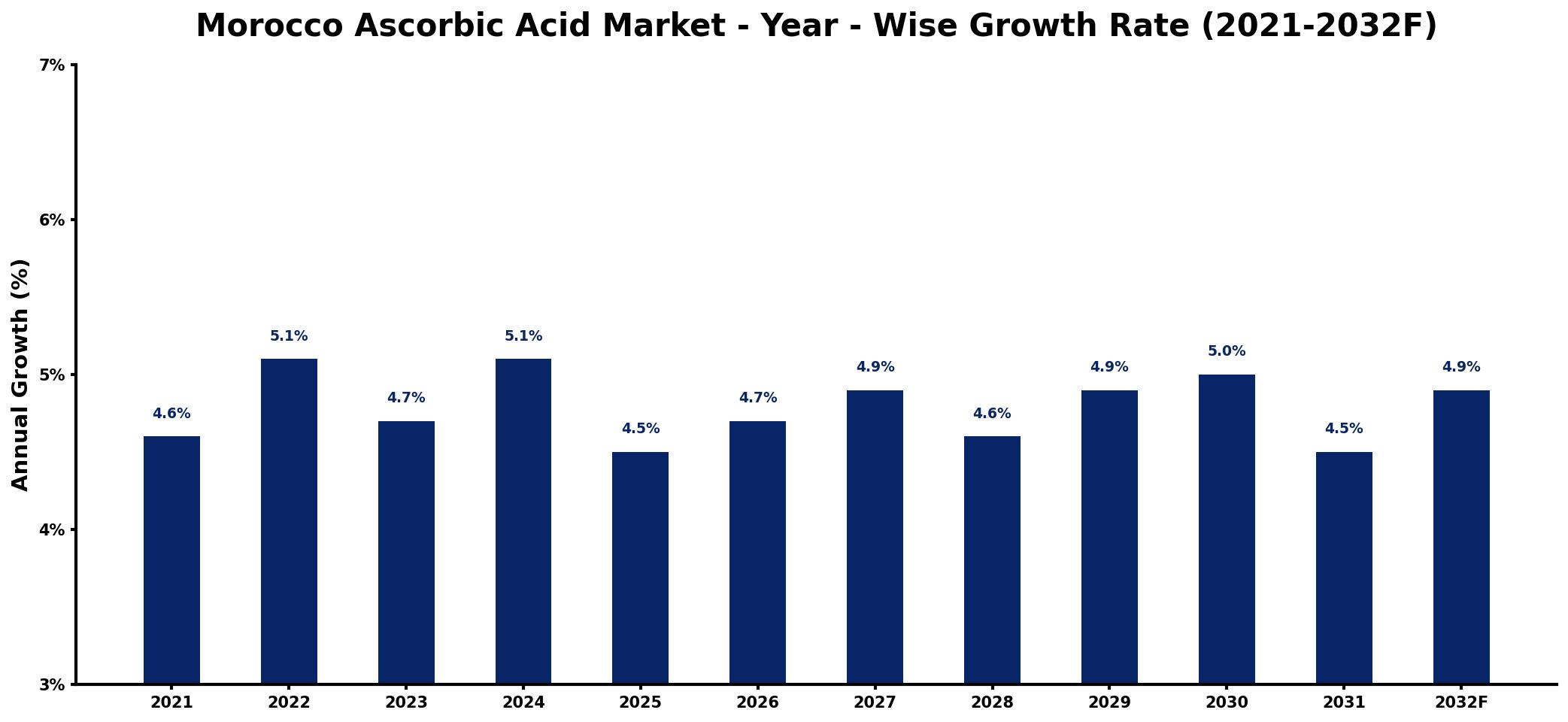
The table below presents the year‑wise growth rates along with the key drivers influencing the market
| Year | Growth Rate | Major Drivers |
| 2021 | 4.6% | Rising health consciousness among consumers |
| 2022 | 5.1% | Increased demand for dietary supplements |
| 2023 | 4.7% | Expansion of food fortification initiatives |
| 2024 | 5.1% | Growth in natural product sector |
| 2025 | 4.5% | Surge in functional food trends |
| 2026 | 4.7% | Investments in pharmaceutical innovations |
| 2027 | 4.9% | Enhanced focus on preventive healthcare |
| 2028 | 4.6% | Growth of organic food market |
| 2029 | 4.9% | Rising popularity of wellness products |
| 2030 | 5.0% | Increased research and development funding |
| 2031 | 4.5% | expanding healthcare application demand |
| 2032 | 4.9% | Growing awareness of nutritional benefits |
Note: Market size estimations and growth projections presented in this report are based on 6Wresearch's proprietary forecasting methodology, utilizing the latest available industry data, government publications, and primary research inputs.
Morocco Ascorbic Acid Market Synopsis
The Morocco Ascorbic Acid Market has experienced robust growth in recent years, reflecting a heightened awareness of health benefits among consumers. This momentum is set to continue as more individuals prioritize dietary supplements and fortified foods rich in vitamin C. As the market evolves, the integration of ascorbic acid into cosmetics highlights the versatility and increasing application of this essential nutrient.
Despite the current growth, the market faces hurdles, including fluctuations in raw material prices and regulatory challenges. Nonetheless, the focus on innovative product formulations and the expanding health-conscious demographic suggests a positive trajectory, with local manufacturers poised to leverage these trends to their advantage.
Morocco Ascorbic Acid Market Key Takeaways
- The market is characterized by a growing demand for vitamin C across food, pharmaceuticals, and cosmetics.
- Increasing health awareness among consumers is propelling the consumption of ascorbic acid products.
- Regulatory frameworks are supporting domestic production while ensuring product safety and quality.
- Emerging trends indicate a rising preference for natural sources of ascorbic acid.
- Investment opportunities are significant, given the strategic location of Morocco in the African market.
Evaluation of Restraints in Morocco Ascorbic Acid Market
The Morocco Ascorbic Acid Market contends with significant challenges that may impede its growth trajectory. One primary concern is the competitive pressure from low-cost imports, which can undercut local producers on price. Additionally, the volatility in raw material prices poses a risk to profitability, as it can lead to increased production costs. Regulatory compliance also presents a considerable barrier, as manufacturers must navigate complex safety and quality standards to remain competitive. Addressing these challenges is essential for sustaining growth in the market.
Morocco Ascorbic Acid Market Trends
Several trends are shaping the Morocco Ascorbic Acid Market. The growing consumer inclination towards preventive healthcare is fueling demand for vitamin C supplements. Moreover, as the food and beverage industry expands, there is a notable trend toward incorporating ascorbic acid as a natural preservative and antioxidant. In the cosmetics sector, innovative formulations featuring ascorbic acid are gaining traction, particularly for their skin-enhancing properties. The shift towards natural and organic sources is fostering further innovation in the market.
Morocco Ascorbic Acid Market Opportunities
The Morocco Ascorbic Acid Market is ripe with investment opportunities. With the increasing awareness of the health benefits associated with vitamin C, particularly in relation to immunity and skin health, there is a clear market potential. The expansion of local food and beverage businesses presents a unique opportunity for suppliers of ascorbic acid. Additionally, with Morocco's strategic position as a gateway to Africa, there exists a promising avenue for export-oriented growth in ascorbic acid production and distribution.
Government Initiatives in the Morocco Ascorbic Acid Market
The Moroccan government has implemented a range of initiatives aimed at enhancing the Ascorbic Acid Market. Policies are in place to establish stringent quality standards for production and distribution to ensure consumer safety. To bolster local manufacturing, import tariffs and regulations have been enacted, aimed at protecting domestic industries. These government efforts not only promote fair competition but also encourage investment in the sector, fostering a sustainable market environment.
Future Insights of the Morocco Ascorbic Acid Market
Looking ahead, the Morocco Ascorbic Acid Market is set for steady growth through 2026-2032, driven by continuous demand for vitamin C in health and wellness products. As consumer awareness expands and the pharmaceutical sector grows, the incorporation of ascorbic acid into a broader range of products is likely to increase. The supportive regulatory environment may further benefit local manufacturers, allowing them to innovate and enhance their offerings, ensuring that the market remains dynamic and resilient.
Morocco Ascorbic Acid Market Latest Developments (2025 - 2026)
Recent developments within the Morocco Ascorbic Acid Market highlight a proactive approach to innovation and consumer engagement. Local manufacturers are exploring new formulations and production techniques to meet the increasing demand for natural products. Collaborations between industry stakeholders are on the rise, aimed at addressing quality and safety standards while boosting production efficiency. Additionally, consumer education campaigns are gaining momentum, further increasing awareness and driving demand for vitamin C products.
Morocco Ascorbic Acid Market - Key Attractiveness of the Report
- 10 Years of Market Numbers
- Historical Data Starting from 2022 to 2025
- Base Year: 2025
- Forecast Data until 2032
- Key Performance Indicators Impacting the Market
- Major Upcoming Developments and Projects
Key Highlights of the Report:
- Morocco Ascorbic Acid Market Outlook
- Market Size of Morocco Ascorbic Acid Market, 2025
- Forecast of Morocco Ascorbic Acid Market, 2032
- Historical Data and Forecast of Morocco Ascorbic Acid Revenues & Volume for the Period 2022-2032F
- Morocco Ascorbic Acid Market Trend Evolution
- Morocco Ascorbic Acid Market Drivers and Challenges
- Morocco Ascorbic Acid Price Trends
- Morocco Ascorbic Acid Porter's Five Forces
- Morocco Ascorbic Acid Industry Life Cycle
- Historical Data and Forecast of Morocco Ascorbic Acid Market Revenues & Volume By Grade for the Period 2022-2032F
- Historical Data and Forecast of Morocco Ascorbic Acid Market Revenues & Volume By Food & Pharmaceutical for the Period 2022-2032F
- Historical Data and Forecast of Morocco Ascorbic Acid Market Revenues & Volume By Industrial for the Period 2022-2032F
- Historical Data and Forecast of Morocco Ascorbic Acid Market Revenues & Volume By Application for the Period 2022-2032F
- Historical Data and Forecast of Morocco Ascorbic Acid Market Revenues & Volume By Food & Beverages for the Period 2022-2032F
- Historical Data and Forecast of Morocco Ascorbic Acid Market Revenues & Volume By Pharmaceutical for the Period 2022-2032F
- Historical Data and Forecast of Morocco Ascorbic Acid Market Revenues & Volume By Cosmetics for the Period 2022-2032F
- Historical Data and Forecast of Morocco Ascorbic Acid Market Revenues & Volume By Chemicals for the Period 2022-2032F
- Historical Data and Forecast of Morocco Ascorbic Acid Market Revenues & Volume By Agriculture for the Period 2022-2032F
- Historical Data and Forecast of Morocco Ascorbic Acid Market Revenues & Volume By Others for the Period 2022-2032F
- Morocco Ascorbic Acid Import Export Trade Statistics
- Market Opportunity Assessment By Grade
- Market Opportunity Assessment By Application
- Morocco Ascorbic Acid Top Companies Market Share
- Morocco Ascorbic Acid Competitive Benchmarking By Technical and Operational Parameters
- Morocco Ascorbic Acid Company Profiles
- Morocco Ascorbic Acid Key Strategic Recommendations






































