Morocco Auto Parts And Accessories Market Size, Share & Growth Rate
The Morocco Auto Parts And Accessories Market was estimated at USD 468 Million in 2025 and is projected to reach USD 644 Million by 2032, growing at a CAGR of 4.7% from 2026 to 2032. This growth is underpinned by a booming automotive sector, with increasing vehicle sales translating directly into demand for auto parts and accessories. Additionally, the rising average age of vehicles in circulation necessitates more frequent replacement of parts, thereby fueling the aftermarket segment of this market.
Morocco Auto Parts And Accessories Market Year-wise Growth Rate and Key Drivers
This graph highlights how the Morocco Auto Parts And Accessories Market has steadily grown over the years, supported by major growth factors.
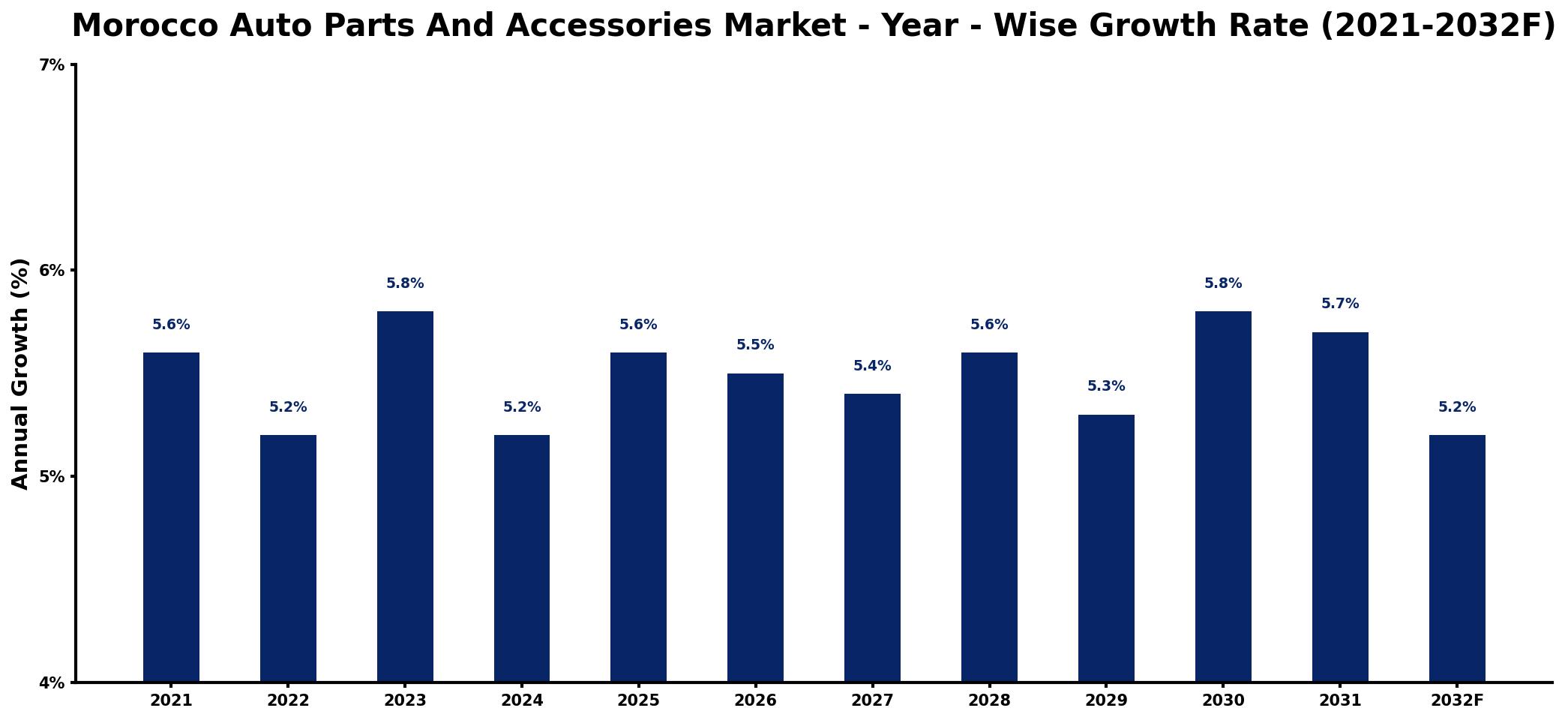
The table below presents the year‑wise growth rates along with the key drivers influencing the market
| Year | Growth Rate | Major Drivers |
| 2021 | 5.6% | Increased vehicle ownership rates |
| 2022 | 5.2% | Growing urban transportation demand |
| 2023 | 5.8% | Rise in e-commerce logistics needs |
| 2024 | 5.2% | Expansion of local manufacturing facilities |
| 2025 | 5.6% | growing commercial sector adoption |
| 2026 | 5.5% | Investment in renewable energy vehicles |
| 2027 | 5.4% | Technological advancements in logistics |
| 2028 | 5.6% | Increase in consumer spending power |
| 2029 | 5.3% | Growth in fleet management solutions |
| 2030 | 5.8% | Development of smart transportation systems |
| 2031 | 5.7% | strengthening underlying market demand |
| 2032 | 5.2% | increased pharmaceutical industry usage |
Note: Market size estimations and growth projections presented in this report are based on 6Wresearch's proprietary forecasting methodology, utilizing the latest available industry data, government publications, and primary research inputs.
Morocco Auto Parts And Accessories Market Synopsis
The Moroccan auto parts and accessories market is rich in diversity, encompassing a wide array of products ranging from engine components to aftermarket accessories. This variety is essential as consumers increasingly seek both functionality and personalization in their vehicles, reflecting a broader trend toward customized automotive experiences.
Moreover, the market is supported by a growing automotive aftermarket industry, driven by the expansion of the vehicle fleet and an influx of foreign automotive manufacturers establishing local operations. This has not only increased the availability of high-quality parts but has also spurred competition among local and international players aiming to cater to evolving consumer preferences.
Morocco Auto Parts And Accessories Market Key Takeaways
- The market is projected to expand significantly, driven by vehicle sales and increasing average vehicle age.
- Consumer demand for customization and eco-friendly products is influencing market dynamics.
- Government initiatives are bolstering the automotive industry and infrastructure development.
- The rise of e-commerce platforms is facilitating greater access to a wider range of automotive products.
- Investment opportunities exist in manufacturing high-demand auto parts and innovative technologies.
Evaluation of Restraints in Morocco Auto Parts And Accessories Market
Despite the positive outlook, several restraints challenge the growth of the Morocco auto parts and accessories market. A notable issue is the lack of standardization in regulations, which can lead to discrepancies in quality and safety across products. This inconsistency poses risks not only to consumer safety but also to the reputations of legitimate manufacturers competing against counterfeit goods. Additionally, local players often face hurdles due to limited access to advanced technology and innovations, which can undermine their ability to compete effectively against established international brands. Economic uncertainties and fluctuations in currency exchange rates further complicate market dynamics, impacting consumer purchasing power.
Morocco Auto Parts And Accessories Market Trends
Current trends within the Morocco auto parts and accessories market are being shaped by a noticeable shift towards sustainability. Increasing environmental awareness among consumers, along with government regulations promoting cleaner energy alternatives, has driven up demand for electric vehicle components. Moreover, advanced technologies such as connected car systems and autonomous driving features are gaining traction, enhancing the overall driving experience. The burgeoning popularity of e-commerce platforms reflects a demand for convenience, allowing consumers to access a wider array of products from their homes.
Morocco Auto Parts And Accessories Market Opportunities
Investment opportunities in the Morocco auto parts and accessories market are abundant, particularly in manufacturing and supplying essential auto parts like batteries, tires, and filters, aimed at both domestic and export markets. Additionally, as the global automotive landscape shifts toward electric vehicles, there is significant potential for investments in innovative technologies such as electric vehicle batteries and charging infrastructure. Collaborations with local manufacturers and distributors can also yield fruitful partnerships, offering avenues for growth within the supply chain.
Government Initiatives in the Morocco Auto Parts And Accessories Market
The Moroccan government plays an integral role in promoting the auto parts and accessories market through various supportive policies. A free trade agreement with the European Union has facilitated reduced tariffs on imported auto parts, encouraging foreign investment in the sector. Furthermore, incentives such as tax breaks and subsidies are provided to manufacturers operating within special economic zones, fostering a competitive environment. Regulations established by the Moroccan Institute of Standardization ensure that safety and quality standards are met, further enhancing consumer trust in the market.
Future Insights of the Morocco Auto Parts And Accessories Market
Looking ahead, the future of the Morocco auto parts and accessories market appears bright, bolstered by factors such as rising disposable incomes and a persistent demand for aftermarket products. The ongoing development of the automotive industry, in tandem with government support for local production, will likely contribute to the market's expansion. Additionally, the rise of digital platforms and the integration of advanced technologies within the automotive segment will continue to redefine consumer expectations and market opportunities in the coming years.
Morocco Auto Parts And Accessories Market Latest Developments (2025 - 2026)
Recent developments in the Morocco auto parts and accessories market indicate a growing emphasis on innovation and sustainability. There has been a noticeable uptick in the introduction of eco-friendly products and electric vehicle components in response to consumer demand for greener options. Additionally, advancements in technology are facilitating better integration of digital interfaces in vehicles, enhancing both safety and user experience. Furthermore, the trend towards e-commerce is evolving, with more companies establishing online platforms to cater to the changing purchasing behavior of consumers.
Morocco Auto Parts And Accessories Market - Key Attractiveness of the Report
- 10 Years of Market Numbers
- Historical Data Starting from 2022 to 2025
- Base Year: 2025
- Forecast Data until 2032
- Key Performance Indicators Impacting the Market
- Major Upcoming Developments and Projects
Key Highlights of the Report:
- Morocco Auto Parts And Accessories Market Outlook
- Market Size of Morocco Auto Parts And Accessories Market, 2025
- Forecast of Morocco Auto Parts And Accessories Market, 2032
- Historical Data and Forecast of Morocco Auto Parts And Accessories Revenues & Volume for the Period 2022-2032F
- Morocco Auto Parts And Accessories Market Trend Evolution
- Morocco Auto Parts And Accessories Market Drivers and Challenges
- Morocco Auto Parts And Accessories Price Trends
- Morocco Auto Parts And Accessories Porter's Five Forces
- Morocco Auto Parts And Accessories Industry Life Cycle
- Historical Data and Forecast of Morocco Auto Parts And Accessories Market Revenues & Volume By Product for the Period 2022-2032F
- Historical Data and Forecast of Morocco Auto Parts And Accessories Market Revenues & Volume By Driveline & Powertrain for the Period 2022-2032F
- Historical Data and Forecast of Morocco Auto Parts And Accessories Market Revenues & Volume By Interiors & Exteriors for the Period 2022-2032F
- Historical Data and Forecast of Morocco Auto Parts And Accessories Market Revenues & Volume By Electronics for the Period 2022-2032F
- Historical Data and Forecast of Morocco Auto Parts And Accessories Market Revenues & Volume By Bodies & Chassis for the Period 2022-2032F
- Historical Data and Forecast of Morocco Auto Parts And Accessories Market Revenues & Volume By Wheel & Tires for the Period 2022-2032F
- Historical Data and Forecast of Morocco Auto Parts And Accessories Market Revenues & Volume By Others for the Period 2022-2032F
- Historical Data and Forecast of Morocco Auto Parts And Accessories Market Revenues & Volume By Application for the Period 2022-2032F
- Historical Data and Forecast of Morocco Auto Parts And Accessories Market Revenues & Volume By OEMs for the Period 2022-2032F
- Historical Data and Forecast of Morocco Auto Parts And Accessories Market Revenues & Volume By Aftermarket for the Period 2022-2032F
- Morocco Auto Parts And Accessories Import Export Trade Statistics
- Market Opportunity Assessment By Product
- Market Opportunity Assessment By Application
- Morocco Auto Parts And Accessories Top Companies Market Share
- Morocco Auto Parts And Accessories Competitive Benchmarking By Technical and Operational Parameters
- Morocco Auto Parts And Accessories Company Profiles
- Morocco Auto Parts And Accessories Key Strategic Recommendations






































