Morocco Bulletproof Glass Market Size, Share & Growth Rate
The Morocco Bulletproof Glass Market was estimated at USD 491 Million in 2025 and is projected to reach USD 648 Million by 2032, growing at a CAGR of 4.0% from 2026 to 2032. This growth trajectory reflects increasing security concerns across multiple sectors, spurred by the rising incidences of crime and terrorism. As high-risk environments necessitate enhanced protective measures, bulletproof glass adoption is expected to permeate various applications including banking and government facilities.
Morocco Bulletproof Glass Market Year-wise Growth Rate and Key Drivers
This graph highlights how the Morocco Bulletproof Glass Market has steadily grown over the years, supported by major growth factors.
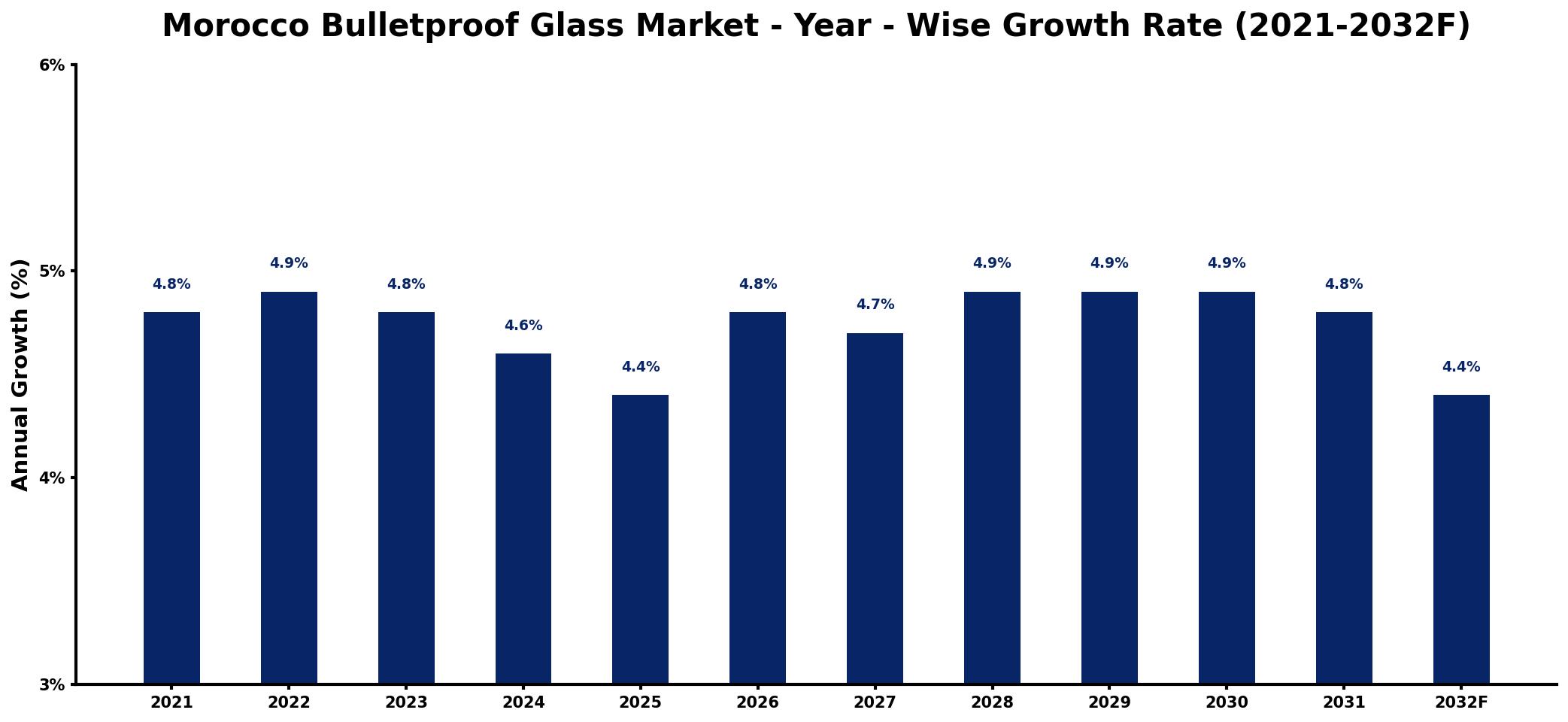
The table below presents the year‑wise growth rates along with the key drivers influencing the market
| Year | Growth Rate | Major Drivers |
| 2021 | 4.8% | Rising security concerns nationwide |
| 2022 | 4.9% | Increased investment in infrastructure |
| 2023 | 4.8% | Growing demand for safety solutions |
| 2024 | 4.6% | Expansion of construction industry projects |
| 2025 | 4.4% | Surge in private security services |
| 2026 | 4.8% | Higher awareness of personal safety |
| 2027 | 4.7% | Increased government security funding |
| 2028 | 4.9% | Growth in luxury vehicle market |
| 2029 | 4.9% | Rising urbanization and development |
| 2030 | 4.9% | Emergence of advanced protection technologies |
| 2031 | 4.8% | Strengthened regulations on safety standards |
| 2032 | 4.4% | Growing focus on risk management |
Note: Market size estimations and growth projections presented in this report are based on 6Wresearch's proprietary forecasting methodology, utilizing the latest available industry data, government publications, and primary research inputs.
Morocco Bulletproof Glass Market Synopsis
Recent momentum in the Morocco Bulletproof Glass Market is underscored by a heightened awareness of security threats, leading to a greater emphasis on protective solutions. However, despite this burgeoning demand, challenges such as high production costs and reliance on imports hinder broader market penetration.
Looking ahead, the market is poised for significant growth as government regulations encourage the use of bulletproof glass in sensitive locations. As security needs evolve, driven by both public and private sector demand, the trajectory for bulletproof glass in Morocco appears increasingly robust.
Morocco Bulletproof Glass Market Key Takeaways
- The market is witnessing robust growth fueled by increasing security threats and a demand for enhanced protection.
- Government regulations are fostering the adoption of bulletproof glass in high-security environments.
- Cost challenges and limited local manufacturing capabilities remain significant barriers to entry.
- A growing awareness of bulletproof glass benefits could lead to expanded applications beyond traditional sectors.
- The market holds potential for innovative product development and local production initiatives.
Evaluation of Restraints in Morocco Bulletproof Glass Market
The Morocco Bulletproof Glass Market faces several notable restraints that are hindering its growth potential. The high cost associated with the production of bulletproof glass is a primary barrier, restricting its use mainly to high-security installations and luxury vehicles. Additionally, the absence of substantial local manufacturing capabilities forces dependency on imported products, adding to overall costs. Furthermore, the awareness of the advantages and applications of bulletproof glass remains limited among potential users, which could stifle broader market acceptance.
Morocco Bulletproof Glass Market Trends
Current trends in the Morocco Bulletproof Glass Market reflect a shift towards integrating advanced technology within protective glass solutions. Manufacturers are increasingly focusing on producing lighter, more durable materials that maintain clarity while enhancing ballistic resistance. Moreover, as security needs diversify, a growing number of commercial and residential establishments are looking to adopt bulletproof glass as a standard feature. This trend is augmented by rising urbanization and evolving design philosophies prioritizing safety alongside aesthetics.
Morocco Bulletproof Glass Market Opportunities
The evolving landscape of the Morocco Bulletproof Glass Market presents numerous opportunities for growth and investment. A notable area for expansion lies in fostering local manufacturing capabilities, which could alleviate reliance on imports and reduce costs. Additionally, tapping into emerging sectors such as residential security and commercial real estate presents untapped avenues for revenue generation. Collaborations with security experts to develop innovative solutions that address specific regional threats further enhances market prospects.
Government Initiatives in the Morocco Bulletproof Glass Market
In light of escalating security concerns, the Moroccan government is actively promoting initiatives that encourage the adoption of bulletproof glass in sensitive infrastructure such as banks, embassies, and government offices. This includes implementing regulations that mandate the use of security glass in high-risk buildings. Additionally, the government is exploring incentives aimed at boosting local production capacities, which is expected to create a more self-sufficient market and align standards with international safety regulations.
Future Insights of the Morocco Bulletproof Glass Market
As we project into 2026-2032, the Morocco Bulletproof Glass Market is anticipated to experience a significant transformation characterized by increased adoption across varied sectors. Enhanced governmental policies supporting local production and the establishment of international safety standards will likely create a conducive environment for growth. Furthermore, as awareness surrounding security solutions broadens, it is expected that demand will rise in previously untapped markets, ensuring a positive outlook for bulletproof glass investments.
Morocco Bulletproof Glass Market Latest Developments (2025 - 2026)
In recent months, the Morocco Bulletproof Glass Market has seen a series of advancements, particularly regarding collaborations between government entities and security experts aimed at enhancing building safety standards. Emerging technologies are also being explored to improve bulletproof glass manufacturing processes, leading to innovations that promise greater durability and performance. Additionally, efforts are being made to raise awareness about the importance of security glass in everyday environments, which could drive further market interest.
Morocco Bulletproof Glass Market - Key Attractiveness of the Report
- 10 Years of Market Numbers
- Historical Data Starting from 2022 to 2025
- Base Year: 2025
- Forecast Data until 2032
- Key Performance Indicators Impacting the Market
- Major Upcoming Developments and Projects
Key Highlights of the Report:
- Morocco Bulletproof Glass Market Outlook
- Market Size of Morocco Bulletproof Glass Market, 2025
- Forecast of Morocco Bulletproof Glass Market, 2032
- Historical Data and Forecast of Morocco Bulletproof Glass Revenues & Volume for the Period 2022-2032F
- Morocco Bulletproof Glass Market Trend Evolution
- Morocco Bulletproof Glass Market Drivers and Challenges
- Morocco Bulletproof Glass Price Trends
- Morocco Bulletproof Glass Porter's Five Forces
- Morocco Bulletproof Glass Industry Life Cycle
- Historical Data and Forecast of Morocco Bulletproof Glass Market Revenues & Volume By Type for the Period 2022-2032F
- Historical Data and Forecast of Morocco Bulletproof Glass Market Revenues & Volume By Solid Acrylic for the Period 2022-2032F
- Historical Data and Forecast of Morocco Bulletproof Glass Market Revenues & Volume By Traditional Laminated for the Period 2022-2032F
- Historical Data and Forecast of Morocco Bulletproof Glass Market Revenues & Volume By Polycarbonate for the Period 2022-2032F
- Historical Data and Forecast of Morocco Bulletproof Glass Market Revenues & Volume By Glass-clad Polycarbonate for the Period 2022-2032F
- Historical Data and Forecast of Morocco Bulletproof Glass Market Revenues & Volume By Other Types for the Period 2022-2032F
- Historical Data and Forecast of Morocco Bulletproof Glass Market Revenues & Volume By End-user Industry for the Period 2022-2032F
- Historical Data and Forecast of Morocco Bulletproof Glass Market Revenues & Volume By Automotive for the Period 2022-2032F
- Historical Data and Forecast of Morocco Bulletproof Glass Market Revenues & Volume By Buildings and Construction for the Period 2022-2032F
- Historical Data and Forecast of Morocco Bulletproof Glass Market Revenues & Volume By Defense for the Period 2022-2032F
- Historical Data and Forecast of Morocco Bulletproof Glass Market Revenues & Volume By Other End-user Industries for the Period 2022-2032F
- Morocco Bulletproof Glass Import Export Trade Statistics
- Market Opportunity Assessment By Type
- Market Opportunity Assessment By End-user Industry
- Morocco Bulletproof Glass Top Companies Market Share
- Morocco Bulletproof Glass Competitive Benchmarking By Technical and Operational Parameters
- Morocco Bulletproof Glass Company Profiles
- Morocco Bulletproof Glass Key Strategic Recommendations






































