Morocco Calcium Silicate Market Size, Share & Growth Rate
The Morocco Calcium Silicate Market was estimated at USD 296 Million in 2025 and is projected to reach USD 405 Million by 2032, growing at a CAGR of 4.6% from 2026 to 2032. This growth trajectory is largely fueled by the booming construction sector, which is characterized by a surge in infrastructure projects. Additionally, the increasing adoption of calcium silicate in automotive applications due to its lightweight nature and fire-resistant properties is further propelling market demand.
Morocco Calcium Silicate Market Year-wise Growth Rate and Key Drivers
This graph highlights how the Morocco Calcium Silicate Market has steadily grown over the years, supported by major growth factors.
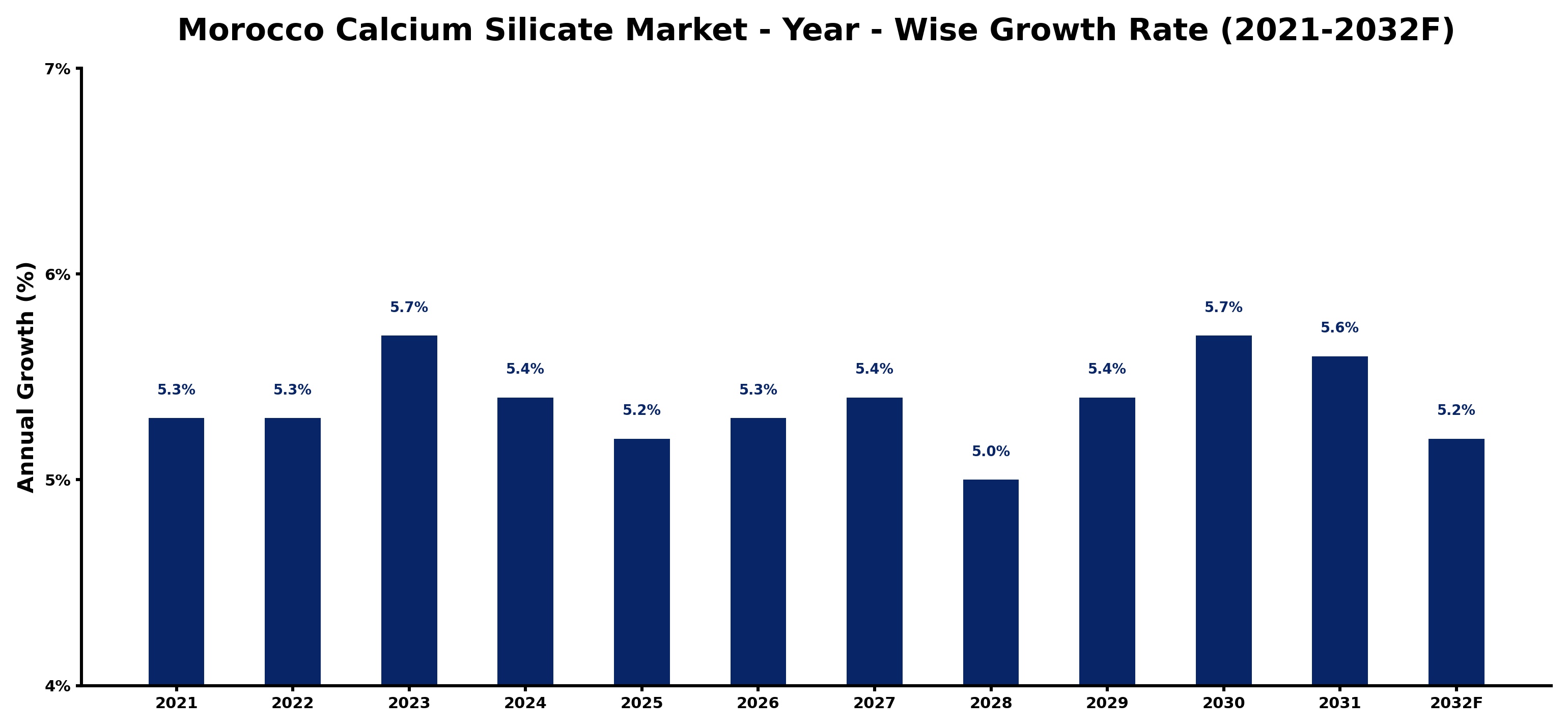
The table below presents the year‑wise growth rates along with the key drivers influencing the market
| Year | Growth Rate | Major Drivers |
| 2021 | 5.3% | Construction sector demand increased |
| 2022 | 5.3% | Industrial applications expanded significantly |
| 2023 | 5.7% | Sustainable building materials trend emerged |
| 2024 | 5.4% | Regulatory support for insulation growth |
| 2025 | 5.2% | Rising awareness of fire safety |
| 2026 | 5.3% | Technological advancements improved production |
| 2027 | 5.4% | Green building initiatives gained momentum |
| 2028 | 5.0% | Export opportunities opened new markets |
| 2029 | 5.4% | Partnerships with construction firms strengthened |
| 2030 | 5.7% | Increased investment in infrastructure projects |
| 2031 | 5.6% | Consumer preference for eco-friendly products |
| 2032 | 5.2% | Market diversification strategies enhanced growth |
Note - Market size estimations and growth projections presented in this report are based on 6Wresearch’s advanced forecasting approach, validated with industry datasets as of June 2026.
Morocco Calcium Silicate Market Synopsis
The most significant force currently shaping the Morocco Calcium Silicate Market is the rapid expansion of the construction industry. With the government investing heavily in infrastructure projects, the need for effective thermal insulation solutions has never been more critical. This demand is further amplified by a growing awareness of energy efficiency in building materials.
In addition to construction, the automotive and food processing sectors are also pivotal in driving market growth. Calcium silicate's role as an anti-caking agent in food products and its use in lightweight vehicle components highlight its versatility, making it a sought-after material across multiple industries in Morocco.
Morocco Calcium Silicate Market Key Takeaways
- The market is on a steady growth path, projected to reach USD 405 Million by 2032.
- Infrastructure development initiatives are the primary catalyst behind increased demand.
- Innovations in product performance are enhancing calcium silicate's appeal.
- Rising awareness of energy-efficient materials is driving industry growth.
- The automotive sector's need for lightweight materials is expanding market opportunities.
Evaluation of Restraints in Morocco Calcium Silicate Market
Despite the promising growth, the Morocco Calcium Silicate Market faces several restraints that could hinder its full potential. A significant barrier is the limited awareness about the advantages of calcium silicate products among potential consumers, which creates challenges in market penetration. Furthermore, the presence of alternative materials complicates competition and may divert attention away from calcium silicate solutions. Regulatory compliance, which often translates to higher production costs, also adds pressure on market players, making it essential for companies to adopt effective marketing strategies and focus on innovation to overcome these challenges.
Morocco Calcium Silicate Market Trends
Several trends are currently shaping the Morocco Calcium Silicate Market. A key trend is the increasing focus on sustainability and energy-efficient building practices, which positions calcium silicate products favorably due to their high-temperature resistance and durability. Technological advancements are also resulting in the development of innovative calcium silicate products with enhanced performance characteristics, catering to evolving market needs. This drive towards improved materials is likely to influence future product offerings and market dynamics significantly.
Morocco Calcium Silicate Market Opportunities
The Morocco Calcium Silicate Market is ripe with investment opportunities, particularly in the context of its burgeoning construction sector. The growing demand for reliable thermal insulation materials offers a lucrative avenue for manufacturers and suppliers. Additionally, as urbanization accelerates and infrastructure projects multiply, there is substantial potential for new entrants to innovate and provide specialized calcium silicate products tailored to market needs. Research and development initiatives aimed at creating advanced calcium silicate solutions could also present profitable opportunities for investors and stakeholders.
Government Initiatives in the Morocco Calcium Silicate Market
Government policies in Morocco are increasingly focused on promoting sustainable development and bolstering industrial competitiveness within the calcium silicate sector. Regulatory frameworks aim to enforce product quality standards, environmental protections, and workplace safety, providing a structured environment for market growth. In addition, initiatives supporting research and development, along with incentives for foreign investment, are designed to enhance domestic production capabilities. These governmental efforts are crucial in creating a conducive atmosphere for manufacturers and fostering innovation within the market.
Future Insights of the Morocco Calcium Silicate Market
Looking ahead to the period from 2026 to 2032, the Morocco Calcium Silicate Market is expected to continue its upward trajectory. The ongoing infrastructure development, coupled with heightened awareness regarding energy-efficient materials, positions calcium silicate as a key player in both construction and industrial applications. With continuous advancements in product technology and a steady influx of investment, the market is well-placed to meet the growing demands of various sectors, leading to robust opportunities for stakeholders.
Morocco Calcium Silicate Market Latest Developments (May 2025 - June 2026)
Recent developments in the Morocco Calcium Silicate Market indicate a strong direction towards increased product innovation and market expansion. Companies are actively investing in research and development to enhance the performance and sustainability of calcium silicate products. Furthermore, strategic partnerships and collaborations within the industry are becoming more commonplace, as stakeholders seek to capitalize on emerging opportunities and address the evolving needs of consumers. This forward momentum is indicative of a market eager to innovate and grow.
Morocco Calcium Silicate Market - Key Attractiveness of the Report
- 10 Years of Market Numbers
- Historical Data Starting from 2022 to 2025
- Base Year: 2025
- Forecast Data until 2032
- Key Performance Indicators Impacting the Market
- Major Upcoming Developments and Projects
Key Highlights of the Report:
- Morocco Calcium Silicate Market Outlook
- Market Size of Morocco Calcium Silicate Market, 2025
- Forecast of Morocco Calcium Silicate Market, 2032
- Historical Data and Forecast of Morocco Calcium Silicate Revenues & Volume for the Period 2022-2032F
- Morocco Calcium Silicate Market Trend Evolution
- Morocco Calcium Silicate Market Drivers and Challenges
- Morocco Calcium Silicate Price Trends
- Morocco Calcium Silicate Porter's Five Forces
- Morocco Calcium Silicate Industry Life Cycle
- Historical Data and Forecast of Morocco Calcium Silicate Market Revenues & Volume By Application for the Period 2022-2032F
- Historical Data and Forecast of Morocco Calcium Silicate Market Revenues & Volume By Insulation for the Period 2022-2032F
- Historical Data and Forecast of Morocco Calcium Silicate Market Revenues & Volume By Paints & Coatings for the Period 2022-2032F
- Historical Data and Forecast of Morocco Calcium Silicate Market Revenues & Volume By Fire Protection for the Period 2022-2032F
- Historical Data and Forecast of Morocco Calcium Silicate Market Revenues & Volume By Cement for the Period 2022-2032F
- Historical Data and Forecast of Morocco Calcium Silicate Market Revenues & Volume By Ceramics for the Period 2022-2032F
- Historical Data and Forecast of Morocco Calcium Silicate Market Revenues & Volume By Others for the Period 2022-2032F
- Morocco Calcium Silicate Import Export Trade Statistics
- Market Opportunity Assessment By Application
- Morocco Calcium Silicate Top Companies Market Share
- Morocco Calcium Silicate Competitive Benchmarking By Technical and Operational Parameters
- Morocco Calcium Silicate Company Profiles
- Morocco Calcium Silicate Key Strategic Recommendations






































