Morocco Candles Market Year-wise Growth Rate (2021-2031F)
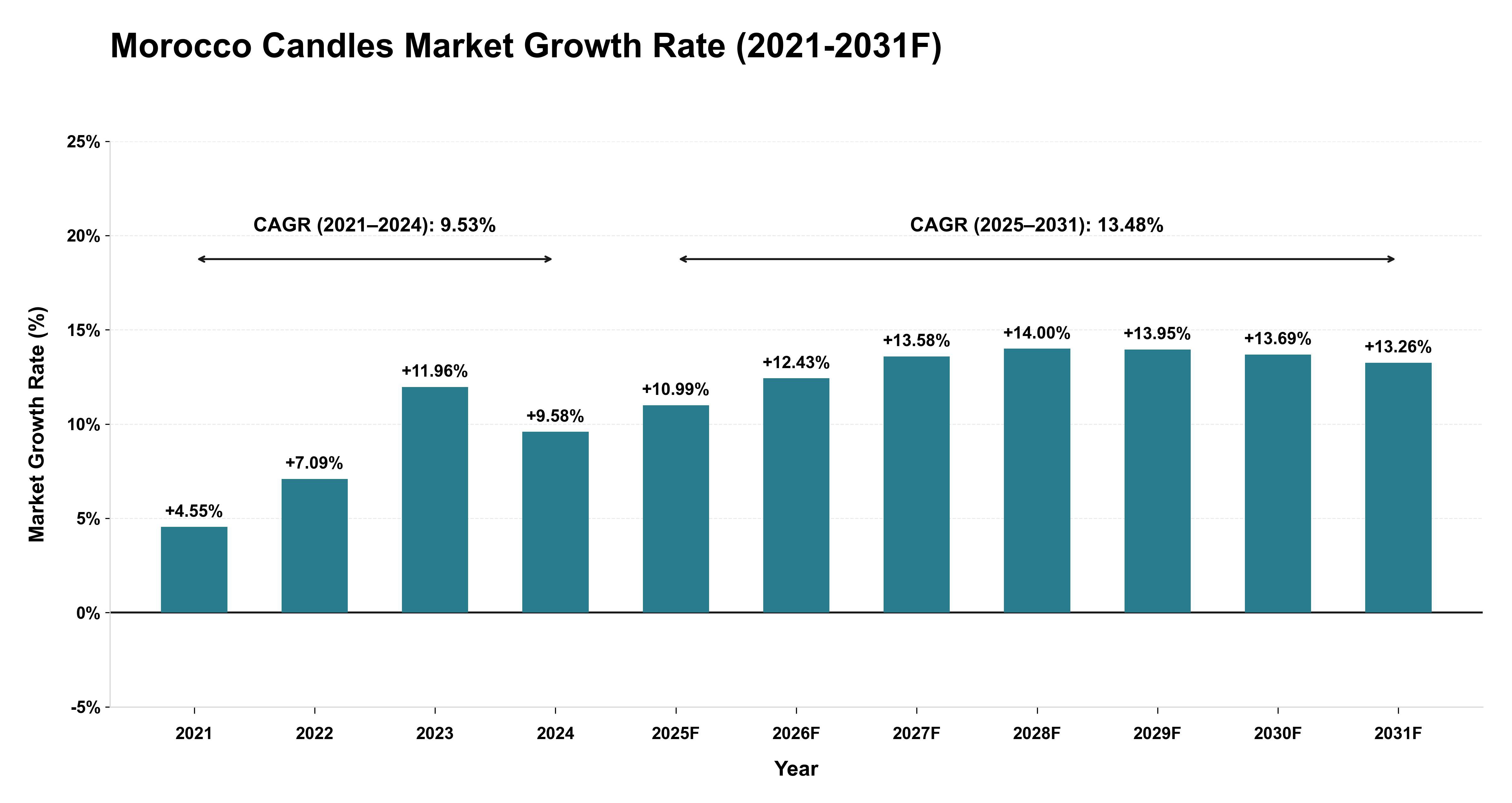
In the Morocco Candles Market, the period 2021-2024 witnessed a steady growth trajectory, with annual growth rates ranging from 4.55% to 11.96%, culminating in a historical CAGR of 9.53%. This growth was driven by increasing consumer demand for decorative and aromatic products, reflecting cultural preferences and lifestyle trends. Looking ahead to 2025-2031, a forecasted CAGR of 13.48% indicates an acceleration in market expansion. Factors such as rising disposable incomes, expanding retail networks, and growing tourism activities are expected to fuel this growth further. Additionally, technological advancements in candle manufacturing processes and sustainable sourcing practices will likely attract environmentally conscious consumers, contributing to sustained demand for candles in Morocco's market landscape.
Key Highlights of the Report:
- Morocco Candles Market Outlook
- Market Size of Morocco Candles Market, 2024
- Forecast of Morocco Candles Market, 2031
- Historical Data and Forecast of Morocco Candles Revenues & Volume for the Period 2021-2031
- Morocco Candles Market Trend Evolution
- Morocco Candles Market Drivers and Challenges
- Morocco Candles Price Trends
- Morocco Candles Porter's Five Forces
- Morocco Candles Industry Life Cycle
- Historical Data and Forecast of Morocco Candles Market Revenues & Volume By Product Type for the Period 2021-2031
- Historical Data and Forecast of Morocco Candles Market Revenues & Volume By Scented Candles for the Period 2021-2031
- Historical Data and Forecast of Morocco Candles Market Revenues & Volume By Unscented Candles for the Period 2021-2031
- Historical Data and Forecast of Morocco Candles Market Revenues & Volume By Application for the Period 2021-2031
- Historical Data and Forecast of Morocco Candles Market Revenues & Volume By Aromatherapy for the Period 2021-2031
- Historical Data and Forecast of Morocco Candles Market Revenues & Volume By Lighting for the Period 2021-2031
- Historical Data and Forecast of Morocco Candles Market Revenues & Volume By Material for the Period 2021-2031
- Historical Data and Forecast of Morocco Candles Market Revenues & Volume By Paraffin Wax for the Period 2021-2031
- Historical Data and Forecast of Morocco Candles Market Revenues & Volume By Soy Wax for the Period 2021-2031
- Historical Data and Forecast of Morocco Candles Market Revenues & Volume By Scent Type for the Period 2021-2031
- Historical Data and Forecast of Morocco Candles Market Revenues & Volume By Lavender, Rose for the Period 2021-2031
- Historical Data and Forecast of Morocco Candles Market Revenues & Volume By Unscented for the Period 2021-2031
- Morocco Candles Import Export Trade Statistics
- Market Opportunity Assessment By Product Type
- Market Opportunity Assessment By Application
- Market Opportunity Assessment By Material
- Market Opportunity Assessment By Scent Type
- Morocco Candles Top Companies Market Share
- Morocco Candles Competitive Benchmarking By Technical and Operational Parameters
- Morocco Candles Company Profiles
- Morocco Candles Key Strategic Recommendations






































