Morocco Canvas Market Size, Share & Growth Rate
The Morocco Canvas Market was estimated at USD 1282 Million in 2025 and is projected to reach USD 1867 Million by 2032, growing at a CAGR of 5.5% from 2026 to 2032. This impressive growth trajectory is primarily driven by expanding end-use sectors such as construction, automotive, and consumer goods, which increasingly rely on the durability and versatility of canvas. Moreover, the rising consumer preference for high-quality and sustainable materials is further fueling demand in this market.
Morocco Canvas Market Year-wise Growth Rate and Key Drivers
This graph highlights how the Morocco Canvas Market has steadily grown over the years, supported by major growth factors.
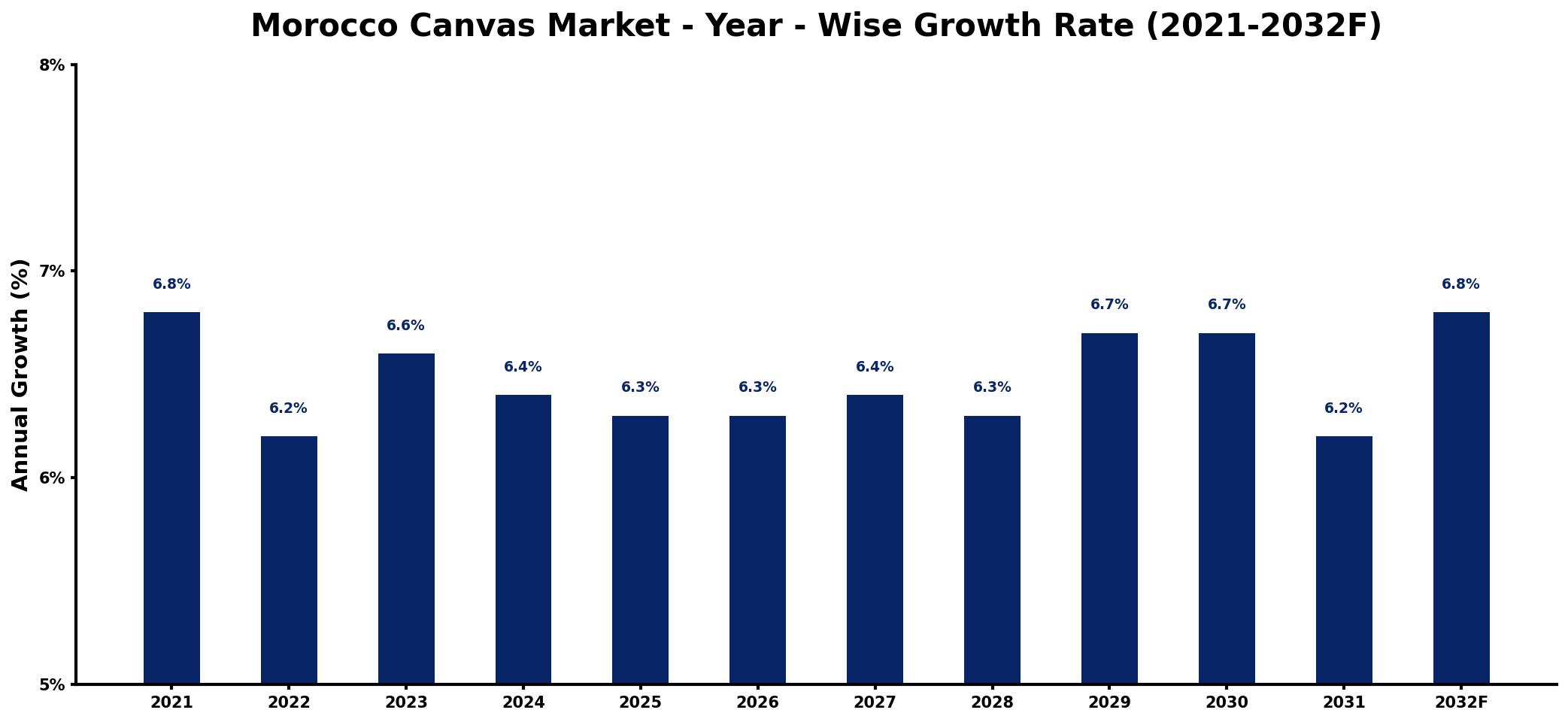
The table below presents the year‑wise growth rates along with the key drivers influencing the market
| Year | Growth Rate | Major Drivers |
| 2021 | 6.8% | Rising interest in outdoor activities |
| 2022 | 6.2% | Increased investment in arts sector |
| 2023 | 6.6% | Growing popularity of DIY projects |
| 2024 | 6.4% | Expansion of local manufacturing facilities |
| 2025 | 6.3% | Surge in tourism and hospitality |
| 2026 | 6.3% | Enhanced focus on sustainability practices |
| 2027 | 6.4% | Emergence of online retail platforms |
| 2028 | 6.3% | Strengthening cultural heritage initiatives |
| 2029 | 6.7% | Increased demand for home decor |
| 2030 | 6.7% | Growth in educational art programs |
| 2031 | 6.2% | expanding industrial usage applications |
| 2032 | 6.8% | Rising collaborations with designers |
Note: Market size estimations and growth projections presented in this report are based on 6Wresearch's proprietary forecasting methodology, utilizing the latest available industry data, government publications, and primary research inputs.
Morocco Canvas Market Synopsis
In recent years, the Morocco Canvas Market has shown notable momentum, reflecting a burgeoning interest in diverse applications ranging from tents to vehicle covers. However, as consumer preferences evolve and industries expand, the market is poised to enter a phase of sustained growth, driven by technological advancements and increasing demand for sustainable materials.
As Morocco continues to solidify its position in the global canvas production arena, the future looks promising. The interplay between economic development and the increasing sophistication of manufacturing processes is expected to create new opportunities for innovation and market expansion, supporting the long-term growth of this sector.
Morocco Canvas Market Key Takeaways
- The Morocco Canvas Market is projected to grow significantly, with a CAGR of 5.5% from 2026 to 2032.
- End-use sectors like construction, automotive, and consumer goods are key drivers of market expansion.
- Technological advancements are enhancing the efficiency and quality of canvas production.
- Consumer preferences are shifting towards high-quality, sustainable materials, further bolstering market demand.
- Government initiatives are in place to support domestic production and export of canvas products.
Evaluation of Restraints in Morocco Canvas Market
While the Morocco Canvas Market demonstrates considerable growth potential, several restraints remain. The high cost of imported raw materials poses significant challenges, increasing production expenses and ultimately impacting retail pricing. Additionally, the market faces tough competition from alternative materials, particularly synthetic fabrics, which are often more affordable and readily available. Furthermore, fluctuations in demand from key sectors such as art and construction can lead to market instability, creating uncertainty for manufacturers and suppliers alike.
Morocco Canvas Market Trends
Current trends in the Morocco Canvas Market highlight a growing inclination towards eco-friendly practices and products. Manufacturers are increasingly adopting sustainable production techniques, which not only meet consumer demand but also align with global environmental standards. Furthermore, the integration of advanced manufacturing technologies is revolutionizing production processes, resulting in higher efficiency and quality assurance. The rise in online sales channels is also making it easier for consumers to access a broader range of canvas products, thus stimulating market growth.
Morocco Canvas Market Opportunities
The Morocco Canvas Market presents ample opportunities for growth and investment, particularly in the realm of product innovation. There is a significant demand for custom canvas products, including specialized tarpaulins and artistic applications, which can lead to niche market creation. Additionally, expanding into export markets offers manufacturers the chance to increase revenue streams, particularly in regions where canvas products are in high demand. Collaborations with eco-conscious brands can also attract a new segment of environmentally aware consumers, further enhancing market potential.
Government Initiatives in the Morocco Canvas Market
The Moroccan government plays a vital role in fostering the canvas market through various supportive initiatives. Policies encouraging domestic production are complemented by subsidies for raw material procurement and technological upgrades in manufacturing. Additionally, tax incentives are offered to exporters, enhancing the competitiveness of Moroccan canvas products in the global market. Regulatory frameworks ensure quality standards are met, bolstering consumer confidence and reinforcing the reputation of Moroccan canvas on the international stage.
Future Insights of the Morocco Canvas Market
Looking ahead to the period between 2026 and 2032, the Morocco Canvas Market is expected to maintain its upward trajectory. The growing industrial base, combined with rising consumer awareness regarding sustainability, will likely encourage further investments in innovative production techniques. As end-use industries evolve, demand for specialized canvas applications will increase, opening new avenues for market players. Overall, the combination of governmental support and market dynamism suggests a robust future for the Morocco Canvas Market.
Morocco Canvas Market Latest Developments (2025 - 2026)
Recent developments in the Morocco Canvas Market indicate a shift towards more sustainable manufacturing practices. Companies are increasingly investing in eco-friendly materials and processes, reflecting changing consumer preferences. Additionally, there has been a notable increase in the number of collaborations with international brands seeking Moroccan canvas for their product lines. The focus on technological upgrades within production facilities is also prominent, aimed at improving quality and efficiency to meet rising demand.
Morocco Canvas Market - Key Attractiveness of the Report
- 10 Years of Market Numbers
- Historical Data Starting from 2022 to 2025
- Base Year: 2025
- Forecast Data until 2032
- Key Performance Indicators Impacting the Market
- Major Upcoming Developments and Projects
Key Highlights of the Report:
- Morocco Canvas Market Outlook
- Market Size of Morocco Canvas Market, 2025
- Forecast of Morocco Canvas Market, 2032
- Historical Data and Forecast of Morocco Canvas Revenues & Volume for the Period 2022-2032F
- Morocco Canvas Market Trend Evolution
- Morocco Canvas Market Drivers and Challenges
- Morocco Canvas Price Trends
- Morocco Canvas Porter's Five Forces
- Morocco Canvas Industry Life Cycle
- Historical Data and Forecast of Morocco Canvas Market Revenues & Volume By Types for the Period 2022-2032F
- Historical Data and Forecast of Morocco Canvas Market Revenues & Volume By Plane Canvas for the Period 2022-2032F
- Historical Data and Forecast of Morocco Canvas Market Revenues & Volume By Duck Canvas for the Period 2022-2032F
- Historical Data and Forecast of Morocco Canvas Market Revenues & Volume By Application for the Period 2022-2032F
- Historical Data and Forecast of Morocco Canvas Market Revenues & Volume By Tent for the Period 2022-2032F
- Historical Data and Forecast of Morocco Canvas Market Revenues & Volume By Luggage Fabric for the Period 2022-2032F
- Historical Data and Forecast of Morocco Canvas Market Revenues & Volume By Automotive Fabric for the Period 2022-2032F
- Historical Data and Forecast of Morocco Canvas Market Revenues & Volume By Apparel for the Period 2022-2032F
- Historical Data and Forecast of Morocco Canvas Market Revenues & Volume By Others for the Period 2022-2032F
- Morocco Canvas Import Export Trade Statistics
- Market Opportunity Assessment By Types
- Market Opportunity Assessment By Application
- Morocco Canvas Top Companies Market Share
- Morocco Canvas Competitive Benchmarking By Technical and Operational Parameters
- Morocco Canvas Company Profiles
- Morocco Canvas Key Strategic Recommendations






































