Morocco Cloud Infrastructure Services Market Size & Growth Rate (2026-2032)
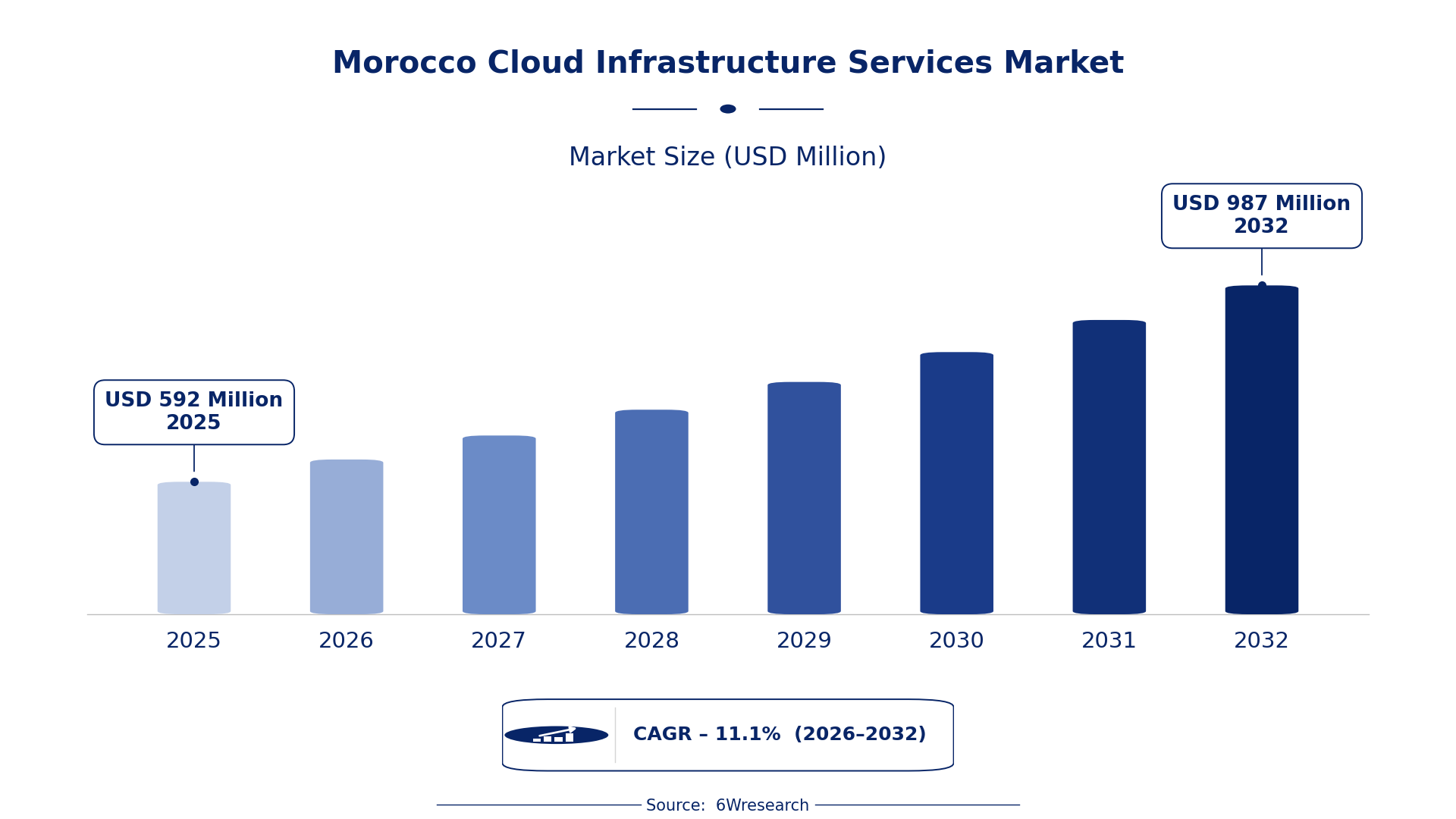
The Morocco Cloud Infrastructure Services Market was estimated at USD 592 Million in 2025 and is projected to reach USD 987 Million by 2032, growing at a CAGR of 11.1% from 2026 to 2032.
Morocco Cloud Infrastructure Services Market Synopsis
The Morocco Cloud Infrastructure Services Market is experiencing a notable shift as organizations increasingly adopt cloud technologies. This momentum is not just a passing trend; it's indicative of a broader transformation within the IT landscape. As businesses realize the benefits of scalability and agility, the demand for cloud infrastructure is set to expand significantly.
With providers enhancing their service portfolios to meet diverse needs, the market is aligning itself with global best practices. This evolution comes amidst challenges such as concerns over data sovereignty and the availability of skilled professionals. However, the long-term outlook remains optimistic as the sector matures and adapts to local requirements.
Morocco Cloud Infrastructure Services Market Year-wise Growth Rate and Key Drivers
This graph illustrates the annual growth rates of the Morocco Cloud Infrastructure Services Market from 2021 to 2032, highlighting a steady upward trajectory and projected expansion over the forecast period.
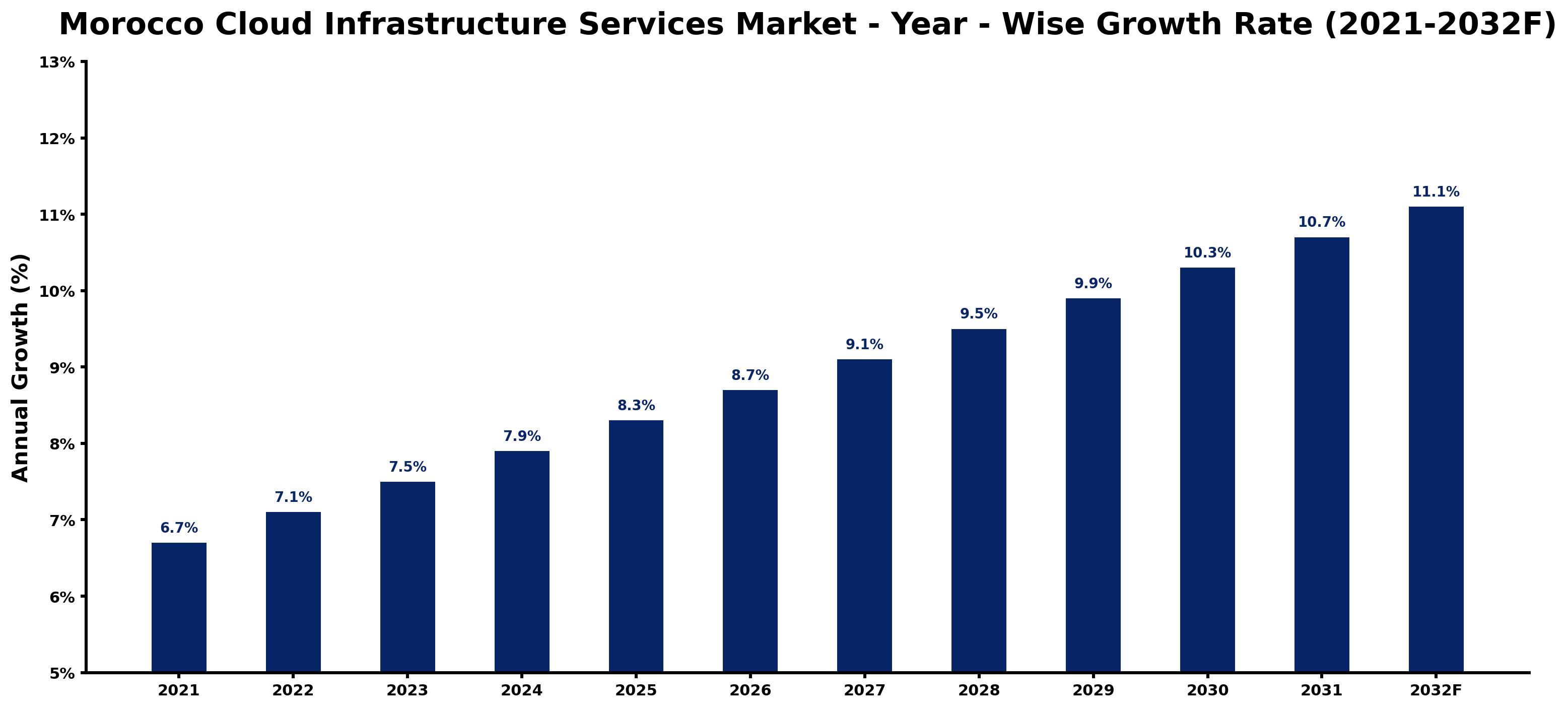
The table below presents the year‑wise growth rates along with the key drivers influencing the market
| Year | Growth Rate | Major Drivers |
| 2021 | 6.7% | CND-CT's cloud initiative boosting local adoption rates |
| 2022 | 7.1% | Growing Moroccan SMEs increasingly migrating to cloud solutions |
| 2023 | 7.5% | Government digital transformation plan accelerating cloud adoption |
| 2024 | 7.9% | Local startups driving innovative cloud-based service offerings |
| 2025 | 8.3% | Increased remote work fostering demand for cloud solutions |
| 2026 | 8.7% | Telecom infrastructure upgrades enhancing cloud service accessibility |
| 2027 | 9.1% | Emerging AI applications requiring robust cloud ecosystems |
| 2028 | 9.5% | International tech firms establishing data centers in Morocco |
| 2029 | 9.9% | Rising cybersecurity regulations driving cloud compliance needs |
| 2030 | 10.3% | Local universities expanding cloud computing education programs |
| 2031 | 10.7% | Increased foreign investments in Morocco's digital infrastructure |
| 2032 | 11.1% | Government incentives for tech companies adopting cloud technology |
Note: Market size estimations and growth projections presented in this report are based on 6Wresearch's proprietary forecasting methodology, utilizing the latest available industry data, government publications, and primary research inputs.
Morocco Cloud Infrastructure Services Market Key Takeaways
Below are some of the specific key takeaways from the market, including:
- The increasing demand for cloud solutions is transforming how businesses manage their IT infrastructure.
- Organizations are gravitating towards hybrid and multi-cloud strategies to optimize costs and enhance performance.
- Government initiatives are fostering growth by incentivizing investments in cloud infrastructure development.
- Data sovereignty concerns are shaping provider offerings and influencing customer choices.
- The market is seeing a growing need for skilled IT professionals to support cloud operations.
Evaluation of Restraints in Morocco Cloud Infrastructure Services Market
The Morocco Cloud Infrastructure Services Market faces certain restraints that are inhibiting its full potential. One major limitation is the scalability of existing infrastructure, which can fall short of the rapid growth in demand. Many businesses find it difficult to identify cloud providers that cater specifically to their unique needs and budget constraints, resulting in a mismatch of services and expectations.
Concerns regarding data sovereignty also loom large, particularly for sectors with strict regulatory frameworks. These issues create hesitancy among organizations that rely heavily on low-latency connections. on top of that, the scarcity of skilled IT professionals capable of managing and optimizing cloud infrastructures remains a critical barrier to broader adoption.
Morocco Cloud Infrastructure Services Market Trends
Several trends are shaping the Morocco Cloud Infrastructure Services Market. The shift towards hybrid and multi-cloud environments is gaining traction, with organizations seeking flexibility and improved resource utilization. This trend is bolstered by businesses' desires to modernize their IT operations and accelerate application deployment.
Another notable trend is the increasing focus on security solutions within cloud services. As cyber threats evolve, organizations are prioritizing data protection and compliance, leading to a demand for enhanced security features. This focus on security is expected to drive innovation among cloud providers as they adapt their offerings to meet these critical requirements.
Morocco Cloud Infrastructure Services Market Opportunities
Opportunities for growth in the Morocco Cloud Infrastructure Services Market are abundant. The ongoing digital transformation initiatives across various sectors present a fertile ground for cloud service adoption. Enterprises are recognizing the need for cost-effective solutions to enhance operational efficiency, which opens doors for cloud providers to tailor their services accordingly.
Additionally, the rise of artificial intelligence and machine learning applications is creating demand for advanced cloud services. As businesses look to leverage data analytics for strategic decision-making, the integration of AI and ML capabilities into cloud offerings represents a significant opportunity for providers aiming to stay competitive in this evolving market.
Government Initiatives in the Morocco Cloud Infrastructure Services Market
The Moroccan government recognizes the critical importance of cloud infrastructure in enhancing the nation's digital capabilities. With policies designed to encourage investment and development in this sector, the government is laying the groundwork for a more robust cloud ecosystem. This proactive approach is essential for fostering innovation and attracting both local and international players to the market.
- A national digital infrastructure upgrade programme was launched in early 2025 to enhance data center capabilities across the country.
- Current efforts include an ongoing initiative aimed at developing a regulatory framework that supports cloud service transparency and security.
- Plans are underway for a public-private partnership to expand telecommunications infrastructure by 2028, which will facilitate better cloud access.
- Incentives for investment in cloud technology have been introduced to attract businesses to adopt modern IT solutions.
- New training programs targeting the upskilling of IT professionals are set to roll out in late 2026, addressing the skills gap in the market.
Future Insights of the Morocco Cloud Infrastructure Services Market
Looking ahead to 2026-2032, the Morocco Cloud Infrastructure Services Market is expected to witness substantial growth. As businesses continue to embrace digital transformation, the demand for scalable and flexible cloud solutions will surge. The increasing integration of advanced technologies, such as AI and ML, into cloud services will further drive innovation and enhance service delivery.
on top of that, government policies aimed at promoting cloud adoption will play a crucial role in shaping the market. As infrastructure improves and regulatory frameworks become more supportive, the barriers to entry will diminish, attracting new players and investments. This dynamic environment will create a rich tapestry of opportunities for both existing and emerging cloud service providers.
Morocco Cloud Infrastructure Services Market Latest Developments
In the past year, the Morocco Cloud Infrastructure Services Market has seen a flurry of activity that underscores its growth trajectory. Providers are actively enhancing their service offerings while responding to the evolving needs of businesses. This agility is essential as organizations increasingly seek tailored cloud solutions to address their unique challenges.
- A major technology vendor launched a new suite of cloud security services in Q2 2025, aimed at helping businesses bolster their data protection efforts.
- An initiative to upgrade existing data centers for better performance has been underway since early 2025, with completion expected by late 2026.
- A leading regional operator is planning to expand its cloud services footprint into underserved areas, with rollouts anticipated in mid-2026.
- In Q3 2025, a partnership was formed between two cloud providers to enhance service integration capabilities, fostering improved interoperability.
- Upcoming in 2027, a new program focused on enhancing cloud adoption in SMEs is set to launch, providing tailored support for smaller businesses.
Morocco Cloud Infrastructure Services Market - Key Attractiveness of the Report
- 10 Years of Market Numbers
- Historical Data Starting from 2022 to 2025
- Base Year: 2025
- Forecast Data until 2032
- Key Performance Indicators Impacting the Market
- Major Upcoming Developments and Projects
Key Highlights of the Report:
- Morocco Cloud Infrastructure Services Market Outlook
- Market Size of Morocco Cloud Infrastructure Services Market, 2025
- Forecast of Morocco Cloud Infrastructure Services Market, 2032
- Historical Data and Forecast of Morocco Cloud Infrastructure Services Revenues & Volume for the Period 2022-2032F
- Morocco Cloud Infrastructure Services Market Trend Evolution
- Morocco Cloud Infrastructure Services Market Drivers and Challenges
- Morocco Cloud Infrastructure Services Price Trends
- Morocco Cloud Infrastructure Services Porter's Five Forces
- Morocco Cloud Infrastructure Services Industry Life Cycle
- Historical Data and Forecast of Morocco Cloud Infrastructure Services Market Revenues & Volume By Service Type for the Period 2022-2032F
- Historical Data and Forecast of Morocco Cloud Infrastructure Services Market Revenues & Volume By Compute as a Service for the Period 2022-2032F
- Historical Data and Forecast of Morocco Cloud Infrastructure Services Market Revenues & Volume By Storage as a Service for the Period 2022-2032F
- Historical Data and Forecast of Morocco Cloud Infrastructure Services Market Revenues & Volume By Disaster Recovery and Backup as a Service for the Period 2022-2032F
- Historical Data and Forecast of Morocco Cloud Infrastructure Services Market Revenues & Volume By Networking as a Service for the Period 2022-2032F
- Historical Data and Forecast of Morocco Cloud Infrastructure Services Market Revenues & Volume By Desktop as a Service for the Period 2022-2032F
- Historical Data and Forecast of Morocco Cloud Infrastructure Services Market Revenues & Volume By Managed Hosting for the Period 2022-2032F
- Historical Data and Forecast of Morocco Cloud Infrastructure Services Market Revenues & Volume By Deployment Type for the Period 2022-2032F
- Historical Data and Forecast of Morocco Cloud Infrastructure Services Market Revenues & Volume By On-premises for the Period 2022-2032F
- Historical Data and Forecast of Morocco Cloud Infrastructure Services Market Revenues & Volume By Cloud for the Period 2022-2032F
- Historical Data and Forecast of Morocco Cloud Infrastructure Services Market Revenues & Volume By Organization Size for the Period 2022-2032F
- Historical Data and Forecast of Morocco Cloud Infrastructure Services Market Revenues & Volume By Small and Medium-sized Enterprises (SMEs) for the Period 2022-2032F
- Historical Data and Forecast of Morocco Cloud Infrastructure Services Market Revenues & Volume By Large Enterprises for the Period 2022-2032F
- Historical Data and Forecast of Morocco Cloud Infrastructure Services Market Revenues & Volume By Vertical for the Period 2022-2032F
- Historical Data and Forecast of Morocco Cloud Infrastructure Services Market Revenues & Volume By Banking, Financial Services, and Insurance (BFSI) for the Period 2022-2032F
- Historical Data and Forecast of Morocco Cloud Infrastructure Services Market Revenues & Volume By IT and Telecommunications for the Period 2022-2032F
- Historical Data and Forecast of Morocco Cloud Infrastructure Services Market Revenues & Volume By Government and Public Sector for the Period 2022-2032F
- Historical Data and Forecast of Morocco Cloud Infrastructure Services Market Revenues & Volume By Retail and Consumer Goods for the Period 2022-2032F
- Historical Data and Forecast of Morocco Cloud Infrastructure Services Market Revenues & Volume By Manufacturing for the Period 2022-2032F
- Historical Data and Forecast of Morocco Cloud Infrastructure Services Market Revenues & Volume By Energy and Utilities for the Period 2022-2032F
- Historical Data and Forecast of Morocco Cloud Infrastructure Services Market Revenues & Volume By Media and Entertainment for the Period 2022-2032F
- Historical Data and Forecast of Morocco Cloud Infrastructure Services Market Revenues & Volume By Healthcare and Life Sciences for the Period 2022-2032F
- Morocco Cloud Infrastructure Services Import Export Trade Statistics
- Market Opportunity Assessment By Service Type
- Market Opportunity Assessment By Deployment Type
- Market Opportunity Assessment By Organization Size
- Market Opportunity Assessment By Vertical
- Morocco Cloud Infrastructure Services Top Companies Market Share
- Morocco Cloud Infrastructure Services Competitive Benchmarking By Technical and Operational Parameters
- Morocco Cloud Infrastructure Services Company Profiles
- Morocco Cloud Infrastructure Services Key Strategic Recommendations






































