Morocco Computer Software Market Size, Share & Growth Rate
The Morocco Computer Software Market was estimated at USD 185 Million in 2025 and is projected to reach USD 257 Million by 2032, growing at a CAGR of 4.8% from 2026 to 2032. This growth trajectory is significantly influenced by the rising demand for tailored software solutions and government support aimed at fostering a digital economy. As Moroccan businesses increasingly embrace technological innovation, the market is set to expand across key sectors such as e-commerce, fintech, and cloud computing.
Morocco Computer Software Market Year-wise Growth Rate and Key Drivers
This graph highlights how the Morocco Computer Software Market has steadily grown over the years, supported by major growth factors.
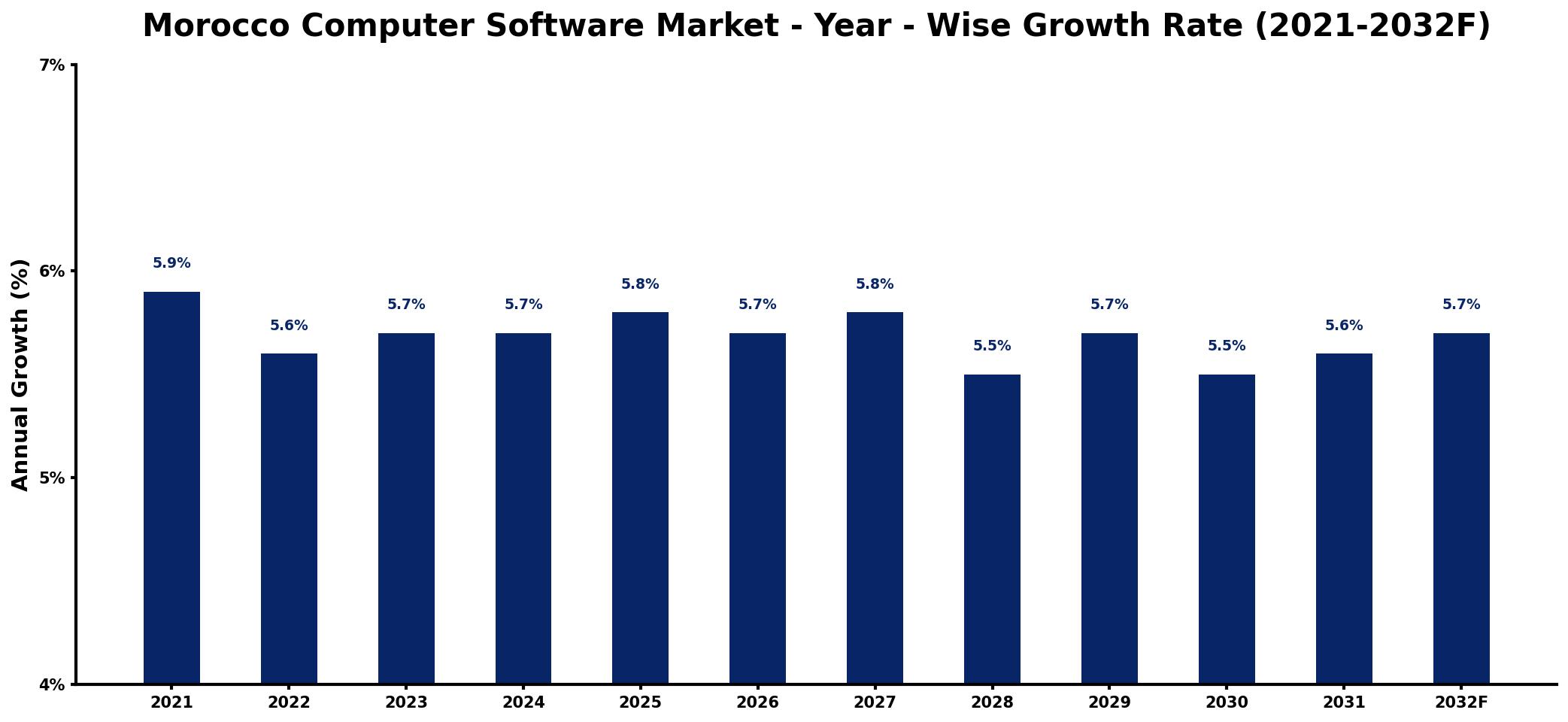
The table below presents the year‑wise growth rates along with the key drivers influencing the market
| Year | Growth Rate | Major Drivers |
| 2021 | 5.9% | Rising demand for digital solutions |
| 2022 | 5.6% | Increased investment in technology infrastructure |
| 2023 | 5.7% | Expansion of e-commerce platforms |
| 2024 | 5.7% | Growth in remote working tools |
| 2025 | 5.8% | Surge in mobile application development |
| 2026 | 5.7% | Adoption of cloud computing services |
| 2027 | 5.8% | Emergence of artificial intelligence applications |
| 2028 | 5.5% | growing downstream application demand |
| 2029 | 5.7% | Increase in digital transformation initiatives |
| 2030 | 5.5% | expanding industrial usage applications |
| 2031 | 5.6% | Rise in data analytics usage |
| 2032 | 5.7% | growing emerging market penetration |
Note: Market size estimations and growth projections presented in this report are based on 6Wresearch's proprietary forecasting methodology, utilizing the latest available industry data, government publications, and primary research inputs.
Morocco Computer Software Market Synopsis
Currently, the Morocco Computer Software Market is characterized by its rapid evolution, reflecting the nations commitment to digital transformation. The proliferation of mobile technology and cloud-based solutions has prompted companies to seek software that enhances operational efficiency and customer engagement.
Local software developers are gaining traction as they deliver customized solutions that meet specific market needs. This, coupled with a youthful and digitally literate population, positions Morocco as a vibrant hub for software innovation in North Africa.
Morocco Computer Software Market Key Takeaways
- The market is witnessing a significant shift towards cloud computing and mobile applications.
- Government initiatives are playing a crucial role in promoting the digital economy.
- Cybersecurity and fintech solutions are increasingly in demand among businesses.
- Local software developers are carving a niche with tailored solutions for Moroccan enterprises.
- Investment opportunities are expanding, particularly in sectors like healthcare and e-commerce.
Evaluation of Restraints in Morocco Computer Software Market
Despite the positive growth outlook, the Morocco Computer Software Market faces notable constraints. A significant shortage of skilled professionals in emerging technologies, such as artificial intelligence and advanced cybersecurity, hampers innovation and the development of cutting-edge products. Furthermore, the persistent issue of software piracy undermines the revenue generation capabilities of companies, posing challenges to sustainable growth. Limited access to funding for startups also restricts the potential of new entrants in this dynamic market.
Morocco Computer Software Market Trends
Several key trends are shaping the Morocco Computer Software Market. Notably, the adoption of cloud-based solutions is accelerating, as businesses seek flexibility and scalability in their operations. Mobile application development is gaining traction, driven by an increasing number of smartphone users. Additionally, the demand for cybersecurity solutions is on the rise, reflecting heightened awareness of digital threats and a commitment to safeguarding data integrity.
Morocco Computer Software Market Opportunities
The market presents numerous investment opportunities, particularly in software development tailored for the finance, healthcare, and government sectors. With a vibrant startup ecosystem and the government's support for tech incubators, there's a fertile ground for innovation. Additionally, as Morocco positions itself as a gateway to Africa, companies that establish a foothold here can leverage growth opportunities across the continent.
Government Initiatives in the Morocco Computer Software Market
The Moroccan government is actively fostering the computer software market through various initiatives and policies. The National Digital 2020 strategy serves as a cornerstone of this effort, aiming to elevate the digital economy and spur innovation within the IT sector. Incentives such as tax breaks and financial support for research and development in the software industry further enhance the environment for growth, driving competitiveness and job creation.
Future Insights of the Morocco Computer Software Market
Looking ahead to 2026-2032, the Morocco Computer Software Market is poised for sustained growth. The increasing adoption of enterprise software solutions, especially in cybersecurity and data analytics, will be pivotal. The rise of startups and innovation hubs is expected to stimulate product development and enhance the overall competitiveness of the sector. Furthermore, Morocco's strategic geographic position will facilitate the expansion of software companies seeking to tap into larger African markets.
Morocco Computer Software Market Latest Developments (2025 - 2026)
Recent developments in the Morocco Computer Software Market indicate a robust trajectory towards digital transformation. Various tech incubators have launched initiatives aimed at nurturing local startups and fostering innovation. Moreover, partnerships between educational institutions and the tech industry are on the rise, focusing on upskilling the workforce in emerging technologies. This collaborative environment is enhancing the overall landscape for software development in Morocco.
Morocco Computer Software Market - Key Attractiveness of the Report
- 10 Years of Market Numbers
- Historical Data Starting from 2022 to 2025
- Base Year: 2025
- Forecast Data until 2032
- Key Performance Indicators Impacting the Market
- Major Upcoming Developments and Projects
Key Highlights of the Report:
- Morocco Computer Software Market Outlook
- Market Size of Morocco Computer Software Market, 2025
- Forecast of Morocco Computer Software Market, 2032
- Historical Data and Forecast of Morocco Computer Software Revenues & Volume for the Period 2022-2032F
- Morocco Computer Software Market Trend Evolution
- Morocco Computer Software Market Drivers and Challenges
- Morocco Computer Software Price Trends
- Morocco Computer Software Porter's Five Forces
- Morocco Computer Software Industry Life Cycle
- Historical Data and Forecast of Morocco Computer Software Market Revenues & Volume By Type for the Period 2022-2032F
- Historical Data and Forecast of Morocco Computer Software Market Revenues & Volume By Operating Systems & Productivity Software Publishing for the Period 2022-2032F
- Historical Data and Forecast of Morocco Computer Software Market Revenues & Volume By Database, Storage & Backup Software Publishing for the Period 2022-2032F
- Historical Data and Forecast of Morocco Computer Software Market Revenues & Volume By Business Analytics & Enterprise Software for the Period 2022-2032F
- Historical Data and Forecast of Morocco Computer Software Market Revenues & Volume By Video Game Software for the Period 2022-2032F
- Historical Data and Forecast of Morocco Computer Software Market Revenues & Volume By Design for the Period 2022-2032F
- Historical Data and Forecast of Morocco Computer Software Market Revenues & Volume By Editing & Rendering Software for the Period 2022-2032F
- Historical Data and Forecast of Morocco Computer Software Market Revenues & Volume By Application for the Period 2022-2032F
- Historical Data and Forecast of Morocco Computer Software Market Revenues & Volume By Personal for the Period 2022-2032F
- Historical Data and Forecast of Morocco Computer Software Market Revenues & Volume By Business/Commercial for the Period 2022-2032F
- Historical Data and Forecast of Morocco Computer Software Market Revenues & Volume By Industrial for the Period 2022-2032F
- Historical Data and Forecast of Morocco Computer Software Market Revenues & Volume By Industry Verticals for the Period 2022-2032F
- Historical Data and Forecast of Morocco Computer Software Market Revenues & Volume By BFSI for the Period 2022-2032F
- Historical Data and Forecast of Morocco Computer Software Market Revenues & Volume By Media & Entertainment for the Period 2022-2032F
- Historical Data and Forecast of Morocco Computer Software Market Revenues & Volume By IT & Telecommunications for the Period 2022-2032F
- Historical Data and Forecast of Morocco Computer Software Market Revenues & Volume By Energy & Utilities for the Period 2022-2032F
- Historical Data and Forecast of Morocco Computer Software Market Revenues & Volume By Government & Public Sector for the Period 2022-2032F
- Historical Data and Forecast of Morocco Computer Software Market Revenues & Volume By Retail & Consumer Goods for the Period 2022-2032F
- Historical Data and Forecast of Morocco Computer Software Market Revenues & Volume By Manufacturing for the Period 2022-2032F
- Historical Data and Forecast of Morocco Computer Software Market Revenues & Volume By Others for the Period 2022-2032F
- Morocco Computer Software Import Export Trade Statistics
- Market Opportunity Assessment By Type
- Market Opportunity Assessment By Application
- Market Opportunity Assessment By Industry Verticals
- Morocco Computer Software Top Companies Market Share
- Morocco Computer Software Competitive Benchmarking By Technical and Operational Parameters
- Morocco Computer Software Company Profiles
- Morocco Computer Software Key Strategic Recommendations






































