Morocco Containers as a Service Market Size & Growth Rate (2026-2032)
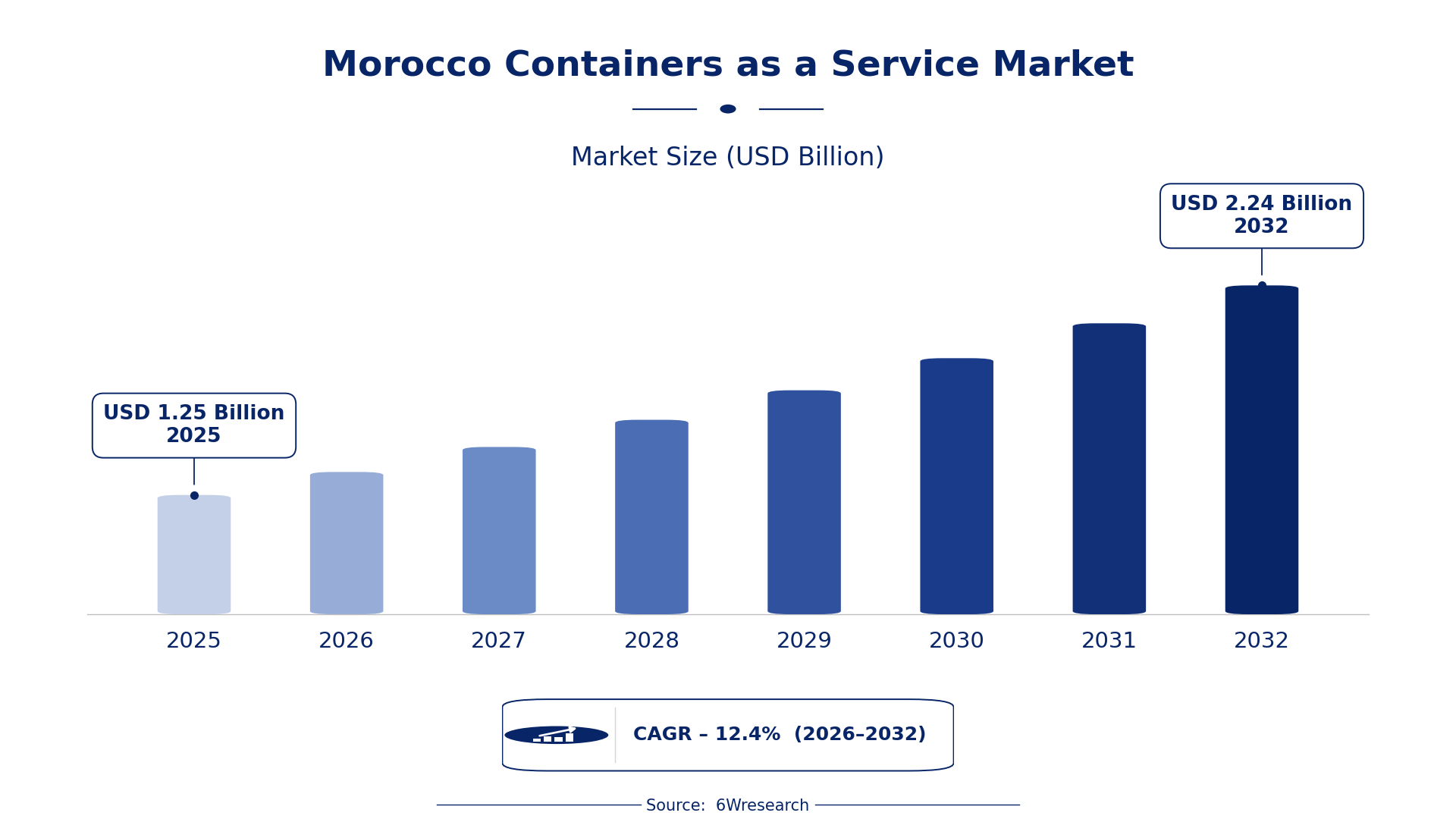
The Morocco Containers as a Service Market was estimated at USD 1252 Million in 2025 and is projected to reach USD 2242 Million by 2032, growing at a CAGR of 12.4% from 2026 to 2032.
Morocco Containers as a Service Market Synopsis
The Containers as a Service (CaaS) market is rapidly evolving in Morocco, driven by the increasing demand for agile and scalable IT solutions. Organizations are turning to containerization to optimize their application deployment processes, allowing them to innovate faster and respond to market changes more effectively.
As cloud-native technologies gain traction, CaaS is emerging as a preferred choice for many Moroccan businesses. This shift is supported by a growing ecosystem of service providers that offer tailored solutions, enabling companies to harness the full potential of containerized applications without the overhead of managing underlying infrastructure.
Morocco Containers as a Service Market Year-wise Growth Rate and Key Drivers
This graph illustrates the annual growth rates of the Morocco Containers as a Service Market from 2021 to 2032, highlighting a steady upward trajectory and projected expansion over the forecast period.
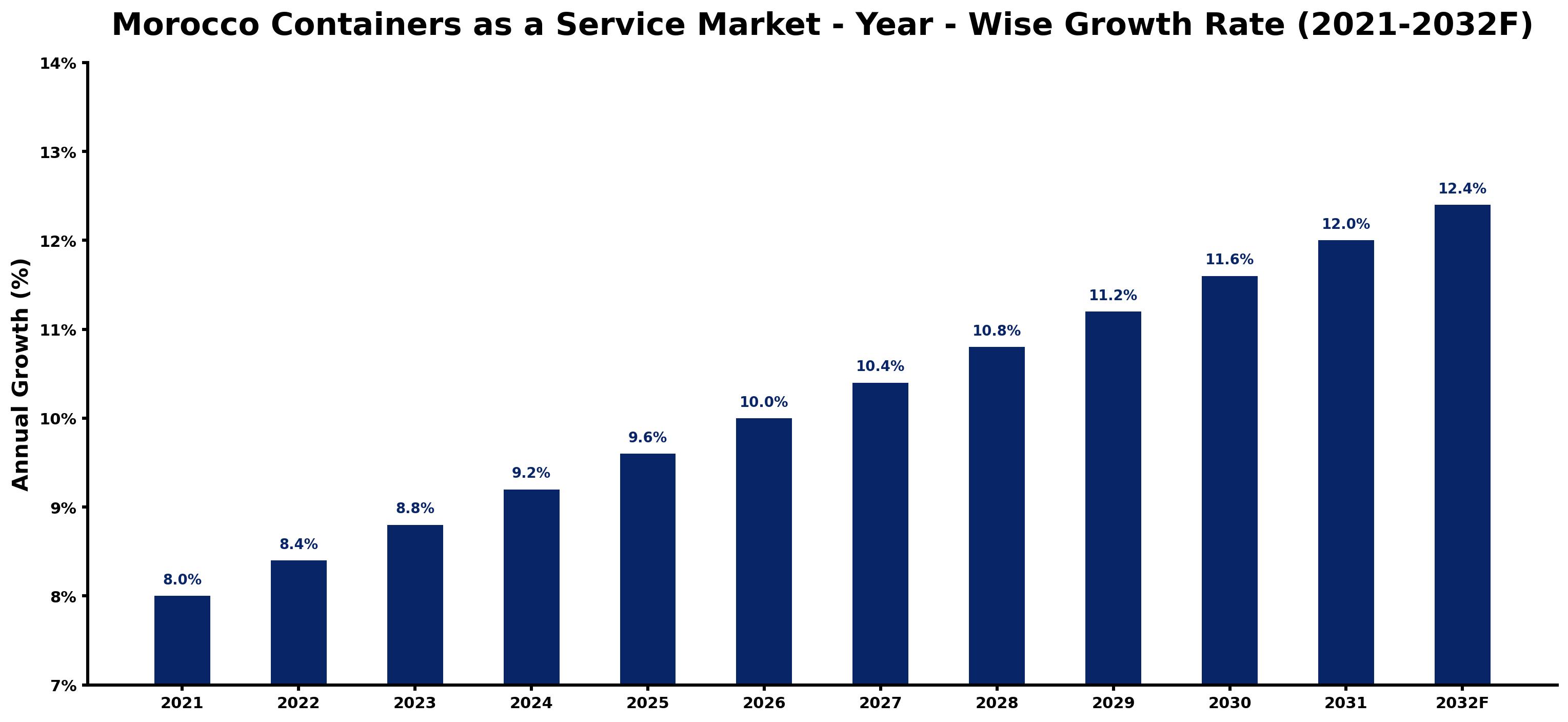
The table below presents the year‑wise growth rates along with the key drivers influencing the market
| Year | Growth Rate | Major Drivers |
| 2021 | 8.0% | Moroccan government promoting cloud adoption for SMEs |
| 2022 | 8.4% | Increased tech startup funding fueling container solutions demand |
| 2023 | 8.8% | Remote work trend boosting demand for flexible services |
| 2024 | 9.2% | Growth in e-commerce driving cloud infrastructure needs |
| 2025 | 9.6% | National digital transformation strategy enhancing container deployment |
| 2026 | 10.0% | Rising cybersecurity regulations stimulating container security services |
| 2027 | 10.4% | Local talent development initiatives supporting container technology growth |
| 2028 | 10.8% | Demand for scalability in enterprises increasing container use |
| 2029 | 11.2% | International companies entering Moroccan market enhancing competition |
| 2030 | 11.6% | Evolving data compliance requirements favoring containerized applications |
| 2031 | 12.0% | Adoption of microservices architecture across various industries |
| 2032 | 12.4% | Investment in 5G technology accelerating container service adoption |
Note: Market size estimations and growth projections presented in this report are based on 6Wresearch's proprietary forecasting methodology, utilizing the latest available industry data, government publications, and primary research inputs.
Morocco Containers as a Service Market Key Takeaways
Below are some of the specific key takeaways from the market, including:
- The market is witnessing a surge in demand as businesses adopt cloud-native applications.
- Agility and efficiency in IT infrastructure are primary drivers for CaaS adoption.
- DevOps practices are enhancing the need for CaaS solutions to support CI/CD pipelines.
- Local expertise in containerization technologies is developing through government initiatives.
- Challenges remain, particularly regarding the maturity of container orchestration tools in the region.
Evaluation of Restraints in Morocco Containers as a Service Market
Despite the promising growth, the Morocco Containers as a Service market faces significant constraints. A key limitation is the lack of mature container orchestration platforms tailored to local businesses. Many organizations struggle to find CaaS solutions that align with their specific needs, which can hinder their operational efficiency. Additionally, a general lack of awareness and understanding of containerization technologies among some business sectors can further slow adoption rates.
Morocco Containers as a Service Market Trends
Several trends are shaping the demand for Containers as a Service in Morocco. The rise of microservices architecture is compelling organizations to adopt containerization for its inherent scalability and manageability. on top of that, the integration of artificial intelligence and machine learning with CaaS platforms is gaining momentum, providing businesses with enhanced analytics and automation capabilities. The focus on security within container environments is also becoming a priority as companies aim to safeguard their data and applications.
Morocco Containers as a Service Market Opportunities
The future holds promising opportunities for investment in the Morocco Containers as a Service market. As local businesses continue to digitize, there is a growing need for tailored CaaS solutions that cater to specific industry requirements. The increasing emphasis on sustainability and energy efficiency also opens avenues for innovative CaaS offerings that reduce operational footprints. Additionally, partnerships between technology providers and local startups can foster growth by enhancing the development of bespoke container solutions.
Government Initiatives in the Morocco Containers as a Service Market
The Moroccan government recognizes the transformative potential of Containers as a Service in promoting digital innovation and economic growth. By implementing supportive policies and initiatives, the government aims to create a favorable environment for technology adoption, including CaaS. These efforts not only facilitate cloud adoption but also focus on building local expertise and ensuring compliance with data security regulations.
- A national digital infrastructure upgrade programme launched in early 2025 aims to enhance connectivity and support cloud services.
- Currently, ongoing training initiatives are being conducted in partnership with educational institutions to develop local talent in containerization technologies.
- A regulatory framework established in 2025 mandates compliance with data protection standards, fostering trust among businesses.
- Plans for a public-private partnership are underway, aimed at expanding access to cloud technologies for SMEs by 2026.
Future Insights of the Morocco Containers as a Service Market
Looking ahead to 2026-2032, the Morocco Containers as a Service market is expected to experience significant growth driven by technological advancements and shifting business needs. The proliferation of cloud-native applications will continue to push organizations toward adopting containerization. As more businesses embrace DevOps practices, the demand for CaaS solutions that support agile workflows will likely escalate. The government's ongoing initiatives to promote digital transformation will further bolster market growth, providing a conducive environment for innovation.
Morocco Containers as a Service Market Latest Developments
In the past year, the Morocco Containers as a Service market has seen a flurry of activity as businesses and service providers adapt to changing technological demands. Companies are increasingly seeking to implement CaaS solutions that align with their operational goals, reflecting a growing trend toward digitalization and efficiency.
- A major technology vendor announced the rollout of a new CaaS platform in Q1 2025, aimed at enhancing application deployment efficiency.
- A leading regional operator is currently upgrading its existing container orchestration tools to better meet the needs of local businesses, with plans to complete the upgrades by mid-2026.
- In Q2 2025, a partnership was formed between a cloud service provider and a local startup to develop customized CaaS solutions for the Moroccan market.
- An initiative that began in early 2025 to promote awareness of containerization technologies is currently underway, targeting small and medium-sized enterprises.
Morocco Containers as a Service Market - Key Attractiveness of the Report
- 10 Years of Market Numbers
- Historical Data Starting from 2022 to 2025
- Base Year: 2025
- Forecast Data until 2032
- Key Performance Indicators Impacting the Market
- Major Upcoming Developments and Projects
Key Highlights of the Report:
- Morocco Containers as a Service Market Outlook
- Market Size of Morocco Containers as a Service Market, 2025
- Forecast of Morocco Containers as a Service Market, 2032
- Historical Data and Forecast of Morocco Containers as a Service Revenues & Volume for the Period 2022-2032F
- Morocco Containers as a Service Market Trend Evolution
- Morocco Containers as a Service Market Drivers and Challenges
- Morocco Containers as a Service Price Trends
- Morocco Containers as a Service Porter's Five Forces
- Morocco Containers as a Service Industry Life Cycle
- Historical Data and Forecast of Morocco Containers as a Service Market Revenues & Volume By Service Type for the Period 2022-2032F
- Historical Data and Forecast of Morocco Containers as a Service Market Revenues & Volume By Management & Orchestration for the Period 2022-2032F
- Historical Data and Forecast of Morocco Containers as a Service Market Revenues & Volume By Security for the Period 2022-2032F
- Historical Data and Forecast of Morocco Containers as a Service Market Revenues & Volume By Monitoring and Analytics for the Period 2022-2032F
- Historical Data and Forecast of Morocco Containers as a Service Market Revenues & Volume By Storage and Networking for the Period 2022-2032F
- Historical Data and Forecast of Morocco Containers as a Service Market Revenues & Volume By Continuous Integration and Continuous Deployment (CI/CD) for the Period 2022-2032F
- Historical Data and Forecast of Morocco Containers as a Service Market Revenues & Volume By Training and Consulting for the Period 2022-2032F
- Historical Data and Forecast of Morocco Containers as a Service Market Revenues & Volume By Support and Maintenance for the Period 2022-2032F
- Historical Data and Forecast of Morocco Containers as a Service Market Revenues & Volume By Deployment Model for the Period 2022-2032F
- Historical Data and Forecast of Morocco Containers as a Service Market Revenues & Volume By Public Cloud for the Period 2022-2032F
- Historical Data and Forecast of Morocco Containers as a Service Market Revenues & Volume By Private Cloud for the Period 2022-2032F
- Historical Data and Forecast of Morocco Containers as a Service Market Revenues & Volume By Hybrid Cloud for the Period 2022-2032F
- Historical Data and Forecast of Morocco Containers as a Service Market Revenues & Volume By Organization Size for the Period 2022-2032F
- Historical Data and Forecast of Morocco Containers as a Service Market Revenues & Volume By Small and Medium-Sized Enterprises (SMEs) for the Period 2022-2032F
- Historical Data and Forecast of Morocco Containers as a Service Market Revenues & Volume By Large Enterprises for the Period 2022-2032F
- Historical Data and Forecast of Morocco Containers as a Service Market Revenues & Volume By Vertical for the Period 2022-2032F
- Historical Data and Forecast of Morocco Containers as a Service Market Revenues & Volume By Retail and Consumer Goods for the Period 2022-2032F
- Historical Data and Forecast of Morocco Containers as a Service Market Revenues & Volume By Manufacturing for the Period 2022-2032F
- Historical Data and Forecast of Morocco Containers as a Service Market Revenues & Volume By Media, Entertainment and Gaming for the Period 2022-2032F
- Historical Data and Forecast of Morocco Containers as a Service Market Revenues & Volume By IT and Telecommunications for the Period 2022-2032F
- Historical Data and Forecast of Morocco Containers as a Service Market Revenues & Volume By Healthcare for the Period 2022-2032F
- Historical Data and Forecast of Morocco Containers as a Service Market Revenues & Volume By BFSI for the Period 2022-2032F
- Historical Data and Forecast of Morocco Containers as a Service Market Revenues & Volume By Transportation & Logistics for the Period 2022-2032F
- Morocco Containers as a Service Import Export Trade Statistics
- Market Opportunity Assessment By Service Type
- Market Opportunity Assessment By Deployment Model
- Market Opportunity Assessment By Organization Size
- Market Opportunity Assessment By Vertical
- Morocco Containers as a Service Top Companies Market Share
- Morocco Containers as a Service Competitive Benchmarking By Technical and Operational Parameters
- Morocco Containers as a Service Company Profiles
- Morocco Containers as a Service Key Strategic Recommendations






































