Morocco Curtains and Window Blinds Market Size, Share & Growth Rate
The Morocco Curtains and Window Blinds Market was estimated at USD 885 Million in 2025 and is projected to reach USD 1619 Million by 2032, growing at a CAGR of 9.0% from 2026 to 2032. This impressive growth trajectory is primarily fueled by urbanization and the rising middle-class population, which increases demand for home interior products. Additionally, the expansion of the real estate sector, alongside an increasing emphasis on aesthetic appeal and energy efficiency, further solidifies the markets optimistic outlook.
Morocco Curtains and Window Blinds Market Year-wise Growth Rate and Key Drivers
This graph highlights how the Morocco Curtains and Window Blinds Market has steadily grown over the years, supported by major growth factors.
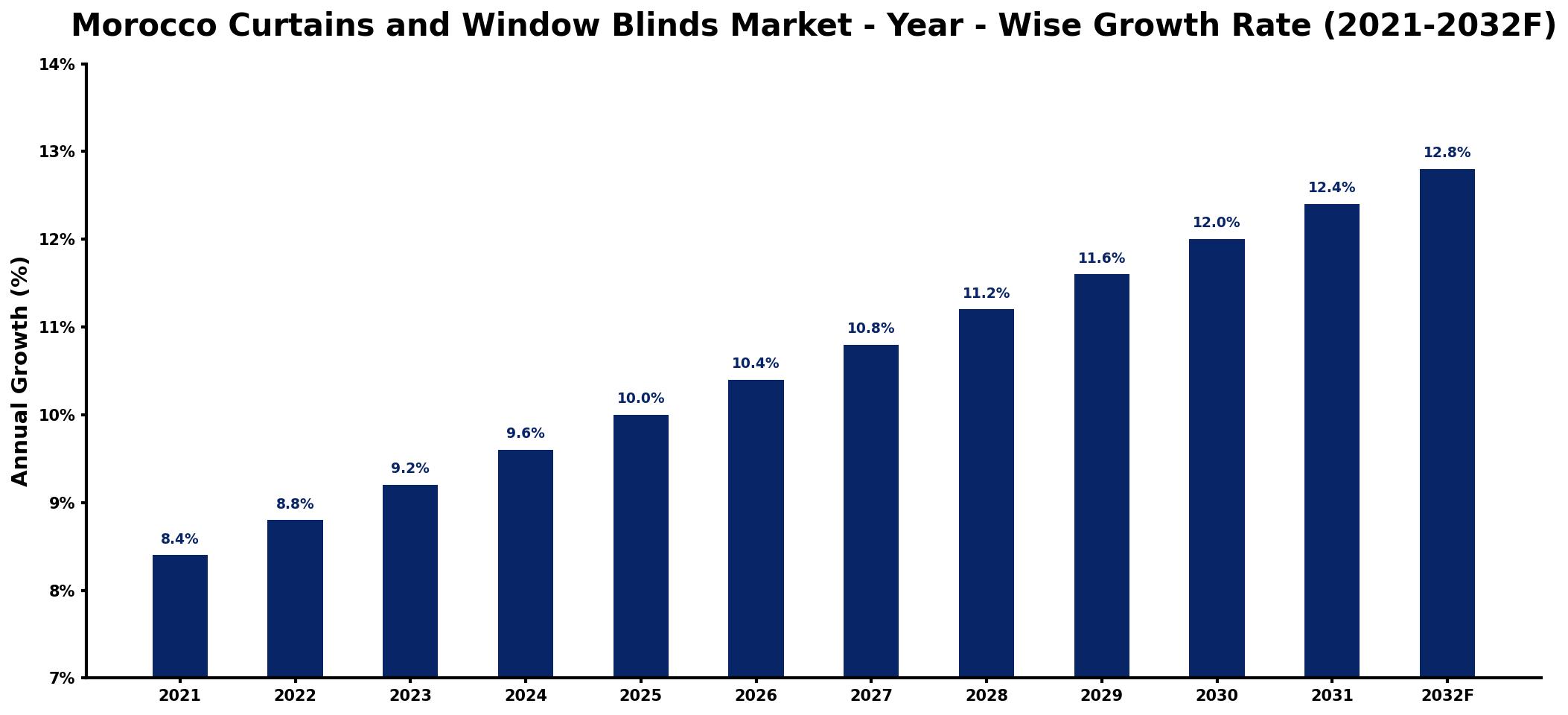
The table below presents the year‑wise growth rates along with the key drivers influencing the market
| Year | Growth Rate | Major Drivers |
| 2021 | 8.4% | Rising residential construction projects |
| 2022 | 8.8% | Increased consumer spending habits |
| 2023 | 9.2% | Growing focus on interior design |
| 2024 | 9.6% | Expansion of real estate market |
| 2025 | 10.0% | Surge in home renovation activities |
| 2026 | 10.4% | Technological advancements in materials |
| 2027 | 10.8% | Higher disposable income levels |
| 2028 | 11.2% | Increasing demand for energy efficiency |
| 2029 | 11.6% | Growth in hospitality sector investments |
| 2030 | 12.0% | Popularity of smart home features |
| 2031 | 12.4% | Emergence of sustainable living trends |
| 2032 | 12.8% | Innovations in decorative solutions |
Note: Market size estimations and growth projections presented in this report are based on 6Wresearch's proprietary forecasting methodology, utilizing the latest available industry data, government publications, and primary research inputs.
Morocco Curtains and Window Blinds Market Synopsis
In Morocco, the curtains and window blinds market is characterized by a diverse range of offerings, from traditional fabrics to modern, tech-enabled solutions. This variety caters to a wide spectrum of consumer tastes and budgets, driving demand in both residential and commercial sectors.
With a growing consciousness surrounding interior décor, consumers increasingly prioritize quality and style in their window treatments. Innovations in eco-friendly materials and smart technology integrations are shaping a competitive landscape, presenting opportunities for brands willing to adapt to these shifts in consumer preference.
Morocco Curtains and Window Blinds Market Key Takeaways
- The market is driven by urbanization and rising disposable incomes.
- Eco-friendly materials are gaining traction among consumers.
- Smart curtains and blinds are increasingly sought after for energy efficiency.
- Customization options are rising, reflecting individual consumer tastes.
- Manufacturers must focus on innovation to stay competitive amidst a crowded market.
Evaluation of Restraints in Morocco Curtains and Window Blinds Market
The Morocco Curtains and Window Blinds Market faces several challenges that could impact its growth trajectory. Intense competition from both local and international players can lead to price wars, which ultimately affect profit margins. Additionally, inconsistent quality standards pose a challenge for manufacturers striving for excellence. The limited availability of skilled labor for installation and production processes further complicates the market landscape. Import regulations and tariffs on raw materials also hinder local manufacturers, making it difficult for them to maintain cost-competitiveness.
Morocco Curtains and Window Blinds Market Trends
A distinct trend in the Morocco Curtains and Window Blinds Market is the increasing demand for sustainable products, with an emphasis on organic materials such as bamboo and cotton. Moreover, minimalistic design aesthetics are becoming increasingly popular, prompting manufacturers to offer products in neutral tones and simple patterns. Automation and smart home integration are shaping consumer preferences, with smart curtains and blinds gaining traction as energy-efficient solutions. The rise of customization options allows consumers to tailor their window treatments to fit their unique style and functional requirements, effectively blending aesthetics with practicality.
Morocco Curtains and Window Blinds Market Opportunities
The Morocco Curtains and Window Blinds Market holds promising investment opportunities as the real estate sector expands. Increased focus on interior design and the growing trend toward personalized home decor create ample room for growth. Investors are encouraged to explore avenues in manufacturing innovative, eco-friendly window treatments, as well as partnering with local artisans to introduce culturally inspired designs that resonate with Moroccan consumers. Such collaborations can distinguish brands in a competitive marketplace and tap into the burgeoning market for unique, handcrafted products.
Government Initiatives in the Morocco Curtains and Window Blinds Market
The Moroccan government has implemented several policies aimed at fostering a competitive environment in the Curtains and Window Blinds Market. These include regulations that support local manufacturers through import controls and quality standards that ensure consumer safety. Environmental initiatives are also in place to promote sustainability, encouraging the use of locally sourced materials. Additionally, incentives aimed at innovation and investment in the sector are helping to boost market development and protect consumer interests.
Future Insights of the Morocco Curtains and Window Blinds Market
Looking ahead to the period from 2026 to 2032, the Morocco Curtains and Window Blinds Market is poised for significant growth. The expanding middle-class population and rising awareness around interior aesthetics will continue to drive demand. The push for energy-efficient solutions and the increasing integration of smart technologies in homes will likely influence consumer purchasing behavior. As manufacturers and retailers adapt to these evolving trends, the market is expected to witness a more diversified product range that aligns with consumer desires for both functionality and style.
Morocco Curtains and Window Blinds Market Latest Developments (2025 - 2026)
Recent developments within the Morocco Curtains and Window Blinds Market indicate a strong focus on innovation, with manufacturers introducing smart products equipped with automated technology. There is also a notable increase in collaborations with local artisans, emphasizing the cultural richness and uniqueness of Moroccan designs. Additionally, brands are increasingly prioritizing sustainability, ensuring their offerings are not only stylish but also environmentally friendly, aligning with consumer preferences.
Morocco Curtains and Window Blinds Market - Key Attractiveness of the Report
- 10 Years of Market Numbers
- Historical Data Starting from 2022 to 2025
- Base Year: 2025
- Forecast Data until 2032
- Key Performance Indicators Impacting the Market
- Major Upcoming Developments and Projects
Key Highlights of the Report:
- Morocco Curtains and Window Blinds Market Outlook
- Market Size of Morocco Curtains and Window Blinds Market, 2025
- Forecast of Morocco Curtains and Window Blinds Market, 2032
- Historical Data and Forecast of Morocco Curtains and Window Blinds Revenues & Volume for the Period 2022-2032F
- Morocco Curtains and Window Blinds Market Trend Evolution
- Morocco Curtains and Window Blinds Market Drivers and Challenges
- Morocco Curtains and Window Blinds Price Trends
- Morocco Curtains and Window Blinds Porter's Five Forces
- Morocco Curtains and Window Blinds Industry Life Cycle
- Historical Data and Forecast of Morocco Curtains and Window Blinds Market Revenues & Volume By Materials for the Period 2022-2032F
- Historical Data and Forecast of Morocco Curtains and Window Blinds Market Revenues & Volume By Curtains (Cotton, Linen, Polyester) for the Period 2022-2032F
- Historical Data and Forecast of Morocco Curtains and Window Blinds Market Revenues & Volume By Window Blinds (Cotton, Linen, Wood, PVC, Metal) for the Period 2022-2032F
- Historical Data and Forecast of Morocco Curtains and Window Blinds Market Revenues & Volume By Product for the Period 2022-2032F
- Historical Data and Forecast of Morocco Curtains and Window Blinds Market Revenues & Volume By Curtains (Box pleat curtains, Pinch pleat curtains & drapery, Goblet pleat curtains & drapery, Eyelet curtains & drapery) for the Period 2022-2032F
- Historical Data and Forecast of Morocco Curtains and Window Blinds Market Revenues & Volume By Window Blinds (Window Shades,, Window Screens, Connected) for the Period 2022-2032F
- Historical Data and Forecast of Morocco Curtains and Window Blinds Market Revenues & Volume By Distribution Channel for the Period 2022-2032F
- Historical Data and Forecast of Morocco Curtains and Window Blinds Market Revenues & Volume By B2B for the Period 2022-2032F
- Historical Data and Forecast of Morocco Curtains and Window Blinds Market Revenues & Volume By B2C for the Period 2022-2032F
- Historical Data and Forecast of Morocco Curtains and Window Blinds Market Revenues & Volume By E-commerce for the Period 2022-2032F
- Historical Data and Forecast of Morocco Curtains and Window Blinds Market Revenues & Volume By Price Range for the Period 2022-2032F
- Historical Data and Forecast of Morocco Curtains and Window Blinds Market Revenues & Volume By High for the Period 2022-2032F
- Historical Data and Forecast of Morocco Curtains and Window Blinds Market Revenues & Volume By Medium for the Period 2022-2032F
- Historical Data and Forecast of Morocco Curtains and Window Blinds Market Revenues & Volume By Low for the Period 2022-2032F
- Morocco Curtains and Window Blinds Import Export Trade Statistics
- Market Opportunity Assessment By Materials
- Market Opportunity Assessment By Product
- Market Opportunity Assessment By Distribution Channel
- Market Opportunity Assessment By Price Range
- Morocco Curtains and Window Blinds Top Companies Market Share
- Morocco Curtains and Window Blinds Competitive Benchmarking By Technical and Operational Parameters
- Morocco Curtains and Window Blinds Company Profiles
- Morocco Curtains and Window Blinds Key Strategic Recommendations






































