Morocco Cutting Equipment Market Size, Share & Growth Rate
The Morocco Cutting Equipment Market was estimated at USD 496 Million in 2025 and is projected to reach USD 660 Million by 2032, growing at a CAGR of 4.2% from 2026 to 2032. This growth trajectory is propelled by an expanding manufacturing sector, particularly in automotive and aerospace industries, where precision cutting is paramount. Additionally, the increasing focus on operational efficiency and cost reduction is stimulating significant investments in advanced cutting technologies across various end-user industries.
Morocco Cutting Equipment Market Year-wise Growth Rate and Key Drivers
This graph highlights how the Morocco Cutting Equipment Market has steadily grown over the years, supported by major growth factors.
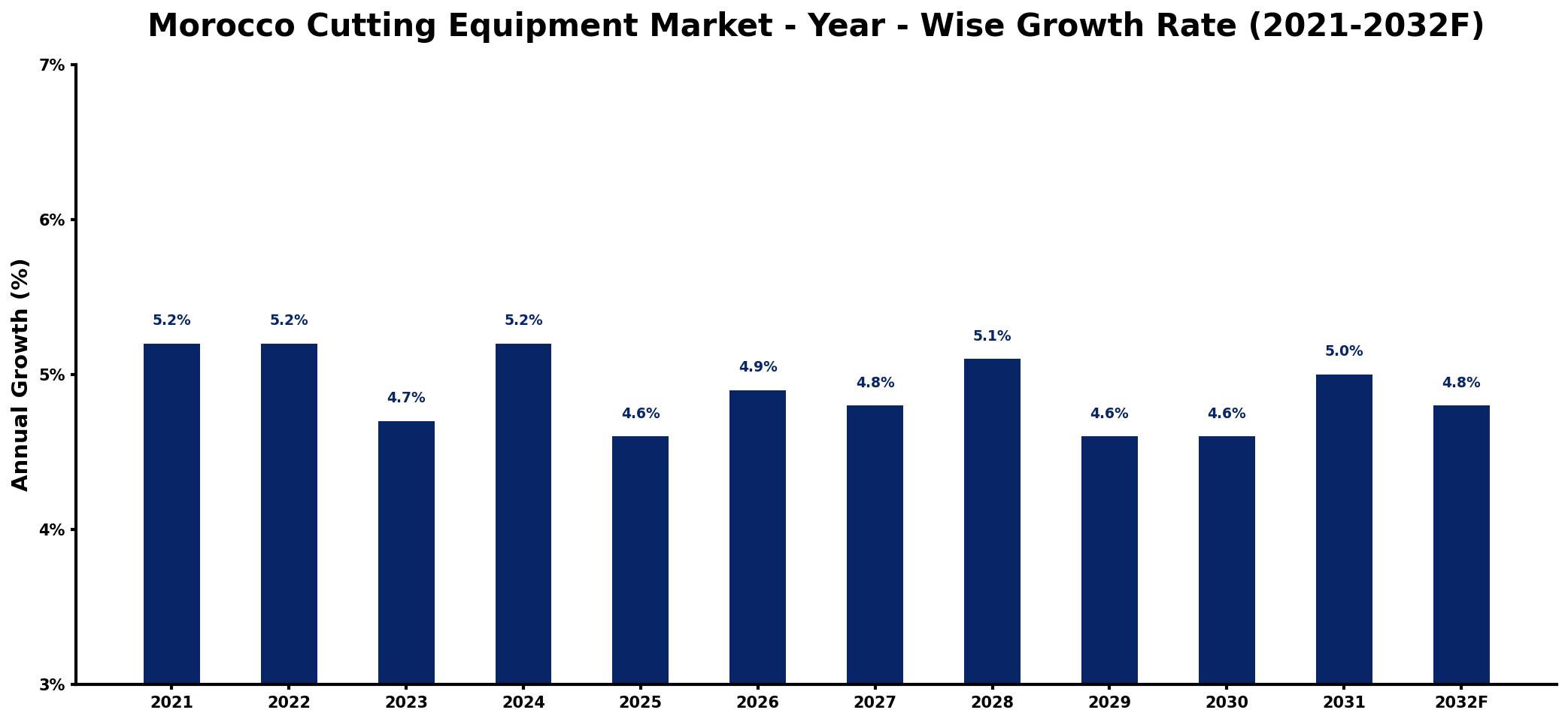
The table below presents the year‑wise growth rates along with the key drivers influencing the market
| Year | Growth Rate | Major Drivers |
| 2021 | 5.2% | Rising construction sector investments |
| 2022 | 5.2% | Growing demand for manufacturing solutions |
| 2023 | 4.7% | Technological advancements in production |
| 2024 | 5.2% | Expansion of renewable energy projects |
| 2025 | 4.6% | Increased automotive industry requirements |
| 2026 | 4.9% | Surge in local manufacturing initiatives |
| 2027 | 4.8% | Boost in infrastructure development projects |
| 2028 | 5.1% | rising infrastructure development spending |
| 2029 | 4.6% | Rising interest in automation technologies |
| 2030 | 4.6% | Investment in smart manufacturing facilities |
| 2031 | 5.0% | Emergence of new industrial applications |
| 2032 | 4.8% | expanding manufacturing base activity |
Note: Market size estimations and growth projections presented in this report are based on 6Wresearch's proprietary forecasting methodology, utilizing the latest available industry data, government publications, and primary research inputs.
Morocco Cutting Equipment Market Synopsis
In Morocco, the demand for cutting equipment is being driven by a surge in industrial activity, particularly in construction and automotive sectors. Companies are increasingly seeking to integrate precision cutting solutions to enhance their production capabilities while maintaining quality standards.
Technological advancements such as automation and digital integration are becoming essential components of the Moroccan manufacturing landscape. As industries strive to modernize their processes, there is a noticeable shift towards adopting cutting-edge machinery designed to boost productivity and operational performance.
Morocco Cutting Equipment Market Key Takeaways
- The market is on an upward trend, driven by enhanced manufacturing processes in key sectors.
- Technological innovations are facilitating a shift towards precision and automated cutting solutions.
- Government initiatives are supporting modernization in manufacturing through funding and training programs.
- Labor skill shortages present challenges to the widespread adoption of advanced cutting technologies.
- Subsidies for industrial machinery are helping businesses invest in essential cutting equipment.
Evaluation of Restraints in Morocco Cutting Equipment Market
Despite promising growth, the Morocco Cutting Equipment Market faces notable constraints. A significant barrier is the limited awareness among potential end-users regarding the benefits of advanced technologies such as CNC machines. This lack of familiarity often leads to hesitance in investment. Furthermore, the shortage of skilled labor necessary to operate sophisticated cutting equipment poses a considerable challenge. Companies must navigate not only these skill gaps but also regulatory compliance and financial constraints that can inhibit their ability to scale operations effectively.
Morocco Cutting Equipment Market Trends
The current trends within the Morocco Cutting Equipment Market indicate a growing shift towards digitization and automation. Businesses are increasingly investing in smart manufacturing technologies that utilize data analytics and artificial intelligence to optimize cutting processes. Furthermore, eco-friendly cutting solutions that reduce waste are gaining traction as industries become more environmentally conscious. This trend aligns with global sustainability goals and further influences purchasing decisions in the Moroccan market.
Morocco Cutting Equipment Market Opportunities
Genuine growth opportunities lie within the burgeoning sectors of automotive and aerospace manufacturing. As Morocco aims to enhance its position as a manufacturing hub, there is a distinct potential for cutting equipment suppliers to innovate and cater to emerging needs. Additionally, initiatives to establish training centers focusing on advanced cutting technologies could open doors for partnerships and expand the market reach for cutting equipment manufacturers.
Government Initiatives in the Morocco Cutting Equipment Market
Moroccan government policies are favorably inclined towards bolstering the cutting equipment market. Various initiatives, such as subsidies for industrial machinery purchases, aim to support the modernization of the manufacturing sector. Training programs are also being implemented to equip the workforce with essential skills for operating advanced cutting technologies, thereby encouraging a more efficient and competitive industrial landscape.
Future Insights of the Morocco Cutting Equipment Market
Looking ahead to 2026-2032, the Morocco Cutting Equipment Market is poised for robust expansion. The anticipated growth will be fueled by ongoing technological advancements, coupled with increased government support for industrial modernization. As manufacturers continue to prioritize efficiency and productivity, the demand for advanced cutting solutions is expected to rise. Furthermore, as the skills gap begins to close through targeted training initiatives, more industries will likely adopt sophisticated cutting technologies, paving the way for sustained market growth.
Morocco Cutting Equipment Market Latest Developments (2025 - 2026)
Recent developments in the Morocco Cutting Equipment Market indicate a heightened focus on integrating automation and data analytics into traditional cutting processes. Industry players are increasingly collaborating with technology firms to bring innovative solutions to market. Additionally, a growing number of training initiatives are being rolled out to address skill shortages, fostering a more knowledgeable workforce capable of handling advanced cutting technologies.
Morocco Cutting Equipment Market - Key Attractiveness of the Report
- 10 Years of Market Numbers
- Historical Data Starting from 2022 to 2025
- Base Year: 2025
- Forecast Data until 2032
- Key Performance Indicators Impacting the Market
- Major Upcoming Developments and Projects
Key Highlights of the Report:
- Morocco Cutting Equipment Market Outlook
- Market Size of Morocco Cutting Equipment Market, 2025
- Forecast of Morocco Cutting Equipment Market, 2032
- Historical Data and Forecast of Morocco Cutting Equipment Revenues & Volume for the Period 2022-2032F
- Morocco Cutting Equipment Market Trend Evolution
- Morocco Cutting Equipment Market Drivers and Challenges
- Morocco Cutting Equipment Price Trends
- Morocco Cutting Equipment Porter's Five Forces
- Morocco Cutting Equipment Industry Life Cycle
- Historical Data and Forecast of Morocco Cutting Equipment Market Revenues & Volume By Equipment Type for the Period 2022-2032F
- Historical Data and Forecast of Morocco Cutting Equipment Market Revenues & Volume By Manual for the Period 2022-2032F
- Historical Data and Forecast of Morocco Cutting Equipment Market Revenues & Volume By Mechanized for the Period 2022-2032F
- Historical Data and Forecast of Morocco Cutting Equipment Market Revenues & Volume By Cutting Technology for the Period 2022-2032F
- Historical Data and Forecast of Morocco Cutting Equipment Market Revenues & Volume By Plasma cutting for the Period 2022-2032F
- Historical Data and Forecast of Morocco Cutting Equipment Market Revenues & Volume By Oxy-fuel cutting for the Period 2022-2032F
- Historical Data and Forecast of Morocco Cutting Equipment Market Revenues & Volume By Laser cutting for the Period 2022-2032F
- Historical Data and Forecast of Morocco Cutting Equipment Market Revenues & Volume By Waterjet cutting for the Period 2022-2032F
- Historical Data and Forecast of Morocco Cutting Equipment Market Revenues & Volume By Carbon arc cutting for the Period 2022-2032F
- Historical Data and Forecast of Morocco Cutting Equipment Market Revenues & Volume By End Use Industry for the Period 2022-2032F
- Historical Data and Forecast of Morocco Cutting Equipment Market Revenues & Volume By Construction for the Period 2022-2032F
- Historical Data and Forecast of Morocco Cutting Equipment Market Revenues & Volume By Heavy metal fabrication for the Period 2022-2032F
- Historical Data and Forecast of Morocco Cutting Equipment Market Revenues & Volume By Shipbuilding & offshore for the Period 2022-2032F
- Historical Data and Forecast of Morocco Cutting Equipment Market Revenues & Volume By Automotive for the Period 2022-2032F
- Historical Data and Forecast of Morocco Cutting Equipment Market Revenues & Volume By Others for the Period 2022-2032F
- Historical Data and Forecast of Morocco Cutting Equipment Market Revenues & Volume By Type for the Period 2022-2032F
- Historical Data and Forecast of Morocco Cutting Equipment Market Revenues & Volume By Equipment for the Period 2022-2032F
- Historical Data and Forecast of Morocco Cutting Equipment Market Revenues & Volume By Consumables/Accessories for the Period 2022-2032F
- Morocco Cutting Equipment Import Export Trade Statistics
- Market Opportunity Assessment By Equipment Type
- Market Opportunity Assessment By Cutting Technology
- Market Opportunity Assessment By End Use Industry
- Market Opportunity Assessment By Type
- Morocco Cutting Equipment Top Companies Market Share
- Morocco Cutting Equipment Competitive Benchmarking By Technical and Operational Parameters
- Morocco Cutting Equipment Company Profiles
- Morocco Cutting Equipment Key Strategic Recommendations






































