Morocco Data Classification Market Size & Growth Rate (2026-2032)
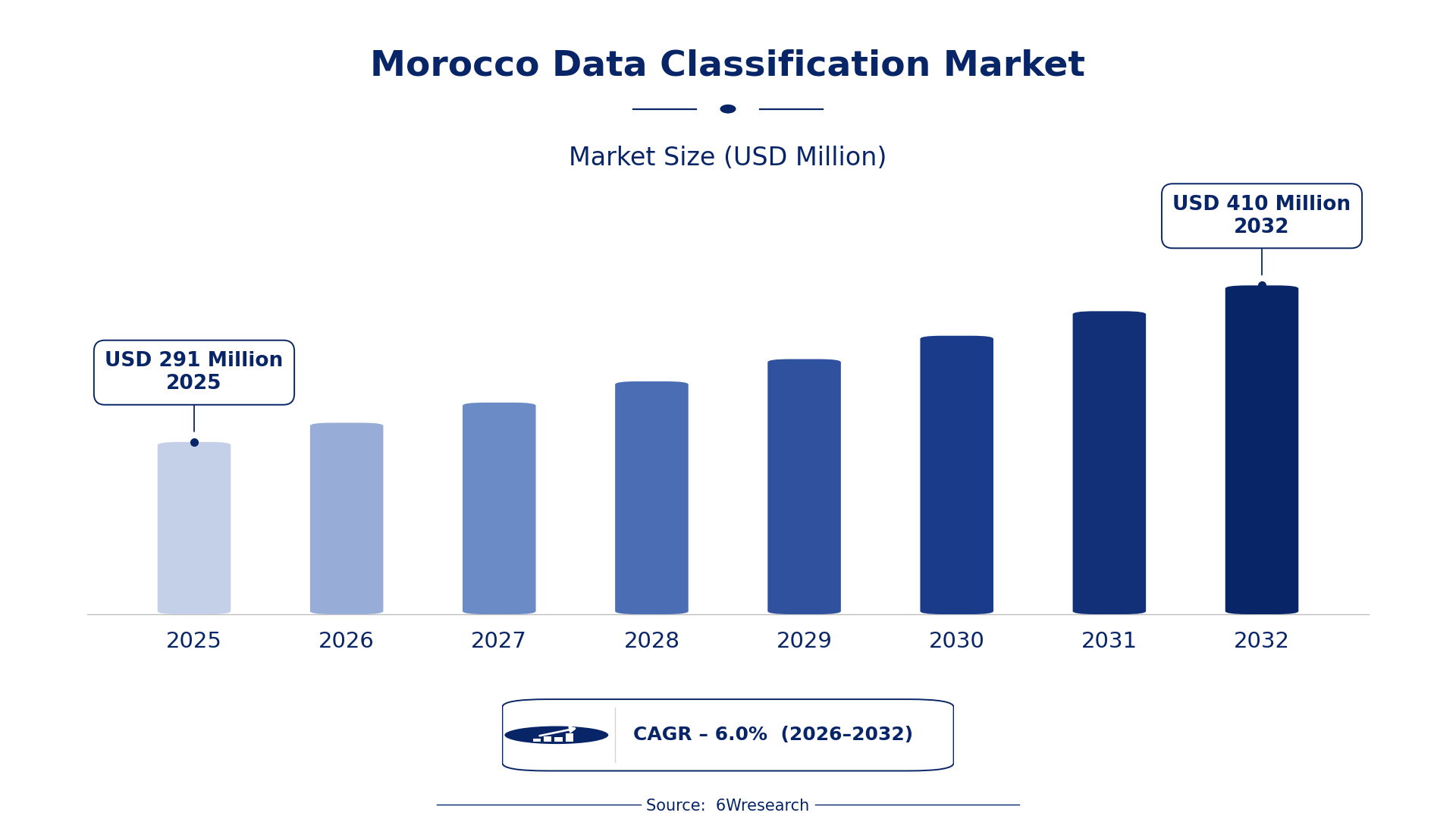
The Morocco Data Classification Market was estimated at USD 291 Million in 2025 and is projected to reach USD 410 Million by 2032, growing at a CAGR of 6.0% from 2026 to 2032.
Morocco Data Classification Market Synopsis
A primary force influencing the Morocco Data Classification Market is the surge in data volume and complexity. Organizations recognize the critical need to safeguard sensitive information while navigating increasing compliance mandates. This pressure is driving a shift towards robust data classification solutions.
Simultaneously, the challenges posed by diverse data types and regulatory frameworks complicate the classification process. Companies must invest significant resources in developing frameworks that accurately categorize their data. Achieving compliance with evolving regulations further intensifies the urgency for effective data classification strategies.
Morocco Data Classification Market Year-wise Growth Rate and Key Drivers
This graph illustrates the annual growth rates of the Morocco Data Classification Market from 2021 to 2032, highlighting a steady upward trajectory and projected expansion over the forecast period.
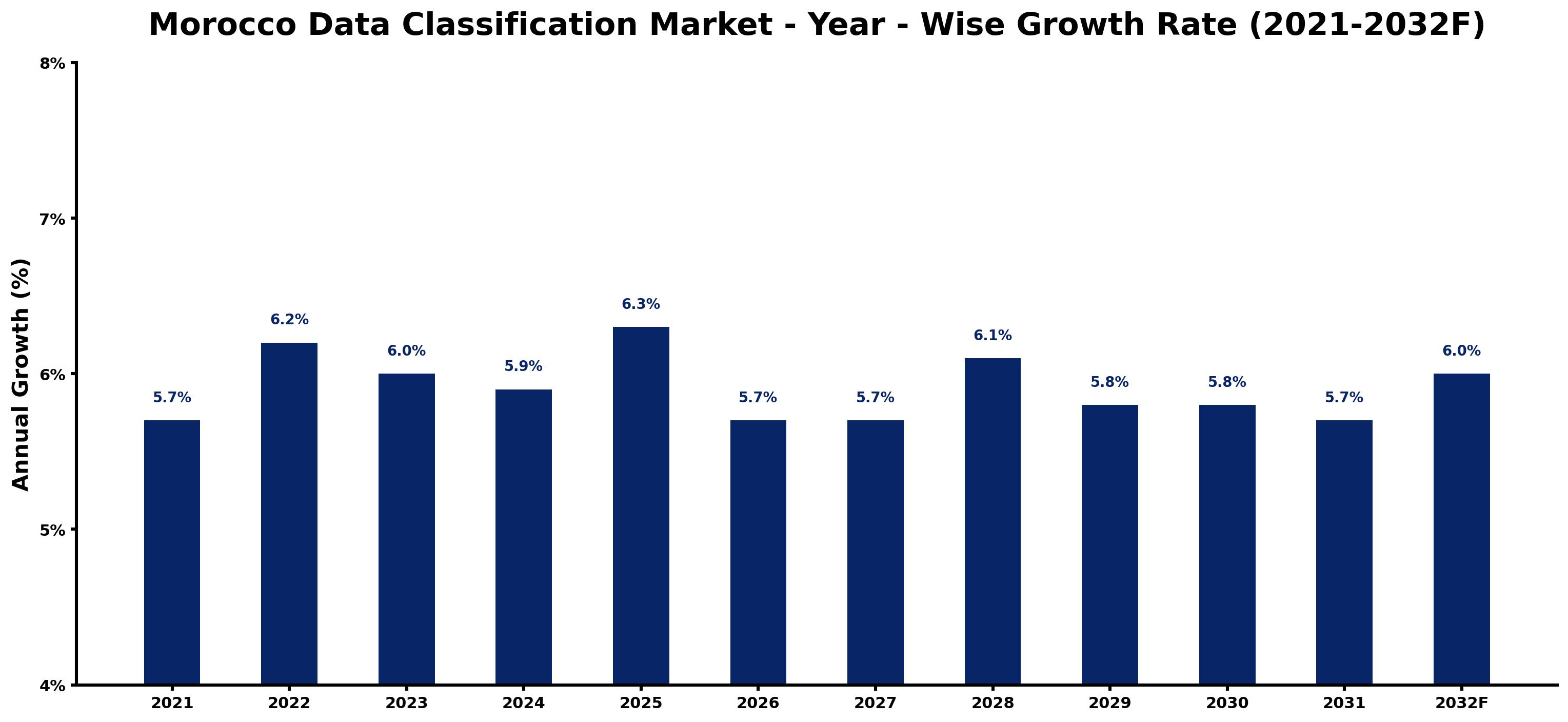
The table below presents the year‑wise growth rates along with the key drivers influencing the market
| Year | Growth Rate | Major Drivers |
| 2021 | 5.7% | Implementation of CNDP data protection guidelines enhances compliance. |
| 2022 | 6.2% | Rising awareness of personal data privacy among consumers. |
| 2023 | 6.0% | Adoption of cloud services drives demand for data governance. |
| 2024 | 5.9% | Growing digital economy necessitates robust data classification frameworks. |
| 2025 | 6.3% | Increased regulatory pressure on data breach penalties enhances interest. |
| 2026 | 5.7% | Boost in e-commerce sector requires better data management practices. |
| 2027 | 5.7% | National cybersecurity strategy emphasizes importance of data protection. |
| 2028 | 6.1% | Telecommunications reforms promote stronger data classification needs. |
| 2029 | 5.8% | Increasing foreign investment drives demand for secure data handling. |
| 2030 | 5.8% | Emergence of fintech companies necessitates advanced data classification. |
| 2031 | 5.7% | Growing number of digital services increases data compliance requirements. |
| 2032 | 6.0% | Government push for digital identity adoption boosts data confidence. |
Note: Market size estimations and growth projections presented in this report are based on 6Wresearch's proprietary forecasting methodology, utilizing the latest available industry data, government publications, and primary research inputs.
Morocco Data Classification Market Key Takeaways
Below are some of the specific key takeaways from the market, including:
- The demand for data classification solutions is spurred by stringent data privacy regulations.
- Companies face challenges in implementing efficient data classification frameworks due to the varied nature of data.
- Government policies increasingly emphasize the importance of data protection and classification methodologies.
- Investment in data management technologies is expected to rise as businesses adapt to compliance requirements.
- There is an emerging focus on integrating artificial intelligence to enhance data classification processes.
Evaluation of Restraints in Morocco Data Classification Market
Several factors limit growth in the Morocco Data Classification Market. One significant restraint is the lack of standardized classification frameworks across various sectors, which creates confusion and inconsistency in data management practices. Organizations must also grapple with the financial and operational costs associated with implementing comprehensive classification systems. on top of that, cultural perceptions around data privacy may hinder the adoption of more rigorous classification measures, as businesses navigate traditional practices versus modern compliance expectations.
Morocco Data Classification Market Trends
A notable trend is the increasing integration of automated solutions for data classification. Companies are investing in advanced technologies, such as machine learning algorithms, to streamline the categorization process. This shift not only improves efficiency but also minimizes the risk of human error in classification. Additionally, organizations are prioritizing data security training for employees, recognizing that effective classification goes hand in hand with a well-informed workforce. Growing collaboration between public and private sectors is another trend, as stakeholders seek to align on standards and protocols for data handling.
Morocco Data Classification Market Opportunities
The Morocco Data Classification Market presents substantial opportunities for growth, particularly in sectors like finance, healthcare, and education, where data privacy is paramount. Companies are looking to enhance their data governance frameworks to comply with international standards, creating demand for tailored classification solutions. on top of that, partnerships with local technology providers could facilitate the development of customized classification tools that address unique industry challenges. As data breaches become more prevalent, investing in security solutions that integrate data classification capabilities is increasingly seen as a necessity.
Government Initiatives in the Morocco Data Classification Market
The Moroccan government is actively shaping the data classification market by establishing clear regulatory frameworks aimed at bolstering data protection standards. Recent policies focus on promoting compliance with international data privacy laws while ensuring that local companies adopt efficient data classification practices. This governmental push not only fosters a safer data environment but also encourages investment in classification technologies.
- A national framework for data classification was introduced in late 2022, outlining compliance requirements for businesses handling sensitive information.
- Currently underway is a public awareness campaign aimed at educating businesses about the importance of data classification and compliance.
- Upcoming initiatives include a regulatory review slated for 2026, which will assess the effectiveness of existing classification standards and propose enhancements.
- New guidelines are being developed in collaboration with industry experts to establish a unified approach to data classification expected to be finalized by mid-2025.
Future Insights of the Morocco Data Classification Market
Looking ahead to 2026-2032, the Morocco Data Classification Market is expected to evolve significantly as regulatory pressures mount and data complexities increase. Organizations will prioritize the adoption of automated classification tools to enhance efficiency and compliance. The push for transparency and accountability in data handling will drive innovation, particularly in sectors handling vast amounts of sensitive data. As global standards become more integrated into local practices, Morocco's market will likely align more closely with international best practices, opening avenues for foreign investment and partnerships.
Morocco Data Classification Market Latest Developments
Recent months have seen various developments in the Morocco Data Classification Market as organizations adapt to a rapidly changing regulatory environment. Companies are exploring new technologies and partnerships to enhance their data management frameworks while meeting compliance demands.
- A major technology vendor launched a new data classification tool in early 2023, which leverages machine learning to categorize data more efficiently.
- Ongoing pilot projects initiated by government agencies aim to test new classification standards and compliance protocols in key sectors.
- In Q3 2023, a public-private partnership was established to promote best practices in data classification across small and medium enterprises.
- Plans are underway for a comprehensive training program designed to equip organizations with the knowledge needed to implement effective data classification practices, expected to roll out by early 2024.
Morocco Data Classification Market - Key Attractiveness of the Report
- 10 Years of Market Numbers
- Historical Data Starting from 2022 to 2025
- Base Year: 2025
- Forecast Data until 2032
- Key Performance Indicators Impacting the Market
- Major Upcoming Developments and Projects
Key Highlights of the Report:
- Morocco Data Classification Market Outlook
- Market Size of Morocco Data Classification Market, 2025
- Forecast of Morocco Data Classification Market, 2032
- Historical Data and Forecast of Morocco Data Classification Revenues & Volume for the Period 2022-2032F
- Morocco Data Classification Market Trend Evolution
- Morocco Data Classification Market Drivers and Challenges
- Morocco Data Classification Price Trends
- Morocco Data Classification Porter's Five Forces
- Morocco Data Classification Industry Life Cycle
- Historical Data and Forecast of Morocco Data Classification Market Revenues & Volume By Component for the Period 2022-2032F
- Historical Data and Forecast of Morocco Data Classification Market Revenues & Volume By Solutions (Standalone and Integrated) for the Period 2022-2032F
- Historical Data and Forecast of Morocco Data Classification Market Revenues & Volume By Services for the Period 2022-2032F
- Historical Data and Forecast of Morocco Data Classification Market Revenues & Volume By Application for the Period 2022-2032F
- Historical Data and Forecast of Morocco Data Classification Market Revenues & Volume By Access Control for the Period 2022-2032F
- Historical Data and Forecast of Morocco Data Classification Market Revenues & Volume By GRC for the Period 2022-2032F
- Historical Data and Forecast of Morocco Data Classification Market Revenues & Volume By Web for the Period 2022-2032F
- Historical Data and Forecast of Morocco Data Classification Market Revenues & Volume By Mobile & Email Protection for the Period 2022-2032F
- Historical Data and Forecast of Morocco Data Classification Market Revenues & Volume By Centralized Management for the Period 2022-2032F
- Historical Data and Forecast of Morocco Data Classification Market Revenues & Volume By Methodology for the Period 2022-2032F
- Historical Data and Forecast of Morocco Data Classification Market Revenues & Volume By Content-based Classification for the Period 2022-2032F
- Historical Data and Forecast of Morocco Data Classification Market Revenues & Volume By Context-based Classification for the Period 2022-2032F
- Historical Data and Forecast of Morocco Data Classification Market Revenues & Volume By User-based Classification for the Period 2022-2032F
- Historical Data and Forecast of Morocco Data Classification Market Revenues & Volume By Vertical for the Period 2022-2032F
- Historical Data and Forecast of Morocco Data Classification Market Revenues & Volume By BFSI for the Period 2022-2032F
- Historical Data and Forecast of Morocco Data Classification Market Revenues & Volume By Healthcare and Lifesciences for the Period 2022-2032F
- Historical Data and Forecast of Morocco Data Classification Market Revenues & Volume By Government and Defense for the Period 2022-2032F
- Historical Data and Forecast of Morocco Data Classification Market Revenues & Volume By Education for the Period 2022-2032F
- Historical Data and Forecast of Morocco Data Classification Market Revenues & Volume By Telecom for the Period 2022-2032F
- Historical Data and Forecast of Morocco Data Classification Market Revenues & Volume By Media and Entertainment for the Period 2022-2032F
- Historical Data and Forecast of Morocco Data Classification Market Revenues & Volume By Others (Retail and Ecommerce, Manufacturing, and Energy and Utilities) for the Period 2022-2032F
- Morocco Data Classification Import Export Trade Statistics
- Market Opportunity Assessment By Component
- Market Opportunity Assessment By Application
- Market Opportunity Assessment By Methodology
- Market Opportunity Assessment By Vertical
- Morocco Data Classification Top Companies Market Share
- Morocco Data Classification Competitive Benchmarking By Technical and Operational Parameters
- Morocco Data Classification Company Profiles
- Morocco Data Classification Key Strategic Recommendations






































