Morocco Data Protection Market Size & Growth Rate (2026-2032)
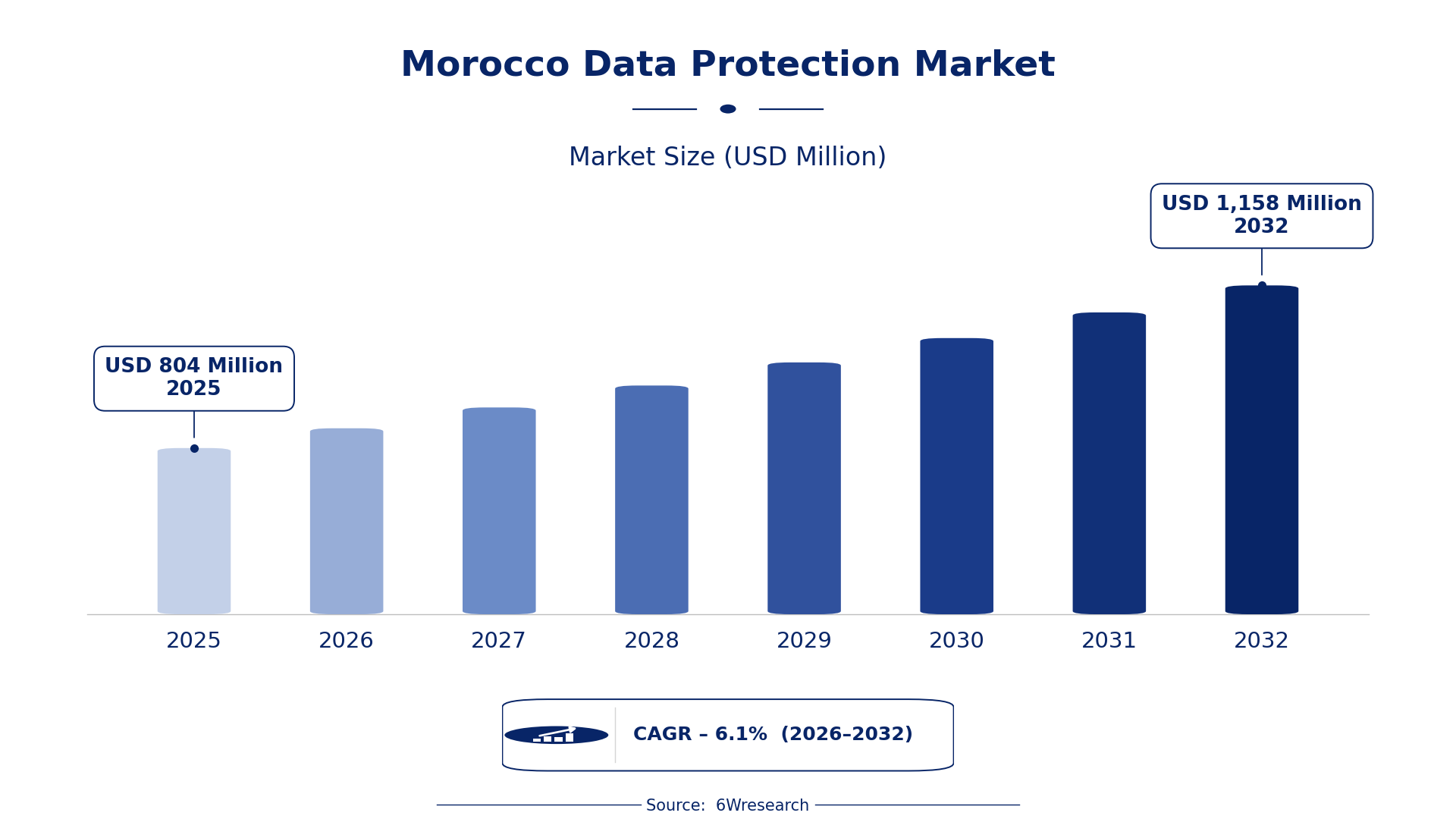
The Morocco Data Protection Market was estimated at USD 804 Million in 2025 and is projected to reach USD 1158 Million by 2032, growing at a CAGR of 6.1% from 2026 to 2032.
Morocco Data Protection Market Synopsis
The increasing dependence of Moroccan businesses on digital technologies has intensified the demand for robust data protection solutions. Organizations are investing heavily in encryption, backup, and disaster recovery to maintain data integrity and compliance amidst rising cyber threats.
Cybersecurity threats, including data breaches and ransomware attacks, have compelled organizations to adopt comprehensive data protection strategies. The push for compliance with international standards further accelerates the need for innovative solutions that safeguard sensitive information from unauthorized access and potential corruption.
Morocco Data Protection Market Year-wise Growth Rate and Key Drivers
This graph illustrates the annual growth rates of the Morocco Data Protection Market from 2021 to 2032, highlighting a steady upward trajectory and projected expansion over the forecast period.
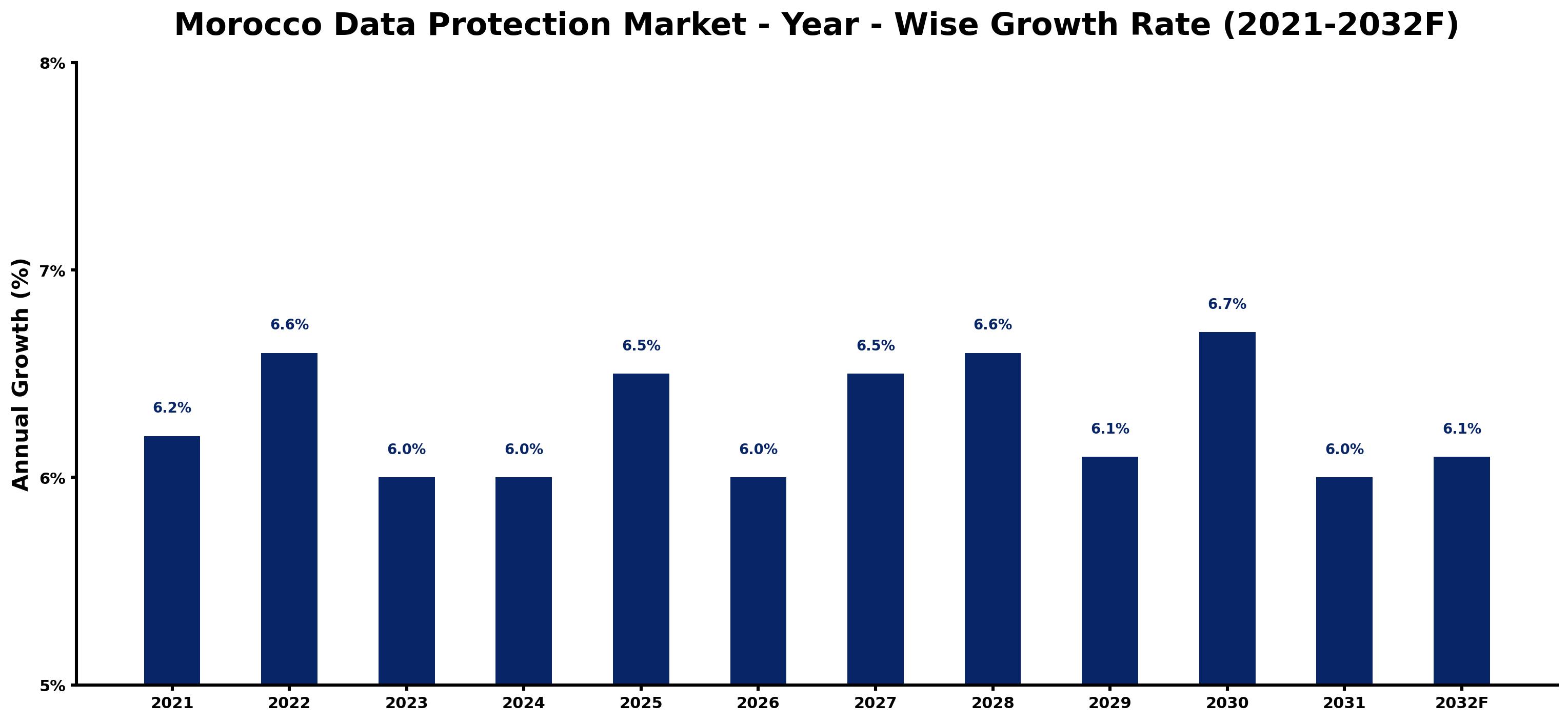
The table below presents the year‑wise growth rates along with the key drivers influencing the market
| Year | Growth Rate | Major Drivers |
| 2021 | 6.2% | CNDP enforcing stricter data protection regulations. |
| 2022 | 6.6% | Increased smartphone adoption boosting digital data usage. |
| 2023 | 6.0% | Emergence of local cybersecurity firms enhancing market resilience. |
| 2024 | 6.0% | Growing consumer trust in online services requiring data protection. |
| 2025 | 6.5% | Retail sector digitization driving data security investments. |
| 2026 | 6.0% | E-commerce growth necessitating robust data protection measures. |
| 2027 | 6.5% | National cybersecurity strategy prioritizing data governance reforms. |
| 2028 | 6.6% | Collaborations between firms and CNDP for compliance assistance. |
| 2029 | 6.1% | Education sector adopting e-learning, intensifying data protection needs. |
| 2030 | 6.7% | Rising social media usage leading to increased data concerns. |
| 2031 | 6.0% | Healthcare digitization driving demand for patient data security. |
| 2032 | 6.1% | Financial sector innovation necessitating enhanced data protection protocols. |
Note: Market size estimations and growth projections presented in this report are based on 6Wresearch's proprietary forecasting methodology, utilizing the latest available industry data, government publications, and primary research inputs.
Morocco Data Protection Market Key Takeaways
Below are some of the specific key takeaways from the market, including:
- Substantial investments in encryption and access controls are shaping the future of data protection.
- Growing regulatory pressures are driving the adoption of data loss prevention technologies.
- Organizations are increasingly focusing on comprehensive data security frameworks to mitigate insider threats.
- Emerging technologies, such as artificial intelligence, are being integrated into data protection measures.
- Partnerships with cybersecurity firms are common as organizations seek advanced threat detection capabilities.
Evaluation of Restraints in Morocco Data Protection Market
Despite its growth, the Morocco Data Protection Market faces significant obstacles. Organizations struggle to keep pace with rapidly evolving cyber threats while ensuring compliance with stringent regulations. Inconsistent data protection across different environments—endpoints, networks, and cloud—poses a critical challenge. on top of that, the threat of insider attacks and human error complicates the already demanding task of safeguarding sensitive data, demanding a reevaluation of existing strategies.
Morocco Data Protection Market Trends
Several trends are influencing the direction of the data protection market in Morocco. The adoption of advanced encryption technologies is becoming a priority for organizations looking to secure sensitive data. Additionally, artificial intelligence and machine learning are playing an increasingly vital role in threat detection and response strategies. Businesses are also prioritizing employee training programs to reduce the risk of human error, which remains a significant vulnerability in data protection.
Morocco Data Protection Market Opportunities
The Morocco Data Protection Market is ripe with growth opportunities. The burgeoning small and medium enterprise (SME) sector is increasingly recognizing the need for data protection, creating a significant demand for tailored solutions. Public-private partnerships in cybersecurity can facilitate innovation and provide the financial resources necessary for advanced data protection technologies. on top of that, the increasing emphasis on digital transformation in various sectors serves as a catalyst for investment in data security.
Government Initiatives in the Morocco Data Protection Market
The Moroccan government is actively shaping the data protection market through various initiatives aimed at enhancing cybersecurity resilience. With increasing awareness of data privacy issues, policies are being introduced to enforce stringent data protection regulations across industries. Such governmental actions are crucial for fostering a secure digital environment and promoting public confidence in the handling of personal data.
- A new regulatory framework was implemented in late 2025 mandating stronger encryption measures for businesses handling sensitive data.
- Currently ongoing initiatives include the establishment of a national cybersecurity awareness program targeting both enterprises and the general public.
- A planned public-private partnership is expected to launch in 2027, focusing on enhancing data protection technologies across critical sectors.
- In 2026, the government will initiate a review of existing data protection laws to align with international standards.
- A cybersecurity skills development program is set to begin in mid-2026, aiming to train professionals in advanced data protection practices.
Future Insights of the Morocco Data Protection Market
Between 2026 and 2032, the Morocco Data Protection Market is expected to undergo significant transformation. With ongoing regulatory changes and an increasing focus on cybersecurity, organizations will likely prioritize comprehensive data protection strategies. The integration of emerging technologies, such as AI and blockchain, into data protection measures will enhance security and compliance capabilities. As the digital economy expands, the need for scalable and effective data protection solutions will remain critical.
Morocco Data Protection Market Latest Developments
Recent months have seen heightened activity in the Morocco Data Protection Market, with organizations prioritizing enhanced security protocols and compliance measures. The urgency for data protection solutions has prompted partnerships among businesses and cybersecurity providers to address the increasing threats.
- A major technology vendor launched a new encryption solution in early 2025 designed specifically for the local market.
- In mid-2025, a collaborative initiative between several regional companies was established to enhance threat detection capabilities.
- A recently completed upgrade of a national data protection framework was announced in late 2025, improving regulatory compliance across various sectors.
- Current projects include a pilot program for cloud-based data loss prevention services that began in early 2026 and continues to expand.
- A new partnership between local firms and international cybersecurity experts is expected to be formalized by the end of 2026, focusing on innovative data protection strategies.
Morocco Data Protection Market - Key Attractiveness of the Report
- 10 Years of Market Numbers
- Historical Data Starting from 2022 to 2025
- Base Year: 2025
- Forecast Data until 2032
- Key Performance Indicators Impacting the Market
- Major Upcoming Developments and Projects
Key Highlights of the Report:
- Morocco Data Protection Market Outlook
- Market Size of Morocco Data Protection Market, 2025
- Forecast of Morocco Data Protection Market, 2032
- Historical Data and Forecast of Morocco Data Protection Revenues & Volume for the Period 2022-2032F
- Morocco Data Protection Market Trend Evolution
- Morocco Data Protection Market Drivers and Challenges
- Morocco Data Protection Price Trends
- Morocco Data Protection Porter's Five Forces
- Morocco Data Protection Industry Life Cycle
- Historical Data and Forecast of Morocco Data Protection Market Revenues & Volume By Component for the Period 2022-2032F
- Historical Data and Forecast of Morocco Data Protection Market Revenues & Volume By Solutions for the Period 2022-2032F
- Historical Data and Forecast of Morocco Data Protection Market Revenues & Volume By Services (Professional Services and Managed Services) for the Period 2022-2032F
- Historical Data and Forecast of Morocco Data Protection Market Revenues & Volume By Deployment Mode for the Period 2022-2032F
- Historical Data and Forecast of Morocco Data Protection Market Revenues & Volume By On-premises for the Period 2022-2032F
- Historical Data and Forecast of Morocco Data Protection Market Revenues & Volume By Cloud for the Period 2022-2032F
- Historical Data and Forecast of Morocco Data Protection Market Revenues & Volume By Industry Vertical for the Period 2022-2032F
- Historical Data and Forecast of Morocco Data Protection Market Revenues & Volume By Government and defense for the Period 2022-2032F
- Historical Data and Forecast of Morocco Data Protection Market Revenues & Volume By Banking, Financial Services, and Insurance (BFSI) for the Period 2022-2032F
- Historical Data and Forecast of Morocco Data Protection Market Revenues & Volume By Healthcare for the Period 2022-2032F
- Historical Data and Forecast of Morocco Data Protection Market Revenues & Volume By IT and telecom for the Period 2022-2032F
- Historical Data and Forecast of Morocco Data Protection Market Revenues & Volume By Consumer goods and retail for the Period 2022-2032F
- Historical Data and Forecast of Morocco Data Protection Market Revenues & Volume By Education for the Period 2022-2032F
- Historical Data and Forecast of Morocco Data Protection Market Revenues & Volume By Media and entertainment for the Period 2022-2032F
- Historical Data and Forecast of Morocco Data Protection Market Revenues & Volume By Organization Size Large Enterprises for the Period 2022-2032F
- Historical Data and Forecast of Morocco Data Protection Market Revenues & Volume By SMEs for the Period 2022-2032F
- Historical Data and Forecast of Morocco Data Protection Market Revenues & Volume By Large Enterprises for the Period 2022-2032F
- Morocco Data Protection Import Export Trade Statistics
- Market Opportunity Assessment By Component
- Market Opportunity Assessment By Deployment Mode
- Market Opportunity Assessment By Industry Vertical
- Market Opportunity Assessment By Organization Size Large Enterprises
- Morocco Data Protection Top Companies Market Share
- Morocco Data Protection Competitive Benchmarking By Technical and Operational Parameters
- Morocco Data Protection Company Profiles
- Morocco Data Protection Key Strategic Recommendations






































