Morocco Digital Lending Market Size & Growth Rate (2026-2032)
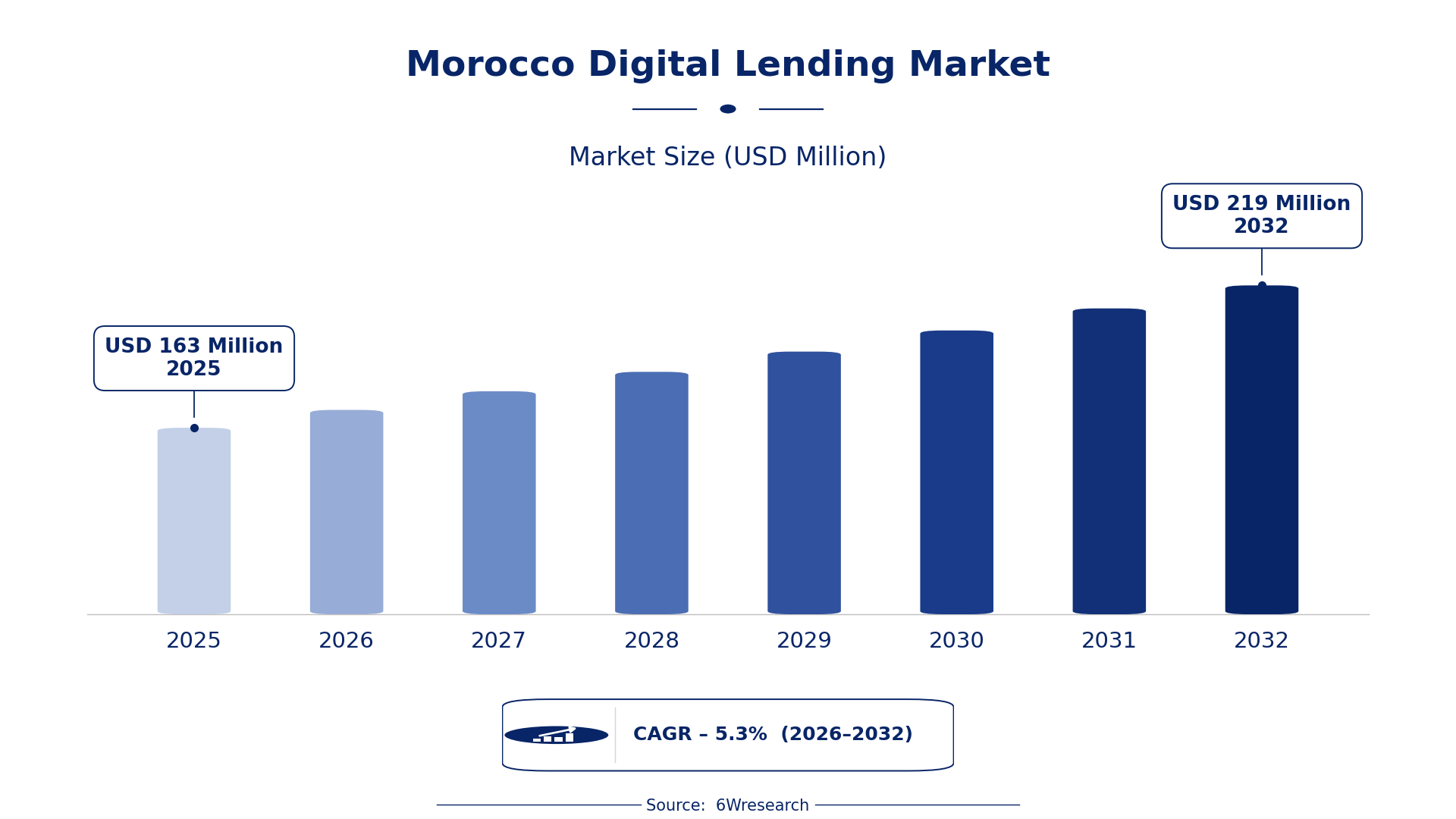
The Morocco Digital Lending Market was estimated at USD 163 Million in 2025 and is projected to reach USD 219 Million by 2032, growing at a CAGR of 5.3% from 2026 to 2032.
Morocco Digital Lending Market Synopsis
The surge in smartphone adoption and internet connectivity is the strongest force shaping the Morocco Digital Lending Market today. As consumers increasingly seek convenient and quick access to credit, fintech companies and traditional banks are responding with tailored digital lending solutions.
Regulatory reforms aimed at enhancing financial inclusion are further propelling the market's growth. The Moroccan government is actively encouraging innovation while ensuring consumer protection, creating an environment conducive to the expansion of digital financial services.
Morocco Digital Lending Market Year-wise Growth Rate and Key Drivers
This graph illustrates the annual growth rates of the Morocco Digital Lending Market from 2021 to 2032, highlighting a steady upward trajectory and projected expansion over the forecast period.
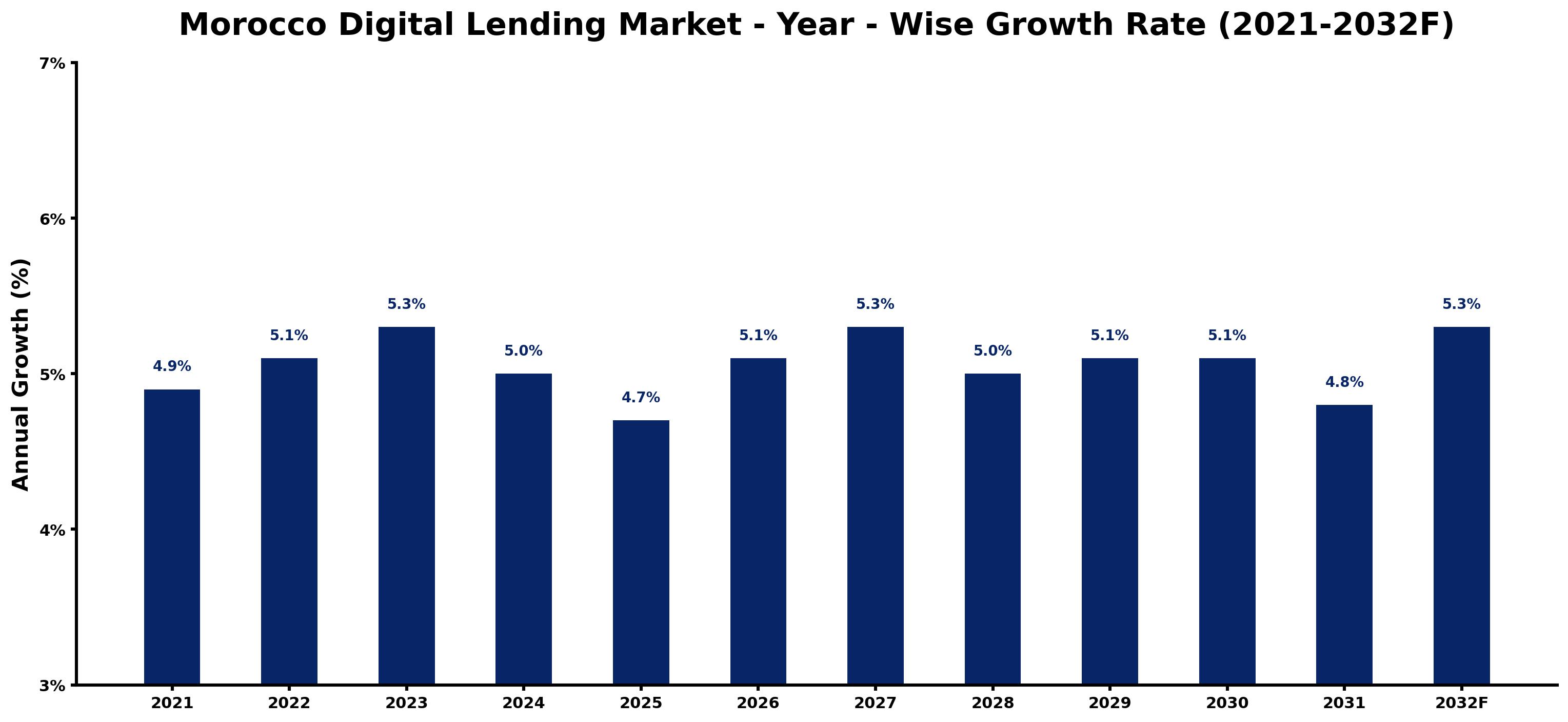
The table below presents the year‑wise growth rates along with the key drivers influencing the market
| Year | Growth Rate | Major Drivers |
| 2021 | 4.9% | Government's push for financial inclusion initiatives. |
| 2022 | 5.1% | Rising fintech adoption among Moroccan millennials. |
| 2023 | 5.3% | New regulations supporting digital credit product innovations. |
| 2024 | 5.0% | Increased focus on mobile app user experience. |
| 2025 | 4.7% | Growth in e-commerce driving personal loan demand. |
| 2026 | 5.1% | Emergence of alternative credit scoring models. |
| 2027 | 5.3% | Government grants promoting digital banking solutions. |
| 2028 | 5.0% | Consumer preference for quick online loan approvals. |
| 2029 | 5.1% | Partnerships between banks and fintech startups increasing access. |
| 2030 | 5.1% | Strengthening consumer protection laws for digital lenders. |
| 2031 | 4.8% | Rising financial literacy programs enhancing digital lending understanding. |
| 2032 | 5.3% | Increased cyber security measures boosting consumer trust. |
Note: Market size estimations and growth projections presented in this report are based on 6Wresearch's proprietary forecasting methodology, utilizing the latest available industry data, government publications, and primary research inputs.
Morocco Digital Lending Market Key Takeaways
Below are some of the specific key takeaways from the market, including:
- The market is expanding rapidly due to increased smartphone and internet penetration.
- Fintech innovations are disrupting traditional banking, offering competitive products.
- Government initiatives focus on promoting financial inclusion and consumer protection.
- Partnerships between fintechs and banks are emerging as a key trend.
- Challenges in credit assessment and consumer trust need to be addressed for growth.
Evaluation of Restraints in Morocco Digital Lending Market
Despite the promising growth trajectory, the Morocco Digital Lending Market faces notable restraints. A significant barrier is the limited access to comprehensive credit information and scoring systems, which hampers lenders' ability to evaluate potential borrowers accurately. on top of that, regulatory compliance can be cumbersome for digital platforms. Low consumer awareness and trust in digital lending, coupled with entrenched informal lending practices, also impede market expansion. Addressing these issues will require concerted efforts from regulators and industry stakeholders.
Morocco Digital Lending Market Trends
Current trends indicate a shift towards personalized lending products, driven by data analytics and artificial intelligence. Fintech companies are utilizing advanced technologies to streamline loan processes and improve credit assessments. There's also a growing demand for mobile payment solutions and digital wallets, which facilitate quicker transactions and enhance user experience. As more Moroccans become tech-savvy, the market is witnessing a shift towards online platforms for financial services.
Morocco Digital Lending Market Opportunities
The Morocco Digital Lending Market offers several growth and investment opportunities. The collaboration between fintechs and traditional banks can enhance service delivery and reach underserved populations. Additionally, innovative credit scoring models can help lenders make better-informed decisions. Expanding digital lending services into rural areas presents a significant opportunity, as these regions often lack access to traditional banking services. As awareness of digital financial services grows, the market is likely to attract more players and investments.
Government Initiatives in the Morocco Digital Lending Market
The Moroccan government is actively shaping the digital lending market through a variety of regulatory and policy initiatives. These efforts are aimed at promoting financial inclusion while ensuring consumer protection and sector stability. By establishing a clear regulatory framework, the government is fostering a competitive environment that encourages innovation and collaboration.
- A regulatory framework established in 2023 mandates licensing requirements and interest rate caps for digital lending platforms.
- Currently underway is a national campaign aimed at increasing financial literacy among underserved populations, promoting awareness of digital lending services.
- A planned public-private initiative expected to launch in 2025 aims to expand digital infrastructure access across rural regions.
- Recent reforms in 2024 focused on enhancing consumer protection measures in the digital lending space.
- Ongoing collaboration between the Central Bank and fintech companies to improve data-sharing practices for better credit assessment.
Future Insights of the Morocco Digital Lending Market
Looking ahead, the Morocco Digital Lending Market is set for dynamic growth from 2026 to 2032. The increasing adoption of digital financial services is expected to drive demand for faster and more accessible credit solutions. The government’s commitment to fostering financial inclusion will further support the market's expansion. As consumer behaviors shift towards online transactions and digital solutions, the landscape for digital lending will continue to evolve, presenting new opportunities for growth.
Morocco Digital Lending Market Latest Developments
Over the past year, the Morocco Digital Lending Market has seen notable activity, with various fintech firms and traditional banks launching new initiatives to enhance their service offerings. This momentum reflects a broader trend of increasing digital adoption and innovation in the financial sector.
- A major regional fintech firm launched a new mobile app in early 2025, streamlining the loan application process for consumers.
- In Q1 2025, a collaborative initiative between banks and fintech companies began to enhance the security of digital lending platforms.
- A product offering that includes flexible repayment plans was rolled out by a leading bank in late 2024 to attract younger borrowers.
- A new partnership between a fintech and a telecom operator is currently underway, aimed at integrating mobile payment solutions to facilitate digital lending.
- A planned rollout of enhanced credit scoring technology is expected to begin in early 2026, aimed at improving lending accuracy.
Morocco Digital Lending Market - Key Attractiveness of the Report
- 10 Years of Market Numbers
- Historical Data Starting from 2022 to 2025
- Base Year: 2025
- Forecast Data until 2032
- Key Performance Indicators Impacting the Market
- Major Upcoming Developments and Projects
Key Highlights of the Report:
- Morocco Digital Lending Market Outlook
- Market Size of Morocco Digital Lending Market, 2025
- Forecast of Morocco Digital Lending Market, 2032
- Historical Data and Forecast of Morocco Digital Lending Revenues & Volume for the Period 2022-2032F
- Morocco Digital Lending Market Trend Evolution
- Morocco Digital Lending Market Drivers and Challenges
- Morocco Digital Lending Price Trends
- Morocco Digital Lending Porter's Five Forces
- Morocco Digital Lending Industry Life Cycle
- Historical Data and Forecast of Morocco Digital Lending Market Revenues & Volume By Offering for the Period 2022-2032F
- Historical Data and Forecast of Morocco Digital Lending Market Revenues & Volume By Solutions for the Period 2022-2032F
- Historical Data and Forecast of Morocco Digital Lending Market Revenues & Volume By Services for the Period 2022-2032F
- Historical Data and Forecast of Morocco Digital Lending Market Revenues & Volume By Deployment Mode for the Period 2022-2032F
- Historical Data and Forecast of Morocco Digital Lending Market Revenues & Volume By Cloud for the Period 2022-2032F
- Historical Data and Forecast of Morocco Digital Lending Market Revenues & Volume By On-premises for the Period 2022-2032F
- Historical Data and Forecast of Morocco Digital Lending Market Revenues & Volume By End User for the Period 2022-2032F
- Historical Data and Forecast of Morocco Digital Lending Market Revenues & Volume By Banks for the Period 2022-2032F
- Historical Data and Forecast of Morocco Digital Lending Market Revenues & Volume By Credit Unions for the Period 2022-2032F
- Historical Data and Forecast of Morocco Digital Lending Market Revenues & Volume By NBFCs for the Period 2022-2032F
- Morocco Digital Lending Import Export Trade Statistics
- Market Opportunity Assessment By Offering
- Market Opportunity Assessment By Deployment Mode
- Market Opportunity Assessment By End User
- Morocco Digital Lending Top Companies Market Share
- Morocco Digital Lending Competitive Benchmarking By Technical and Operational Parameters
- Morocco Digital Lending Company Profiles
- Morocco Digital Lending Key Strategic Recommendations






































