Morocco Donkey Milk Market Size, Share & Growth Rate
The Morocco Donkey Milk Market was estimated at USD 1181 Million in 2025 and is projected to reach USD 1704 Million by 2032, growing at a CAGR of 5.4% from 2026 to 2032. This growth trajectory is largely fueled by increasing consumer awareness surrounding the health benefits of donkey milk, particularly its nutritional profile rich in proteins, vitamins, and minerals. As demand for natural and organic products continues to rise, the production of donkey milk-based offerings, especially within the beauty sector, is expected to gain traction, pushing the market forward.
Morocco Donkey Milk Market Year-wise Growth Rate and Key Drivers
This graph highlights how the Morocco Donkey Milk Market has steadily grown over the years, supported by major growth factors.
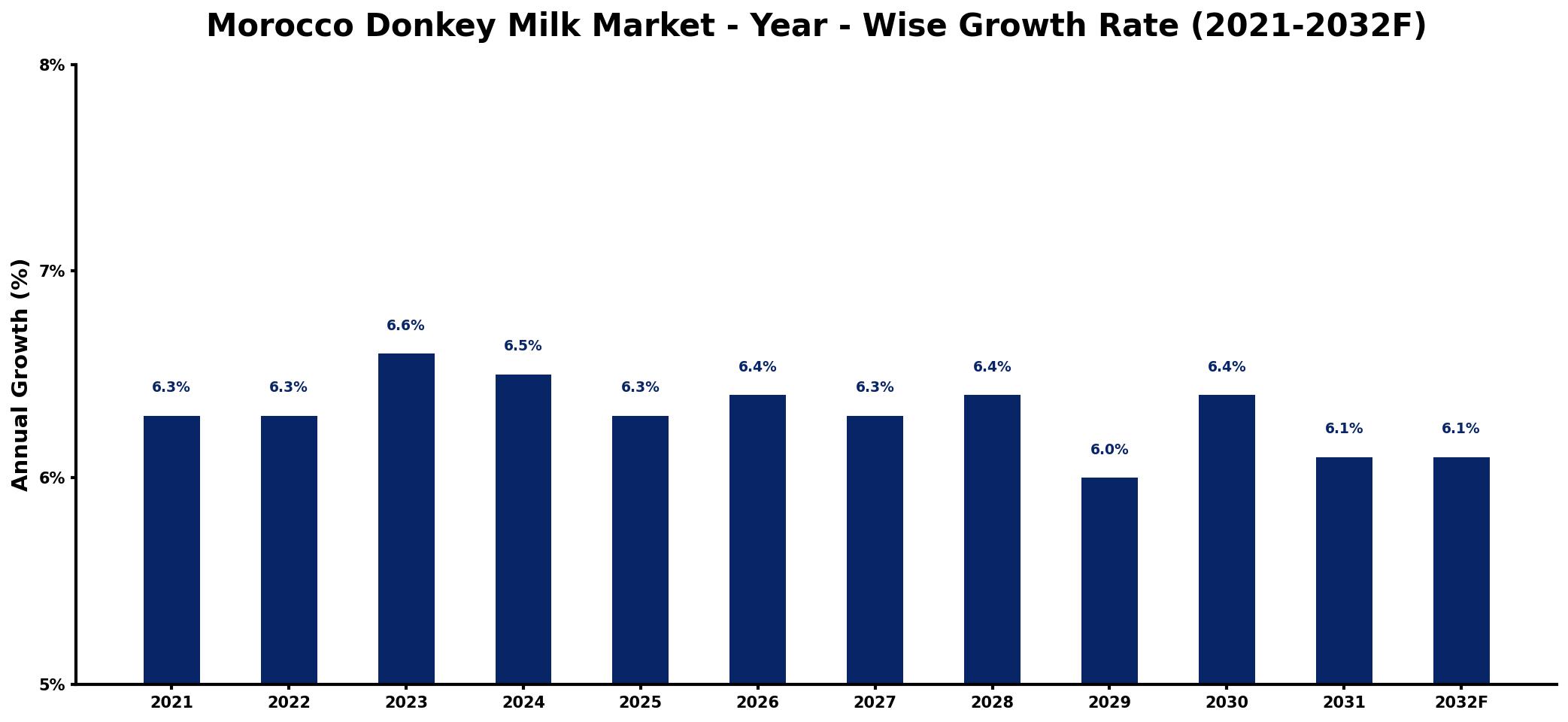
The table below presents the year‑wise growth rates along with the key drivers influencing the market
| Year | Growth Rate | Major Drivers |
| 2021 | 6.3% | Growing interest in natural products |
| 2022 | 6.3% | Increased health awareness among consumers |
| 2023 | 6.6% | Rising popularity of alternative nutrition |
| 2024 | 6.5% | Expansion of wellness industry offerings |
| 2025 | 6.3% | Higher investments in organic farming |
| 2026 | 6.4% | Broader distribution channels emerging |
| 2027 | 6.3% | Increased consumer education initiatives |
| 2028 | 6.4% | Surge in online shopping platforms |
| 2029 | 6.0% | Growth in niche market segments |
| 2030 | 6.4% | Enhanced product diversity available |
| 2031 | 6.1% | Strengthened partnerships with retailers |
| 2032 | 6.1% | Continued innovation in health supplements |
Note: Market size estimations and growth projections presented in this report are based on 6Wresearch's proprietary forecasting methodology, utilizing the latest available industry data, government publications, and primary research inputs.
Morocco Donkey Milk Market Synopsis
The strongest force shaping the Morocco Donkey Milk Market is the burgeoning consumer interest in natural skincare solutions. Increasingly, consumers are gravitating toward products that prioritize both efficacy and environmental sustainability, a trend that donkey milk is uniquely positioned to satisfy.
This heightened awareness of donkey milk's numerous benefits, especially in the cosmetic industry, has resulted in a steady influx of donkey milk-infused products. The growing emphasis on clean beauty practices has further solidified the market's foundations, attracting both seasoned brands and innovative newcomers.
Morocco Donkey Milk Market Key Takeaways
- The market is experiencing steady growth driven by the rising popularity of natural and organic skincare products.
- Donkey milk is increasingly recognized for its rich nutritional benefits and suitability for sensitive skin.
- Production challenges and regulatory issues pose hurdles that the industry must navigate for sustainable growth.
- Investment opportunities are burgeoning, particularly in donkey milk farms and product development.
- Government policies are geared toward promoting quality standards while safeguarding animal welfare.
Evaluation of Restraints in Morocco Donkey Milk Market
Despite its potential, the Morocco Donkey Milk Market faces significant restraints that could limit its growth. A primary challenge lies in the limited consumer awareness regarding the benefits of donkey milk, which often results in hesitancy among potential buyers. Additionally, the production process can be both labor-intensive and costly, which can affect market accessibility and affordability. Regulatory frameworks surrounding hygiene and animal welfare add another layer of complexity, necessitating robust compliance mechanisms. Addressing these challenges will require a concerted effort to educate the market, streamline production practices, and bolster distribution channels.
Morocco Donkey Milk Market Trends
Current trends in the Morocco Donkey Milk Market are markedly influenced by the clean beauty movement, which emphasizes the use of natural and sustainable ingredients. More beauty brands are incorporating donkey milk into their formulations, capitalizing on its moisturizing and anti-aging properties. Theres also an emerging trend toward creating donkey milk supplements and functional foods as consumers seek holistic health solutions. Furthermore, eco-conscious consumers are increasingly prioritizing brands that align with ethical and sustainable practices, giving donkey milk a unique market position.
Morocco Donkey Milk Market Opportunities
The Morocco Donkey Milk Market is rife with investment opportunities as consumer demand for natural beauty products continues to soar. Investors can explore opportunities in developing donkey milk farms or expanding production facilities, capitalizing on Moroccos favorable climate for donkey breeding. Moreover, forging partnerships with beauty brands to incorporate donkey milk into their product lines can provide lucrative avenues for growth. The alignment with sustainable and cruelty-free production methods also represents a compelling value proposition for stakeholders looking to enter this burgeoning market.
Government Initiatives in the Morocco Donkey Milk Market
Government initiatives play a critical role in the development of the Morocco Donkey Milk Market. The Moroccan government has implemented regulatory frameworks to ensure the quality and safety of donkey milk products, which includes setting production standards and labeling guidelines. Programs designed to protect the welfare of donkeys during the milk extraction process underscore a commitment to ethical practices. Additionally, the government supports research aimed at enhancing the efficiency and sustainability of donkey milk production, thereby facilitating market expansion while prioritizing both consumer health and animal welfare.
Future Insights of the Morocco Donkey Milk Market
Looking ahead to 2026-2032, the Morocco Donkey Milk Market is poised for significant advancements driven by rising consumer awareness and an increasing preference for natural ingredients. As the demand for donkey milk products—especially in the beauty and wellness sectors—continues to escalate, companies will likely innovate to meet these needs. Additionally, Moroccos growing tourism sector, where donkey milk is traditionally used in local skincare products, will further propel market growth as international visitors seek authentic local experiences. Overall, the market's trajectory appears bright, with ample opportunities for both established players and new entrants.
Morocco Donkey Milk Market Latest Developments (2025 - 2026)
In the recent months leading up to June 2026, the Morocco Donkey Milk Market has seen a noteworthy expansion in product offerings as more companies launch donkey milk-infused skincare lines. This shift reflects an increasing acceptance of donkey milk as a staple ingredient in premium beauty products. Additionally, collaborations between local farmers and beauty brands are becoming more common, promoting sustainable practices while enhancing market reach. Research initiatives focused on improving donkey milk extraction processes have also gained traction, suggesting a future marked by innovation and growth.
Morocco Donkey Milk Market - Key Attractiveness of the Report
- 10 Years of Market Numbers
- Historical Data Starting from 2022 to 2025
- Base Year: 2025
- Forecast Data until 2032
- Key Performance Indicators Impacting the Market
- Major Upcoming Developments and Projects
Key Highlights of the Report:
- Morocco Donkey Milk Market Outlook
- Market Size of Morocco Donkey Milk Market, 2025
- Forecast of Morocco Donkey Milk Market, 2032
- Historical Data and Forecast of Morocco Donkey Milk Revenues & Volume for the Period 2022-2032F
- Morocco Donkey Milk Market Trend Evolution
- Morocco Donkey Milk Market Drivers and Challenges
- Morocco Donkey Milk Price Trends
- Morocco Donkey Milk Porter's Five Forces
- Morocco Donkey Milk Industry Life Cycle
- Historical Data and Forecast of Morocco Donkey Milk Market Revenues & Volume By Application for the Period 2022-2032F
- Historical Data and Forecast of Morocco Donkey Milk Market Revenues & Volume By Cosmetics and Personal Care for the Period 2022-2032F
- Historical Data and Forecast of Morocco Donkey Milk Market Revenues & Volume By Food & Beverages for the Period 2022-2032F
- Historical Data and Forecast of Morocco Donkey Milk Market Revenues & Volume By Form for the Period 2022-2032F
- Historical Data and Forecast of Morocco Donkey Milk Market Revenues & Volume By Liquid for the Period 2022-2032F
- Historical Data and Forecast of Morocco Donkey Milk Market Revenues & Volume By Powder for the Period 2022-2032F
- Morocco Donkey Milk Import Export Trade Statistics
- Market Opportunity Assessment By Application
- Market Opportunity Assessment By Form
- Morocco Donkey Milk Top Companies Market Share
- Morocco Donkey Milk Competitive Benchmarking By Technical and Operational Parameters
- Morocco Donkey Milk Company Profiles
- Morocco Donkey Milk Key Strategic Recommendations






































