Morocco Fans and Ventilators Market Summary
The morocco fans and ventilators market was estimated at USD 305 Million in 2025 and is projected to reach USD 405 Million by 2032, growing at a CAGR of 5.1% from 2026 to 2032.
Morocco Fans and Ventilators Market Year-wise Growth Rate and Key Drivers
This graph highlights how the Morocco Fans and Ventilators Market has steadily grown over the past five years, supported by major growth factors.
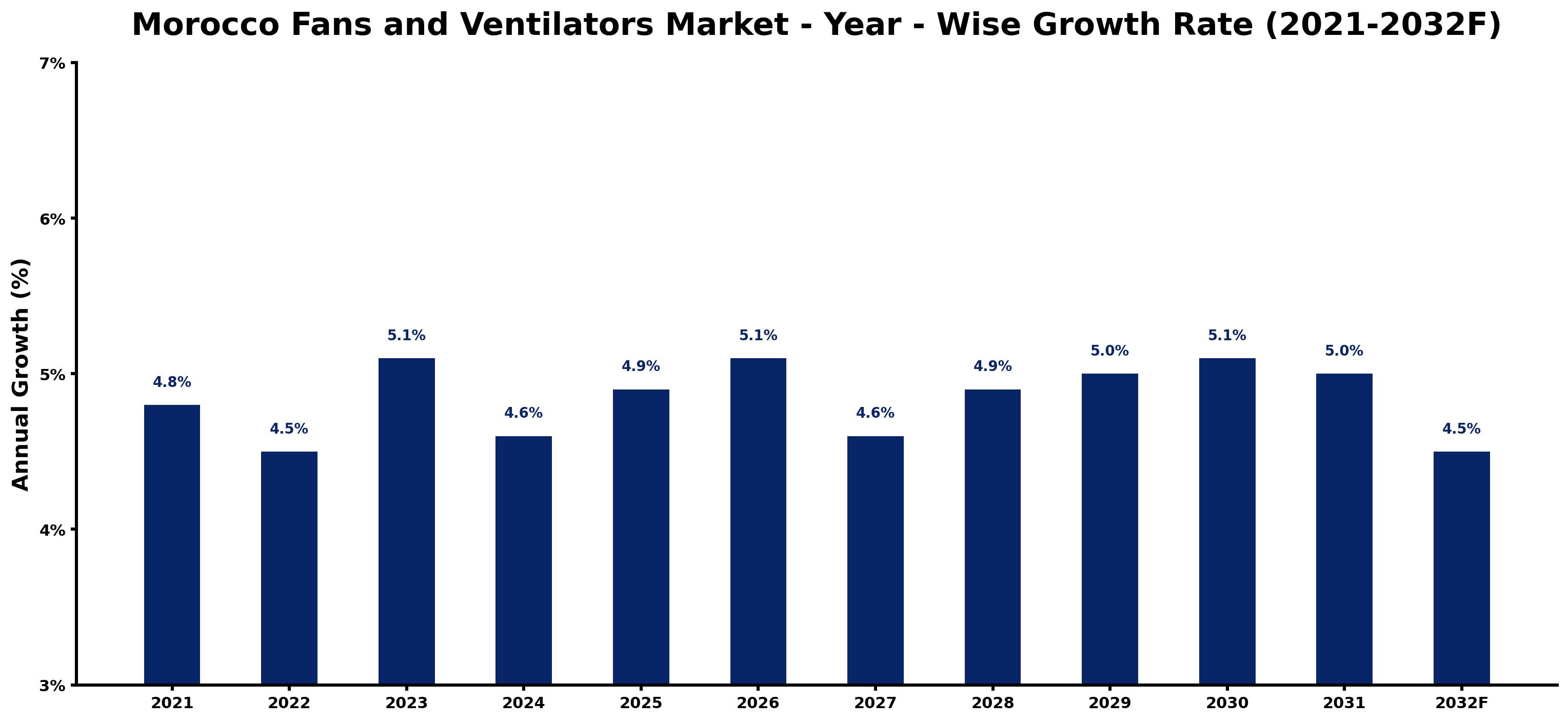
The table below presents the year wise growth rates along with the key drivers influencing the market
| Year | Growth Rate | Major Drivers |
| 2021 | 4.8% | Consumers increasingly favor energy-efficient air circulation solutions in urban areas. |
| 2022 | 4.5% | Heat waves prompt manufacturers to innovate portable and durable fan designs. |
| 2023 | 5.1% | E-commerce platforms expand reach, making ventilators accessible in remote regions. |
| 2024 | 4.6% | Growing awareness of air quality drives interest toward advanced filtration systems. |
| 2025 | 4.9% | Local manufacturers collaborate with international brands, enhancing product diversity. |
| 2026 | 5.1% | Tourism recovery boosts sales of cooling solutions in hospitality sectors. |
| 2027 | 4.6% | Smart home integration becomes a key feature in new ventilation product lines. |
| 2028 | 4.9% | Urban development projects prioritize sustainable cooling solutions in residential planning. |
| 2029 | 5.0% | Emerging middle class seeks premium fan options for health and comfort. |
| 2030 | 5.1% | Innovative materials make fans lighter and more efficient for everyday use. |
| 2031 | 5.0% | Increased disposable income leads to higher demand for luxury home appliances. |
| 2032 | 4.5% | Awareness campaigns educate consumers on energy-saving ventilator technologies. |
Note - Market size estimations and growth projections presented in this report are based on 6Wresearch's advanced forecasting approach, validated with industry datasets as of June 2026.
Morocco Fans and Ventilators Market Synopsis
The Morocco Fans and Ventilators Market is projected to reach 5.1% and witness significant growth during the forecast period (2026-2032). This expansion is largely driven by the increasing need for effective air circulation and ventilation across various sectors, including residential, commercial, and industrial buildings. As indoor air quality becomes a paramount concern, the demand for fans and ventilators is anticipated to rise, underscoring their essential role in maintaining thermal comfort and health standards in enclosed spaces.
Morocco Fans and Ventilators Market Growth Drivers
Several factors contribute to the robust growth of the Morocco fans and ventilators market. The burgeoning construction sector, paired with ongoing industrial activities, is a primary driver. Key elements supporting this growth include:
- Investment in new residential and commercial properties is leading to increased demand for advanced ventilation solutions, essential for enhancing indoor air quality.
- The ongoing retrofitting of existing buildings with modern HVAC systems is generating demand for efficient fans and ventilators that comply with contemporary standards.
- Rising awareness about health issues linked to poor air quality is encouraging consumers and businesses to prioritize effective ventilation systems.
- Technological advancements in the design and efficiency of fans and ventilators are making these products more attractive to end-users.
- There is a growing inclination towards sustainable building practices, resulting in an increased adoption of energy-efficient ventilation technologies.
Morocco Fans and Ventilators Market Challenges and Restraints
Despite the promising outlook, the Morocco fans and ventilators market faces several challenges that could hinder growth. These include:
- The need for manufacturers to develop energy-efficient and high-performance ventilation solutions in response to stringent environmental regulations.
- Meeting compliance requirements while balancing production costs presents a significant challenge for market players.
- Intense competition from international manufacturers can limit market share for local companies, necessitating effective marketing strategies.
- The fluctuating costs of raw materials may affect pricing strategies and profit margins for manufacturers in the region.
- Consumer education about the importance of ventilation solutions is crucial, as many potential customers may not fully understand their benefits.
Morocco Fans and Ventilators Market Government Investment and Initiatives
The Moroccan government plays a pivotal role in shaping the fans and ventilators market through various investment and policy initiatives. With a focus on improving indoor air quality and promoting energy efficiency, the government has outlined several strategies:
- The establishment of regulations governing the performance and energy efficiency of ventilation systems aims to encourage manufacturers to innovate.
- Incentives for the adoption of energy-saving technologies in both residential and commercial sectors are fostering a culture of sustainable development.
- Government-sponsored awareness campaigns highlight the importance of indoor air quality management, thereby increasing demand for ventilation solutions.
- Funding for research and development projects related to HVAC technologies is enhancing the capacity of local manufacturers to deliver high-quality products.
- Support for green building initiatives and retrofitting programs is generating market opportunities for advanced ventilation solutions.
Morocco Fans and Ventilators Market Latest Developments (May 2025 - June 2026)
The period from May 2025 to June 2026 has witnessed notable developments in the Morocco fans and ventilators market. Industry stakeholders have focused on integrating smart technologies into ventilation systems, promoting enhanced user control and energy efficiency. Additionally, collaborations between local companies and international technology firms have surfaced, aimed at incorporating innovative solutions into the market. The government's commitment to sustainability has also strengthened, with new policies being enacted to further support energy-efficient building practices and innovations in ventilation technology.
Morocco Fans and Ventilators Market - Key Attractiveness of the Report
- 10 Years of Market Numbers
- Historical Data Starting from 2022 to 2025
- Base Year: 2025
- Forecast Data until 2032
- Key Performance Indicators Impacting the Market
- Major Upcoming Developments and Projects
Key Highlights of the Report:
- Morocco Fans and Ventilators Market Outlook
- Market Size of Morocco Fans and Ventilators Market, 2025
- Forecast of Morocco Fans and Ventilators Market, 2032
- Historical Data and Forecast of Morocco Fans and Ventilators Revenues & Volume for the Period 2022-2032F
- Morocco Fans and Ventilators Market Trend Evolution
- Morocco Fans and Ventilators Market Drivers and Challenges
- Morocco Fans and Ventilators Price Trends
- Morocco Fans and Ventilators Porter's Five Forces
- Morocco Fans and Ventilators Industry Life Cycle
- Historical Data and Forecast of Morocco Fans and Ventilators Market Revenues & Volume By Material for the Period 2022-2032F
- Historical Data and Forecast of Morocco Fans and Ventilators Market Revenues & Volume By Metal for the Period 2022-2032F
- Historical Data and Forecast of Morocco Fans and Ventilators Market Revenues & Volume By Composite for the Period 2022-2032F
- Historical Data and Forecast of Morocco Fans and Ventilators Market Revenues & Volume By Rubber for the Period 2022-2032F
- Historical Data and Forecast of Morocco Fans and Ventilators Market Revenues & Volume By Plastic for the Period 2022-2032F
- Historical Data and Forecast of Morocco Fans and Ventilators Market Revenues & Volume By Application for the Period 2022-2032F
- Historical Data and Forecast of Morocco Fans and Ventilators Market Revenues & Volume By Interior for the Period 2022-2032F
- Historical Data and Forecast of Morocco Fans and Ventilators Market Revenues & Volume By Exterior for the Period 2022-2032F
- Historical Data and Forecast of Morocco Fans and Ventilators Market Revenues & Volume By Structural for the Period 2022-2032F
- Historical Data and Forecast of Morocco Fans and Ventilators Market Revenues & Volume By Powertrain for the Period 2022-2032F
- Historical Data and Forecast of Morocco Fans and Ventilators Market Revenues & Volume By Vehicle Types for the Period 2022-2032F
- Historical Data and Forecast of Morocco Fans and Ventilators Market Revenues & Volume By Passenger Vehicles for the Period 2022-2032F
- Historical Data and Forecast of Morocco Fans and Ventilators Market Revenues & Volume By Light Commercial Vehicles for the Period 2022-2032F
- Historical Data and Forecast of Morocco Fans and Ventilators Market Revenues & Volume By Heavy Commercial Vehicles for the Period 2022-2032F
- Morocco Fans and Ventilators Import Export Trade Statistics
- Market Opportunity Assessment By Material
- Market Opportunity Assessment By Application
- Market Opportunity Assessment By Vehicle Types
- Morocco Fans and Ventilators Top Companies Market Share
- Morocco Fans and Ventilators Competitive Benchmarking By Technical and Operational Parameters
- Morocco Fans and Ventilators Company Profiles
- Morocco Fans and Ventilators Key Strategic Recommendations






































