Morocco Food Dehydrators Market Size, Share & Growth Rate
The Morocco Food Dehydrators Market was estimated at USD 977 Million in 2025 and is projected to reach USD 1414 Million by 2032, growing at a CAGR of 5.4% from 2026 to 2032. This growth trajectory is fueled by an increasing consumer preference for healthier food options, coupled with a surge in the popularity of home food preservation methods. The growing awareness of the nutritional advantages associated with dehydrated foods significantly contributes to this upward trend.
Morocco Food Dehydrators Market Year-wise Growth Rate and Key Drivers
This graph highlights how the Morocco Food Dehydrators Market has steadily grown over the years, supported by major growth factors.
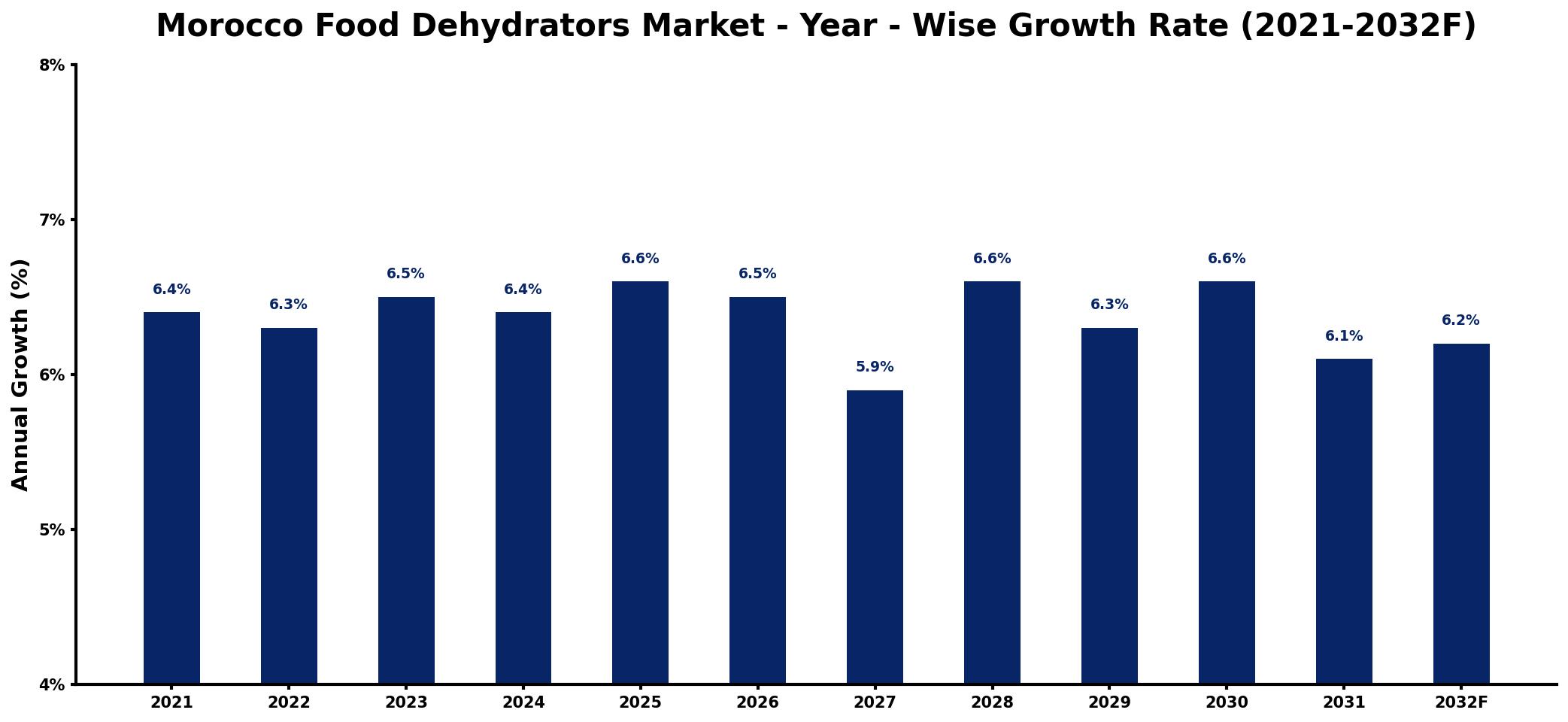
The table below presents the year‑wise growth rates along with the key drivers influencing the market
| Year | Growth Rate | Major Drivers |
| 2021 | 6.4% | Rising health consciousness among consumers |
| 2022 | 6.3% | Increased demand for convenience solutions |
| 2023 | 6.5% | Growing interest in sustainable practices |
| 2024 | 6.4% | Expansion of local agricultural production |
| 2025 | 6.6% | Advancements in energy-efficient technologies |
| 2026 | 6.5% | Surge in home preservation activities |
| 2027 | 5.9% | Shift towards online retail platforms |
| 2028 | 6.6% | Growth in urban population demographics |
| 2029 | 6.3% | Emergence of new culinary trends |
| 2030 | 6.6% | Rising popularity of outdoor activities |
| 2031 | 6.1% | Increase in wellness-oriented lifestyles |
| 2032 | 6.2% | growing downstream application demand |
Note: Market size estimations and growth projections presented in this report are based on 6Wresearch's proprietary forecasting methodology, utilizing the latest available industry data, government publications, and primary research inputs.
Morocco Food Dehydrators Market Synopsis
The Morocco food dehydrators market is currently experiencing momentum driven by health-conscious consumers and small businesses embracing home food preservation techniques. However, the market is expected to evolve further, with an increasing shift towards innovative and energy-efficient dehydrator models that meet the changing demands of consumers.
Looking ahead, the momentum will likely continue, especially as manufacturers focus on integrating smart technology and customizable features. This will not only enhance user experience but also align with the sustainability trends that are becoming increasingly prevalent among Moroccan consumers.
Morocco Food Dehydrators Market Key Takeaways
- The market shows promising growth, driven by the demand for healthy snacks and convenient food preservation.
- Product innovation is crucial, with manufacturers prioritizing advanced features and energy efficiency.
- Consumer awareness of the benefits of dehydrated foods is rising, propelling market adoption.
- Sustainable practices are becoming integral to market dynamics, influencing purchasing decisions.
- Investment opportunities in manufacturing and innovative technology development are plentiful.
Evaluation of Restraints in Morocco Food Dehydrators Market
Despite its growth potential, the Morocco food dehydrators market faces several restraints. A significant barrier is the limited awareness of food dehydration technology, especially in rural areas where traditional methods persist. The high initial cost of dehydrators may deter individuals and small businesses from entering the market. Furthermore, inconsistent electricity supply in certain regions and a lack of standardized regulations can undermine consumer confidence regarding product safety and quality. Addressing these issues will require collaborative efforts from stakeholders to promote the technology effectively.
Morocco Food Dehydrators Market Trends
Currently, the market is characterized by a growing demand for compact and energy-efficient dehydrators, appealing to both health-conscious consumers and small-scale food enterprises. There is a marked increase in interest around home food preservation techniques, which positions food dehydrators as a practical solution for extending the shelf life of perishable items. Additionally, emerging trends indicate a shift towards eco-friendly models that utilize renewable energy and aim to minimize food waste. Manufacturers are also increasingly incorporating smart technology into their products, enabling users to customize drying settings and optimize energy consumption.
Morocco Food Dehydrators Market Opportunities
Investors in the Morocco food dehydrators market have a range of opportunities available, primarily driven by the rising demand for convenient and health-oriented food preservation solutions. There is a robust potential for growth in the manufacturing sector, particularly in producing high-quality dehydrator equipment tailored for households, restaurants, and food processing facilities. Additionally, investment in research and development for innovative dehydration technologies can yield competitive advantages. Expanding marketing and distribution channels to reach a broader consumer base is also a promising avenue, capitalizing on the increasing trend towards healthy eating and sustainable practices.
Government Initiatives in the Morocco Food Dehydrators Market
The Moroccan government is committed to enhancing food security and supporting the agricultural sector, which in turn positively impacts the food dehydrators market. Various incentives and subsidies are in place to bolster local food processing industries, including those involved in dehydrated food production. Regulations aimed at ensuring food safety and maintaining quality standards are critical to instilling consumer confidence and facilitating export opportunities. The government's emphasis on sustainable agricultural practices further underscores its intention to promote growth within this sector.
Future Insights of the Morocco Food Dehydrators Market
The outlook for the Morocco food dehydrators market from 2026 to 2032 appears optimistic. With consumer awareness about the advantages of dehydrated foods continuing to rise, demand is set to escalate. The trend toward healthier eating habits and sustainable living will likely influence consumer preferences, steering them toward dehydrators that offer advanced features. Manufacturers are expected to invest significantly in product innovation, aligning with the market's evolving landscape and ensuring their offerings remain competitive. This growth phase presents ample opportunities for both local and international stakeholders aiming to make their mark in this dynamic market.
Morocco Food Dehydrators Market Latest Developments (2025 - 2026)
Recent developments in the Morocco food dehydrators market indicate a shift toward incorporating more advanced technology in product designs. Manufacturers are increasingly integrating smart features that allow consumers to monitor and control the dehydration process via mobile applications. Additionally, there's a growing focus on developing models that utilize less energy and comply with sustainable practices, appealing to the eco-conscious consumer. The market also anticipates enhanced marketing strategies aimed at educating potential buyers about the benefits and functionalities of food dehydrators.
Morocco Food Dehydrators Market - Key Attractiveness of the Report
- 10 Years of Market Numbers
- Historical Data Starting from 2022 to 2025
- Base Year: 2025
- Forecast Data until 2032
- Key Performance Indicators Impacting the Market
- Major Upcoming Developments and Projects
Key Highlights of the Report:
- Morocco Food Dehydrators Market Outlook
- Market Size of Morocco Food Dehydrators Market, 2025
- Forecast of Morocco Food Dehydrators Market, 2032
- Historical Data and Forecast of Morocco Food Dehydrators Revenues & Volume for the Period 2022-2032F
- Morocco Food Dehydrators Market Trend Evolution
- Morocco Food Dehydrators Market Drivers and Challenges
- Morocco Food Dehydrators Price Trends
- Morocco Food Dehydrators Porter's Five Forces
- Morocco Food Dehydrators Industry Life Cycle
- Historical Data and Forecast of Morocco Food Dehydrators Market Revenues & Volume By Technology for the Period 2022-2032F
- Historical Data and Forecast of Morocco Food Dehydrators Market Revenues & Volume By Vertical Flow for the Period 2022-2032F
- Historical Data and Forecast of Morocco Food Dehydrators Market Revenues & Volume By Horizontal Flow for the Period 2022-2032F
- Historical Data and Forecast of Morocco Food Dehydrators Market Revenues & Volume By End-Use for the Period 2022-2032F
- Historical Data and Forecast of Morocco Food Dehydrators Market Revenues & Volume By Industrial for the Period 2022-2032F
- Historical Data and Forecast of Morocco Food Dehydrators Market Revenues & Volume By Commercial for the Period 2022-2032F
- Historical Data and Forecast of Morocco Food Dehydrators Market Revenues & Volume By Residential for the Period 2022-2032F
- Historical Data and Forecast of Morocco Food Dehydrators Market Revenues & Volume By Others for the Period 2022-2032F
- Historical Data and Forecast of Morocco Food Dehydrators Market Revenues & Volume By Energy Source for the Period 2022-2032F
- Historical Data and Forecast of Morocco Food Dehydrators Market Revenues & Volume By Electricity for the Period 2022-2032F
- Historical Data and Forecast of Morocco Food Dehydrators Market Revenues & Volume By Biofuel for the Period 2022-2032F
- Historical Data and Forecast of Morocco Food Dehydrators Market Revenues & Volume By Solar for the Period 2022-2032F
- Historical Data and Forecast of Morocco Food Dehydrators Market Revenues & Volume By Others for the Period 2022-2032F
- Morocco Food Dehydrators Import Export Trade Statistics
- Market Opportunity Assessment By Technology
- Market Opportunity Assessment By End-Use
- Market Opportunity Assessment By Energy Source
- Morocco Food Dehydrators Top Companies Market Share
- Morocco Food Dehydrators Competitive Benchmarking By Technical and Operational Parameters
- Morocco Food Dehydrators Company Profiles
- Morocco Food Dehydrators Key Strategic Recommendations






































