Morocco Food & Grocery Retail Market Size, Share & Growth Rate
The Morocco Food & Grocery Retail Market was estimated at USD 539 Million in 2025 and is projected to reach USD 949 Million by 2032, growing at a CAGR of 8.4% from 2026 to 2032. This growth trajectory is primarily driven by increasing urbanization, which is transforming shopping behaviors, along with rising disposable incomes that enable consumers to spend more on food and grocery items. The demand for modern retail formats is also on the rise, as consumers increasingly seek convenience and variety in their shopping experiences.
Morocco Food & Grocery Retail Market Year-wise Growth Rate and Key Drivers
This graph highlights how the Morocco Food & Grocery Retail Market has steadily grown over the years, supported by major growth factors.
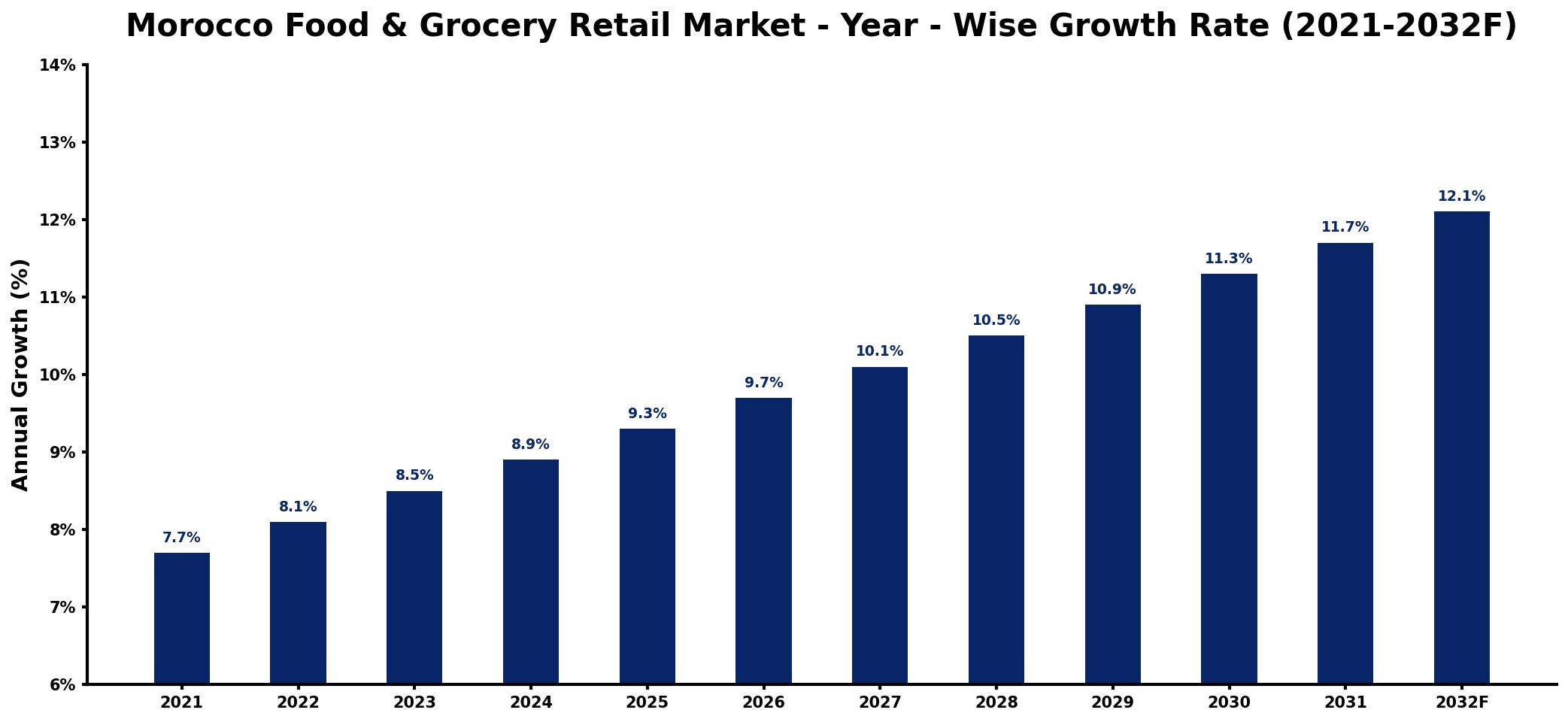
The table below presents the year‑wise growth rates along with the key drivers influencing the market
| Year | Growth Rate | Major Drivers |
| 2021 | 7.7% | Rising consumer spending patterns |
| 2022 | 8.1% | Expansion of online shopping channels |
| 2023 | 8.5% | Increase in health-conscious consumers |
| 2024 | 8.9% | Growing demand for convenience options |
| 2025 | 9.3% | Investment in local production facilities |
| 2026 | 9.7% | Emergence of new distribution networks |
| 2027 | 10.1% | growing regional consumption patterns |
| 2028 | 10.5% | Development of sustainable sourcing practices |
| 2029 | 10.9% | Strengthening of supply chain logistics |
| 2030 | 11.3% | Adoption of technology in operations |
| 2031 | 11.7% | Focus on premium product offerings |
| 2032 | 12.1% | Enhancement of customer loyalty programs |
Note: Market size estimations and growth projections presented in this report are based on 6Wresearch's proprietary forecasting methodology, utilizing the latest available industry data, government publications, and primary research inputs.
Morocco Food & Grocery Retail Market Synopsis
Recent momentum in the Morocco Food & Grocery Retail Market has been robust, characterized by a growing shift from traditional grocery formats to modern retail options. Looking ahead, the market is set to evolve further, with emerging trends towards organic and locally sourced products, which are reshaping consumer preferences.
As both local and international players intensify their presence, the competitive landscape is becoming increasingly dynamic. Retailers must adapt to this changing environment, focusing on meeting the diverse demands of Moroccan consumers while ensuring a streamlined shopping experience.
- The market is witnessing a significant transition from traditional grocery shopping to modern formats like supermarkets and hypermarkets.
- Online grocery shopping is gaining traction, driven by convenience and changing lifestyles among consumers.
- A pronounced demand for organic and healthy food products is influencing retail strategies.
- The Moroccan government is actively promoting policies that enhance local agricultural production and consumer protection.
- Investment opportunities abound in sectors such as e-commerce, specialty food stores, and food processing.
Despite the market's promising growth, several restraints hinder its full potential. The presence of an extensive informal market complicates the competitive landscape, as informal vendors often operate outside formal regulatory frameworks. Additionally, the inconsistencies in supply chain infrastructure pose challenges to timely product delivery and inventory management. These factors create hurdles that local retailers must overcome to maintain competitiveness against international entrants who are pushing for innovation and quality in offerings.
Current trends in the Morocco Food & Grocery Retail Market emphasize a consumer shift towards health-conscious products and sustainability. Increased demand for organic items and locally sourced foods reflects a growing awareness of health and environmental issues among consumers. Furthermore, the rise of e-commerce platforms is changing the retail landscape, providing consumers with enhanced access to a diverse range of products while facilitating greater convenience in shopping. This evolution is also accompanied by the emergence of specialty stores, which cater to niche markets and international tastes.
Investors looking at the Morocco Food & Grocery Retail Market will find a wealth of opportunities. The expanding middle class and an overall increase in disposable income create a ripe environment for supermarket chains, convenience stores, and online grocery platforms. Furthermore, the growing consumer preference for premium products opens up avenues for specialty food stores that can cater to diverse and discerning tastes. In addition, tapping into the local agricultural sector for food processing and distribution presents another promising investment pathway.
The Moroccan government has taken significant steps to regulate the Food & Grocery Retail Market, focusing on consumer protection and food safety. Policies have been established to set quality standards for food products, along with licensing requirements that retail businesses must adhere to. Additionally, efforts to encourage the consumption of locally-produced goods reflect a commitment to supporting domestic producers while reducing reliance on imports. These initiatives contribute to creating a sustainable and competitive market environment.
Looking towards 2026-2032, the Morocco Food & Grocery Retail Market is poised for steady growth. The combination of rising incomes, urbanization, and a shift in consumer preferences towards healthier and more convenient options will continue to drive demand. Moreover, the growing embrace of e-commerce platforms will further reshape consumer interactions with retail. Government efforts to bolster agricultural production and enhance food security are likely to provide a supportive backdrop for sustained market growth.
In recent months, the Morocco Food & Grocery Retail Market has witnessed several significant developments. Retailers are increasingly adopting digital solutions to enhance customer experiences, with many launching mobile applications and e-commerce platforms. Additionally, a focus on sustainability is prompting retailers to adopt ethical sourcing practices and reduce their environmental footprints. The market is also seeing a rise in partnerships between local producers and retailers, aimed at promoting fresh, locally sourced products to meet the growing consumer demand.
- 10 Years of Market Numbers
- Historical Data Starting from 2022 to 2025
- Base Year: 2025
- Forecast Data until 2032
- Key Performance Indicators Impacting the Market
- Major Upcoming Developments and Projects
Key Highlights of the Report:
- Morocco Food & Grocery Retail Market Outlook
- Market Size of Morocco Food & Grocery Retail Market, 2025
- Forecast of Morocco Food & Grocery Retail Market, 2032
- Historical Data and Forecast of Morocco Food & Grocery Retail Revenues & Volume for the Period 2022-2032F
- Morocco Food & Grocery Retail Market Trend Evolution
- Morocco Food & Grocery Retail Market Drivers and Challenges
- Morocco Food & Grocery Retail Price Trends
- Morocco Food & Grocery Retail Porter's Five Forces
- Morocco Food & Grocery Retail Industry Life Cycle
- Historical Data and Forecast of Morocco Food & Grocery Retail Market Revenues & Volume By Product for the Period 2022-2032F
- Historical Data and Forecast of Morocco Food & Grocery Retail Market Revenues & Volume By Fresh Food for the Period 2022-2032F
- Historical Data and Forecast of Morocco Food & Grocery Retail Market Revenues & Volume By Frozen Food for the Period 2022-2032F
- Historical Data and Forecast of Morocco Food & Grocery Retail Market Revenues & Volume By Food Cupboard for the Period 2022-2032F
- Historical Data and Forecast of Morocco Food & Grocery Retail Market Revenues & Volume By Beverages for the Period 2022-2032F
- Historical Data and Forecast of Morocco Food & Grocery Retail Market Revenues & Volume By Cleaning & Household for the Period 2022-2032F
- Historical Data and Forecast of Morocco Food & Grocery Retail Market Revenues & Volume By Others for the Period 2022-2032F
- Historical Data and Forecast of Morocco Food & Grocery Retail Market Revenues & Volume By Distribution Channel for the Period 2022-2032F
- Historical Data and Forecast of Morocco Food & Grocery Retail Market Revenues & Volume By Supermarkets & Hypermarkets for the Period 2022-2032F
- Historical Data and Forecast of Morocco Food & Grocery Retail Market Revenues & Volume By Convenience Stores for the Period 2022-2032F
- Historical Data and Forecast of Morocco Food & Grocery Retail Market Revenues & Volume By Departmental Stores & Clubs for the Period 2022-2032F
- Historical Data and Forecast of Morocco Food & Grocery Retail Market Revenues & Volume By Online for the Period 2022-2032F
- Morocco Food & Grocery Retail Import Export Trade Statistics
- Market Opportunity Assessment By Product
- Market Opportunity Assessment By Distribution Channel
- Morocco Food & Grocery Retail Top Companies Market Share
- Morocco Food & Grocery Retail Competitive Benchmarking By Technical and Operational Parameters
- Morocco Food & Grocery Retail Company Profiles
- Morocco Food & Grocery Retail Key Strategic Recommendations






































