Morocco Formwork Market Summary
The morocco formwork market was estimated at USD 440 Million in 2025 and is projected to reach USD 639 Million by 2032, growing at a CAGR of 6.6% from 2026 to 2032.
Morocco Formwork Market Year-wise Growth Rate and Key Drivers
This graph highlights how the Morocco Formwork Market has steadily grown over the past five years, supported by major growth factors.
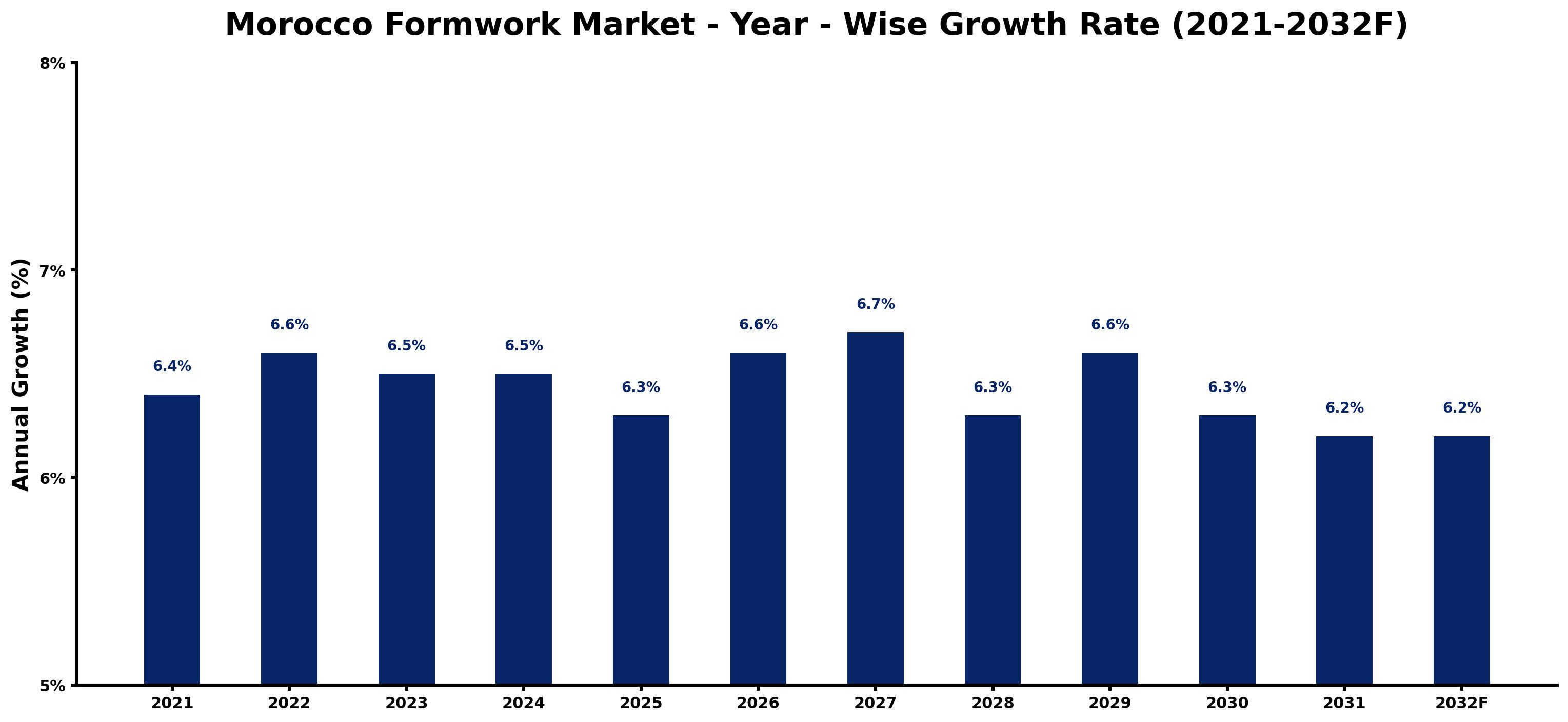
The table below presents the year wise growth rates along with the key drivers influencing the market
| Year | Growth Rate | Major Drivers |
| 2021 | 6.4% | Construction activity surged as urbanization trends intensified across Moroccan cities. |
| 2022 | 6.6% | Major infrastructure projects launched in response to increasing foreign investment opportunities. |
| 2023 | 6.5% | Local manufacturers began optimizing production processes to enhance formwork efficiency significantly. |
| 2024 | 6.5% | Sustainability initiatives prompted businesses to explore eco-friendly formwork alternatives. |
| 2025 | 6.3% | Rising competition among suppliers led to innovative product offerings and pricing strategies. |
| 2026 | 6.6% | Economic recovery from COVID-19 spurred construction growth in both residential and commercial sectors. |
| 2027 | 6.7% | Technological advancements allowed for quicker setup and dismantling of formwork systems. |
| 2028 | 6.3% | Government-backed housing projects fueled demand for affordable and durable construction solutions. |
| 2029 | 6.6% | Cross-border collaborations between Moroccan firms and international players strengthened market capacity. |
| 2030 | 6.3% | Regional development plans accelerated urban infrastructure upgrades across major Moroccan hubs. |
| 2031 | 6.2% | Emerging trends in modular construction encouraged shifts towards lightweight formwork solutions. |
| 2032 | 6.2% | Rising awareness of construction efficiency drove advanced training for formwork application techniques. |
Note - Market size estimations and growth projections presented in this report are based on 6Wresearch's advanced forecasting approach, validated with industry datasets as of June 2026.
Morocco Formwork Market Synopsis
The Morocco Formwork Market is projected to reach 6.6% and witness significant growth during the forecast period (2026-2032). This growth trajectory is primarily driven by a surge in construction activities across the nation, influenced by extensive infrastructure projects, commercial builds, and exceptional residential expansions. The rising demand for versatile formwork systems reflects the need for enhanced construction efficiency and adherence to sustainability principles, allowing the industry to meet both current and future challenges.
Morocco Formwork Market Growth Drivers
The expansion of the Morocco formwork market can be attributed to several key drivers:
- Significant government investments in infrastructure development are stimulating demand for robust formwork solutions in construction projects.
- A growing trend towards urbanization is resulting in increased residential and commercial construction, necessitating efficient formwork systems.
- The introduction of advanced formwork technologies that prioritize sustainability and cost-efficiency is reshaping market dynamics.
- Enhanced construction techniques that incorporate modular and innovative formwork solutions are leading to expedited project timelines and reduced labor costs.
- A shift towards eco-friendly materials in the formwork market aligns with global sustainability trends and meets the demands of environmentally conscious consumers.
Morocco Formwork Market Trends and Opportunities
In recent years, the Morocco formwork market has showcased several notable trends, presenting numerous opportunities for stakeholders:
- The adoption of modular formwork systems is on the rise, attributed to their flexibility, reusability, and ability to cater to complex design requirements.
- Contractors are increasingly favoring formwork solutions that promise quicker assembly and dismantling processes, impacting project efficiency positively.
- There is a marked shift towards adopting sustainable materials and practices within formwork, which is critical for compliance with environmental regulations.
- The integration of technology in formwork solutions, including digital project management tools and automated systems, is enhancing productivity.
- A growing emphasis on workforce training in advanced formwork technologies is reinforcing market capacity and operational effectiveness.
Morocco Formwork Market Challenges and Restraints
Despite the positive growth trends, the Morocco formwork market faces several challenges that stakeholders need to navigate:
- The high initial costs associated with advanced formwork systems can deter smaller and medium-sized construction companies from investing.
- A scarcity of skilled labor knowledgeable in modern formwork technologies can hinder operational efficiency and productivity.
- Lack of adequate maintenance support and service infrastructure for formwork equipment can lead to increased operational downtimes.
- The competitive landscape, characterized by limited established suppliers, can result in pricing pressures that affect profit margins.
- Economic fluctuations and uncertainties can impact investment in construction activities, subsequently influencing demand for formwork solutions.
Morocco Formwork Market Investment Opportunities
Investment prospects within the Morocco formwork market are prominent and are anticipated to be influenced by various factors:
- The ongoing governmental focus on infrastructure upgrades creates a fertile environment for formwork manufacturers to thrive.
- Opportunities arise from the increasing need for diverse formwork solutions due to the expansion of urban infrastructure and housing initiatives.
- Financial incentives for sustainable technologies can attract investors toward innovative formwork systems that meet contemporary construction demands.
- Technological advancements present opportunities for developing new formwork products that cater to changing industry standards.
- Exploitation of local manufacturing capabilities can reduce dependency on imports, enhancing market self-sufficiency and competitiveness.
Morocco Formwork Market Government Investment and Initiatives
The Moroccan government plays a pivotal role in shaping the formwork market through various policies and initiatives:
- Government regulations emphasize safety and quality standards for formwork materials used in construction, promoting higher industry benchmarks.
- Substantial public spending on infrastructure projects such as highways and urban developments underpins the ongoing demand for formwork solutions.
- Strategic initiatives to support local manufacturers aim to foster domestic production capabilities and minimize reliance on imported formwork products.
- Tax incentives and subsidies are offered to encourage the adoption of innovative construction technologies that align with sustainability goals.
- Policies promoting collaboration between the private sector and public institutions are designed to enhance the efficiency and effectiveness of construction practices.
Morocco Formwork Market Latest Developments (May 2025 - June 2026)
In the timeframe between May 2025 and June 2026, the Morocco formwork market has encountered several noteworthy developments that signify its evolution:
- The increasing incorporation of smart technology in formwork solutions has been a focal point, facilitating improved project management and delivery.
- Innovations in eco-friendly formwork materials have gained traction, responding to rising environmental concerns among developers and policymakers.
- Public-private partnerships have emerged as a strategic approach to addressing infrastructure needs, impacting formwork investment positively.
- The ongoing expansion of urban areas has led to heightened demand for specialized formwork solutions tailored to diverse construction environments.
- Training programs aimed at enhancing the skill set of the workforce in advanced formwork technologies have been initiated to tackle labor shortages.
Morocco Formwork Market - Key Attractiveness of the Report
- 10 Years of Market Numbers
- Historical Data Starting from 2022 to 2025
- Base Year: 2025
- Forecast Data until 2032
- Key Performance Indicators Impacting the Market
- Major Upcoming Developments and Projects
Key Highlights of the Report:
- Morocco Formwork Market Outlook
- Market Size of Morocco Formwork Market, 2025
- Forecast of Morocco Formwork Market, 2032F
- Historical Data and Forecast of Morocco Formwork Revenues & Volume for the Period 2022-2032F
- Morocco Formwork Market Trend Evolution
- Morocco Formwork Market Drivers and Challenges
- Morocco Formwork Price Trends
- Morocco Formwork Porter's Five Forces
- Morocco Formwork Industry Life Cycle
- Historical Data and Forecast of Morocco Formwork Market Revenues & Volume By Product Type for the Period 2022-2032F
- Historical Data and Forecast of Morocco Formwork Market Revenues & Volume By Traditional timber formwork for the Period 2022-2032F
- Historical Data and Forecast of Morocco Formwork Market Revenues & Volume By Engineered Formwork System for the Period 2022-2032F
- Historical Data and Forecast of Morocco Formwork Market Revenues & Volume By Re-usable plastic formwork for the Period 2022-2032F
- Historical Data and Forecast of Morocco Formwork Market Revenues & Volume By Others for the Period 2022-2032F
- Historical Data and Forecast of Morocco Formwork Market Revenues & Volume By Applications for the Period 2022-2032F
- Historical Data and Forecast of Morocco Formwork Market Revenues & Volume By Buildings for the Period 2022-2032F
- Historical Data and Forecast of Morocco Formwork Market Revenues & Volume By Transportation for the Period 2022-2032F
- Historical Data and Forecast of Morocco Formwork Market Revenues & Volume By Industrial Facilities for the Period 2022-2032F
- Morocco Formwork Import Export Trade Statistics
- Market Opportunity Assessment By Product Type
- Market Opportunity Assessment By Applications
- Morocco Formwork Top Companies Market Share
- Morocco Formwork Competitive Benchmarking By Technical and Operational Parameters
- Morocco Formwork Company Profiles
- Morocco Formwork Key Strategic Recommendations






































