Morocco Fuel Station Market Size, Share & Growth Rate
The Morocco Fuel Station Market was estimated at USD 454 Million in 2025 and is projected to reach USD 642 Million by 2032, growing at a CAGR of 5.1% from 2026 to 2032. This growth trajectory is being propelled by factors such as increasing urbanization, the rise in disposable incomes among the population, and the growing number of vehicles on Moroccan roads. As the fuel station network expands, so does the demand for enhanced services and diversified fuel options, including renewable energy sources.
Morocco Fuel Station Market Year-wise Growth Rate and Key Drivers
This graph highlights how the Morocco Fuel Station Market has steadily grown over the years, supported by major growth factors.
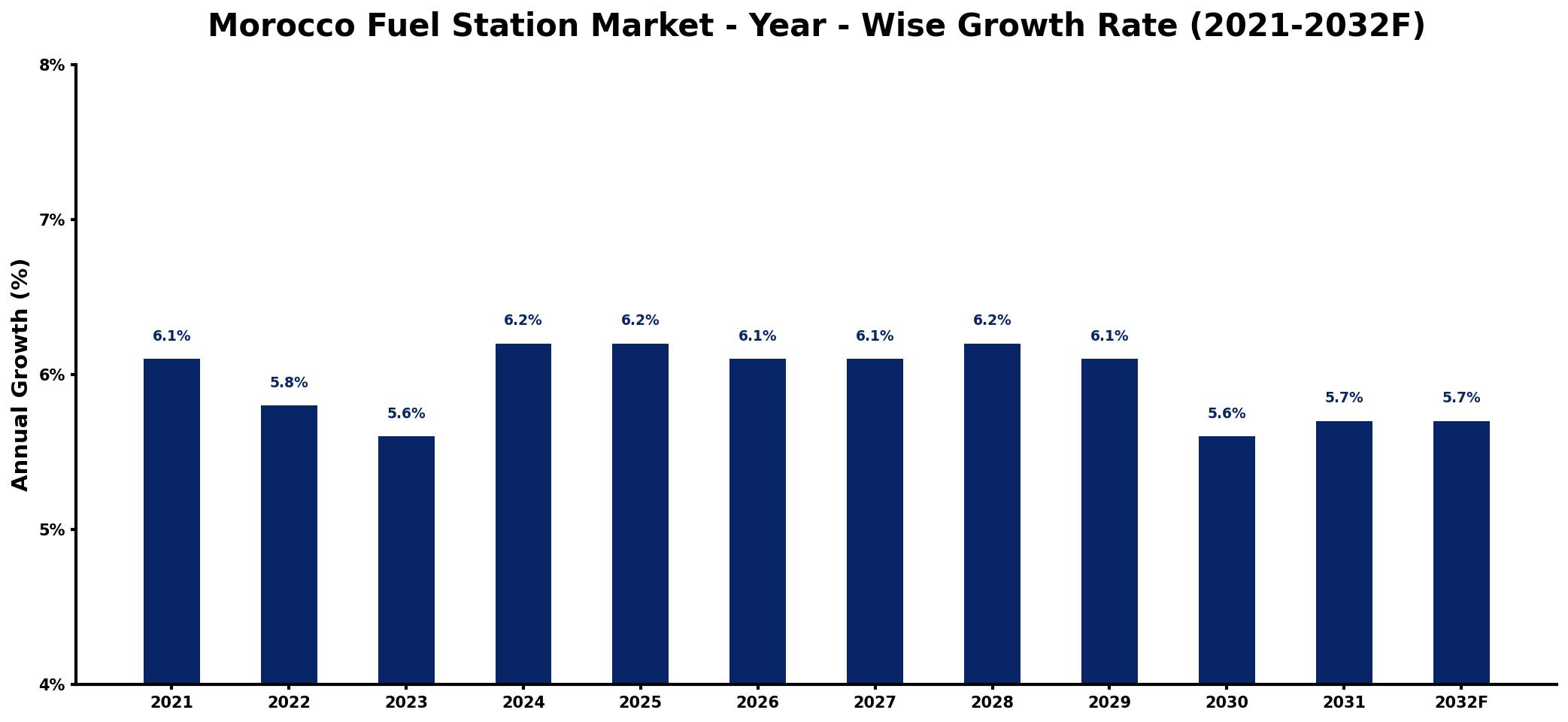
The table below presents the year‑wise growth rates along with the key drivers influencing the market
| Year | Growth Rate | Major Drivers |
| 2021 | 6.1% | Increased transportation sector demand |
| 2022 | 5.8% | Expansion of urban infrastructure projects |
| 2023 | 5.6% | Rising consumer mobility trends |
| 2024 | 6.2% | expanding manufacturing base activity |
| 2025 | 6.2% | Increased tourism and travel activities |
| 2026 | 6.1% | Higher levels of industrial production |
| 2027 | 6.1% | Increased investments in renewable energy |
| 2028 | 6.2% | stronger distribution network expansion |
| 2029 | 6.1% | Rising demand for personal vehicles |
| 2030 | 5.6% | Stabilization of global oil prices |
| 2031 | 5.7% | Increased public transportation initiatives |
| 2032 | 5.7% | Growth in regional trade agreements |
Note: Market size estimations and growth projections presented in this report are based on 6Wresearch's proprietary forecasting methodology, utilizing the latest available industry data, government publications, and primary research inputs.
Morocco Fuel Station Market Synopsis
The strongest force currently shaping the Morocco Fuel Station Market is the shift towards cleaner energy solutions. Government initiatives are driving the adoption of alternative fuels and encouraging fuel station operators to modernize their offerings. This focus on sustainability not only aligns with global environmental trends but also meets the evolving expectations of consumers.
Additionally, the competitive landscape is intensifying as operators innovate to attract and retain customers. The introduction of convenience stores, loyalty programs, and digital services at fuel stations is becoming increasingly common, positioning operators to better cater to consumer needs while enhancing profitability.
Morocco Fuel Station Market Key Takeaways
- The market is undergoing transformation due to rising demand for electric and alternative fuel stations.
- Increased competition is spurring innovation and enhanced customer service offerings.
- Government regulations ensure quality standards while limiting market saturation in urban areas.
- Investments in infrastructure upgrades are crucial for adapting to environmental regulations.
- Opportunities for diversification are presenting themselves through additional services and eco-friendly fuel options.
Evaluation of Restraints in Morocco Fuel Station Market
Despite the promising outlook, the Morocco Fuel Station Market faces several restraints that could impede growth. Intense competition among existing operators puts pressure on profit margins, especially with fluctuating global oil prices. Furthermore, regulatory changes can impact pricing and operational flexibility, making it essential for operators to remain agile. The transition to electric vehicles also poses a long-term challenge, as consumer preferences shift towards sustainable energy solutions. Addressing these constraints will require strategic investments and innovations to ensure long-term viability.
Morocco Fuel Station Market Trends
Key trends are defining the trajectory of the Morocco Fuel Station Market. There is an increasing demand for alternative fuels, particularly natural gas and electricity, as the nation pushes towards sustainability. Digital technologies are becoming integral to enhancing operational efficiency and improving customer experience. Furthermore, fuel stations are increasingly diversifying their service offerings by incorporating convenience stores, car washes, and dining options, responding to shifting consumer preferences and maximizing revenue streams.
Morocco Fuel Station Market Opportunities
The Morocco Fuel Station Market presents numerous investment opportunities, particularly in the area of modernization. Operators can capitalize on enhancing existing stations to include electric vehicle charging facilities or alternative fuel options, thereby attracting a wider customer base. Additionally, establishing fuel stations in underserved regions or key transportation corridors offers a promising avenue for growth. Embracing eco-friendly initiatives, like biofuels or energy-efficient technologies, not only meets regulatory demands but also appeals to environmentally-conscious consumers.
Government Initiatives in the Morocco Fuel Station Market
The Moroccan government plays a crucial role in the fuel station market through regulatory measures aimed at promoting fair competition and consumer safety. Price control mechanisms are in place to manage profit margins for fuel operators while ensuring quality and safety standards are met. Licensing requirements for new stations are stringently enforced to maintain a balance between market supply and demand, ultimately fostering a sustainable and competitive marketplace.
Future Insights of the Morocco Fuel Station Market
Looking ahead to 2026-2032, the Morocco Fuel Station Market is expected to thrive amidst ongoing urbanization and rising disposable incomes. With continued investments in infrastructure and a governmental focus on renewable energy, the landscape will likely shift towards sustainability. Fuel station operators are anticipated to increasingly adopt advanced technologies and expand their offerings to stay relevant in a rapidly evolving market. As consumer preferences evolve towards cleaner alternatives, those who innovate are likely to capture greater market share.
Morocco Fuel Station Market Latest Developments (2025 - 2026)
Recent developments in the Morocco Fuel Station Market indicate a growing emphasis on integrating technology with traditional fuel services. Operators are investing in modernizing their infrastructures, including digital payment systems and improved customer engagement platforms. Initiatives aimed at enhancing electric vehicle charging networks are gaining traction, reflecting the national commitment to sustainability. Overall, these trends are indicative of a market poised for innovative changes over the coming years.
Morocco Fuel Station Market - Key Attractiveness of the Report
- 10 Years of Market Numbers
- Historical Data Starting from 2022 to 2025
- Base Year: 2025
- Forecast Data until 2032
- Key Performance Indicators Impacting the Market
- Major Upcoming Developments and Projects
Key Highlights of the Report:
- Morocco Fuel Station Market Outlook
- Market Size of Morocco Fuel Station Market, 2025
- Forecast of Morocco Fuel Station Market, 2032
- Historical Data and Forecast of Morocco Fuel Station Revenues & Volume for the Period 2022-2032F
- Morocco Fuel Station Market Trend Evolution
- Morocco Fuel Station Market Drivers and Challenges
- Morocco Fuel Station Price Trends
- Morocco Fuel Station Porter's Five Forces
- Morocco Fuel Station Industry Life Cycle
- Historical Data and Forecast of Morocco Fuel Station Market Revenues & Volume By Fuel for the Period 2022-2032F
- Historical Data and Forecast of Morocco Fuel Station Market Revenues & Volume By Gasoline for the Period 2022-2032F
- Historical Data and Forecast of Morocco Fuel Station Market Revenues & Volume By Diesel for the Period 2022-2032F
- Historical Data and Forecast of Morocco Fuel Station Market Revenues & Volume By Gas for the Period 2022-2032F
- Historical Data and Forecast of Morocco Fuel Station Market Revenues & Volume By others for the Period 2022-2032F
- Historical Data and Forecast of Morocco Fuel Station Market Revenues & Volume By End-User for the Period 2022-2032F
- Historical Data and Forecast of Morocco Fuel Station Market Revenues & Volume By Road Transport Vehicles for the Period 2022-2032F
- Historical Data and Forecast of Morocco Fuel Station Market Revenues & Volume By Air Transport Vehicles for the Period 2022-2032F
- Historical Data and Forecast of Morocco Fuel Station Market Revenues & Volume By Water Transport Vehicles for the Period 2022-2032F
- Morocco Fuel Station Import Export Trade Statistics
- Market Opportunity Assessment By Fuel
- Market Opportunity Assessment By End-User
- Morocco Fuel Station Top Companies Market Share
- Morocco Fuel Station Competitive Benchmarking By Technical and Operational Parameters
- Morocco Fuel Station Company Profiles
- Morocco Fuel Station Key Strategic Recommendations






































