Morocco Full Grain Leather Market Year-wise Growth Rate (2021-2031F)
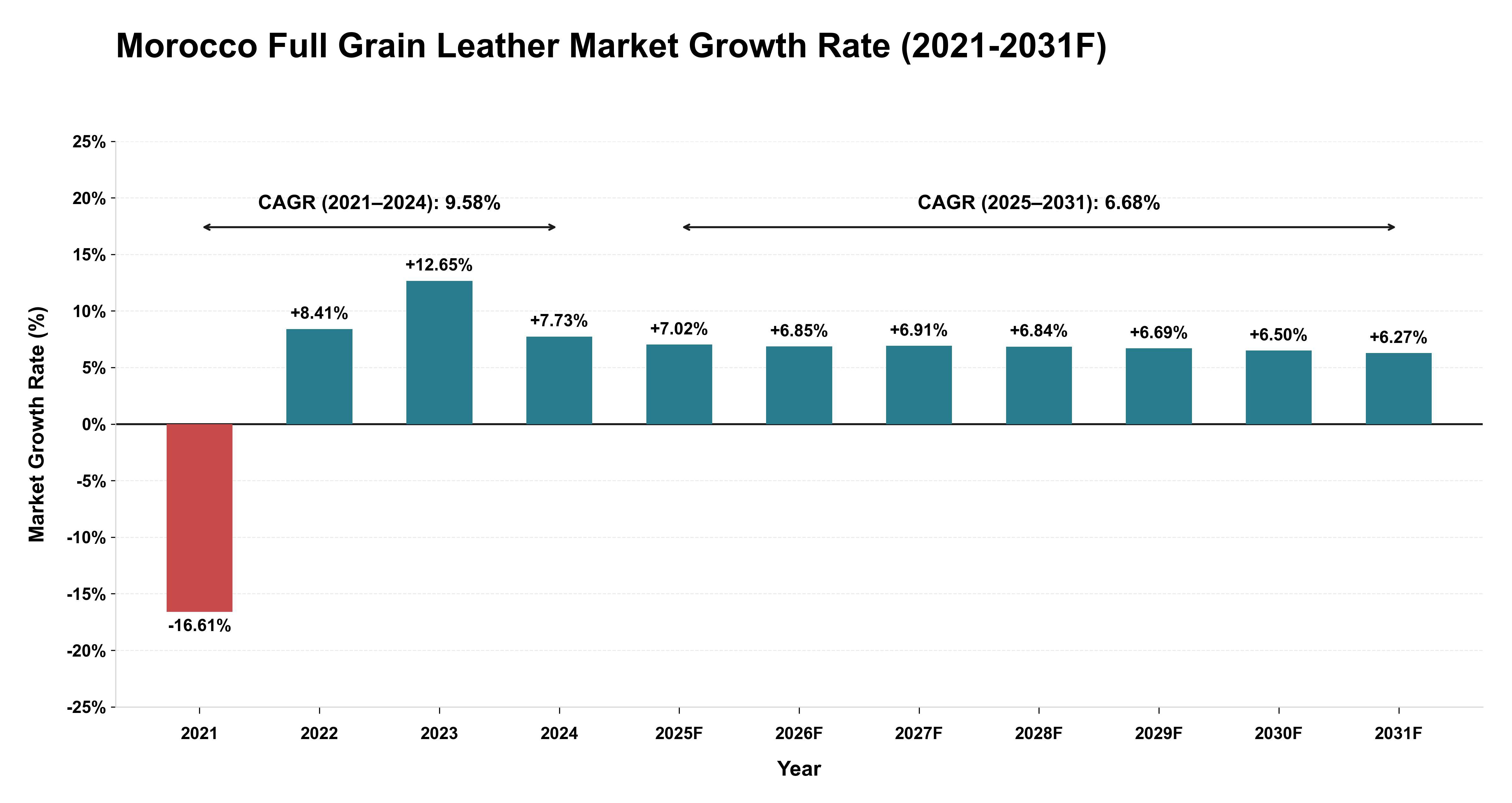
The Morocco Full Grain Leather Market witnessed a tumultuous period from 2021 to 2024, marked by a sharp decline in 2021 followed by a robust recovery in subsequent years, with growth rates fluctuating between negative and double digits. The rebound can be attributed to increased demand from luxury goods manufacturers and the automotive industry, as well as advancements in leather processing technologies. Moving forward to 2025-2031, the market is anticipated to stabilize with a lower but sustainable CAGR of 6.68%. This deceleration reflects a more mature market phase, influenced by stable demand from fashion houses and furniture producers, alongside regulatory pressures for sustainable sourcing practices. The sector's resilience and adaptability are expected to drive steady growth despite the moderation in expansion rates.
Key Highlights of the Report:
- Morocco Full Grain Leather Market Outlook
- Market Size of Morocco Full Grain Leather Market, 2024
- Forecast of Morocco Full Grain Leather Market, 2031
- Historical Data and Forecast of Morocco Full Grain Leather Revenues & Volume for the Period 2021 - 2031
- Morocco Full Grain Leather Market Trend Evolution
- Morocco Full Grain Leather Market Drivers and Challenges
- Morocco Full Grain Leather Price Trends
- Morocco Full Grain Leather Porter's Five Forces
- Morocco Full Grain Leather Industry Life Cycle
- Historical Data and Forecast of Morocco Full Grain Leather Market Revenues & Volume By Type for the Period 2021 - 2031
- Historical Data and Forecast of Morocco Full Grain Leather Market Revenues & Volume By Coated for the Period 2021 - 2031
- Historical Data and Forecast of Morocco Full Grain Leather Market Revenues & Volume By Non-Coated for the Period 2021 - 2031
- Historical Data and Forecast of Morocco Full Grain Leather Market Revenues & Volume By Application for the Period 2021 - 2031
- Historical Data and Forecast of Morocco Full Grain Leather Market Revenues & Volume By Automobile for the Period 2021 - 2031
- Historical Data and Forecast of Morocco Full Grain Leather Market Revenues & Volume By Consumer Goods for the Period 2021 - 2031
- Historical Data and Forecast of Morocco Full Grain Leather Market Revenues & Volume By Furniture for the Period 2021 - 2031
- Morocco Full Grain Leather Import Export Trade Statistics
- Market Opportunity Assessment By Type
- Market Opportunity Assessment By Application
- Morocco Full Grain Leather Top Companies Market Share
- Morocco Full Grain Leather Competitive Benchmarking By Technical and Operational Parameters
- Morocco Full Grain Leather Company Profiles
- Morocco Full Grain Leather Key Strategic Recommendations






































