Morocco Gold Bullion Market Size, Share & Growth Rate
The Morocco Gold Bullion Market was estimated at USD 395 Million in 2025 and is projected to reach USD 555 Million by 2032, growing at a CAGR of 5.0% from 2026 to 2032. This upward trajectory is primarily fueled by an increasing inclination among Moroccan investors towards gold as a safe-haven asset amid global economic uncertainties. Additionally, factors such as inflationary pressures and geopolitical tensions are prompting more individuals to secure their wealth through physical gold investments.
Morocco Gold Bullion Market Year-wise Growth Rate and Key Drivers
This graph highlights how the Morocco Gold Bullion Market has steadily grown over the years, supported by major growth factors.
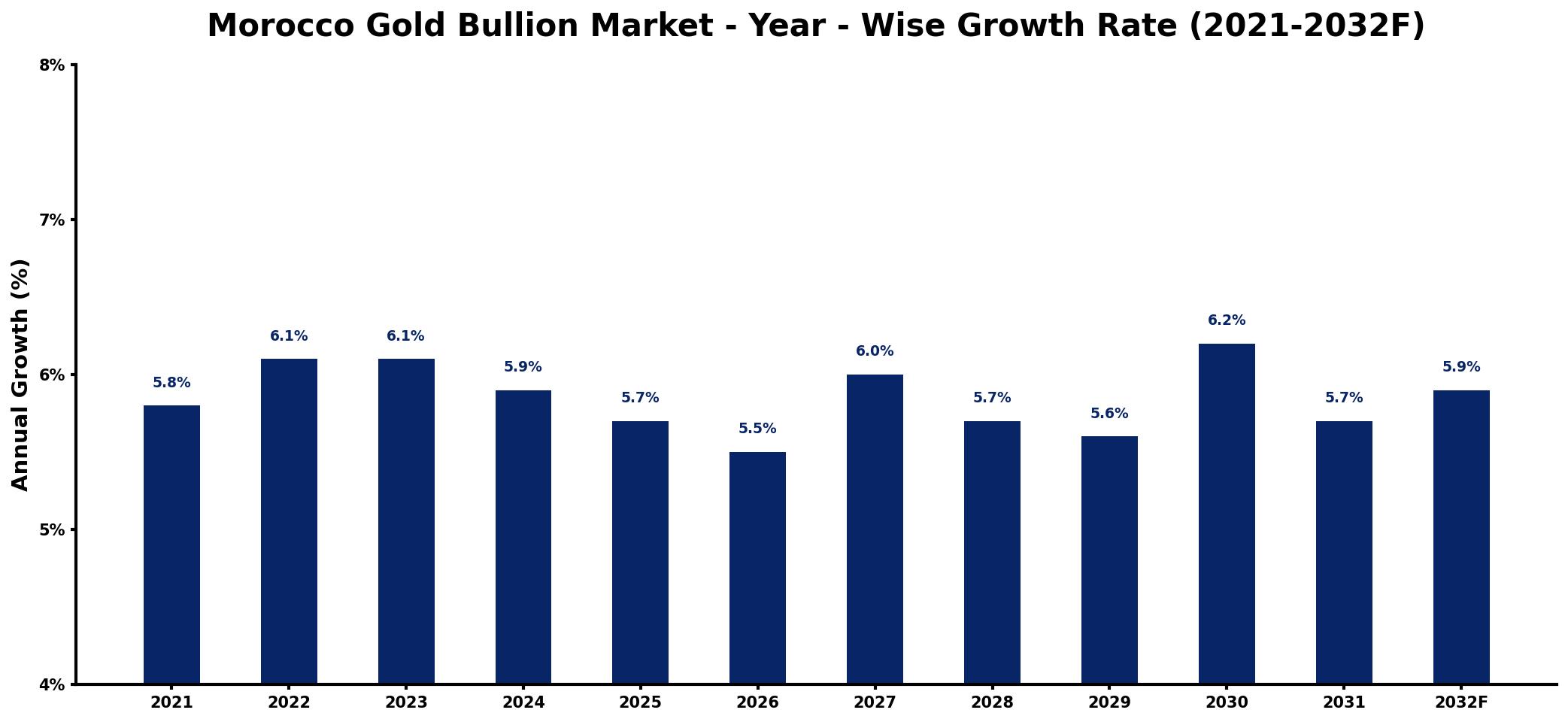
The table below presents the year‑wise growth rates along with the key drivers influencing the market
| Year | Growth Rate | Major Drivers |
| 2021 | 5.8% | Increased investor confidence in assets |
| 2022 | 6.1% | Growing interest in safe havens |
| 2023 | 6.1% | Rising global economic uncertainties |
| 2024 | 5.9% | Expansion of retail investment platforms |
| 2025 | 5.7% | Increased demand for luxury items |
| 2026 | 5.5% | Surge in high-net-worth individuals |
| 2027 | 6.0% | Growing awareness of inflation hedges |
| 2028 | 5.7% | Strengthening demand from institutional buyers |
| 2029 | 5.6% | Increased diversification in investment portfolios |
| 2030 | 6.2% | Rising international geopolitical tensions |
| 2031 | 5.7% | Continued growth in emerging markets |
| 2032 | 5.9% | Increased availability of financial products |
Note: Market size estimations and growth projections presented in this report are based on 6Wresearch's proprietary forecasting methodology, utilizing the latest available industry data, government publications, and primary research inputs.
Morocco Gold Bullion Market Synopsis
In Morocco, gold bars and coins, particularly 24 karat gold, dominate investment preferences due to their purity and high value retention. The local market is characterized by a burgeoning demand for physical gold as individuals seek stability in an unpredictable economic landscape.
The Moroccan government regulates the gold bullion market, ensuring transparency and authenticity of the products available. As international gold prices fluctuate, Moroccan investors are increasingly influenced by global economic conditions and geopolitical events, creating a dynamic investment environment.
Morocco Gold Bullion Market Key Takeaways
- The market shows significant growth potential as interest in gold as a safe-haven asset rises among investors.
- 24 karat gold is the preferred form of bullion, emphasizing purity and long-term value.
- Government regulation plays a vital role in maintaining market integrity and consumer protection.
- Challenges such as counterfeit products and limited transparency need to be addressed for market stability.
- The increasing popularity of online trading platforms is enhancing access to gold investments.
Evaluation of Restraints in Morocco Gold Bullion Market
Despite its growth, the Morocco Gold Bullion Market faces significant challenges. The presence of counterfeit gold products and a lack of robust regulatory oversight pose serious risks to investors. Additionally, the limited transparency in pricing and concerns regarding the authenticity of traded gold further complicate the market landscape. Economic fluctuations, coupled with investor apprehension, may also hinder trading volumes. To promote a secure market, it is crucial to enhance regulatory measures and improve investor education initiatives.
Morocco Gold Bullion Market Trends
Currently, the market is experiencing a noticeable shift as more investors turn to gold bullion to hedge against inflation and currency fluctuations. Geopolitical tensions and a weakening US dollar have spurred interest in physical gold as a reliable store of value. Furthermore, the rising trend of online trading platforms is making gold investment more accessible, inviting a new generation of investors to participate in this asset class.
Morocco Gold Bullion Market Opportunities
The Morocco Gold Bullion Market offers numerous investment opportunities for both seasoned investors and newcomers. Purchasing physical gold bars or coins presents a direct hedge against economic uncertainties. Furthermore, alternatives like gold exchange-traded funds (ETFs) and gold mining stocks provide options for gaining exposure without physical ownership. As the economy grows and investor sentiment shifts, now is a strategic moment to consider entering this evolving market.
Government Initiatives in the Morocco Gold Bullion Market
The Moroccan government has implemented various policies aimed at regulating the gold bullion market. These include strict regulations on the import and export of gold, licensing requirements for dealers, and consumer protection measures. By ensuring the quality and purity of gold sold in the country, the government is striving to maintain market integrity. Additionally, initiatives to promote gold investments, such as the establishment of gold savings accounts, are expected to enhance market participation.
Future Insights of the Morocco Gold Bullion Market
Looking ahead to 2026-2032, the Morocco Gold Bullion Market is positioned for continued growth. The increasing demand for gold as a safeguard against economic instability, coupled with a burgeoning middle class seeking to invest in luxury assets, is likely to drive market expansion. Government initiatives promoting gold investment and evolving consumer preferences will further bolster market activity, making Morocco an attractive destination for gold investment.
Morocco Gold Bullion Market Latest Developments (2025 - 2026)
In recent months, the Morocco Gold Bullion Market has witnessed a surge in investor interest, particularly in the realm of online trading. Regulatory bodies have intensified efforts to combat counterfeit products and enhance consumer confidence. Moreover, there has been a noticeable rise in educational initiatives aimed at informing investors about the benefits of gold investments, further solidifying the market's foundation for growth.
Morocco Gold Bullion Market - Key Attractiveness of the Report
- 10 Years of Market Numbers
- Historical Data Starting from 2022 to 2025
- Base Year: 2025
- Forecast Data until 2032
- Key Performance Indicators Impacting the Market
- Major Upcoming Developments and Projects
Key Highlights of the Report:
- Morocco Gold Bullion Market Outlook
- Market Size of Morocco Gold Bullion Market, 2025
- Forecast of Morocco Gold Bullion Market, 2032
- Historical Data and Forecast of Morocco Gold Bullion Revenues & Volume for the Period 2022-2032F
- Morocco Gold Bullion Market Trend Evolution
- Morocco Gold Bullion Market Drivers and Challenges
- Morocco Gold Bullion Price Trends
- Morocco Gold Bullion Porter's Five Forces
- Morocco Gold Bullion Industry Life Cycle
- Historical Data and Forecast of Morocco Gold Bullion Market Revenues & Volume By Type for the Period 2022-2032F
- Historical Data and Forecast of Morocco Gold Bullion Market Revenues & Volume By Gold Bar for the Period 2022-2032F
- Historical Data and Forecast of Morocco Gold Bullion Market Revenues & Volume By Gold Coin for the Period 2022-2032F
- Historical Data and Forecast of Morocco Gold Bullion Market Revenues & Volume By Distribution Channel for the Period 2022-2032F
- Historical Data and Forecast of Morocco Gold Bullion Market Revenues & Volume By Online for the Period 2022-2032F
- Historical Data and Forecast of Morocco Gold Bullion Market Revenues & Volume By Offline for the Period 2022-2032F
- Morocco Gold Bullion Import Export Trade Statistics
- Market Opportunity Assessment By Type
- Market Opportunity Assessment By Distribution Channel
- Morocco Gold Bullion Top Companies Market Share
- Morocco Gold Bullion Competitive Benchmarking By Technical and Operational Parameters
- Morocco Gold Bullion Company Profiles
- Morocco Gold Bullion Key Strategic Recommendations






































