Morocco Halogenated Solvents Market Growth Rate Analysis (2025 - 2031)
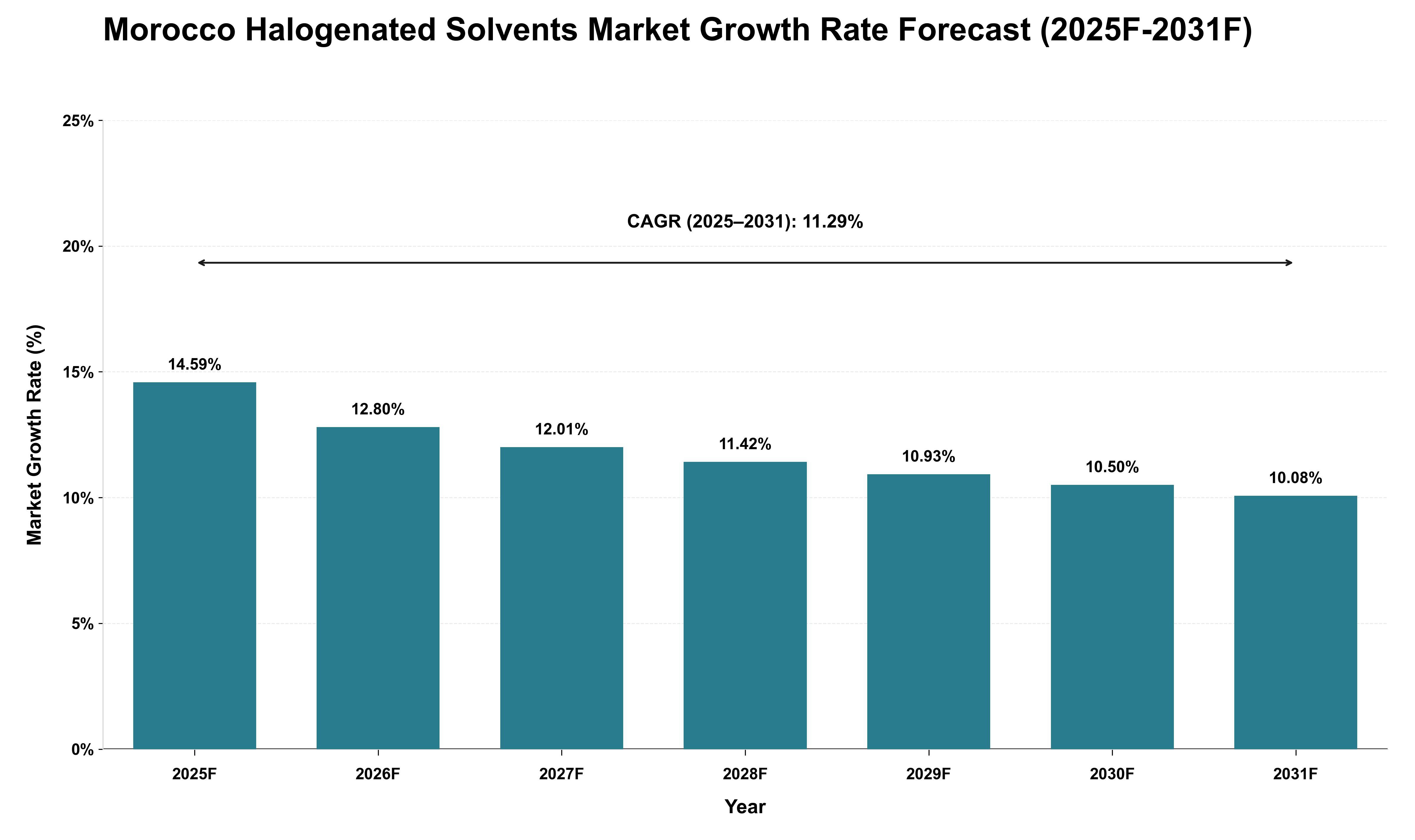
The forecasted growth trajectory for the Moroccan halogenated solvents market will exhibit a notable deceleration from an initial robust increase of 14.59% in 2025 to a more tempered 10.08% by 2031, reflecting a gradual shift in demand dynamics. This trend suggests that while the market will initially benefit from heightened industrial activity and technological advancements driving solvent applications, the subsequent years will likely see a transition towards alternative products and eco-friendly substitutes as regulatory pressures intensify and sustainability becomes paramount. The projected compound annual growth rate (CAGR) of 11.29% indicates strong underlying demand; however, the declining annual growth rates signal potential challenges related to import dependencies and global supply chain fluctuations that could impact availability and pricing. As industries adapt to evolving environmental standards, the halogenated solvents market may face increased competition from innovative materials, influencing its long-term viability within Morocco's chemical sector.
Key Highlights of the Report:
- Morocco Halogenated Solvents Market Outlook
- Market Size of Morocco Halogenated Solvents Market, 2024
- Forecast of Morocco Halogenated Solvents Market, 2031
- Historical Data and Forecast of Morocco Halogenated Solvents Revenues & Volume for the Period 2021 - 2031
- Morocco Halogenated Solvents Market Trend Evolution
- Morocco Halogenated Solvents Market Drivers and Challenges
- Morocco Halogenated Solvents Price Trends
- Morocco Halogenated Solvents Porter's Five Forces
- Morocco Halogenated Solvents Industry Life Cycle
- Historical Data and Forecast of Morocco Halogenated Solvents Market Revenues & Volume By Product for the Period 2021 - 2031
- Historical Data and Forecast of Morocco Halogenated Solvents Market Revenues & Volume By Methylene Chloride for the Period 2021 - 2031
- Historical Data and Forecast of Morocco Halogenated Solvents Market Revenues & Volume By Perchloroethylene for the Period 2021 - 2031
- Historical Data and Forecast of Morocco Halogenated Solvents Market Revenues & Volume By Trichloroethylene for the Period 2021 - 2031
- Historical Data and Forecast of Morocco Halogenated Solvents Market Revenues & Volume By End-use for the Period 2021 - 2031
- Historical Data and Forecast of Morocco Halogenated Solvents Market Revenues & Volume By Paint & Coatings for the Period 2021 - 2031
- Historical Data and Forecast of Morocco Halogenated Solvents Market Revenues & Volume By Printing Inks for the Period 2021 - 2031
- Historical Data and Forecast of Morocco Halogenated Solvents Market Revenues & Volume By Cosmetics & Toiletries for the Period 2021 - 2031
- Historical Data and Forecast of Morocco Halogenated Solvents Market Revenues & Volume By Other for the Period 2021 - 2031
- Morocco Halogenated Solvents Import Export Trade Statistics
- Market Opportunity Assessment By Product
- Market Opportunity Assessment By End-use
- Morocco Halogenated Solvents Top Companies Market Share
- Morocco Halogenated Solvents Competitive Benchmarking By Technical and Operational Parameters
- Morocco Halogenated Solvents Company Profiles
- Morocco Halogenated Solvents Key Strategic Recommendations






































