Morocco Hiking Gear & Equipment Market Size, Share & Growth Rate
The Morocco Hiking Gear & Equipment Market was estimated at USD 460 Million in 2025 and is projected to reach USD 644 Million by 2032, growing at a CAGR of 4.9% from 2026 to 2032. This growth trajectory is primarily driven by the rising interest in outdoor activities, particularly hiking and trekking, among both locals and tourists. The countrys diverse landscapes, including the breathtaking Atlas Mountains and expansive Sahara Desert, offer unparalleled opportunities for adventure, encouraging more individuals to invest in high-quality hiking gear.
Morocco Hiking Gear & Equipment Market Year-wise Growth Rate and Key Drivers
This graph highlights how the Morocco Hiking Gear & Equipment Market has steadily grown over the years, supported by major growth factors.
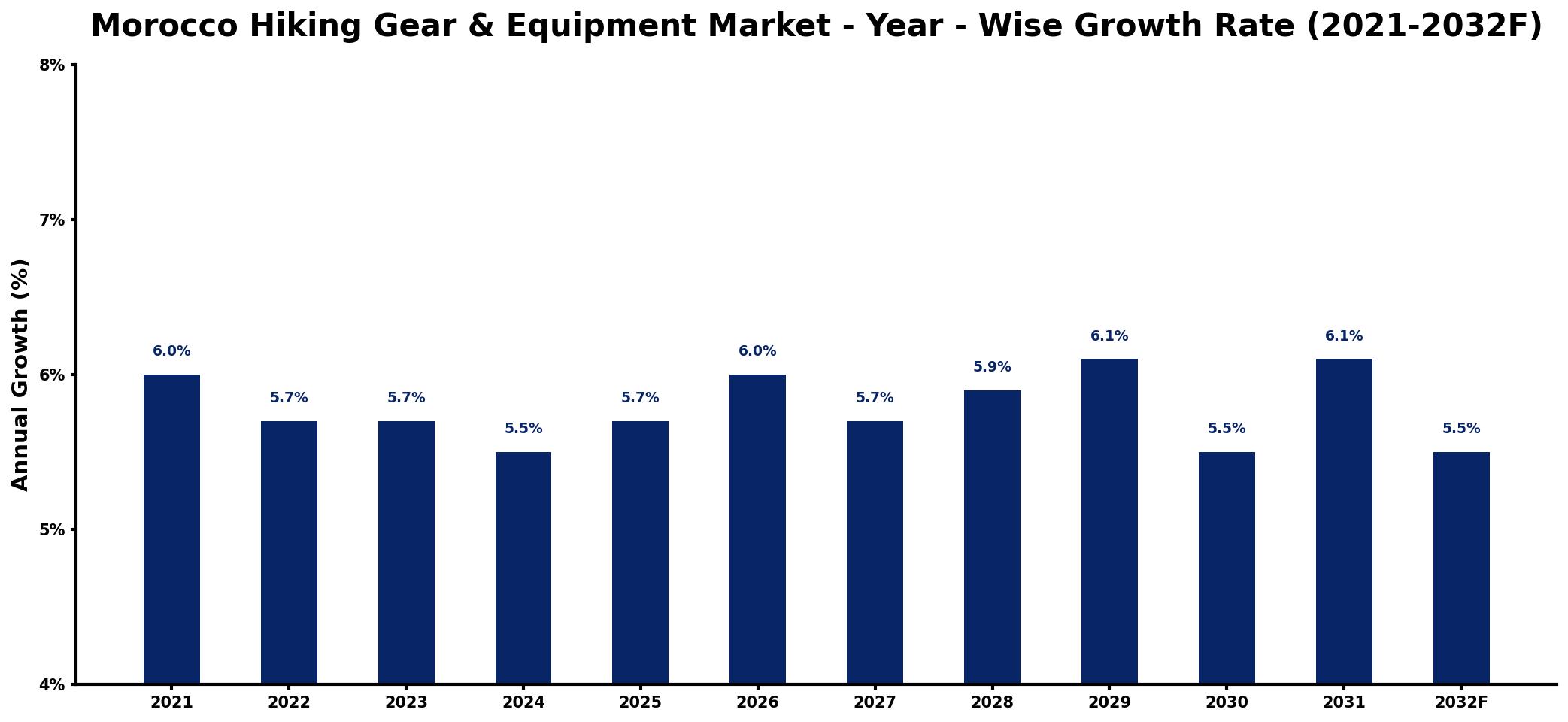
The table below presents the year‑wise growth rates along with the key drivers influencing the market
| Year | Growth Rate | Major Drivers |
| 2021 | 6.0% | Rising interest in outdoor activities |
| 2022 | 5.7% | Increased tourism and travel demand |
| 2023 | 5.7% | Growing popularity of adventure sports |
| 2024 | 5.5% | Expansion of national parks access |
| 2025 | 5.7% | Investment in eco-tourism initiatives |
| 2026 | 6.0% | Emergence of outdoor lifestyle trends |
| 2027 | 5.7% | Enhanced online retail platforms |
| 2028 | 5.9% | Collaboration with local influencers |
| 2029 | 6.1% | Development of sustainable materials |
| 2030 | 5.5% | Focus on health and wellness |
| 2031 | 6.1% | Boost in domestic travel options |
| 2032 | 5.5% | Rise of community-based adventures |
Note: Market size estimations and growth projections presented in this report are based on 6Wresearch's proprietary forecasting methodology, utilizing the latest available industry data, government publications, and primary research inputs.
Morocco Hiking Gear & Equipment Market Synopsis
The most significant force shaping the Morocco Hiking Gear & Equipment Market today is the burgeoning adventure tourism sector. As more travelers are drawn to the countrys natural beauty, the demand for specialized hiking gear has surged, prompting retailers to expand their offerings. Additionally, local interest in outdoor activities is on the rise, with more Moroccans embracing hiking as a recreational pursuit.
Moreover, the increasing availability of e-commerce platforms is transforming consumer accessibility to hiking gear. This shift not only facilitates a wider selection of products but also promotes a competitive pricing environment that benefits consumers. As more brands enter the market, the landscape is evolving rapidly to meet the needs of outdoor enthusiasts.
- The market is projected to reach USD 644 Million by 2032, showcasing robust growth prospects.
- Adventure tourism is a significant catalyst, with both local and international hikers seeking quality equipment.
- Technological advancements are leading to the creation of innovative, lightweight, and durable gear.
- The rise of e-commerce platforms is enhancing product accessibility for consumers across Morocco.
- There is a growing consumer preference for eco-friendly and sustainable hiking equipment.
Despite the promising growth, the Morocco Hiking Gear & Equipment Market faces certain restraints that can impede its progress. A key challenge is the limited availability of specialized products within local retail outlets, which often struggle to keep pace with global trends in hiking gear. This results in a constrained variety for consumers seeking specific items suited to varied terrains. Additionally, the high costs associated with importing specialized gear can limit accessibility, making it expensive for both retailers and consumers. Furthermore, the general lack of awareness regarding the importance of quality hiking gear underscores a need for educational initiatives that can promote informed purchasing decisions.
The market is currently experiencing a notable shift towards lightweight and high-performance gear, driven by hikers preferences for equipment that enhances their outdoor experience. Innovative materials like carbon fiber and moisture-wicking fabrics are gaining traction, reflecting a demand for functionality and durability. Additionally, eco-friendly options made from recycled materials are becoming increasingly popular as consumers prioritize sustainability in their purchasing decisions. Ergonomic designs and multifunctional gear features are also key trends, catering to the modern hikers desire for comfort and versatility on their adventures.
The Morocco hiking gear and equipment market presents numerous avenues for growth and investment. Local manufacturing of high-quality hiking products tailored specifically for Moroccan terrain can offer significant advantages, reducing reliance on imported goods. Retail ventures, both physical stores and online platforms, that focus on outdoor gear can tap into the expanding consumer base. Collaborations with tour operators to create hiking packages that include gear rentals could also provide a strategic advantage, aligning with the growing adventure tourism sector. Overall, stakeholders in this market stand to benefit from the increasing demand for quality outdoor equipment.
The Moroccan government has implemented several initiatives aimed at fostering a robust hiking gear and equipment market. These include encouraging sustainable practices among manufacturers and retailers, promoting local production to enhance the domestic industry, and enforcing quality standards that ensure consumer safety. Additionally, public investment in infrastructure improvements at popular hiking locations is a priority, aimed at bolstering tourism and enhancing accessibility. By offering tax incentives and subsidies to businesses in this sector, the government aims to stimulate innovation and growth within the market.
Looking ahead to the 2026-2032 period, the Morocco Hiking Gear & Equipment Market is poised for steady advancement. The continued rise in health consciousness and interest in outdoor recreation among the populace, coupled with increasing disposable incomes, will likely fuel demand for high-quality hiking gear. Additionally, government initiatives to promote eco-tourism and outdoor activities will further catalyze market growth. As companies innovate and adapt their product offerings to meet the evolving preferences of consumers, the market is set to thrive, offering ample opportunities for both local and international brands.
Recent developments in the Morocco hiking gear and equipment market indicate a strong push towards sustainability, with several brands introducing eco-friendly products made from recycled materials. Additionally, retailers are enhancing their online presence to cater to the growing demand for e-commerce, resulting in improved accessibility for consumers nationwide. Infrastructure upgrades in popular hiking regions are also underway, which are expected to attract more tourists and outdoor enthusiasts, further stimulating market growth.
- 10 Years of Market Numbers
- Historical Data Starting from 2022 to 2025
- Base Year: 2025
- Forecast Data until 2032
- Key Performance Indicators Impacting the Market
- Major Upcoming Developments and Projects
Key Highlights of the Report:
- Morocco Hiking Gear & Equipment Market Outlook
- Market Size of Morocco Hiking Gear & Equipment Market, 2025
- Forecast of Morocco Hiking Gear & Equipment Market, 2032
- Historical Data and Forecast of Morocco Hiking Gear & Equipment Revenues & Volume for the Period 2022-2032F
- Morocco Hiking Gear & Equipment Market Trend Evolution
- Morocco Hiking Gear & Equipment Market Drivers and Challenges
- Morocco Hiking Gear & Equipment Price Trends
- Morocco Hiking Gear & Equipment Porter's Five Forces
- Morocco Hiking Gear & Equipment Industry Life Cycle
- Historical Data and Forecast of Morocco Hiking Gear & Equipment Market Revenues & Volume By Product for the Period 2022-2032F
- Historical Data and Forecast of Morocco Hiking Gear & Equipment Market Revenues & Volume By Clothes for the Period 2022-2032F
- Historical Data and Forecast of Morocco Hiking Gear & Equipment Market Revenues & Volume By Footwear for the Period 2022-2032F
- Historical Data and Forecast of Morocco Hiking Gear & Equipment Market Revenues & Volume By Backpack for the Period 2022-2032F
- Historical Data and Forecast of Morocco Hiking Gear & Equipment Market Revenues & Volume By Equipment for the Period 2022-2032F
- Historical Data and Forecast of Morocco Hiking Gear & Equipment Market Revenues & Volume By Others for the Period 2022-2032F
- Historical Data and Forecast of Morocco Hiking Gear & Equipment Market Revenues & Volume By Distribution Channel for the Period 2022-2032F
- Historical Data and Forecast of Morocco Hiking Gear & Equipment Market Revenues & Volume By Specialty stores for the Period 2022-2032F
- Historical Data and Forecast of Morocco Hiking Gear & Equipment Market Revenues & Volume By Retail stores for the Period 2022-2032F
- Historical Data and Forecast of Morocco Hiking Gear & Equipment Market Revenues & Volume By Online for the Period 2022-2032F
- Morocco Hiking Gear & Equipment Import Export Trade Statistics
- Market Opportunity Assessment By Product
- Market Opportunity Assessment By Distribution Channel
- Morocco Hiking Gear & Equipment Top Companies Market Share
- Morocco Hiking Gear & Equipment Competitive Benchmarking By Technical and Operational Parameters
- Morocco Hiking Gear & Equipment Company Profiles
- Morocco Hiking Gear & Equipment Key Strategic Recommendations






































