Morocco Hospital Equipment And Supplies Market Size, Share & Growth Rate
The Morocco Hospital Equipment And Supplies Market was estimated at USD 218 Million in 2025 and is projected to reach USD 287 Million by 2032, growing at a CAGR of 4.0% from 2026 to 2032. This robust growth trajectory is driven by the country's ongoing investments in healthcare infrastructure, which include the construction of new hospitals and the renovation of existing facilities. Additionally, the rise in chronic diseases among the population is creating an urgent demand for advanced medical devices and surgical tools.
Morocco Hospital Equipment And Supplies Market Year-wise Growth Rate and Key Drivers
This graph highlights how the Morocco Hospital Equipment And Supplies Market has steadily grown over the years, supported by major growth factors.
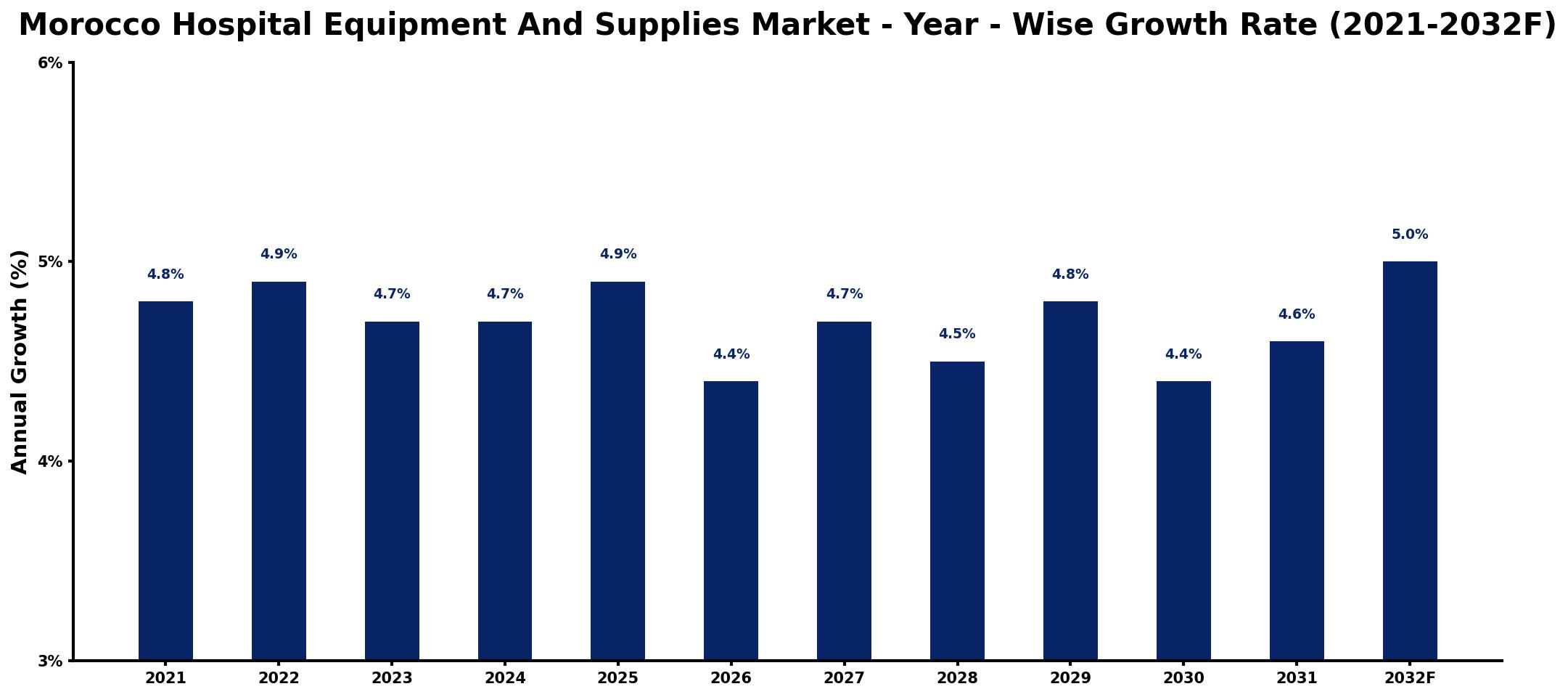
The table below presents the year‑wise growth rates along with the key drivers influencing the market
| Year | Growth Rate | Major Drivers |
| 2021 | 4.8% | Rising healthcare expenditure trends |
| 2022 | 4.9% | Increased public health initiatives |
| 2023 | 4.7% | Growing aging population demands |
| 2024 | 4.7% | Expansion of healthcare facilities |
| 2025 | 4.9% | Technological advancements in services |
| 2026 | 4.4% | Higher investments in healthcare infrastructure |
| 2027 | 4.7% | Surge in chronic disease management |
| 2028 | 4.5% | Improved healthcare insurance coverage |
| 2029 | 4.8% | Increased government health funding |
| 2030 | 4.4% | Emergence of telehealth services |
| 2031 | 4.6% | Enhanced patient care standards |
| 2032 | 5.0% | Focus on preventive healthcare measures |
Note: Market size estimations and growth projections presented in this report are based on 6Wresearch's proprietary forecasting methodology, utilizing the latest available industry data, government publications, and primary research inputs.
Morocco Hospital Equipment And Supplies Market Synopsis
The Moroccan healthcare landscape is undergoing transformative changes, reflected by a notable increase in the procurement of essential medical equipment. Specifically, the demand for hospital beds and diagnostic tools has surged as healthcare facilities strive to enhance their service delivery capabilities. This shift underscores a commitment to improving patient outcomes across various medical disciplines.
Furthermore, the push towards integrating cutting-edge medical technology within hospitals is a pivotal factor contributing to the growth of the market. As healthcare practitioners seek innovative solutions to optimize efficiency and accuracy, surgical instruments and consumables are now more critical than ever, positioning the market for sustained expansion.
Morocco Hospital Equipment And Supplies Market Key Takeaways
- The market is poised for growth, fueled by substantial investments in healthcare infrastructure.
- Chronic diseases are becoming increasingly prevalent, driving demand for advanced medical technologies.
- Government policies focus on enhancing quality standards and promoting local manufacturing of medical supplies.
- Challenges include budget constraints and regulatory hurdles that could affect market dynamics.
- The rise of telemedicine and remote diagnostics represents a new frontier for equipment and supply demand.
Evaluation of Restraints in Morocco Hospital Equipment And Supplies Market
While the Morocco Hospital Equipment And Supplies Market is experiencing growth, several constraints could hinder its full potential. Limited healthcare budgets pose significant challenges, as hospitals may struggle to allocate sufficient funds for purchasing new equipment. Regulatory hurdles also impact the timely introduction of innovative technologies, often leading to delays in procurement processes. Additionally, supply chain disruptions, exacerbated by global events, can affect the availability of essential medical supplies, ultimately slowing market momentum.
Morocco Hospital Equipment And Supplies Market Trends
Current trends within the Morocco Hospital Equipment And Supplies Market highlight a significant shift towards digital health solutions. Telemedicine is becoming increasingly popular, prompting hospitals to invest in the requisite technology and equipment. Furthermore, an emphasis on minimally invasive surgical procedures is influencing the demand for sophisticated surgical instruments, which are associated with reduced recovery times and improved patient safety. There is also a growing inclination towards sustainable practices in the procurement of medical supplies, as facilities seek eco-friendly options.
Morocco Hospital Equipment And Supplies Market Opportunities
The Moroccan market presents numerous growth and investment opportunities, particularly in the realm of localized manufacturing. The governments push for self-sufficiency in medical device production is opening avenues for partnerships with international manufacturers. Additionally, as telehealth continues to gain traction, the demand for related equipment and software solutions is set to expand significantly. This sector offers promising prospects for businesses that can leverage technological advancements to meet the evolving needs of healthcare providers.
Government Initiatives in the Morocco Hospital Equipment And Supplies Market
The Moroccan government has implemented several initiatives aimed at bolstering the hospital equipment and supplies market. These include policies that prioritize the enhancement of quality standards and the establishment of procurement regulations to ensure that healthcare facilities have access to reliable products. Furthermore, there are ongoing efforts to reduce import tariffs on essential medical equipment, which encourages investment in both local manufacturing and international partnerships. Such measures are vital for increasing accessibility to quality healthcare services throughout the country.
Future Insights of the Morocco Hospital Equipment And Supplies Market
Looking forward to the period from 2026 to 2032, the Morocco Hospital Equipment And Supplies Market is expected to witness significant advancements, primarily driven by technological innovations. The increasing integration of artificial intelligence and machine learning in diagnostics and patient monitoring will redefine service delivery in hospitals. Moreover, the emphasis on preventive care will likely reshape the demand landscape, focusing more on diagnostic and monitoring equipment as the healthcare system transitions towards more proactive management of patient health.
Morocco Hospital Equipment And Supplies Market Latest Developments (2025 - 2026)
In recent months, the Moroccan healthcare sector has seen heightened activity, particularly in the procurement of advanced medical technologies. Hospitals are actively engaging in partnerships with suppliers to incorporate innovative devices designed for improved patient care. Additionally, local manufacturing initiatives are gaining momentum, allowing for the development of products tailored to meet regional needs. This strategic direction aims to enhance the overall healthcare ecosystem in Morocco.
Morocco Hospital Equipment And Supplies Market - Key Attractiveness of the Report
- 10 Years of Market Numbers
- Historical Data Starting from 2022 to 2025
- Base Year: 2025
- Forecast Data until 2032
- Key Performance Indicators Impacting the Market
- Major Upcoming Developments and Projects
Key Highlights of the Report:
- Morocco Hospital Equipment And Supplies Market Outlook
- Market Size of Morocco Hospital Equipment And Supplies Market, 2025
- Forecast of Morocco Hospital Equipment And Supplies Market, 2032
- Historical Data and Forecast of Morocco Hospital Equipment And Supplies Revenues & Volume for the Period 2022-2032F
- Morocco Hospital Equipment And Supplies Market Trend Evolution
- Morocco Hospital Equipment And Supplies Market Drivers and Challenges
- Morocco Hospital Equipment And Supplies Price Trends
- Morocco Hospital Equipment And Supplies Porter's Five Forces
- Morocco Hospital Equipment And Supplies Industry Life Cycle
- Historical Data and Forecast of Morocco Hospital Equipment And Supplies Market Revenues & Volume By Product for the Period 2022-2032F
- Historical Data and Forecast of Morocco Hospital Equipment And Supplies Market Revenues & Volume By Sterilization And Disinfectant Equipment for the Period 2022-2032F
- Historical Data and Forecast of Morocco Hospital Equipment And Supplies Market Revenues & Volume By Disposable Hospital Supplies Patient Examination Devices for the Period 2022-2032F
- Historical Data and Forecast of Morocco Hospital Equipment And Supplies Market Revenues & Volume By Syringes And Needles for the Period 2022-2032F
- Historical Data and Forecast of Morocco Hospital Equipment And Supplies Market Revenues & Volume By Application for the Period 2022-2032F
- Historical Data and Forecast of Morocco Hospital Equipment And Supplies Market Revenues & Volume By OEMs for the Period 2022-2032F
- Historical Data and Forecast of Morocco Hospital Equipment And Supplies Market Revenues & Volume By Aftermarket for the Period 2022-2032F
- Morocco Hospital Equipment And Supplies Import Export Trade Statistics
- Market Opportunity Assessment By Product
- Market Opportunity Assessment By Application
- Morocco Hospital Equipment And Supplies Top Companies Market Share
- Morocco Hospital Equipment And Supplies Competitive Benchmarking By Technical and Operational Parameters
- Morocco Hospital Equipment And Supplies Company Profiles
- Morocco Hospital Equipment And Supplies Key Strategic Recommendations






































