Morocco Household furniture Market Summary
The morocco household furniture market was estimated at USD 201 Million in 2025 and is projected to reach USD 221 Million by 2032, growing at a CAGR of 0.9% from 2026 to 2032.
Morocco Household furniture Market Year-wise Growth Rate and Key Drivers
This graph highlights how the Morocco Household furniture Market has steadily grown over the past five years, supported by major growth factors.
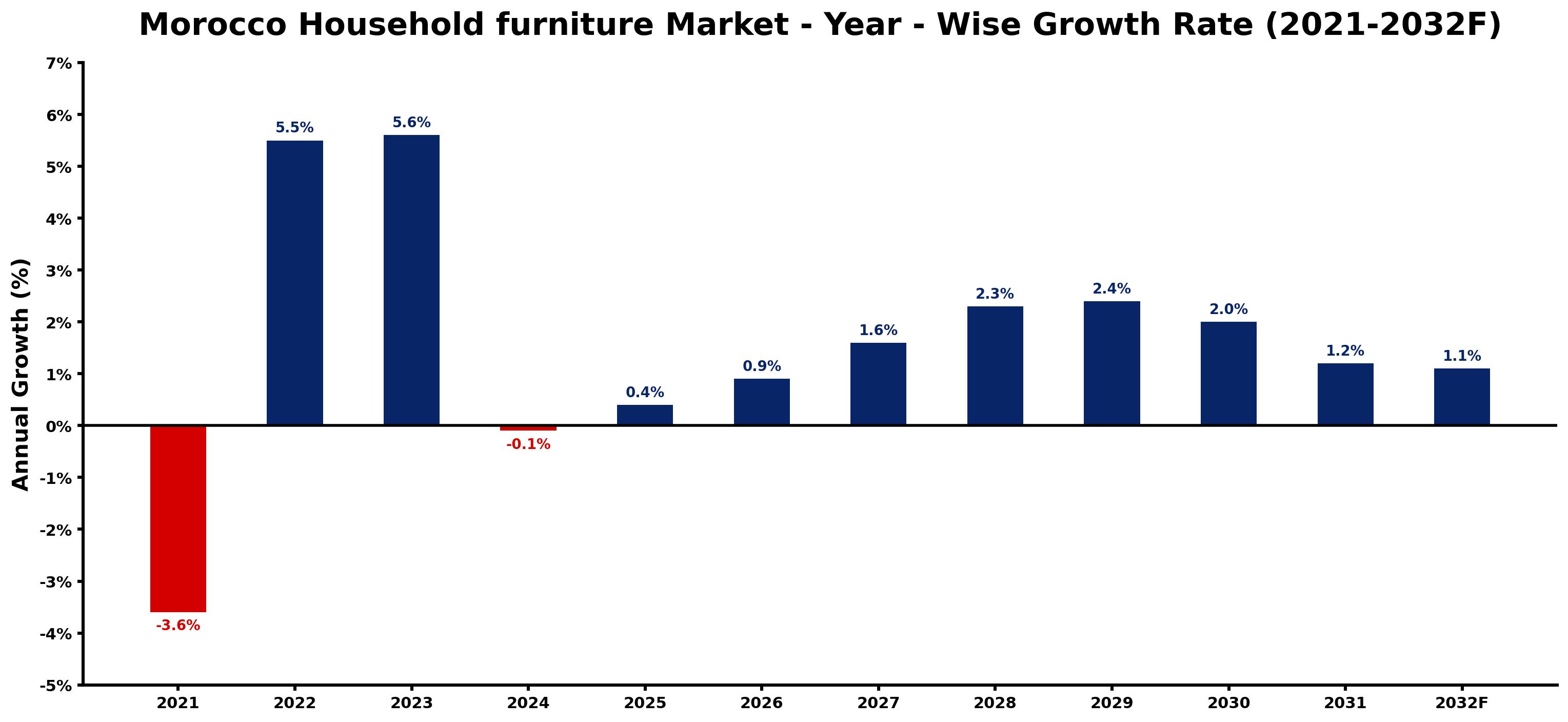
The table below presents the year wise growth rates along with the key drivers influencing the market
| Year | Growth Rate | Major Drivers |
| 2021 | -3.6% | Supply chain disruptions and increased shipping costs hindered availability of household furniture, dampening sales in 2021. |
| 2022 | 5.5% | Increased disposable incomes allowed families to invest in quality furniture products. |
| 2023 | 5.6% | Urbanization trends prompted a surge in demand for contemporary living solutions. |
| 2024 | -0.1% | Increased foreign competition eroded market share, leading to reduced sales for local furniture manufacturers. |
| 2025 | 0.4% | Middle-class expansion results in heightened interest in premium home decor items. |
| 2026 | 0.9% | Sustainability concerns pushed manufacturers to explore eco-friendly material alternatives. |
| 2027 | 1.6% | Rural electrification projects enabled greater purchasing power in underserved areas. |
| 2028 | 2.3% | Technological innovations in design led to unique, tailored furniture solutions for homes. |
| 2029 | 2.4% | Cultural shifts towards remote work increased demand for home office furniture. |
| 2030 | 2.0% | Tourism recovery promoted local artisans, showcasing Moroccan furniture craftsmanship worldwide. |
| 2031 | 1.2% | Real estate developments emphasized integrated living spaces, driving furniture sales further. |
| 2032 | 1.1% | Growing consumer awareness about brand values influenced preferences for ethical products. |
Note - Market size estimations and growth projections presented in this report are based on 6Wresearch's advanced forecasting approach, validated with industry datasets as of June 2026.
Morocco Household furniture Market Synopsis
The Morocco Household furniture Market is projected to reach 0.9% and witness significant growth during the forecast period (2026-2032). This robust growth trajectory is underpinned by several factors, including rapid urbanization, an increase in disposable incomes, and a notable shift in consumer preferences toward both modern and traditional furniture styles. As urban living spaces evolve, there is an increasing demand for a diverse range of products ranging from living room and bedroom furniture to outdoor and kitchen furnishings. The market dynamics reflect a blend of local craftsmanship and modern design, indicative of Morocco's rich cultural heritage and its adaptive response to contemporary trends.
Morocco Household furniture Market Growth Drivers
Several key drivers are propelling the growth of the Morocco Household furniture Market:
- Urbanization is a significant driver, as more individuals and families migrate to cities, leading to increased demand for modern furniture that fits smaller living spaces.
- Rising disposable incomes enable consumers to invest in quality furniture, shifting preferences towards higher-end products that combine aesthetics and functionality.
- The growing popularity of e-commerce platforms has transformed shopping habits, making it more convenient for consumers to access a wide variety of furniture options from the comfort of their homes.
- There is an increasing consumer inclination toward sustainable living, prompting demand for eco-friendly furniture made from recycled or locally sourced materials.
- The revival of traditional Moroccan designs alongside contemporary styles caters to a diverse demographic, helping to retain cultural identity while appealing to modern tastes.
Morocco Household furniture Market Trends and Opportunities
The Morocco Household furniture Market is witnessing several notable trends:
- Modern and contemporary furniture designs are gaining traction, with consumers seeking innovative and space-efficient solutions for their homes.
- Customization and personalization of furniture pieces are rapidly becoming popular, allowing consumers to express their unique tastes and preferences.
- There is a marked shift towards multifunctional furniture, particularly in urban areas where space is limited, driving innovations in design.
- Online retail continues to expand, with brands investing in digital marketing and user-friendly platforms to enhance the consumer shopping experience.
- Sustainability trends are influencing production processes, with manufacturers focusing on sustainable practices and the use of eco-friendly materials.
Morocco Household furniture Market Challenges and Restraints
Despite its growth prospects, the Morocco Household furniture Market faces several challenges:
- Intensified competition from both local and international manufacturers could pressure margins and market share for smaller, local producers.
- Fluctuations in raw material prices can adversely impact production costs and profitability, making it challenging for manufacturers to maintain stable pricing.
- The presence of a large informal sector contributes to unfair competition, where lower-quality products are offered at reduced prices, undermining established brands.
- Economic fluctuations can lead to decreased consumer spending on non-essential items, including medium to high-end furniture purchases.
- Geopolitical uncertainties and trade restrictions may disrupt supply chains, affecting the import and export of furniture materials and finished products.
Morocco Household furniture Market Investment Opportunities
Investment opportunities abound in the Morocco Household furniture Market, particularly in the following areas:
- Investing in the production of modern and trendy furniture designs that cater to the evolving aesthetic preferences of consumers presents a significant market opportunity.
- Capitalizing on the demand for sustainable furniture by integrating eco-friendly practices and materials into the manufacturing process will appeal to environmentally conscious consumers.
- Leveraging the growth of e-commerce can offer brands a wider reach, enhancing customer engagement and driving sales through improved online platforms.
- Collaborating with local artisans to produce unique, handcrafted furniture can create a niche market, attracting consumers looking for authenticity and cultural value.
- Exploring export opportunities, particularly in regions with a demand for Moroccan design elements, can facilitate market expansion and brand visibility.
Morocco Household furniture Market Government Investment and Initiatives
The Moroccan government is actively involved in promoting the household furniture market through various initiatives:
- Policies are in place to incentivize local furniture manufacturers, encouraging domestic production and enhancing competitiveness within the market.
- Focus on sustainable practices has led to government support for initiatives that promote eco-friendly production methods, ensuring the long-term viability of the industry.
- Investment in infrastructure improvements, such as logistics and distribution networks, facilitates smoother supply chains for furniture manufacturers.
- Quality control regulations are enforced to protect consumers, ensuring that only safe and reliable products are available in the market.
- Public spending on urban development and housing projects can stimulate demand for household furniture as new residential areas are established.
Morocco Household furniture Market Latest Developments (May 2025 - June 2026)
During the period from May 2025 to June 2026, several developments within the Morocco Household furniture Market have emerged:
- A noticeable surge in demand for online purchasing options has led many traditional retailers to enhance their digital offerings and establish e-commerce strategies.
- Investment in sustainable furniture manufacturing has increased, with more companies adopting practices that align with eco-friendly standards.
- Collaborations between local craftsmen and designers have resulted in innovative furniture collections that blend traditional Moroccan artistry with modern functionality.
- Market players are increasingly engaging in promotional campaigns to highlight the benefits of investing in higher-quality furniture products, educating consumers on the value proposition.
- The introduction of new regulations aimed at ensuring product quality has further strengthened consumer trust and market integrity.
Morocco Household furniture Market - Key Attractiveness of the Report
- 10 Years of Market Numbers
- Historical Data Starting from 2022 to 2025
- Base Year: 2025
- Forecast Data until 2032
- Key Performance Indicators Impacting the Market
- Major Upcoming Developments and Projects
Key Highlights of the Report:
- Morocco Household furniture Market Outlook
- Market Size of Morocco Household furniture Market, 2025
- Forecast of Morocco Household furniture Market, 2032F
- Historical Data and Forecast of Morocco Household furniture Revenues & Volume for the Period 2022-2032F
- Morocco Household furniture Market Trend Evolution
- Morocco Household furniture Market Drivers and Challenges
- Morocco Household furniture Price Trends
- Morocco Household furniture Porter's Five Forces
- Morocco Household furniture Industry Life Cycle
- Historical Data and Forecast of Morocco Household furniture Market Revenues & Volume By Types for the Period 2022-2032F
- Historical Data and Forecast of Morocco Household furniture Market Revenues & Volume By Wood Furniture for the Period 2022-2032F
- Historical Data and Forecast of Morocco Household furniture Market Revenues & Volume By Metal Furniture for the Period 2022-2032F
- Historical Data and Forecast of Morocco Household furniture Market Revenues & Volume By Plastic Furniture for the Period 2022-2032F
- Historical Data and Forecast of Morocco Household furniture Market Revenues & Volume By Others for the Period 2022-2032F
- Historical Data and Forecast of Morocco Household furniture Market Revenues & Volume By Area of Use for the Period 2022-2032F
- Historical Data and Forecast of Morocco Household furniture Market Revenues & Volume By ?Bedroom Furniture for the Period 2022-2032F
- Historical Data and Forecast of Morocco Household furniture Market Revenues & Volume By Living Room Furniture for the Period 2022-2032F
- Historical Data and Forecast of Morocco Household furniture Market Revenues & Volume By Dining Room Furniture for the Period 2022-2032F
- Historical Data and Forecast of Morocco Household furniture Market Revenues & Volume By Household Furniture for the Period 2022-2032F
- Historical Data and Forecast of Morocco Household furniture Market Revenues & Volume By Others for the Period 2022-2032F
- Morocco Household furniture Import Export Trade Statistics
- Market Opportunity Assessment By Types
- Market Opportunity Assessment By Area of Use
- Morocco Household furniture Top Companies Market Share
- Morocco Household furniture Competitive Benchmarking By Technical and Operational Parameters
- Morocco Household furniture Company Profiles
- Morocco Household furniture Key Strategic Recommendations






































