Morocco Image Recognition Market Size & Growth Rate (2026-2032)
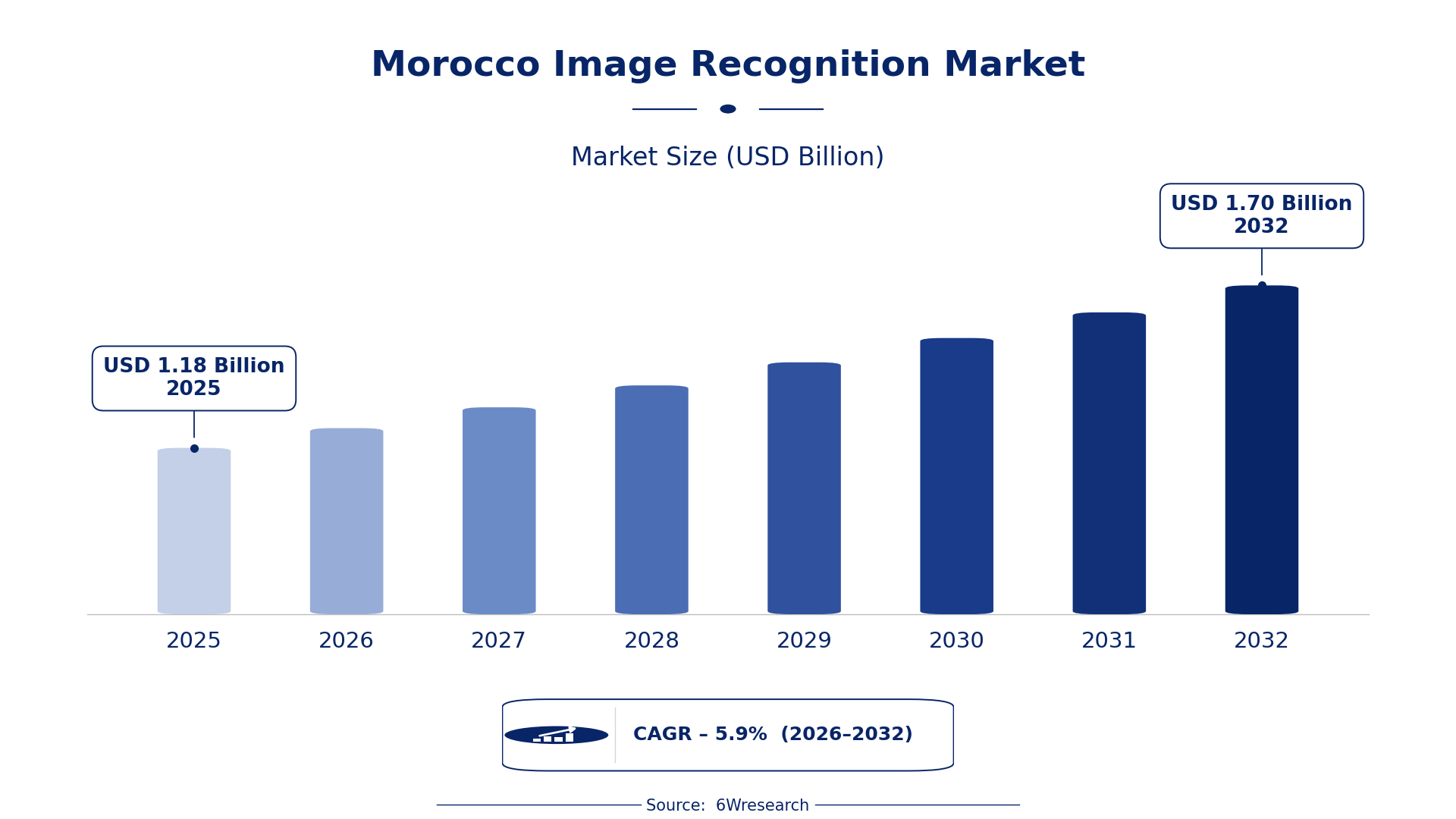
The Morocco Image Recognition Market was estimated at USD 1179 Million in 2025 and is projected to reach USD 1697 Million by 2032, growing at a CAGR of 5.9% from 2026 to 2032.
Morocco Image Recognition Market Synopsis
The driving force behind the Morocco Image Recognition Market is the increasing adoption of artificial intelligence technologies across multiple sectors. Retail, healthcare, and security are at the forefront of this trend, as organizations seek to enhance efficiency and customer experience through advanced visual recognition systems.
As smartphone usage rises, the integration of image recognition capabilities into mobile applications is also expanding. This growth reflects a broader trend of businesses leveraging technology to streamline operations and gain a competitive edge in the market.
Morocco Image Recognition Market Year-wise Growth Rate and Key Drivers
This graph illustrates the annual growth rates of the Morocco Image Recognition Market from 2021 to 2032, highlighting a steady upward trajectory and projected expansion over the forecast period.
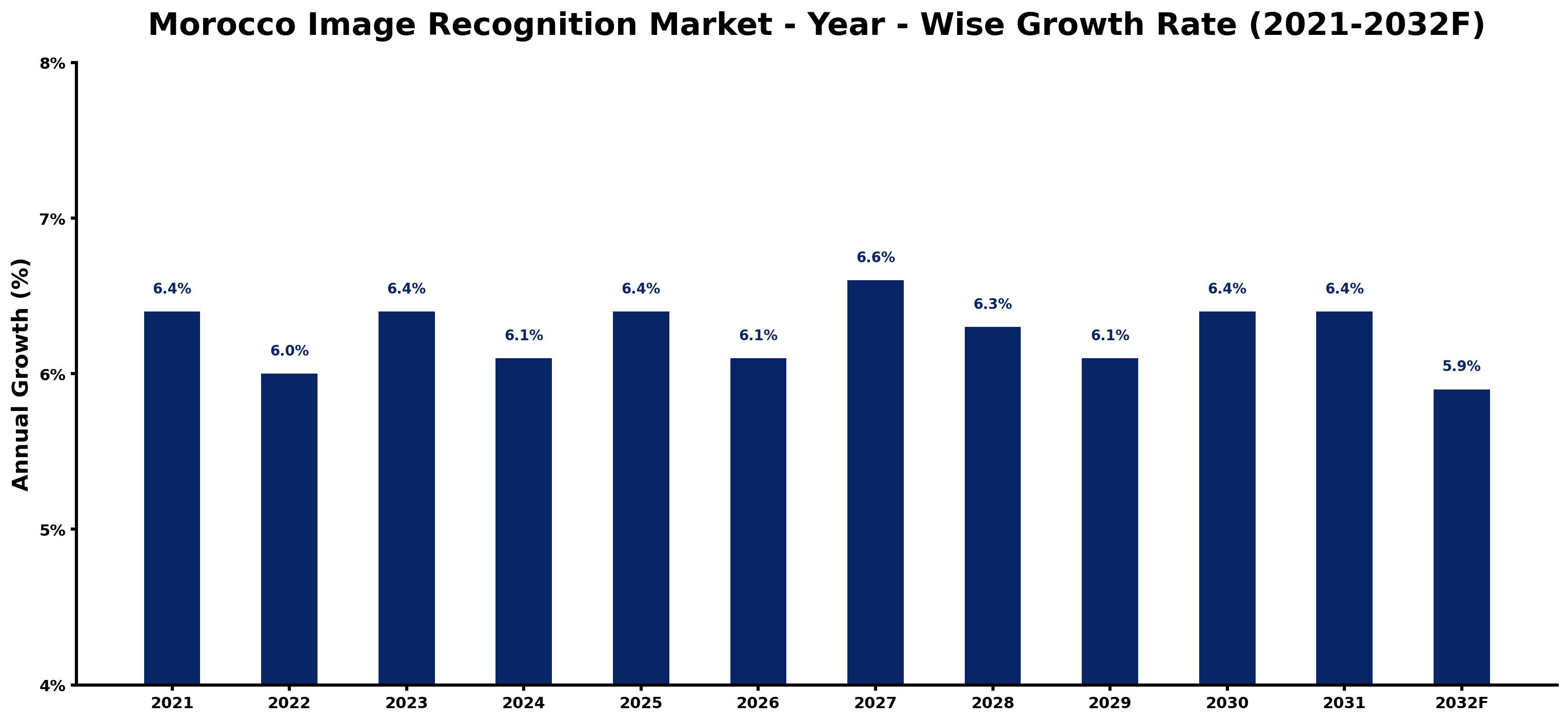
The table below presents the year‑wise growth rates along with the key drivers influencing the market
| Year | Growth Rate | Major Drivers |
| 2021 | 6.4% | Growing adoption of biometric systems in retail industry. |
| 2022 | 6.0% | Increased government focus on smart city initiatives. |
| 2023 | 6.4% | Rising e-commerce growth necessitating advanced image analytics. |
| 2024 | 6.1% | Local universities enhancing AI curriculum for image processing. |
| 2025 | 6.4% | Adoption of image recognition in Moroccan tourism sector. |
| 2026 | 6.1% | Investment in health tech driving medical imaging solutions. |
| 2027 | 6.6% | Emergence of local startups developing retail scanning tools. |
| 2028 | 6.3% | Integration of image recognition in national security systems. |
| 2029 | 6.1% | Platforms enhancing cultural heritage management with visual tech. |
| 2030 | 6.4% | Government supporting AI innovations through funding programs. |
| 2031 | 6.4% | Adoption of image recognition in smart agriculture practices. |
| 2032 | 5.9% | Increased demand for visual data analytics in marketing. |
Note: Market size estimations and growth projections presented in this report are based on 6Wresearch's proprietary forecasting methodology, utilizing the latest available industry data, government publications, and primary research inputs.
Morocco Image Recognition Market Key Takeaways
Below are some of the specific key takeaways from the market, including:
- The market is significantly driven by advancements in artificial intelligence and machine learning.
- Growing demand for security solutions is pushing the adoption of image recognition technologies.
- Integration of image recognition in retail and healthcare sectors is enhancing operational efficiency.
- Opportunities exist in developing applications for facial recognition and object detection.
- The government's commitment to digital transformation supports market growth through favorable policies.
Evaluation of Restraints in Morocco Image Recognition Market
While the Morocco Image Recognition Market is on an upward trajectory, it faces notable constraints. Technological limitations, particularly the need for more sophisticated algorithms, hinder accurate object identification. Privacy concerns surrounding data protection present another significant challenge. The absence of high-quality training datasets tailored to local contexts further complicates the development of effective solutions. Market players must address these issues through investment in R&D and collaborations that enhance technology transfer.
Morocco Image Recognition Market Trends
Current trends show a marked increase in the integration of image recognition technologies across various industries. Retailers are utilizing these tools for visual search capabilities, while healthcare providers are adopting them for diagnostic support. The rise of smart city initiatives is also pushing demand for image recognition solutions in urban planning and management. on top of that, the popularity of social media platforms is driving the need for efficient content moderation tools.
Morocco Image Recognition Market Opportunities
A wealth of opportunities exists within the Morocco Image Recognition Market, particularly in the realms of facial recognition and object detection applications. Companies are encouraged to explore the development of tailored solutions for local industries, including tourism and agriculture. The growth of e-commerce also presents a fertile ground for image recognition technology, especially for personalized marketing and enhanced user experience. As smart city projects advance, the demand for efficient surveillance and data analytics tools will only increase.
Government Initiatives in the Morocco Image Recognition Market
The Moroccan government is actively shaping the image recognition market through a series of strategic initiatives. By investing in digital infrastructure and promoting innovation, the government aims to create an environment conducive to technological advancement. Public-private partnerships are being encouraged to facilitate knowledge transfer and enhance local capabilities in this space.
- A national digital infrastructure upgrade programme launched in 2023 aims to enhance connectivity and technological capabilities across the country.
- Currently underway is a research initiative focused on developing advanced image recognition algorithms tailored to local needs.
- A planned public-private partnership expected to commence in 2026 seeks to boost the development of smart city technologies, including image recognition applications.
- The introduction of data protection regulations in 2025 ensures consumer privacy, a crucial aspect for the image recognition market.
Future Insights of the Morocco Image Recognition Market
Looking ahead to 2026-2032, the Morocco Image Recognition Market is set for substantial growth. The increasing integration of artificial intelligence and machine learning technologies across sectors will continue to drive demand for image recognition solutions. As businesses increasingly recognize the value of data analytics and automation, the market is likely to see a surge in innovative applications. The government’s initiatives to support digital transformation will further bolster this growth trajectory.
Morocco Image Recognition Market Latest Developments
In the past year, the Morocco Image Recognition Market has witnessed significant developments, reflecting a dynamic and rapidly evolving environment. As technology continues to advance, various stakeholders are engaging in initiatives that enhance capabilities and expand applications in this sector.
- A regional technology vendor launched a new image recognition tool in early 2023, aimed at improving retail analytics.
- An initiative that began in mid-2023 is currently enhancing public security through the deployment of facial recognition systems in urban areas.
- A collaboration between local universities and tech firms to develop machine learning models for healthcare applications is ongoing and expected to yield results by late 2024.
- A planned rollout of a comprehensive image recognition solution for e-commerce platforms is set to begin in Q1 2025.
Morocco Image Recognition Market - Key Attractiveness of the Report
- 10 Years of Market Numbers
- Historical Data Starting from 2022 to 2025
- Base Year: 2025
- Forecast Data until 2032
- Key Performance Indicators Impacting the Market
- Major Upcoming Developments and Projects
Key Highlights of the Report:
- Morocco Image Recognition Market Outlook
- Market Size of Morocco Image Recognition Market, 2025
- Forecast of Morocco Image Recognition Market, 2032
- Historical Data and Forecast of Morocco Image Recognition Revenues & Volume for the Period 2022-2032F
- Morocco Image Recognition Market Trend Evolution
- Morocco Image Recognition Market Drivers and Challenges
- Morocco Image Recognition Price Trends
- Morocco Image Recognition Porter's Five Forces
- Morocco Image Recognition Industry Life Cycle
- Historical Data and Forecast of Morocco Image Recognition Market Revenues & Volume By Technology for the Period 2022-2032F
- Historical Data and Forecast of Morocco Image Recognition Market Revenues & Volume By Digital Image Processing for the Period 2022-2032F
- Historical Data and Forecast of Morocco Image Recognition Market Revenues & Volume By Facial Recognition for the Period 2022-2032F
- Historical Data and Forecast of Morocco Image Recognition Market Revenues & Volume By Pattern Recognition for the Period 2022-2032F
- Historical Data and Forecast of Morocco Image Recognition Market Revenues & Volume By Deployment Mode for the Period 2022-2032F
- Historical Data and Forecast of Morocco Image Recognition Market Revenues & Volume By On-premises for the Period 2022-2032F
- Historical Data and Forecast of Morocco Image Recognition Market Revenues & Volume By Cloud for the Period 2022-2032F
- Historical Data and Forecast of Morocco Image Recognition Market Revenues & Volume By Component for the Period 2022-2032F
- Historical Data and Forecast of Morocco Image Recognition Market Revenues & Volume By Hardware for the Period 2022-2032F
- Historical Data and Forecast of Morocco Image Recognition Market Revenues & Volume By Software for the Period 2022-2032F
- Historical Data and Forecast of Morocco Image Recognition Market Revenues & Volume By Services for the Period 2022-2032F
- Historical Data and Forecast of Morocco Image Recognition Market Revenues & Volume By Application for the Period 2022-2032F
- Historical Data and Forecast of Morocco Image Recognition Market Revenues & Volume By Scanning and Imaging for the Period 2022-2032F
- Historical Data and Forecast of Morocco Image Recognition Market Revenues & Volume By Security and Surveillance for the Period 2022-2032F
- Historical Data and Forecast of Morocco Image Recognition Market Revenues & Volume By Image Search for the Period 2022-2032F
- Historical Data and Forecast of Morocco Image Recognition Market Revenues & Volume By Augmented Reality for the Period 2022-2032F
- Historical Data and Forecast of Morocco Image Recognition Market Revenues & Volume By Marketing and Advertising for the Period 2022-2032F
- Morocco Image Recognition Import Export Trade Statistics
- Market Opportunity Assessment By Technology
- Market Opportunity Assessment By Deployment Mode
- Market Opportunity Assessment By Component
- Market Opportunity Assessment By Application
- Morocco Image Recognition Top Companies Market Share
- Morocco Image Recognition Competitive Benchmarking By Technical and Operational Parameters
- Morocco Image Recognition Company Profiles
- Morocco Image Recognition Key Strategic Recommendations






































