Morocco Industrial Rubber Products Market Size, Share & Growth Rate
The Morocco Industrial Rubber Products Market was estimated at USD 87 Million in 2025 and is projected to reach USD 95 Million by 2032, growing at a CAGR of 1.3% from 2026 to 2032. This growth is primarily fueled by the increasing demand from automotive and construction sectors, where rubber products are indispensable for efficient operations. Additionally, advancements in manufacturing technologies are enabling the production of high-performance rubber materials, further driving market traction.
Morocco Industrial Rubber Products Market Year-wise Growth Rate and Key Drivers
This graph highlights how the Morocco Industrial Rubber Products Market has steadily grown over the years, supported by major growth factors.
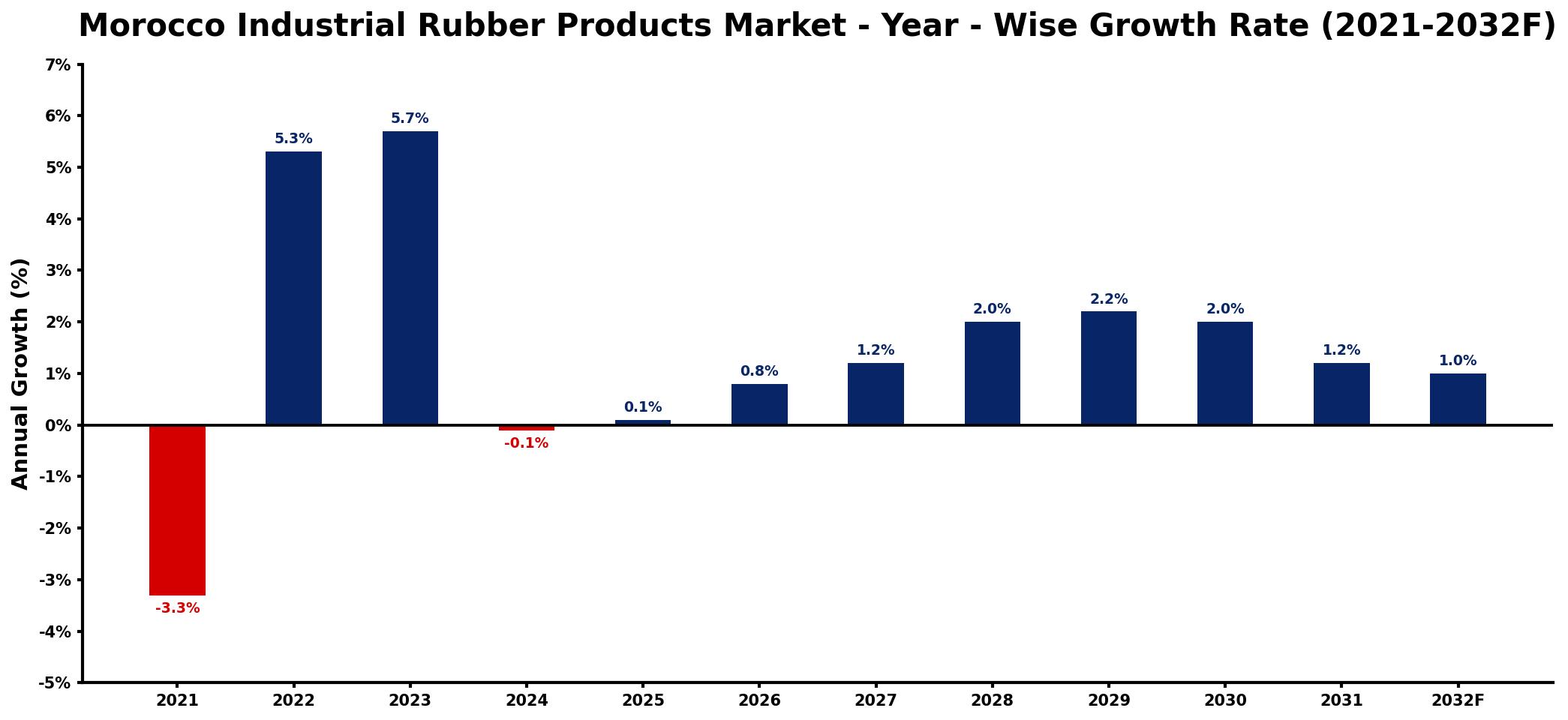
The table below presents the year‑wise growth rates along with the key drivers influencing the market
| Year | Growth Rate | Major Drivers |
| 2021 | -3.3% | decrease in construction sector activity |
| 2022 | 5.3% | increased demand from automotive sector |
| 2023 | 5.7% | growth in renewable energy investments |
| 2024 | -0.1% | lower exports to neighboring countries |
| 2025 | 0.1% | rising infrastructure development projects |
| 2026 | 0.8% | expansion in manufacturing capabilities |
| 2027 | 1.2% | enhanced transportation network investments |
| 2028 | 2.0% | growing consumer goods market demand |
| 2029 | 2.2% | higher adoption of eco-friendly materials |
| 2030 | 2.0% | increased focus on sustainable practices |
| 2031 | 1.2% | increased overall sector activity |
| 2032 | 1.0% | rising demand from construction projects |
Note: Market size estimations and growth projections presented in this report are based on 6Wresearch's proprietary forecasting methodology, utilizing the latest available industry data, government publications, and primary research inputs.
Morocco Industrial Rubber Products Market Synopsis
Recently, the Morocco Industrial Rubber Products Market has experienced steady momentum due to the surge in industrial activities across key sectors. Looking ahead, the market is poised for continued growth as investments in infrastructure and vehicle manufacturing ramp up. This trajectory not only highlights the resilience of rubber products but also underscores the vital role they play in various applications.
As industries evolve, the demand for durable, flexible, and chemically resistant rubber products is becoming more pronounced. The market landscape is shaped by the interplay between technological innovations and regulatory standards, ensuring that manufacturers remain committed to producing high-quality, sustainable solutions.
Morocco Industrial Rubber Products Market Key Takeaways
- Growth in the automotive and construction sectors is propelling demand for rubber products.
- Technological advancements are enhancing production efficiencies and product performance.
- The market faces challenges from fluctuating raw material prices and competition from alternatives.
- Government policies are increasingly focusing on sustainability and eco-friendly materials.
- Recycling initiatives are becoming a focal point to reduce environmental impact.
Evaluation of Restraints in Morocco Industrial Rubber Products Market
While the Morocco Industrial Rubber Products Market is on a growth trajectory, several key restraints continue to hold it back. Fluctuating raw material prices can create uncertainties in profit margins for manufacturers, prompting a need for better supply chain management. Additionally, quality control issues present a significant hurdle, particularly as businesses strive to meet rising consumer expectations. The emergence of alternative materials, such as plastics, also poses a competitive challenge, necessitating ongoing innovation and differentiation within the rubber sector.
Morocco Industrial Rubber Products Market Trends
Several trends are shaping the Morocco Industrial Rubber Products Market, particularly in terms of product development and application. The adoption of smart manufacturing processes, including automation and advanced materials, is becoming increasingly prevalent. Furthermore, the push towards sustainability is driving demand for bio-based and recycled rubber products, reflecting a broader global trend towards eco-friendliness. Finally, customization is gaining traction, with customers seeking tailored rubber solutions that cater to specific industry requirements.
Morocco Industrial Rubber Products Market Opportunities
As the Morocco Industrial Rubber Products Market evolves, multiple growth opportunities emerge for stakeholders. Investment in R&D can lead to the development of innovative products, particularly those that enhance performance while minimizing environmental impact. Additionally, expanding distribution networks to reach underserved markets offers a significant avenue for growth. The rising emphasis on industrial automation presents an opportunity for rubber products designed for machinery and equipment, aligning with the trend towards increased efficiency and productivity.
Government Initiatives in the Morocco Industrial Rubber Products Market
Government initiatives in Morocco play a crucial role in shaping the Industrial Rubber Products Market. Policies focusing on quality standards and product certification are essential for ensuring the safety and performance of rubber products. Additionally, there are measures aimed at promoting sustainable practices within the industry, including incentives for using eco-friendly materials and engaging in recycling programs. Such initiatives not only support market growth but also align with global environmental goals.
Future Insights of the Morocco Industrial Rubber Products Market
Looking forward to the period between 2026 and 2032, the Morocco Industrial Rubber Products Market is expected to experience steady growth. With the automotive and construction industries remaining at the forefront of demand, manufacturers are likely to adapt by innovating their product lines. Furthermore, as sustainability continues to gain prominence, businesses will be compelled to develop eco-friendly solutions that meet regulatory requirements and consumer expectations. The evolution of market dynamics will hinge on the ability to balance traditional manufacturing processes with emerging technologies and sustainable practices.
Morocco Industrial Rubber Products Market Latest Developments (2025 - 2026)
Recent developments in the Morocco Industrial Rubber Products Market indicate a shift toward enhanced product offerings and sustainability measures. Companies are investing in advanced manufacturing technologies to improve efficiency and reduce waste. Furthermore, collaborations within the industry are emerging to address challenges related to recycling and material sourcing, aiming for a more sustainable future. The focus on innovation is evident as businesses strive to meet the growing demand for high-performance rubber solutions.
Morocco Industrial Rubber Products Market - Key Attractiveness of the Report
- 10 Years of Market Numbers
- Historical Data Starting from 2022 to 2025
- Base Year: 2025
- Forecast Data until 2032
- Key Performance Indicators Impacting the Market
- Major Upcoming Developments and Projects
Key Highlights of the Report:
- Morocco Industrial Rubber Products Market Outlook
- Market Size of Morocco Industrial Rubber Products Market, 2025
- Forecast of Morocco Industrial Rubber Products Market, 2032
- Historical Data and Forecast of Morocco Industrial Rubber Products Revenues & Volume for the Period 2022-2032F
- Morocco Industrial Rubber Products Market Trend Evolution
- Morocco Industrial Rubber Products Market Drivers and Challenges
- Morocco Industrial Rubber Products Price Trends
- Morocco Industrial Rubber Products Porter's Five Forces
- Morocco Industrial Rubber Products Industry Life Cycle
- Historical Data and Forecast of Morocco Industrial Rubber Products Market Revenues & Volume By Rubber Type for the Period 2022-2032F
- Historical Data and Forecast of Morocco Industrial Rubber Products Market Revenues & Volume By Natural Rubber for the Period 2022-2032F
- Historical Data and Forecast of Morocco Industrial Rubber Products Market Revenues & Volume By Styrene Butadiene Rubber for the Period 2022-2032F
- Historical Data and Forecast of Morocco Industrial Rubber Products Market Revenues & Volume By Polybutadiene for the Period 2022-2032F
- Historical Data and Forecast of Morocco Industrial Rubber Products Market Revenues & Volume By Ethylene-propylene for the Period 2022-2032F
- Historical Data and Forecast of Morocco Industrial Rubber Products Market Revenues & Volume By Nitrile Butadiene Rubber for the Period 2022-2032F
- Historical Data and Forecast of Morocco Industrial Rubber Products Market Revenues & Volume By Others for the Period 2022-2032F
- Historical Data and Forecast of Morocco Industrial Rubber Products Market Revenues & Volume By Process for the Period 2022-2032F
- Historical Data and Forecast of Morocco Industrial Rubber Products Market Revenues & Volume By Molded for the Period 2022-2032F
- Historical Data and Forecast of Morocco Industrial Rubber Products Market Revenues & Volume By Extruded for the Period 2022-2032F
- Historical Data and Forecast of Morocco Industrial Rubber Products Market Revenues & Volume By Fabricated for the Period 2022-2032F
- Historical Data and Forecast of Morocco Industrial Rubber Products Market Revenues & Volume By Latex-Based for the Period 2022-2032F
- Historical Data and Forecast of Morocco Industrial Rubber Products Market Revenues & Volume By Others for the Period 2022-2032F
- Historical Data and Forecast of Morocco Industrial Rubber Products Market Revenues & Volume By Product for the Period 2022-2032F
- Historical Data and Forecast of Morocco Industrial Rubber Products Market Revenues & Volume By Mechanical Rubber Products for the Period 2022-2032F
- Historical Data and Forecast of Morocco Industrial Rubber Products Market Revenues & Volume By Rubber Hoses for the Period 2022-2032F
- Historical Data and Forecast of Morocco Industrial Rubber Products Market Revenues & Volume By Rubber Belts for the Period 2022-2032F
- Historical Data and Forecast of Morocco Industrial Rubber Products Market Revenues & Volume By Rubber Roofing for the Period 2022-2032F
- Historical Data and Forecast of Morocco Industrial Rubber Products Market Revenues & Volume By Others for the Period 2022-2032F
- Historical Data and Forecast of Morocco Industrial Rubber Products Market Revenues & Volume By End-use for the Period 2022-2032F
- Historical Data and Forecast of Morocco Industrial Rubber Products Market Revenues & Volume By Construction & Infrastructure for the Period 2022-2032F
- Historical Data and Forecast of Morocco Industrial Rubber Products Market Revenues & Volume By Automotive for the Period 2022-2032F
- Historical Data and Forecast of Morocco Industrial Rubber Products Market Revenues & Volume By Aerospace for the Period 2022-2032F
- Historical Data and Forecast of Morocco Industrial Rubber Products Market Revenues & Volume By Energy for the Period 2022-2032F
- Historical Data and Forecast of Morocco Industrial Rubber Products Market Revenues & Volume By Others for the Period 2022-2032F
- Morocco Industrial Rubber Products Import Export Trade Statistics
- Market Opportunity Assessment By Rubber Type
- Market Opportunity Assessment By Process
- Market Opportunity Assessment By Product
- Market Opportunity Assessment By End-use
- Morocco Industrial Rubber Products Top Companies Market Share
- Morocco Industrial Rubber Products Competitive Benchmarking By Technical and Operational Parameters
- Morocco Industrial Rubber Products Company Profiles
- Morocco Industrial Rubber Products Key Strategic Recommendations






































