Morocco Integrated Cloud Management Platform Market Size & Growth Rate (2026-2032)
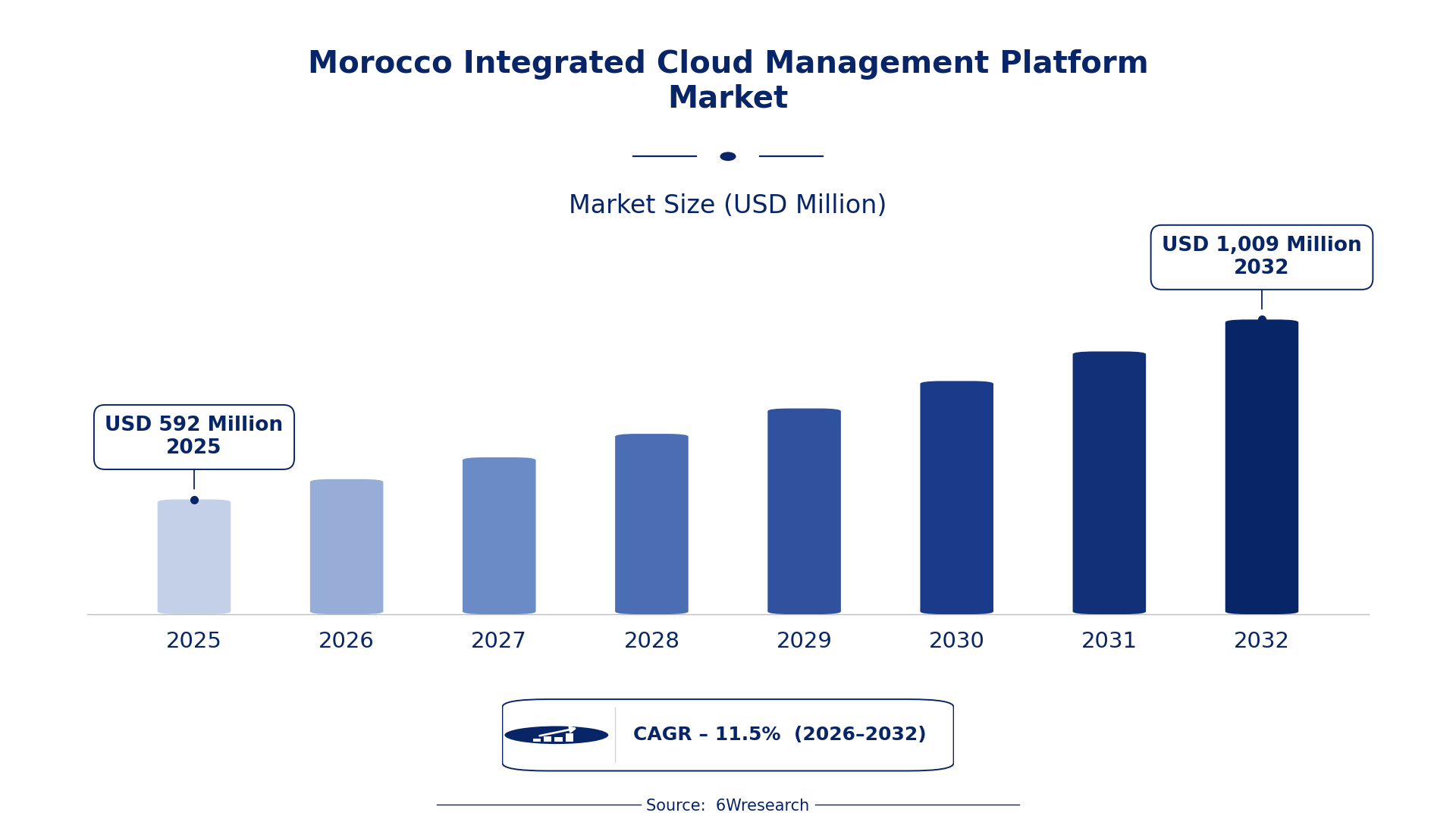
The Morocco Integrated Cloud Management Platform Market was estimated at USD 592 Million in 2025 and is projected to reach USD 1009 Million by 2032, growing at a CAGR of 11.5% from 2026 to 2032.
Morocco Integrated Cloud Management Platform Market Synopsis
The adoption of integrated cloud management platforms in Morocco is gaining momentum, as businesses recognize the efficiency and scalability these solutions offer. This market is increasingly attractive to small and medium-sized enterprises that are looking to optimize costs while enhancing operational capabilities.
As Moroccan companies embrace digital transformation, the demand for hybrid cloud solutions is on the rise. The shift towards multi-cloud strategies reflects a growing need for flexibility and security in managing diverse workloads.
Morocco Integrated Cloud Management Platform Market Year-wise Growth Rate and Key Drivers
This graph illustrates the annual growth rates of the Morocco Integrated Cloud Management Platform Market from 2021 to 2032, highlighting a steady upward trajectory and projected expansion over the forecast period.
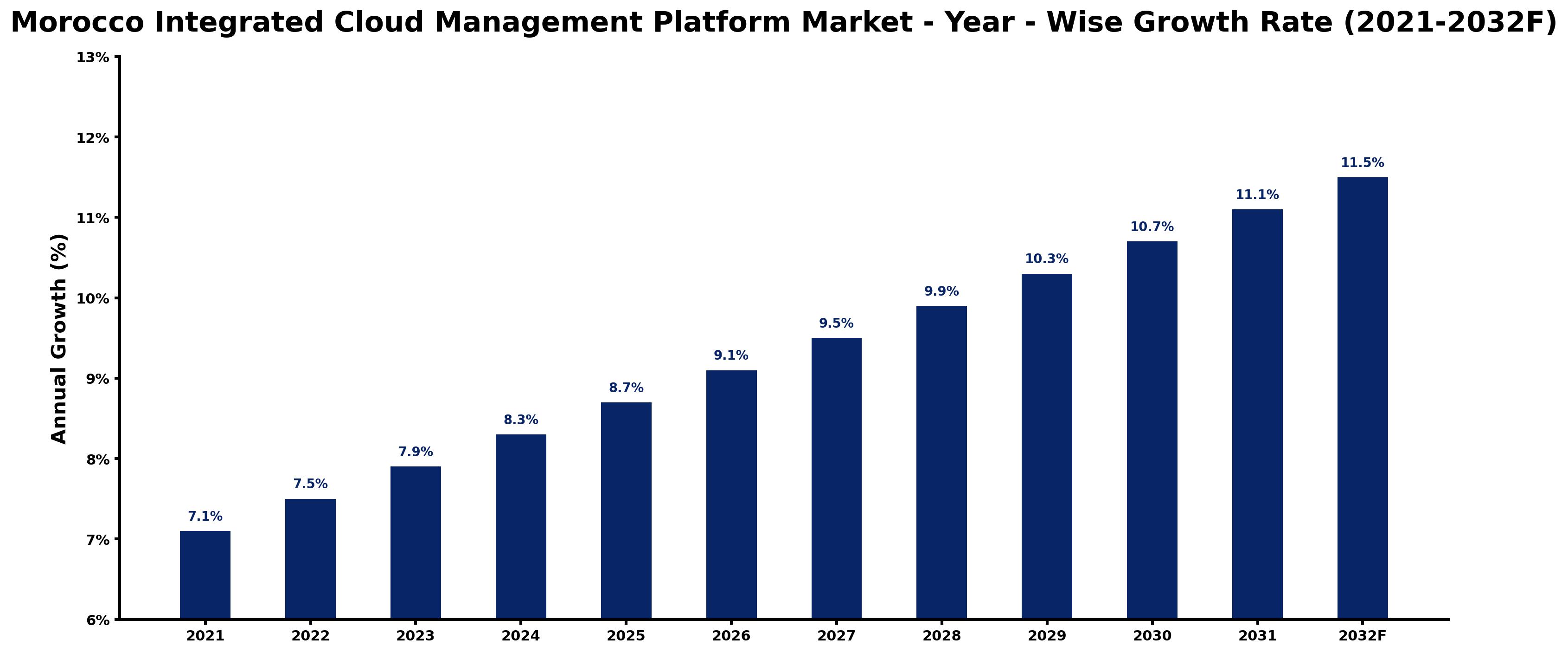
The table below presents the year‑wise growth rates along with the key drivers influencing the market
| Year | Growth Rate | Major Drivers |
| 2021 | 7.1% | Launch of Morocco's Digital Accelerators initiative |
| 2022 | 7.5% | Increased adoption of e-commerce platforms by Moroccan businesses |
| 2023 | 7.9% | Regulatory support for cloud computing security standards |
| 2024 | 8.3% | Rise in local startups leveraging cloud technologies |
| 2025 | 8.7% | National ICT strategy promoting digital services expansion |
| 2026 | 9.1% | Growing emphasis on data sovereignty among enterprises |
| 2027 | 9.5% | Interest in AI integration within cloud solutions |
| 2028 | 9.9% | Investment in local tech talent development programs |
| 2029 | 10.3% | Collaboration between telecom providers and cloud platforms |
| 2030 | 10.7% | Increased digital literacy among Moroccan SMEs |
| 2031 | 11.1% | Supportive policies from AMDI for tech investments |
| 2032 | 11.5% | Emergence of localized cloud service providers |
Note: Market size estimations and growth projections presented in this report are based on 6Wresearch's proprietary forecasting methodology, utilizing the latest available industry data, government publications, and primary research inputs.
Morocco Integrated Cloud Management Platform Market Key Takeaways
Below are some of the specific key takeaways from the market, including:
- The market is set for substantial growth, driven by increasing cloud adoption among Moroccan businesses.
- Hybrid cloud solutions are becoming increasingly popular as organizations seek to balance cost and performance.
- Data security and compliance remain top priorities for businesses exploring cloud management options.
- Small and medium-sized enterprises are leading the charge towards adopting integrated platforms for improved efficiency.
- Government initiatives are playing a crucial role in fostering a conducive environment for cloud technology adoption.
Evaluation of Restraints in Morocco Integrated Cloud Management Platform Market
Several constraints hinder the growth of the Morocco Integrated Cloud Management Platform Market. A lack of awareness surrounding cloud technologies, particularly among SMEs, poses a significant barrier. Concerns related to data security and compliance with privacy regulations further complicate adoption. The shortage of skilled IT professionals capable of managing cloud systems adds another layer of challenge, limiting the implementation and maintenance of these platforms. on top of that, the presence of outdated IT infrastructure in certain sectors slows the transition to cloud solutions.
Morocco Integrated Cloud Management Platform Market Trends
Several trends are emerging in the Morocco Integrated Cloud Management Platform Market. The increasing preference for hybrid cloud environments indicates a shift toward flexible and scalable solutions that cater to diverse business needs. Multi-cloud strategies are gaining traction as organizations strive to optimize their resources and reduce dependency on a single provider. There is also a heightened focus on data security measures and compliance frameworks as companies look to mitigate risks associated with cloud adoption.
Morocco Integrated Cloud Management Platform Market Opportunities
The market presents numerous opportunities for growth and investment. Providers can differentiate themselves by offering comprehensive cloud management solutions that incorporate automation and advanced analytics. As businesses continue to adopt digital transformation initiatives, there is a demand for platforms that facilitate seamless integration of cloud services. Additionally, the emphasis on cost optimization presents an avenue for vendors to develop tools that enhance operational efficiency and drive down expenses.
Government Initiatives in the Morocco Integrated Cloud Management Platform Market
Government policies are significantly shaping the Morocco Integrated Cloud Management Platform Market. The Moroccan government is focused on promoting digital transformation and enhancing cybersecurity measures, creating a favorable regulatory environment. These initiatives aim to encourage cloud technology adoption among businesses, driving technological advancement across various sectors.
- A recent initiative focused on enhancing cybersecurity protocols was launched in 2023, aiming to safeguard cloud-based systems.
- Current efforts are underway to develop a national digital infrastructure upgrade program, enhancing connectivity for cloud services.
- A regulatory framework established in 2025 promotes competition among cloud service providers, fostering innovation.
- Upcoming plans include a public-private partnership initiative aimed at increasing access to cloud services by 2026.
Future Insights of the Morocco Integrated Cloud Management Platform Market
Looking ahead to 2026-2032, the Morocco Integrated Cloud Management Platform Market is expected to thrive as businesses increasingly transition to cloud-based solutions. The convergence of digital transformation strategies and remote work trends will continue to drive demand for integrated platforms. Additionally, the government's commitment to promoting technology adoption will likely create new avenues for innovation and investment in this sector.
Morocco Integrated Cloud Management Platform Market Latest Developments
In recent months, the Morocco Integrated Cloud Management Platform Market has seen notable activity as companies adapt to new technologies and consumer demands. A focus on enhancing service offerings and improving security measures has emerged as a key priority among industry players.
- A major technology vendor launched a new cloud management solution in Q1 2025, focusing on improved data analytics capabilities.
- In mid-2025, a regional operator began a comprehensive upgrade of its cloud infrastructure, aimed at enhancing service delivery.
- An ongoing initiative is set to expand cloud service offerings by integrating advanced AI-driven tools, expected to roll out by late 2025.
- Plans for a nationwide training program to upskill IT professionals in cloud management are currently being developed for implementation by 2026.
Morocco Integrated Cloud Management Platform Market - Key Attractiveness of the Report
- 10 Years of Market Numbers
- Historical Data Starting from 2022 to 2025
- Base Year: 2025
- Forecast Data until 2032
- Key Performance Indicators Impacting the Market
- Major Upcoming Developments and Projects
Key Highlights of the Report:
- Morocco Integrated Cloud Management Platform Market Outlook
- Market Size of Morocco Integrated Cloud Management Platform Market, 2025
- Forecast of Morocco Integrated Cloud Management Platform Market, 2032
- Historical Data and Forecast of Morocco Integrated Cloud Management Platform Revenues & Volume for the Period 2022-2032F
- Morocco Integrated Cloud Management Platform Market Trend Evolution
- Morocco Integrated Cloud Management Platform Market Drivers and Challenges
- Morocco Integrated Cloud Management Platform Price Trends
- Morocco Integrated Cloud Management Platform Porter's Five Forces
- Morocco Integrated Cloud Management Platform Industry Life Cycle
- Historical Data and Forecast of Morocco Integrated Cloud Management Platform Market Revenues & Volume By Component for the Period 2022-2032F
- Historical Data and Forecast of Morocco Integrated Cloud Management Platform Market Revenues & Volume By Solutions for the Period 2022-2032F
- Historical Data and Forecast of Morocco Integrated Cloud Management Platform Market Revenues & Volume By Services for the Period 2022-2032F
- Historical Data and Forecast of Morocco Integrated Cloud Management Platform Market Revenues & Volume By Vertical for the Period 2022-2032F
- Historical Data and Forecast of Morocco Integrated Cloud Management Platform Market Revenues & Volume By BFSI for the Period 2022-2032F
- Historical Data and Forecast of Morocco Integrated Cloud Management Platform Market Revenues & Volume By IT and Telecom for the Period 2022-2032F
- Historical Data and Forecast of Morocco Integrated Cloud Management Platform Market Revenues & Volume By Government and Public Sector for the Period 2022-2032F
- Historical Data and Forecast of Morocco Integrated Cloud Management Platform Market Revenues & Volume By Manufacturing for the Period 2022-2032F
- Historical Data and Forecast of Morocco Integrated Cloud Management Platform Market Revenues & Volume By Retail and Consumer Goods for the Period 2022-2032F
- Historical Data and Forecast of Morocco Integrated Cloud Management Platform Market Revenues & Volume By Healthcare and Lifesciences for the Period 2022-2032F
- Historical Data and Forecast of Morocco Integrated Cloud Management Platform Market Revenues & Volume By Energy and Utilities for the Period 2022-2032F
- Historical Data and Forecast of Morocco Integrated Cloud Management Platform Market Revenues & Volume By Others for the Period 2022-2032F
- Historical Data and Forecast of Morocco Integrated Cloud Management Platform Market Revenues & Volume By Organization Size for the Period 2022-2032F
- Historical Data and Forecast of Morocco Integrated Cloud Management Platform Market Revenues & Volume By SMEs for the Period 2022-2032F
- Historical Data and Forecast of Morocco Integrated Cloud Management Platform Market Revenues & Volume By Large Enterprises for the Period 2022-2032F
- Morocco Integrated Cloud Management Platform Import Export Trade Statistics
- Market Opportunity Assessment By Component
- Market Opportunity Assessment By Vertical
- Market Opportunity Assessment By Organization Size
- Morocco Integrated Cloud Management Platform Top Companies Market Share
- Morocco Integrated Cloud Management Platform Competitive Benchmarking By Technical and Operational Parameters
- Morocco Integrated Cloud Management Platform Company Profiles
- Morocco Integrated Cloud Management Platform Key Strategic Recommendations






































