Morocco IoT Connectivity Market Size & Growth Rate (2026-2032)
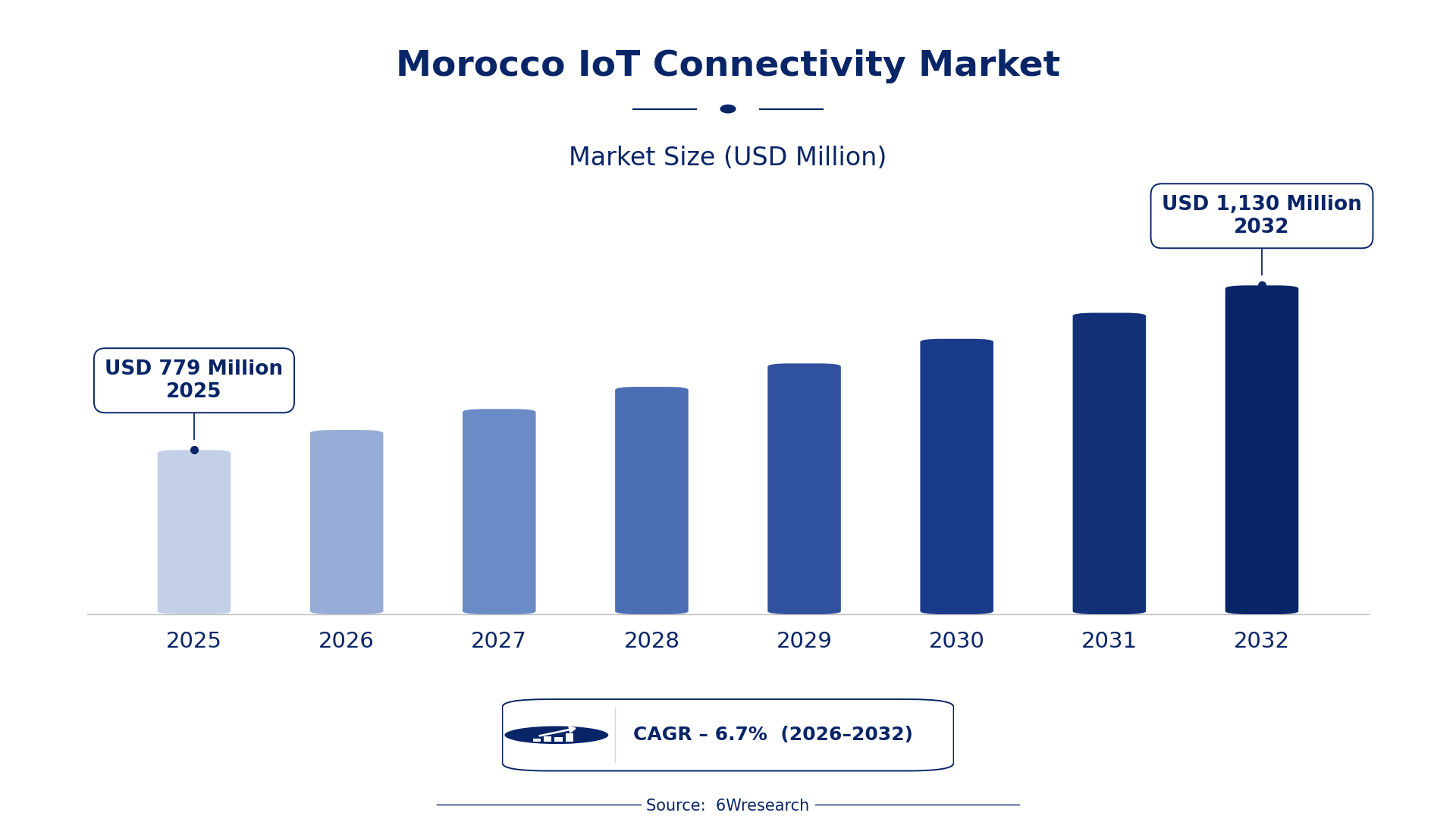
The Morocco IoT Connectivity Market was estimated at USD 779 Million in 2025 and is projected to reach USD 1130 Million by 2032, growing at a CAGR of 6.7% from 2026 to 2032.
Morocco IoT Connectivity Market Synopsis
In recent years, Morocco has seen a surge in the adoption of Internet of Things (IoT) technologies, driven by a growing emphasis on digital transformation across various sectors. This momentum, however, is merely a precursor to the more extensive growth anticipated in the coming years as businesses and government entities increasingly seek reliable connectivity solutions tailored to IoT applications.
The Morocco IoT Connectivity Market is transitioning from basic connectivity frameworks to advanced solutions that cater to diverse use cases, including smart agriculture, asset tracking, and healthcare innovations. As industry demand continues to evolve, the market is set to embrace enhanced technologies such as LPWAN and satellite networks, offering a variety of options for scalable, secure, and low-power connectivity.
Morocco IoT Connectivity Market Year-wise Growth Rate and Key Drivers
This graph illustrates the annual growth rates of the Morocco IoT Connectivity Market from 2021 to 2032, highlighting a steady upward trajectory and projected expansion over the forecast period.
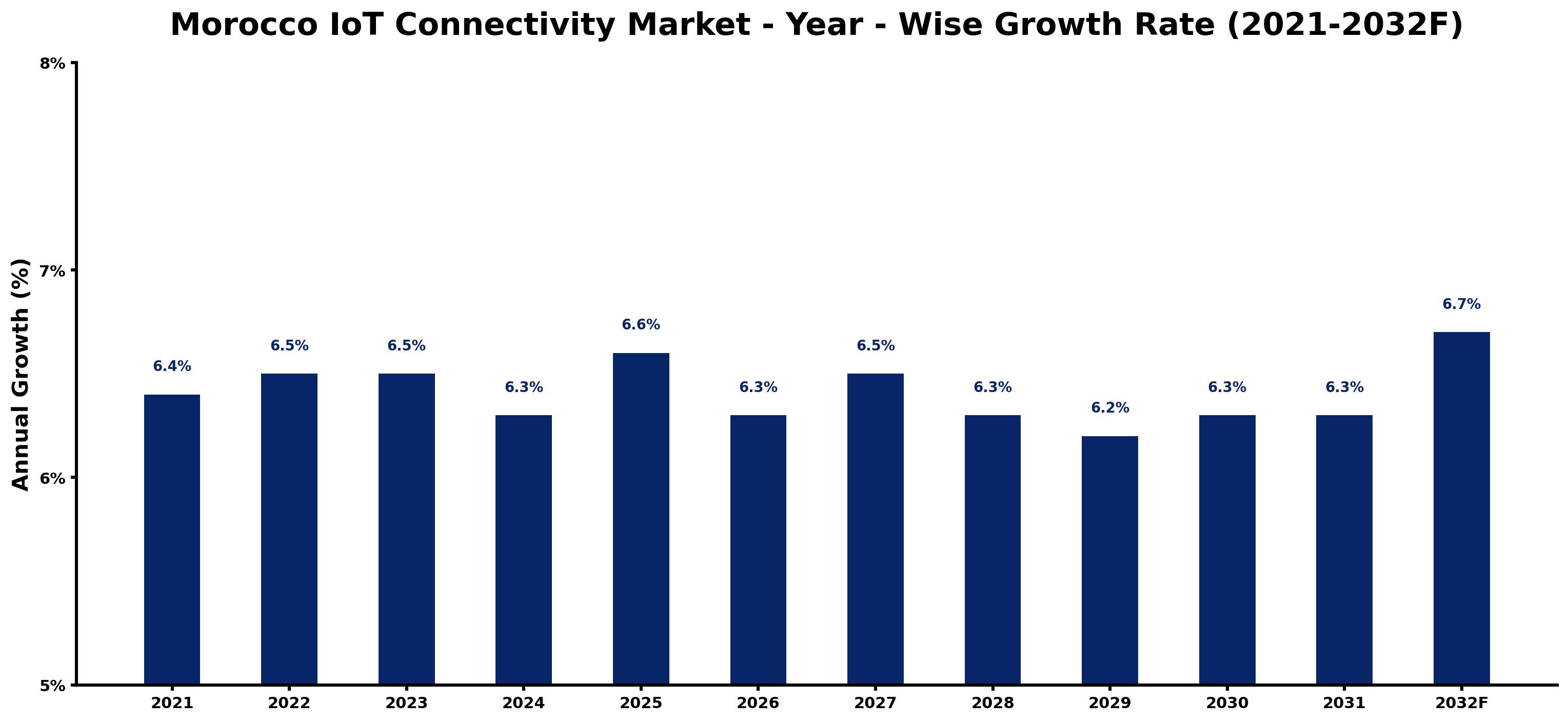
The table below presents the year‑wise growth rates along with the key drivers influencing the market
| Year | Growth Rate | Major Drivers |
| 2021 | 6.4% | Launch of Morocco's National IoT Strategy framework. |
| 2022 | 6.5% | Investment in IoT infrastructure by Maroc Telecom. |
| 2023 | 6.5% | Increased government subsidies for smart city projects. |
| 2024 | 6.3% | Emerging startups focusing on agri-tech IoT solutions. |
| 2025 | 6.6% | Growing collaborations between telecoms and tech startups. |
| 2026 | 6.3% | Regulatory support for IoT application in logistics. |
| 2027 | 6.5% | Enhanced connectivity projects targeting rural IoT deployment. |
| 2028 | 6.3% | Development of IoT-based renewable energy solutions. |
| 2029 | 6.2% | Rising consumer demand for connected automotive technologies. |
| 2030 | 6.3% | Implementation of smart grid innovations by ONEE. |
| 2031 | 6.3% | Adoption of IoT solutions for water management initiatives. |
| 2032 | 6.7% | Public-private partnerships promoting IoT in educational sectors. |
Note: Market size estimations and growth projections presented in this report are based on 6Wresearch's proprietary forecasting methodology, utilizing the latest available industry data, government publications, and primary research inputs.
Morocco IoT Connectivity Market Key Takeaways
Below are some of the specific key takeaways from the market, including:
- The market is witnessing increasing investments in telecommunications infrastructure to support IoT connectivity.
- Growth in sectors such as healthcare and manufacturing is directly driving demand for IoT solutions.
- Emerging technologies like LPWAN are gaining traction for their ability to provide low-power and wide-area connectivity.
- Challenges remain, particularly in terms of network security and infrastructure limitations in remote areas.
- Government initiatives are actively shaping the market through financial incentives and public-private partnerships.
Evaluation of Restraints in Morocco IoT Connectivity Market
The Morocco IoT Connectivity Market faces several limitations that can impede its growth trajectory. One of the most pressing issues is the existing infrastructure, which often lacks the necessary coverage, especially in remote regions. This results in connectivity gaps that hinder the full potential of IoT applications. on top of that, the complexities surrounding network security and data privacy remain significant concerns for businesses. Implementing effective encryption and authentication measures can be resource-intensive, posing a barrier for smaller enterprises. The financial aspect also presents challenges; managing subscription costs and optimizing data plans are critical for companies looking to deploy IoT solutions economically.
Morocco IoT Connectivity Market Trends
Several trends are currently shaping the Morocco IoT Connectivity Market. The rise of smart cities is pushing the demand for integrated IoT solutions that can manage urban resources efficiently. Additionally, there's a growing focus on sustainability, prompting industries to adopt IoT technologies for energy management and waste reduction. The healthcare sector is increasingly leveraging IoT for telemedicine and remote patient monitoring, further driving connectivity needs. Finally, partnerships between telecom operators and technology providers are on the rise, enabling more innovative solutions to enter the market.
Morocco IoT Connectivity Market Opportunities
As Morocco continues to modernize its infrastructure, the IoT connectivity market presents various growth opportunities. The agriculture sector stands out, with the potential for smart farming solutions that enhance productivity and resource management. on top of that, advancements in LPWAN technology offer new avenues for cost-effective and scalable connectivity, particularly in rural areas. Investment in smart healthcare is also on the rise, with opportunities for IoT solutions that improve patient care and operational efficiency. Finally, as businesses increasingly prioritize digital transformation, the demand for customized IoT solutions will continue to expand.
Government Initiatives in the Morocco IoT Connectivity Market
Government policy plays a crucial role in shaping the Morocco IoT Connectivity Market. Authorities are actively promoting the deployment of advanced telecommunications infrastructure, which is essential for expanding IoT connectivity. The government is committed to collaborating with private sector partners, ensuring that innovative technologies can be rapidly integrated into existing systems. Financial incentives for telecom companies are also a focus, aimed at fostering the expansion of IoT networks nationwide.
- A recently completed initiative focused on upgrading telecommunications infrastructure in urban centers to enhance connectivity for IoT applications.
- A current program aims to provide financial incentives for telecom operators to expand IoT networks into underserved regions.
- A planned public-private initiative expected to launch in 2026 will focus on developing smart city projects utilizing IoT connectivity.
- A regulatory framework introduced in 2025 mandates the implementation of security standards for IoT devices across various industries.
- A national awareness campaign is currently underway to educate businesses about the benefits of IoT technologies and connectivity solutions.
Future Insights of the Morocco IoT Connectivity Market
Looking ahead to 2026-2032, the Morocco IoT Connectivity Market is set to undergo transformative growth. With a solid foundation being laid through government initiatives and private investments, we expect the integration of more sophisticated technologies to enhance connectivity. The anticipated rise in smart city projects will significantly influence the demand for IoT solutions. As businesses increasingly recognize the value of real-time data and automation, the need for reliable IoT connectivity will be paramount. Ultimately, the market's trajectory will depend on how effectively the challenges related to infrastructure and security are addressed.
Morocco IoT Connectivity Market Latest Developments
In the last 12-14 months, the Morocco IoT Connectivity Market has experienced a flurry of activity, with both public and private sectors making strides toward enhanced connectivity solutions. The focus on digital transformation has catalyzed numerous initiatives aimed at improving infrastructure and expanding IoT applications across various industries.
- A leading regional operator launched an IoT platform in early 2025, aimed at providing businesses with scalable connectivity solutions for various applications.
- An initiative that began in mid-2025 is currently underway, focusing on deploying LPWAN technology in rural areas to improve agricultural productivity.
- A partnership between technology vendors and telecom providers is set to begin in Q3 2026, aimed at developing smart healthcare solutions using IoT connectivity.
- A project expected to kick off in late 2025 will upgrade existing cellular infrastructure to support the growing demand for IoT applications.
- A pilot program launched in early 2025 is currently testing IoT applications for resource management in urban environments, with promising results.
Morocco IoT Connectivity Market - Key Attractiveness of the Report
- 10 Years of Market Numbers
- Historical Data Starting from 2022 to 2025
- Base Year: 2025
- Forecast Data until 2032
- Key Performance Indicators Impacting the Market
- Major Upcoming Developments and Projects
Key Highlights of the Report:
- Morocco IoT Connectivity Market Outlook
- Market Size of Morocco IoT Connectivity Market, 2025
- Forecast of Morocco IoT Connectivity Market, 2032
- Historical Data and Forecast of Morocco IoT Connectivity Revenues & Volume for the Period 2022-2032F
- Morocco IoT Connectivity Market Trend Evolution
- Morocco IoT Connectivity Market Drivers and Challenges
- Morocco IoT Connectivity Price Trends
- Morocco IoT Connectivity Porter's Five Forces
- Morocco IoT Connectivity Industry Life Cycle
- Historical Data and Forecast of Morocco IoT Connectivity Market Revenues & Volume By Component for the Period 2022-2032F
- Historical Data and Forecast of Morocco IoT Connectivity Market Revenues & Volume By Platform for the Period 2022-2032F
- Historical Data and Forecast of Morocco IoT Connectivity Market Revenues & Volume By Services for the Period 2022-2032F
- Historical Data and Forecast of Morocco IoT Connectivity Market Revenues & Volume By Application Areas for the Period 2022-2032F
- Historical Data and Forecast of Morocco IoT Connectivity Market Revenues & Volume By Building & Home Automation for the Period 2022-2032F
- Historical Data and Forecast of Morocco IoT Connectivity Market Revenues & Volume By Smart Energy & Utility for the Period 2022-2032F
- Historical Data and Forecast of Morocco IoT Connectivity Market Revenues & Volume By Smart Manufacturing for the Period 2022-2032F
- Historical Data and Forecast of Morocco IoT Connectivity Market Revenues & Volume By Connected Health for the Period 2022-2032F
- Historical Data and Forecast of Morocco IoT Connectivity Market Revenues & Volume By Smart Retail for the Period 2022-2032F
- Historical Data and Forecast of Morocco IoT Connectivity Market Revenues & Volume By Smart Transportation for the Period 2022-2032F
- Historical Data and Forecast of Morocco IoT Connectivity Market Revenues & Volume By Others (Education and Agriculture) for the Period 2022-2032F
- Historical Data and Forecast of Morocco IoT Connectivity Market Revenues & Volume By Organization Size for the Period 2022-2032F
- Historical Data and Forecast of Morocco IoT Connectivity Market Revenues & Volume By Large Enterprises for the Period 2022-2032F
- Historical Data and Forecast of Morocco IoT Connectivity Market Revenues & Volume By SMEs for the Period 2022-2032F
- Morocco IoT Connectivity Import Export Trade Statistics
- Market Opportunity Assessment By Component
- Market Opportunity Assessment By Application Areas
- Market Opportunity Assessment By Organization Size
- Morocco IoT Connectivity Top Companies Market Share
- Morocco IoT Connectivity Competitive Benchmarking By Technical and Operational Parameters
- Morocco IoT Connectivity Company Profiles
- Morocco IoT Connectivity Key Strategic Recommendations






































