Morocco Jewellery Crafting Tools Market Summary
The morocco jewellery crafting tools market was estimated at USD 501 Million in 2025 and is projected to reach USD 719 Million by 2032, growing at a CAGR of 6.1% from 2026 to 2032.
Morocco Jewellery Crafting Tools Market Year-wise Growth Rate and Key Drivers
This graph highlights how the Morocco Jewellery Crafting Tools Market has steadily grown over the past five years, supported by major growth factors.
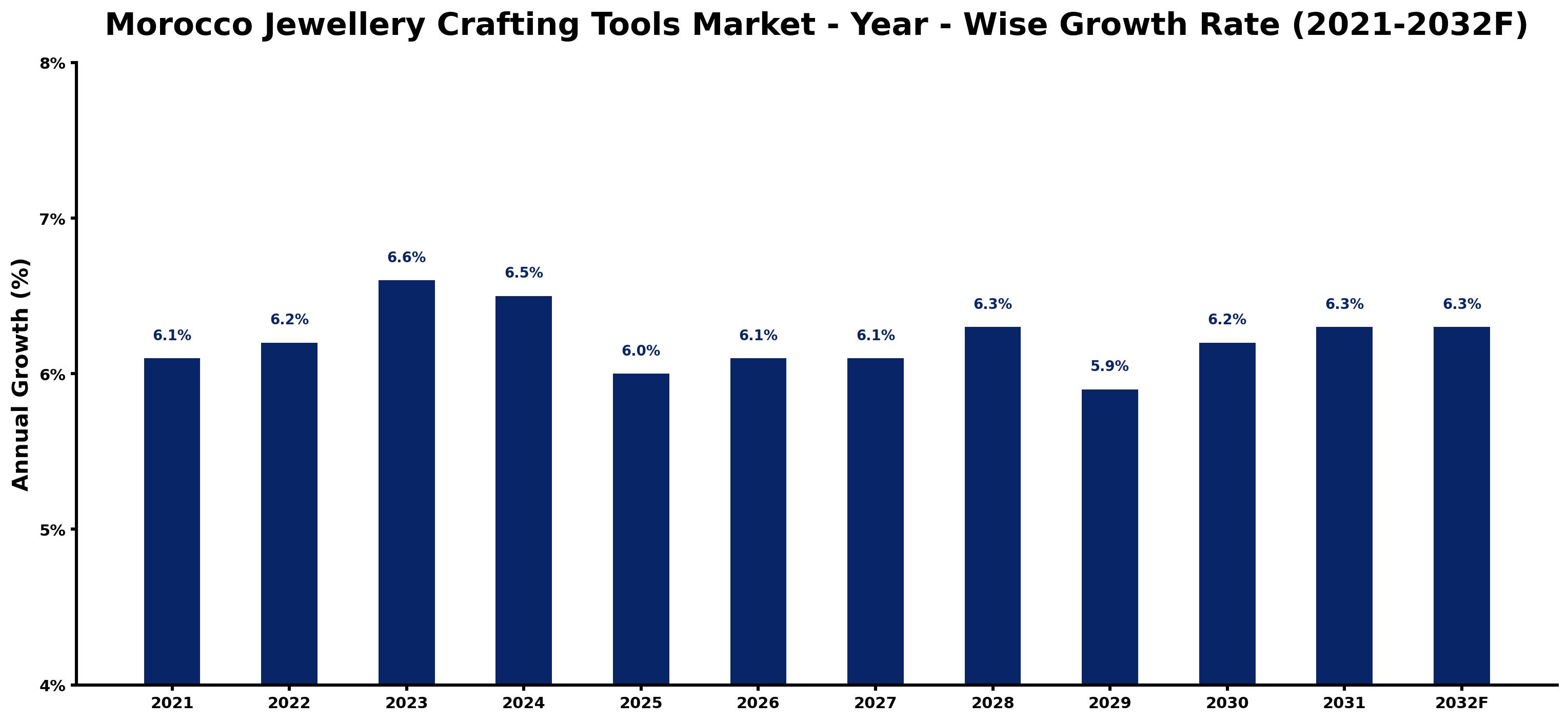
The table below presents the year wise growth rates along with the key drivers influencing the market
| Year | Growth Rate | Major Drivers |
| 2021 | 6.1% | Post-pandemic recovery saw increased interest in local artisanal craftsmanship. |
| 2022 | 6.2% | Innovative designs gained traction, attracting both local and international buyers. |
| 2023 | 6.6% | Online marketplaces offered Moroccan artisans greater visibility and expanded customer reach. |
| 2024 | 6.5% | Cultural tourism resurgence boosted demand for traditional and modern jewellery pieces. |
| 2025 | 6.0% | Emerging collaborations between artisans and designers spurred fresh product lines. |
| 2026 | 6.1% | Sustainability trends encouraged use of eco-friendly materials in jewellery crafting. |
| 2027 | 6.1% | Investment in training programs enhanced skills among local jewellery artisans. |
| 2028 | 6.3% | Rising disposable incomes led to increased spending on luxury and handcrafted items. |
| 2029 | 5.9% | Technological integration streamlined the design and production processes for artisans. |
| 2030 | 6.2% | Social media marketing strategies amplified brand awareness for local jewellers. |
| 2031 | 6.3% | Export opportunities expanded as international markets showed interest in Moroccan craftsmanship. |
| 2032 | 6.3% | Local festivals and exhibitions showcased jewellery, fostering community engagement and sales. |
Note - Market size estimations and growth projections presented in this report are based on 6Wresearch's advanced forecasting approach, validated with industry datasets as of June 2026.
Morocco Jewellery Crafting Tools Market Synopsis
The Morocco Jewellery Crafting Tools Market is projected to reach 6.1% and witness significant growth during the forecast period (2026-2032). This growth is driven by several key factors, including rising disposable incomes among Moroccan households, a shift towards contemporary and traditional jewellery designs, and an increasing demand for high-quality craftsmanship. The cultural affinity for customization and personalized jewellery is expected to drive further demand for crafting tools, making them essential to both hobbyists and professional artisans in the region. Additionally, Moroccan government initiatives aimed at revitalizing various industries, including the jewellery sector through policies like 'Vision 2040', will support this market's expansion by promoting local craftsmanship and production.
Morocco Jewellery Crafting Tools Market Growth Drivers
Several key drivers are propelling the growth of the Morocco Jewellery Crafting Tools Market. Firstly, the increase in disposable incomes has enabled consumers to invest more in personalised and finely crafted jewellery items, necessitating the use of quality crafting tools to satisfy this demand. Secondly, the evolving fashion landscape in Morocco is influencing the production of diverse jewellery designs, blending traditional artistry with contemporary trends. This fusion creates opportunities for artisans to leverage advanced tools and techniques.
- The Moroccan appreciation for bespoke items is leading to a heightened demand for jewellery crafting tools as consumers increasingly seek personalized accessories. Customization allows for the expression of individual style, which many are willing to invest in.
- Government initiatives focused on economic development are encouraging entrepreneurship within the jewellery sector. This supportive environment is fostering innovation and increasing the availability of crafting tools needed for production.
- The rising popularity of artisanal and handmade jewellery is spurring interest in high-quality crafting tools among both professionals and craft enthusiasts, thereby driving market demand.
- The influence of social media and online platforms is facilitating new market entrants, who require crafting tools to design and produce unique jewellery items that resonate with consumers.
- The increasing participation of women in the workforce and entrepreneurial activities is further contributing to the market as more individuals seek to venture into jewellery crafting, necessitating the acquisition of appropriate tools.
Morocco Jewellery Crafting Tools Market Trends and Opportunities
The Morocco Jewellery Crafting Tools Market is exhibiting notable trends that present numerous opportunities for growth. One significant trend is the increasing integration of technology in jewellery crafting, including the use of CAD (Computer-Aided Design) tools and 3D printing technologies. This evolution is enabling artisans to create more intricate designs while improving efficiency in the crafting process.
- The trend towards sustainability is influencing the jewellery sector, with a rising demand for eco-friendly tools and materials. Artisans are increasingly seeking tools that align with sustainable practices, creating a niche market for environmentally responsible crafting equipment.
- Collaboration among local artisans and designers is becoming prevalent, leading to shared resources that include crafting tools, thus reducing individual costs and increasing access to quality equipment.
- Educational programs and workshops aimed at enhancing jewellery crafting skills are gaining popularity, which is expected to drive the demand for a wider range of crafting tools among new artisans.
- The rise of e-commerce platforms is facilitating access to a broader assortment of jewellery crafting tools, enhancing market reach for both suppliers and artisans.
- Local tourism promoting Moroccan craftsmanship is likely to increase demand for distinctive jewellery pieces, thus creating additional market opportunities for crafting tools tailored to meet this demand.
Morocco Jewellery Crafting Tools Market Challenges and Restraints
Despite the growth prospects, the Morocco Jewellery Crafting Tools Market faces challenges that may hinder its development. The traditional nature of the market, with many artisans adhering to age-old methods, can impede the adoption of modern tools and techniques. This resistance to change may limit the market's potential. Additionally, economic fluctuations can affect disposable incomes, thereby impacting consumer spending on luxury items such as jewellery and the tools needed for their creation.
- The high cost of advanced jewellery crafting tools can be a barrier for new entrants and small-scale artisans, who may struggle to compete with established players.
- Inadequate infrastructure in certain regions may limit access to advanced tools and materials, affecting the ability of artisans to innovate and meet consumer demands.
- Limited awareness of modern jewellery crafting techniques may prevent artisans from fully utilizing the capabilities of the tools available, leading to underutilization and inefficiencies.
- Stringent import regulations and tariffs can create additional costs for suppliers of jewellery crafting tools, which may affect pricing and availability in the local market.
- Competition from alternative forms of adornment, such as costume jewellery, may detract consumer interest from fine jewellery and the associated crafting tools.
Morocco Jewellery Crafting Tools Market Government Investment and Initiatives
The Moroccan government has been actively investing in initiatives aimed at boosting various sectors, including the jewellery crafting industry. Policies under 'Vision 2040' encompass reforms intended to enhance the manufacturing capabilities within the country. These reforms include improving access to finance for small and medium enterprises (SMEs) that operate within the jewellery sector, which could facilitate greater procurement of necessary crafting tools.
- Support for vocational training programs is being enhanced, with a focus on equipping individuals with modern skills in jewellery crafting, directly impacting the demand for relevant tools.
- Government grants and incentives for artisans are encouraging the adoption of new technologies in jewellery creation, which will require access to advanced crafting tools.
- Public-private partnerships are being fostered to stimulate innovation within the jewellery sector, providing artisans and suppliers with better resources and technology.
- Promotion of Moroccan craftsmanship on international platforms aims to attract foreign investments, potentially elevating the demand for local jewellery crafting tools.
- The government is also focusing on promoting sustainable practices within the jewellery industry, encouraging the use of eco-friendly crafting tools and materials.
Morocco Jewellery Crafting Tools Market Latest Developments (May 2025 - June 2026)
The period from May 2025 to June 2026 has seen significant developments in the Morocco Jewellery Crafting Tools Market. There has been a notable push towards incorporating advanced technology in the crafting process, with increased availability and interest in digital design tools among local artisans. Additionally, workshops and training programs have become more prevalent, focusing on the importance of modern tools and techniques in improving craftsmanship and market competitiveness.
- The sustainability movement is gaining traction, leading to a rise in the availability of eco-friendly crafting tools, aligning with global demands for responsible production.
- Increased collaboration among craft groups has resulted in shared knowledge and resources, allowing smaller artisans access to specialized crafting tools previously out of reach.
- E-commerce platforms have expanded, providing artisans with better access to markets and the tools needed to cater to a growing online consumer base.
- Cultural events and exhibitions have showcased Moroccan craftsmanship, sparking interest in locally made jewellery and, consequently, the tools necessary for creating such pieces.
- The government's emphasis on improving infrastructure and support for the jewellery sector demonstrates a commitment to fostering market growth and enhancing tool accessibility.
Morocco Jewellery Crafting Tools Market - Key Attractiveness of the Report
- 10 Years of Market Numbers
- Historical Data Starting from 2022 to 2025
- Base Year: 2025
- Forecast Data until 2032
- Key Performance Indicators Impacting the Market
- Major Upcoming Developments and Projects
Key Highlights of the Report:
- Morocco Jewellery Crafting Tools Market Outlook
- Market Size of Morocco Jewellery Crafting Tools Market, 2025
- Forecast of Morocco Jewellery Crafting Tools Market, 2032F
- Historical Data and Forecast of Morocco Jewellery Crafting Tools Revenues & Volume for the Period 2022-2032F
- Morocco Jewellery Crafting Tools Market Trend Evolution
- Morocco Jewellery Crafting Tools Market Drivers and Challenges
- Morocco Jewellery Crafting Tools Price Trends
- Morocco Jewellery Crafting Tools Porter's Five Forces
- Morocco Jewellery Crafting Tools Industry Life Cycle
- Historical Data and Forecast of Morocco Jewellery Crafting Tools Market Revenues & Volume By Tool Types for the Period 2022-2032F
- Historical Data and Forecast of Morocco Jewellery Crafting Tools Market Revenues & Volume By Bench Tools for the Period 2022-2032F
- Historical Data and Forecast of Morocco Jewellery Crafting Tools Market Revenues & Volume By Casting Tools for the Period 2022-2032F
- Historical Data and Forecast of Morocco Jewellery Crafting Tools Market Revenues & Volume By Cutting Tools for the Period 2022-2032F
- Historical Data and Forecast of Morocco Jewellery Crafting Tools Market Revenues & Volume By Drawing Tools for the Period 2022-2032F
- Historical Data and Forecast of Morocco Jewellery Crafting Tools Market Revenues & Volume By Drilling Tools for the Period 2022-2032F
- Historical Data and Forecast of Morocco Jewellery Crafting Tools Market Revenues & Volume By Measuring Tools for the Period 2022-2032F
- Historical Data and Forecast of Morocco Jewellery Crafting Tools Market Revenues & Volume By Polishing & Finishing Tools for the Period 2022-2032F
- Historical Data and Forecast of Morocco Bench Tools Jewellery Crafting Tools Market Revenues & Volume By Others for the Period 2022-2032F
- Historical Data and Forecast of Morocco Jewellery Crafting Tools Market Revenues & Volume By Product Type for the Period 2022-2032F
- Historical Data and Forecast of Morocco Jewellery Crafting Tools Market Revenues & Volume By Necklace for the Period 2022-2032F
- Historical Data and Forecast of Morocco Jewellery Crafting Tools Market Revenues & Volume By Ring for the Period 2022-2032F
- Historical Data and Forecast of Morocco Jewellery Crafting Tools Market Revenues & Volume By Earrings for the Period 2022-2032F
- Historical Data and Forecast of Morocco Jewellery Crafting Tools Market Revenues & Volume By Bracelet for the Period 2022-2032F
- Historical Data and Forecast of Morocco Jewellery Crafting Tools Market Revenues & Volume By Others for the Period 2022-2032F
- Historical Data and Forecast of Morocco Jewellery Crafting Tools Market Revenues & Volume By Material Type for the Period 2022-2032F
- Historical Data and Forecast of Morocco Jewellery Crafting Tools Market Revenues & Volume By Gold for the Period 2022-2032F
- Historical Data and Forecast of Morocco Jewellery Crafting Tools Market Revenues & Volume By Silver for the Period 2022-2032F
- Historical Data and Forecast of Morocco Jewellery Crafting Tools Market Revenues & Volume By Platinum for the Period 2022-2032F
- Historical Data and Forecast of Morocco Jewellery Crafting Tools Market Revenues & Volume By Diamond for the Period 2022-2032F
- Historical Data and Forecast of Morocco Jewellery Crafting Tools Market Revenues & Volume By Others for the Period 2022-2032F
- Historical Data and Forecast of Morocco Jewellery Crafting Tools Market Revenues & Volume By Distribution Channel for the Period 2022-2032F
- Historical Data and Forecast of Morocco Jewellery Crafting Tools Market Revenues & Volume By Departmental Stores for the Period 2022-2032F
- Historical Data and Forecast of Morocco Jewellery Crafting Tools Market Revenues & Volume By Exclusive Branded Showrooms for the Period 2022-2032F
- Historical Data and Forecast of Morocco Jewellery Crafting Tools Market Revenues & Volume By Online Retailing for the Period 2022-2032F
- Historical Data and Forecast of Morocco Jewellery Crafting Tools Market Revenues & Volume By Specialist Retailers for the Period 2022-2032F
- Morocco Jewellery Crafting Tools Import Export Trade Statistics
- Market Opportunity Assessment By Tool Types
- Market Opportunity Assessment By Product Type
- Market Opportunity Assessment By Material Type
- Market Opportunity Assessment By Distribution Channel
- Morocco Jewellery Crafting Tools Top Companies Market Share
- Morocco Jewellery Crafting Tools Competitive Benchmarking By Technical and Operational Parameters
- Morocco Jewellery Crafting Tools Company Profiles
- Morocco Jewellery Crafting Tools Key Strategic Recommendations






































