Morocco Low Power Wide Area Network Market Size & Growth Rate (2026-2032)
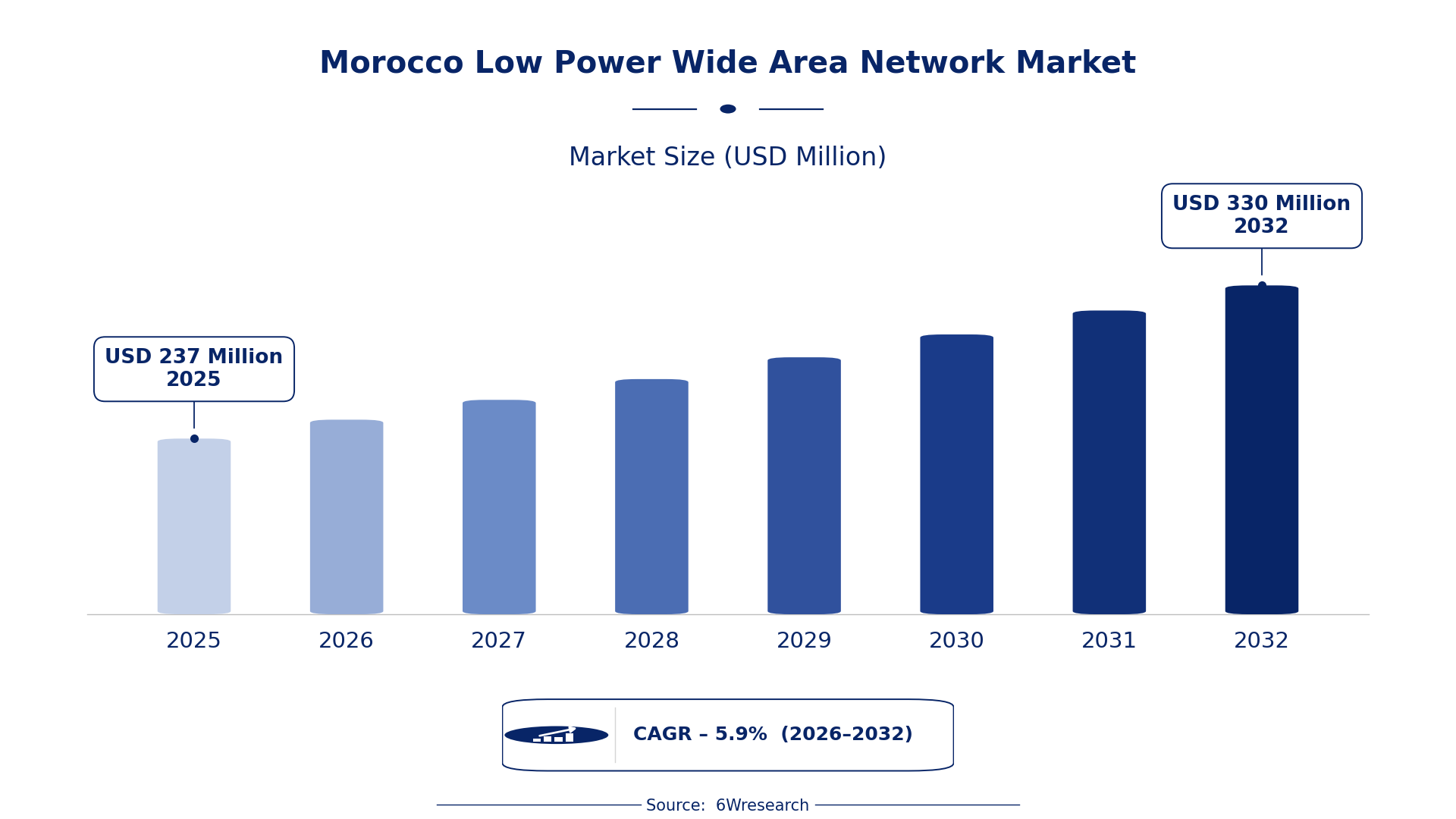
The Morocco Low Power Wide Area Network Market was estimated at USD 237 Million in 2025 and is projected to reach USD 330 Million by 2032, growing at a CAGR of 5.9% from 2026 to 2032.
Morocco Low Power Wide Area Network Market Synopsis
The Morocco Low Power Wide Area Network (LPWAN) market is witnessing a transformative phase, characterized by a surge in IoT adoption across critical sectors like agriculture, smart cities, and utilities. As companies increasingly recognize the operational efficiencies provided by LPWAN technologies, the market momentum is set to gain further traction in the coming years.
Government initiatives aimed at digital transformation, coupled with an expanding focus on smart infrastructure projects, are propelling demand for LPWAN solutions. This trajectory not only highlights the current growth pattern but also signals a robust future potential for innovative service applications within the Moroccan economy.
Morocco Low Power Wide Area Network Market Year-wise Growth Rate and Key Drivers
This graph illustrates the annual growth rates of the Morocco Low Power Wide Area Network Market from 2021 to 2032, highlighting a steady upward trajectory and projected expansion over the forecast period.
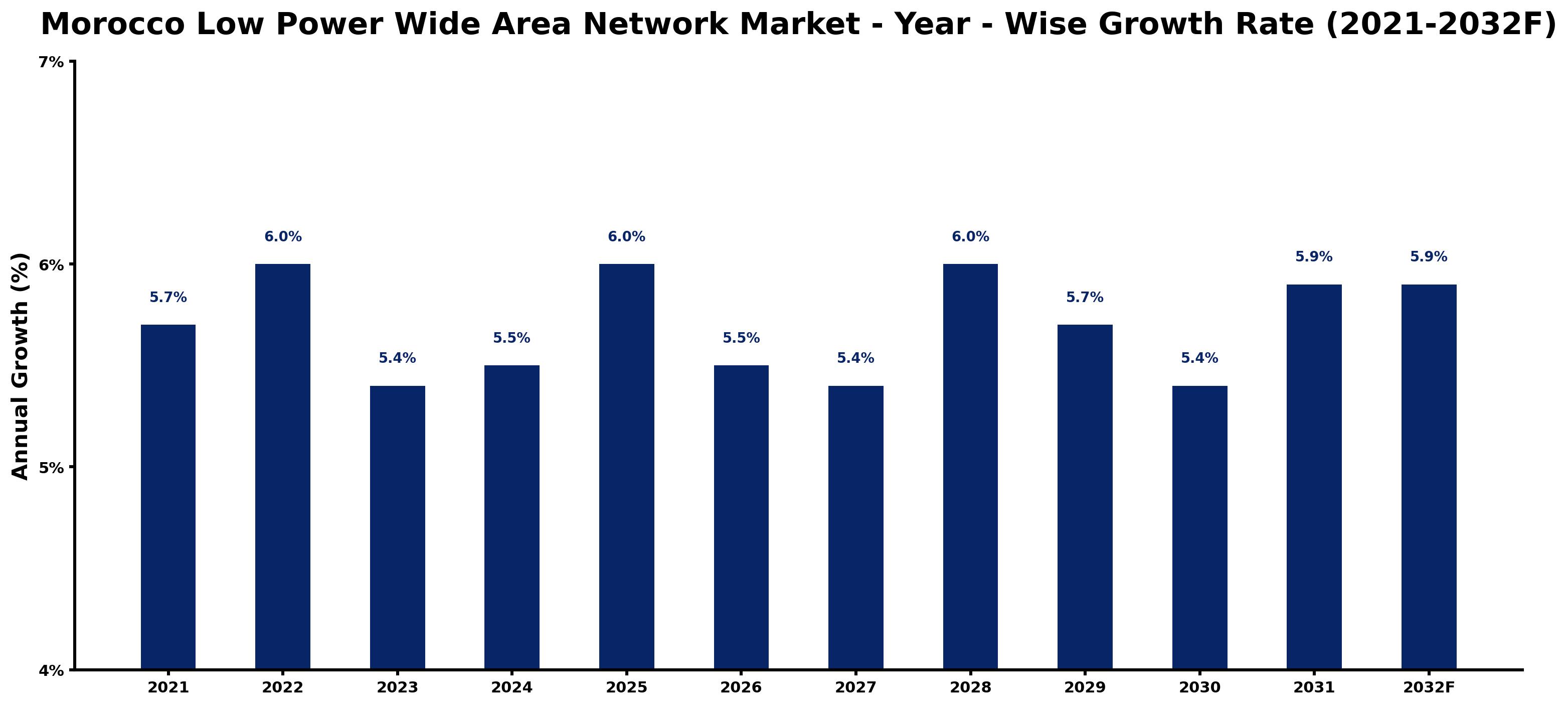
The table below presents the year‑wise growth rates along with the key drivers influencing the market
| Year | Growth Rate | Major Drivers |
| 2021 | 5.7% | Government's Green Energy Initiative boosts IoT connectivity. |
| 2022 | 6.0% | Telecom regulatory reforms encourage LPWAN infrastructure investments. |
| 2023 | 5.4% | Rising adoption of smart metering for utility management. |
| 2024 | 5.5% | Increased urbanization drives smart city LPWAN deployments. |
| 2025 | 6.0% | Local startups focus on LPWAN solutions for agriculture. |
| 2026 | 5.5% | Moroccan telecom companies partner for enhanced network coverage. |
| 2027 | 5.4% | Growing interest in environmental monitoring applications accelerates usage. |
| 2028 | 6.0% | Government funding supports public safety IoT deployments. |
| 2029 | 5.7% | Expanding e-commerce sector boosts logistics IoT needs. |
| 2030 | 5.4% | Increased urban traffic management needs drive LPWAN solutions. |
| 2031 | 5.9% | National digitization strategy emphasizes IoT service rollouts. |
| 2032 | 5.9% | Local universities research LPWAN for sustainable cities. |
Note: Market size estimations and growth projections presented in this report are based on 6Wresearch's proprietary forecasting methodology, utilizing the latest available industry data, government publications, and primary research inputs.
Morocco Low Power Wide Area Network Market Key Takeaways
Below are some of the specific key takeaways from the market, including:
- The market is seeing increasing adoption of LPWAN technologies like LoRaWAN and NB-IoT for IoT applications.
- Key sectors driving demand include agriculture, logistics, and smart city initiatives.
- Government policies are supportive of digital transformation, enhancing LPWAN deployment opportunities.
- Partnerships among telecom operators and technology providers are strengthening service offerings.
- Investment in LPWAN infrastructure is anticipated to escalate as market opportunities expand.
Evaluation of Restraints in Morocco Low Power Wide Area Network Market
Despite the promising outlook, certain factors restrain the Morocco LPWAN market's growth. Challenges include inconsistent network coverage in rural areas, which complicates reliable service provision. The competitive presence of alternative wireless technologies also limits the penetration of LPWAN. Furthermore, regulatory constraints and the substantial initial investment required for infrastructure deployment add complexity to market expansion efforts.
Morocco Low Power Wide Area Network Market Trends
A number of trends are emerging in the Morocco LPWAN market that warrant attention. There is a growing demand for cost-effective and energy-efficient connectivity solutions, particularly in underserved regions. The increasing prevalence of IoT devices calls for long-range connectivity options, which LPWAN technologies are well-equipped to offer. Additionally, partnerships between telecom companies and LPWAN providers are facilitating the development of comprehensive IoT solutions tailored to various sectors.
Morocco Low Power Wide Area Network Market Opportunities
Investment opportunities within the Morocco LPWAN market are abundant, driven by rising demand across various sectors. The potential for LPWAN technologies like LoRa and Sigfox lies in their capacity to deliver low-power, long-range communication. Investors focusing on infrastructure development, as well as IoT solution deployment, stand to benefit significantly from the favorable market conditions fueled by government initiatives aimed at digital transformation.
Government Initiatives in the Morocco Low Power Wide Area Network Market
The Moroccan government is actively shaping the LPWAN market through strategic initiatives that aim to bolster digital infrastructure and facilitate IoT adoption. This regulatory environment not only prioritizes technological innovation but also seeks to enhance the overall connectivity framework within the nation. The government's engagement in promoting LPWAN technologies reflects its commitment to fostering economic development through digital means.
- A spectrum allocation for LPWAN technologies by the National Telecommunications Regulatory Agency (ANRT) was completed in 2018, paving the way for IoT network deployments.
- Currently, there is an ongoing national digital infrastructure upgrade programme focusing on expanding connectivity in rural and underserved areas.
- A planned public-private partnership is expected to kick off by 2027, aimed at increasing the availability of LPWAN services throughout Morocco.
- Policy measures encouraging the integration of LPWAN solutions within the agriculture sector are currently in effect.
- Long-term initiatives to create smart city frameworks are being designed, expected to support LPWAN technology adoption.
Future Insights of the Morocco Low Power Wide Area Network Market
Looking ahead to the period between 2026 and 2032, the Morocco LPWAN market is expected to maintain a steady growth trajectory, driven by heightened interest in IoT applications across diverse industries. The favorable regulatory environment, alongside advances in LPWAN technology, will likely foster innovation and create opportunities for enhanced connectivity solutions. As industries recognize the efficiency gains through IoT implementations, market expansion appears increasingly viable.
Morocco Low Power Wide Area Network Market Latest Developments
Recent activity in the Morocco LPWAN market indicates a vibrant atmosphere of growth and innovation. Over the past year, various projects and partnerships have emerged, aimed at addressing both connectivity and technology needs across different sectors. The market is evolving rapidly, as stakeholders capitalize on the increasing demand for IoT solutions.
- A leading regional operator launched a new LPWAN service in early 2025, designed to enhance connectivity for agricultural applications.
- Currently, an initiative that began in mid-2025 focuses on establishing smart infrastructure in urban areas, supporting LPWAN deployment.
- A major technology vendor is rolling out a low-power, long-range connectivity solution expected to be available by mid-2026.
- A partnership between a telecom provider and an IoT solutions company is ongoing, aimed at developing integrated service packages for businesses.
- A planned outreach programme to educate local enterprises about LPWAN technologies is expected to begin in late 2026.
Morocco Low Power Wide Area Network Market - Key Attractiveness of the Report
- 10 Years of Market Numbers
- Historical Data Starting from 2022 to 2025
- Base Year: 2025
- Forecast Data until 2032
- Key Performance Indicators Impacting the Market
- Major Upcoming Developments and Projects
Key Highlights of the Report:
- Morocco Low Power Wide Area Network Market Outlook
- Market Size of Morocco Low Power Wide Area Network Market, 2025
- Forecast of Morocco Low Power Wide Area Network Market, 2032
- Historical Data and Forecast of Morocco Low Power Wide Area Network Revenues & Volume for the Period 2022-2032F
- Morocco Low Power Wide Area Network Market Trend Evolution
- Morocco Low Power Wide Area Network Market Drivers and Challenges
- Morocco Low Power Wide Area Network Price Trends
- Morocco Low Power Wide Area Network Porter's Five Forces
- Morocco Low Power Wide Area Network Industry Life Cycle
- Historical Data and Forecast of Morocco Low Power Wide Area Network Market Revenues & Volume By Connectivity Technology for the Period 2022-2032F
- Historical Data and Forecast of Morocco Low Power Wide Area Network Market Revenues & Volume By SIGFOX for the Period 2022-2032F
- Historical Data and Forecast of Morocco Low Power Wide Area Network Market Revenues & Volume By LoRaWAN for the Period 2022-2032F
- Historical Data and Forecast of Morocco Low Power Wide Area Network Market Revenues & Volume By Weigthless for the Period 2022-2032F
- Historical Data and Forecast of Morocco Low Power Wide Area Network Market Revenues & Volume By Others for the Period 2022-2032F
- Historical Data and Forecast of Morocco Low Power Wide Area Network Market Revenues & Volume By Verticals for the Period 2022-2032F
- Historical Data and Forecast of Morocco Low Power Wide Area Network Market Revenues & Volume By Agriculture for the Period 2022-2032F
- Historical Data and Forecast of Morocco Low Power Wide Area Network Market Revenues & Volume By Smart Logistic and Transportation for the Period 2022-2032F
- Historical Data and Forecast of Morocco Low Power Wide Area Network Market Revenues & Volume By Healthcare for the Period 2022-2032F
- Historical Data and Forecast of Morocco Low Power Wide Area Network Market Revenues & Volume By Industrial Manufacturing for the Period 2022-2032F
- Historical Data and Forecast of Morocco Low Power Wide Area Network Market Revenues & Volume By Oil and Gas for the Period 2022-2032F
- Historical Data and Forecast of Morocco Low Power Wide Area Network Market Revenues & Volume By Consumer Electronics for the Period 2022-2032F
- Historical Data and Forecast of Morocco Low Power Wide Area Network Market Revenues & Volume By Others for the Period 2022-2032F
- Historical Data and Forecast of Morocco Low Power Wide Area Network Market Revenues & Volume By Application for the Period 2022-2032F
- Historical Data and Forecast of Morocco Low Power Wide Area Network Market Revenues & Volume By Smart Waste Management for the Period 2022-2032F
- Historical Data and Forecast of Morocco Low Power Wide Area Network Market Revenues & Volume By Smart Buildings for the Period 2022-2032F
- Historical Data and Forecast of Morocco Low Power Wide Area Network Market Revenues & Volume By Smart Gas and Water Metering for the Period 2022-2032F
- Historical Data and Forecast of Morocco Low Power Wide Area Network Market Revenues & Volume By Smart Streetlights for the Period 2022-2032F
- Historical Data and Forecast of Morocco Low Power Wide Area Network Market Revenues & Volume By Smart Parking for the Period 2022-2032F
- Historical Data and Forecast of Morocco Low Power Wide Area Network Market Revenues & Volume By Livestock Monitoring for the Period 2022-2032F
- Historical Data and Forecast of Morocco Low Power Wide Area Network Market Revenues & Volume By Others for the Period 2022-2032F
- Historical Data and Forecast of Morocco Low Power Wide Area Network Market Revenues & Volume By Network Deployment for the Period 2022-2032F
- Historical Data and Forecast of Morocco Low Power Wide Area Network Market Revenues & Volume By Public Sector for the Period 2022-2032F
- Historical Data and Forecast of Morocco Low Power Wide Area Network Market Revenues & Volume By Private Sector for the Period 2022-2032F
- Historical Data and Forecast of Morocco Low Power Wide Area Network Market Revenues & Volume By Technology Service for the Period 2022-2032F
- Historical Data and Forecast of Morocco Low Power Wide Area Network Market Revenues & Volume By Managed Services for the Period 2022-2032F
- Historical Data and Forecast of Morocco Low Power Wide Area Network Market Revenues & Volume By Professional Services for the Period 2022-2032F
- Morocco Low Power Wide Area Network Import Export Trade Statistics
- Market Opportunity Assessment By Connectivity Technology
- Market Opportunity Assessment By Verticals
- Market Opportunity Assessment By Application
- Market Opportunity Assessment By Network Deployment
- Market Opportunity Assessment By Technology Service
- Morocco Low Power Wide Area Network Top Companies Market Share
- Morocco Low Power Wide Area Network Competitive Benchmarking By Technical and Operational Parameters
- Morocco Low Power Wide Area Network Company Profiles
- Morocco Low Power Wide Area Network Key Strategic Recommendations






































