Morocco LTE IoT Market Size & Growth Rate (2026-2032)
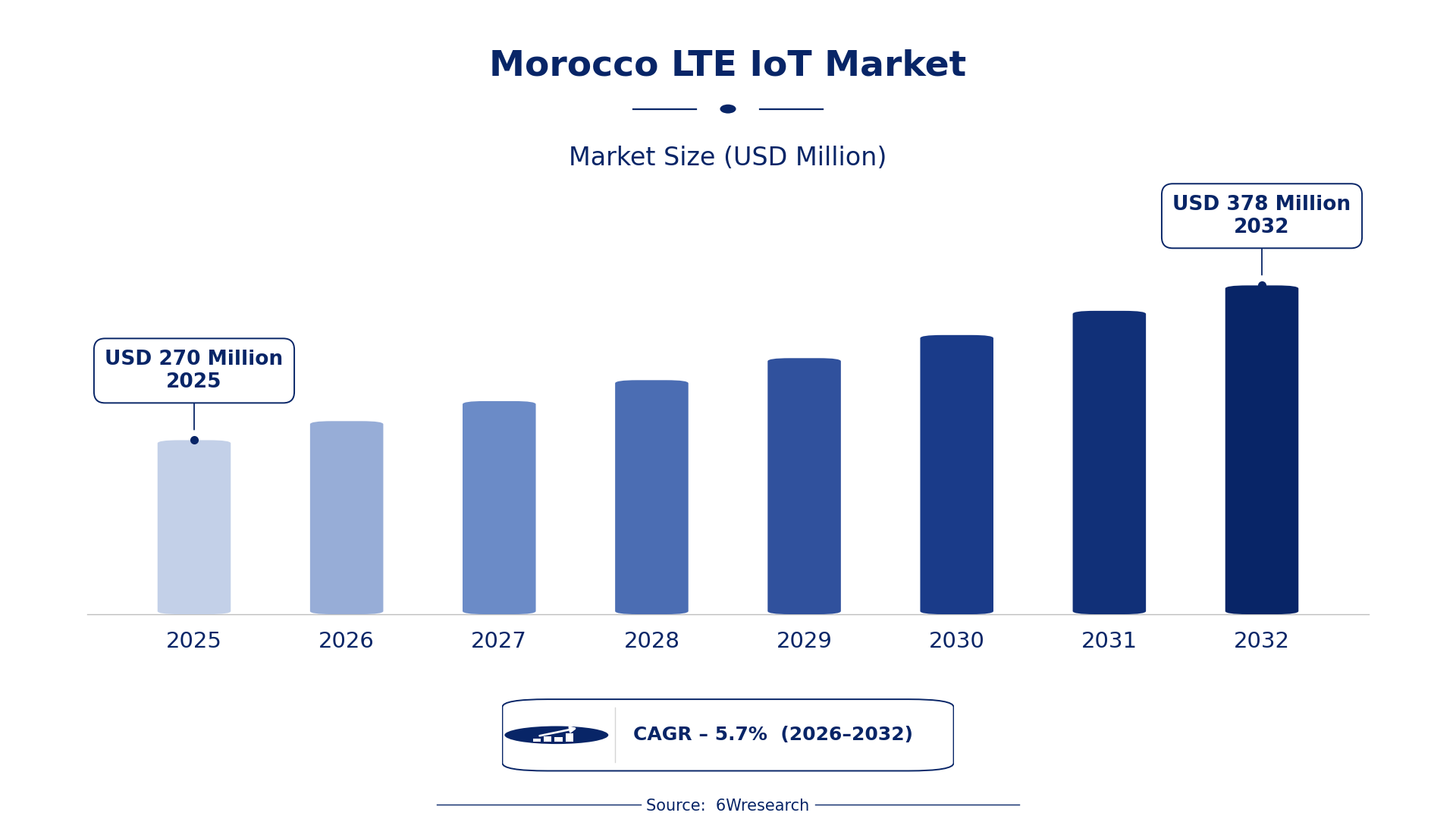
The Morocco LTE IoT Market was estimated at USD 270 Million in 2025 and is projected to reach USD 378 Million by 2032, growing at a CAGR of 5.7% from 2026 to 2032.
Morocco LTE IoT Market Synopsis
A surge in the adoption of IoT solutions across diverse sectors like agriculture, transportation, and manufacturing is the strongest force currently shaping the Morocco LTE IoT market. Businesses are increasingly realizing the efficiency and cost benefits of LTE technology, which provides faster and more secure connectivity.
Government initiatives aimed at enhancing digital transformation in Morocco further stimulate market growth. With smart city projects taking off, businesses are tapping into the potential of LTE IoT applications to improve operations and service delivery, fostering a conducive environment for innovation.
Morocco LTE IoT Market Year-wise Growth Rate and Key Drivers
This graph illustrates the annual growth rates of the Morocco LTE IoT Market from 2021 to 2032, highlighting a steady upward trajectory and projected expansion over the forecast period.
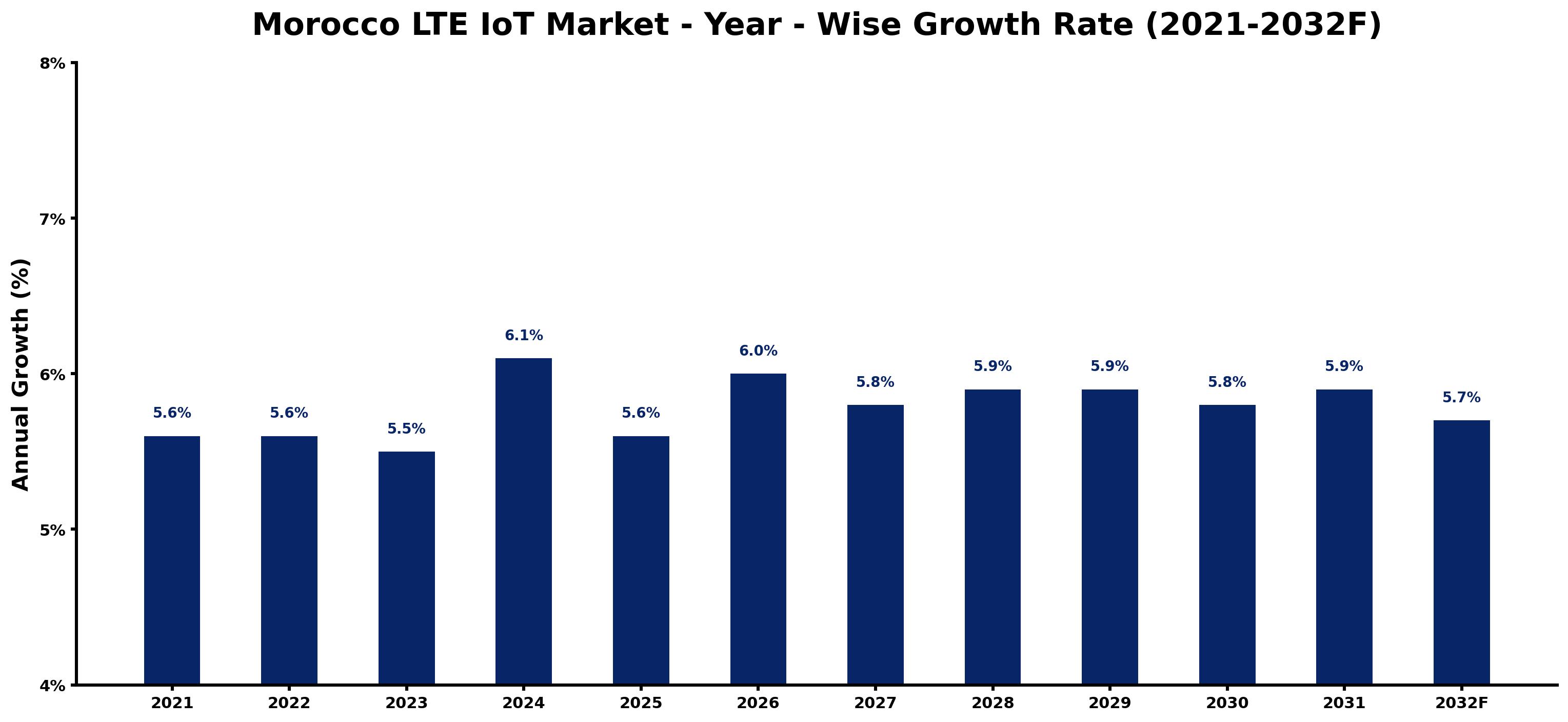
The table below presents the year‑wise growth rates along with the key drivers influencing the market
| Year | Growth Rate | Major Drivers |
| 2021 | 5.6% | Launch of Morocco's National IoT Strategy initiative |
| 2022 | 5.6% | Coverage expansion by Morocco Telecom for IoT networks |
| 2023 | 5.5% | Increased investment in smart agriculture technologies |
| 2024 | 6.1% | Growing adoption of smart metering solutions by ONEE |
| 2025 | 5.6% | Partnerships between local startups and international IoT firms |
| 2026 | 6.0% | Implementation of 5G technology enhancing LTE IoT capabilities |
| 2027 | 5.8% | Rising urbanization driving demand for smart city solutions |
| 2028 | 5.9% | Government incentives for IoT innovation in agriculture sector |
| 2029 | 5.9% | Development of applications tracking renewable energy sources |
| 2030 | 5.8% | Adoption of IoT platforms in automotive manufacturing |
| 2031 | 5.9% | Establishment of IoT incubators by Moroccan universities |
| 2032 | 5.7% | Growing concerns for security boosting smart surveillance uptake |
Note: Market size estimations and growth projections presented in this report are based on 6Wresearch's proprietary forecasting methodology, utilizing the latest available industry data, government publications, and primary research inputs.
Morocco LTE IoT Market Key Takeaways
Below are some of the specific key takeaways from the market, including:
- Growing demand for high-speed, low-latency connectivity solutions.
- Government support through policies promoting smart city and digital transformation projects.
- Key trends highlighting the rise of NB-IoT and LTE-M technologies.
- Investment opportunities emerging in sectors like healthcare and agriculture.
- Challenges related to device costs and network coverage needing strategic attention.
Evaluation of Restraints in Morocco LTE IoT Market
While the Morocco LTE IoT market shows promise, several restraints hinder its rapid expansion. High initial costs for IoT devices and solutions present a significant barrier for many businesses. Furthermore, limited network coverage, particularly in rural regions, exacerbates the challenges faced by potential users. Regulatory barriers and data privacy concerns also pose risks. To unlock the market's full potential, a concerted effort among stakeholders is necessary to address these issues effectively.
Morocco LTE IoT Market Trends
The market is witnessing a clear trend toward the adoption of NB-IoT and LTE-M technologies, which are favored for their low power consumption and extensive device connectivity. Furthermore, there is a growing emphasis on smart city implementations, with IoT applications becoming integral to urban planning. As industries embrace digital solutions, the demand for reliable and fast connectivity continues to surge, creating new avenues for technological advancement.
Morocco LTE IoT Market Opportunities
Investors will find fertile ground in various sectors, particularly in smart cities, healthcare, agriculture, and logistics. With the ongoing expansion of LTE networks, opportunities abound for developing IoT solutions that enhance energy management, improve agricultural productivity, and facilitate better patient care. Those focusing on IoT connectivity platforms and data analytics services tailored to the Moroccan market stand to gain significantly.
Government Initiatives in the Morocco LTE IoT Market
The Moroccan government is actively fostering the growth of the LTE IoT market through a series of strategic initiatives. Regulatory bodies are working to establish a supportive framework that encourages innovation, while public-sector investments in infrastructure are crucial for expanding network capabilities. This proactive approach is essential for building a competitive environment that will drive the IoT sector forward.
- A national digital infrastructure upgrade programme now in its rollout phase aims to enhance LTE network capabilities nationwide.
- The National Telecommunications Regulatory Agency (ANRT) has introduced a regulatory framework that facilitates IoT technology deployment.
- A recently completed initiative focused on public-private partnerships to foster collaboration in developing IoT solutions for smart cities.
- Ongoing discussions regarding the expansion of broadband access in rural areas are crucial for bridging connectivity gaps.
- A planned framework to incentivize local startups in the IoT space is expected to be rolled out by mid-2026.
Future Insights of the Morocco LTE IoT Market
The Morocco LTE IoT market is set for robust growth through 2032 as more sectors embrace IoT technologies. Healthcare, agriculture, and smart cities are positioned to leverage new LTE capabilities, improving service delivery and operational efficiencies. Continuous investment in infrastructure, combined with government initiatives, is expected to further catalyze advancements in the IoT sphere, creating a dynamic environment ripe for innovation.
Morocco LTE IoT Market Latest Developments
Recent months have witnessed a flurry of activity in the Morocco LTE IoT market, reflecting the ongoing commitment of stakeholders to harness IoT technologies for diverse applications. This direction suggests a growing momentum towards achieving digital transformation across multiple sectors.
- A major technology vendor launched a new IoT platform in early 2025 designed to streamline agricultural operations and enhance productivity.
- A collaborative initiative focused on smart energy management is currently underway, seeking to deploy IoT solutions in urban areas.
- An expansion of IoT sensor networks in major cities began in Q3 2025 to facilitate smart city applications.
- Upcoming plans for an integrated data analytics service tailored for healthcare providers are set to be unveiled in late 2026.
- A partnership between telecom operators to enhance connectivity for IoT devices across the nation is ongoing and expected to be completed by early 2026.
Morocco LTE IoT Market - Key Attractiveness of the Report
- 10 Years of Market Numbers
- Historical Data Starting from 2022 to 2025
- Base Year: 2025
- Forecast Data until 2032
- Key Performance Indicators Impacting the Market
- Major Upcoming Developments and Projects
Key Highlights of the Report:
- Morocco LTE IoT Market Outlook
- Market Size of Morocco LTE IoT Market, 2025
- Forecast of Morocco LTE IoT Market, 2032
- Historical Data and Forecast of Morocco LTE IoT Revenues & Volume for the Period 2022-2032F
- Morocco LTE IoT Market Trend Evolution
- Morocco LTE IoT Market Drivers and Challenges
- Morocco LTE IoT Price Trends
- Morocco LTE IoT Porter's Five Forces
- Morocco LTE IoT Industry Life Cycle
- Historical Data and Forecast of Morocco LTE IoT Market Revenues & Volume By Technology for the Period 2022-2032F
- Historical Data and Forecast of Morocco LTE IoT Market Revenues & Volume By NB-IoT for the Period 2022-2032F
- Historical Data and Forecast of Morocco LTE IoT Market Revenues & Volume By LTE-M for the Period 2022-2032F
- Historical Data and Forecast of Morocco LTE IoT Market Revenues & Volume By Service for the Period 2022-2032F
- Historical Data and Forecast of Morocco LTE IoT Market Revenues & Volume By Professional Services for the Period 2022-2032F
- Historical Data and Forecast of Morocco LTE IoT Market Revenues & Volume By Managed Services for the Period 2022-2032F
- Historical Data and Forecast of Morocco LTE IoT Market Revenues & Volume By Industry for the Period 2022-2032F
- Historical Data and Forecast of Morocco LTE IoT Market Revenues & Volume By Manufacturing for the Period 2022-2032F
- Historical Data and Forecast of Morocco LTE IoT Market Revenues & Volume By Energy and utilities for the Period 2022-2032F
- Historical Data and Forecast of Morocco LTE IoT Market Revenues & Volume By Transportation and logistics for the Period 2022-2032F
- Historical Data and Forecast of Morocco LTE IoT Market Revenues & Volume By Healthcare for the Period 2022-2032F
- Historical Data and Forecast of Morocco LTE IoT Market Revenues & Volume By Agriculture for the Period 2022-2032F
- Morocco LTE IoT Import Export Trade Statistics
- Market Opportunity Assessment By Technology
- Market Opportunity Assessment By Service
- Market Opportunity Assessment By Industry
- Morocco LTE IoT Top Companies Market Share
- Morocco LTE IoT Competitive Benchmarking By Technical and Operational Parameters
- Morocco LTE IoT Company Profiles
- Morocco LTE IoT Key Strategic Recommendations






































