Morocco Non-ferrous Metal Market Summary
The morocco non-ferrous metal market was estimated at USD 112 Million in 2025 and is projected to reach USD 122 Million by 2032, growing at a CAGR of 1.3% from 2026 to 2032.
Morocco Non-ferrous Metal Market Year-wise Growth Rate and Key Drivers
This graph highlights how the Morocco Non-ferrous Metal Market has steadily grown over the past five years, supported by major growth factors.
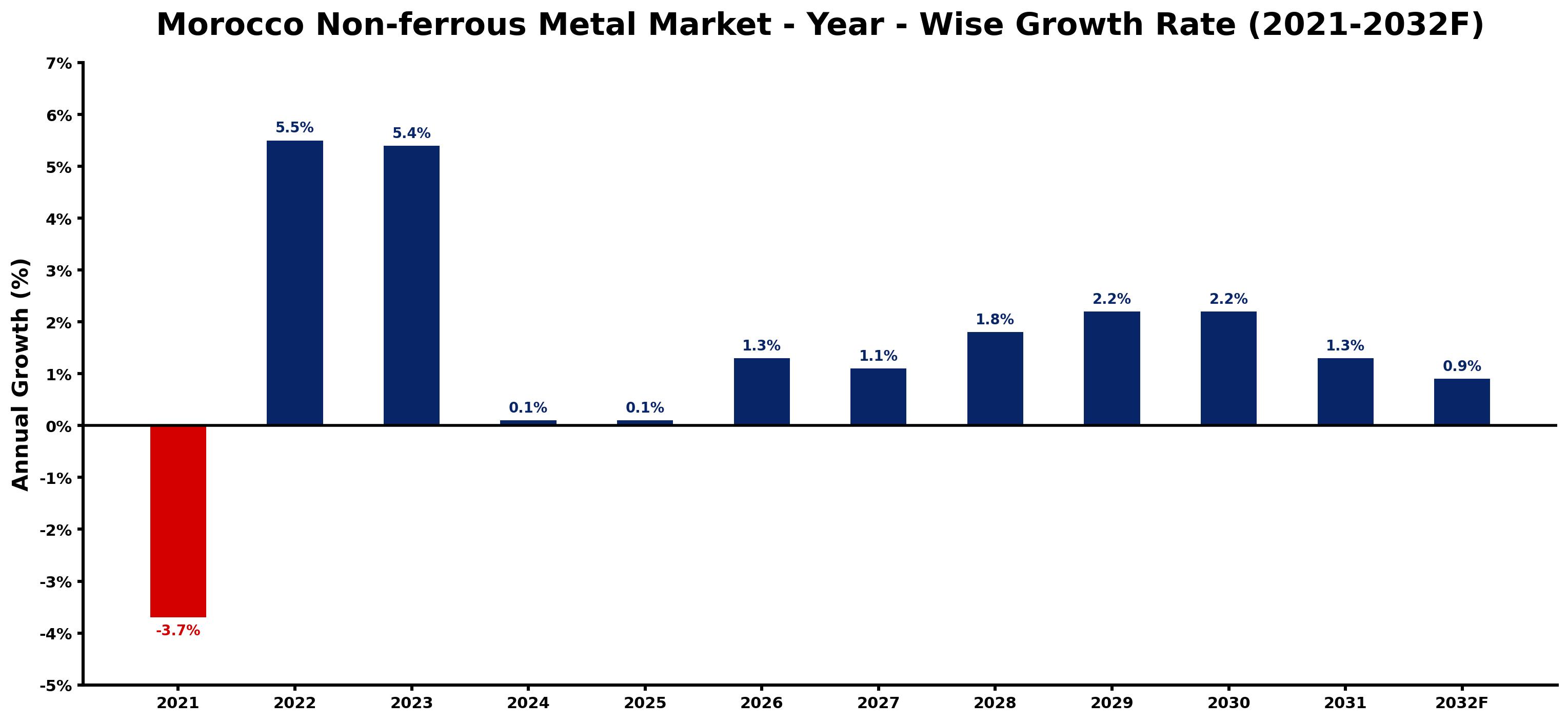
The table below presents the year wise growth rates along with the key drivers influencing the market
| Year | Growth Rate | Major Drivers |
| 2021 | -3.7% | Supply chain disruptions due to global shipping delays hindered timely production and delivery of nonferrous metals. |
| 2022 | 5.5% | Local manufacturing incentives strengthen the supply chain for metal producers. |
| 2023 | 5.4% | Rising global prices encourage export growth for Moroccan non-ferrous metals. |
| 2024 | 0.1% | Infrastructure projects expand, focusing on sustainable electrical grid solutions. |
| 2025 | 0.1% | Investment in renewable energy boosts copper and aluminum requirements significantly. |
| 2026 | 1.3% | Increasing urbanization intensifies needs for construction materials and metal recycling. |
| 2027 | 1.1% | Technology upgrades in smelting processes enhance efficiency and reduce costs. |
| 2028 | 1.8% | Emerging industries in electric vehicles heighten demand for lightweight metals. |
| 2029 | 2.2% | Trade agreements with EU offer preferential tariffs on Moroccan metal exports. |
| 2030 | 2.2% | Innovations in metallurgy improve product quality, attracting international clients. |
| 2031 | 1.3% | Local startups engage in metal recovery, ensuring sustainable resource management. |
| 2032 | 0.9% | Diversification into alloys opens new market opportunities for Moroccan manufacturers. |
Note - Market size estimations and growth projections presented in this report are based on 6Wresearch's advanced forecasting approach, validated with industry datasets as of June 2026.
Morocco Non-ferrous Metal Market Synopsis
The Morocco Non-ferrous Metal Market is projected to reach 1.3% and witness significant growth during the forecast period (2026-2032). This anticipated growth is underpinned by a confluence of factors, including expanding industrial activities, rapid urbanization, and increasing consumer demand across various sectors. The government's commitment to infrastructure development, along with the burgeoning automotive and electrical sectors, further amplifies this demand, heralding a robust period for non-ferrous metal products.
Morocco Non-ferrous Metal Market Growth Drivers
Several factors are driving the Morocco Non-ferrous Metal Market, enhancing its attractiveness for stakeholders:
- Continuous economic growth has bolstered disposable incomes, prompting consumers to spend more on durable goods such as automobiles and household appliances that rely heavily on non-ferrous metal components.
- An increase in industrial activities is being witnessed, particularly in manufacturing and construction sectors, which require substantial amounts of non-ferrous metals like aluminum and copper for production processes.
- The rapid urbanization of cities across Morocco fosters a strong demand for electrical infrastructure, necessitating the use of non-ferrous metals in power generation and distribution systems.
- Government investment in infrastructure projects indicates a stable future for the non-ferrous metal market, as projects such as roads, bridges, and public buildings require metal components.
- Shifts towards more sustainable production processes, encouraged by regulatory frameworks, have motivated production facilities to adopt advanced technologies, improving efficiency and competitiveness in the non-ferrous metal sector.
Morocco Non-ferrous Metal Market Trends and Opportunities
The Morocco Non-ferrous Metal Market is poised to experience transformative trends driven by innovation and adaptation to global demands:
- A growing emphasis on recycling and sustainable sourcing of raw materials is anticipated, as manufacturers recognize both ethical considerations and the economic advantages of utilizing recycled non-ferrous metals.
- Technological advancements in production methodologies are paving the way for enhanced efficiency and reduced costs, likely leading to more competitive pricing in the non-ferrous metal market.
- Investment in smart technologies within the automotive sector, including electric vehicles, could stimulate demand for lightweight non-ferrous metals, creating new avenues for growth in this market.
- As Morocco develops as a regional hub for manufacturing, opportunities for foreign investment and partnerships in the non-ferrous metal sector will likely arise.
- The alignment of domestic policies with international standards for sustainability and environmental protection positions Morocco favorably in the global non-ferrous metal market.
Morocco Non-ferrous Metal Market Challenges and Restraints
Despite positive growth prospects, challenges persist that could impact the Morocco Non-ferrous Metal Market:
- Volatility in global metal prices can lead to fluctuating costs for manufacturers, affecting profitability and potentially delaying new investments in the sector.
- Supply chain disruptions experienced during global crises could hinder the timely availability of essential non-ferrous metals, impacting production schedules.
- Regulatory changes within Morocco or internationally may impose stricter compliance measures that manufacturers must navigate, contributing to increased operational overhead.
- Competition from other regions with established non-ferrous metal industries can create pressures on pricing and market share for Moroccan firms.
- Environmental concerns regarding mining and production processes necessitate investments in cleaner technologies, which may strain budgets and resources for smaller players in the market.
Morocco Non-ferrous Metal Market Government Investment and Initiatives
The Moroccan government plays a pivotal role in shaping the Non-ferrous Metal Market through strategic investments and initiatives:
- Government-led infrastructure projects have led to increased construction activity, stimulating demand for non-ferrous metals required in building materials.
- Investment incentives aimed at attracting foreign direct investment (FDI) are designed to bolster the domestic non-ferrous metal industry.
- Regulatory frameworks focused on sustainable development are encouraging manufacturers to adopt eco-friendly practices, which align with global sustainability goals.
- The government's plan to modernize transport and energy infrastructure highlights the critical role of non-ferrous metals in achieving these developmental goals.
- Programs promoting technological innovation are expected to enhance productivity in the non-ferrous metal sector, ensuring competitiveness both domestically and internationally.
Morocco Non-ferrous Metal Market Latest Developments (May 2025 - June 2026)
Recent developments in the Morocco Non-ferrous Metal Market indicate a dynamic and evolving landscape:
- Increased exploration and mining activities have been noted, aimed at securing more local sources of non-ferrous metals in response to global supply chain challenges.
- Partnerships between Moroccan firms and international players are emerging, focusing on technology transfer and expertise sharing to enhance production capabilities.
- Regulatory revisions are underway, streamlining procedures and promoting transparency in the non-ferrous metal sector, which is expected to enhance investor confidence.
- Sustainability initiatives are gaining momentum, with companies increasingly committing to environmental standards and responsible sourcing practices to meet market demands.
- The introduction of new trade policies aims to facilitate the importation of competitively priced raw materials, thereby supporting local manufacturers in their production processes.
Morocco Non-ferrous Metal Market - Key Attractiveness of the Report
- 10 Years of Market Numbers
- Historical Data Starting from 2022 to 2025
- Base Year: 2025
- Forecast Data until 2032
- Key Performance Indicators Impacting the Market
- Major Upcoming Developments and Projects
Key Highlights of the Report:
- Morocco Non-ferrous Metal Market Outlook
- Market Size of Morocco Non-ferrous Metal Market, 2025
- Forecast of Morocco Non-ferrous Metal Market, 2032F
- Historical Data and Forecast of Morocco Non-ferrous Metal Revenues & Volume for the Period 2022-2032F
- Morocco Non-ferrous Metal Market Trend Evolution
- Morocco Non-ferrous Metal Market Drivers and Challenges
- Morocco Non-ferrous Metal Price Trends
- Morocco Non-ferrous Metal Porter's Five Forces
- Morocco Non-ferrous Metal Industry Life Cycle
- Historical Data and Forecast of Morocco Non-ferrous Metal Market Revenues & Volume By Types for the Period 2022-2032F
- Historical Data and Forecast of Morocco Non-ferrous Metal Market Revenues & Volume By Aluminum for the Period 2022-2032F
- Historical Data and Forecast of Morocco Non-ferrous Metal Market Revenues & Volume By Copper for the Period 2022-2032F
- Historical Data and Forecast of Morocco Non-ferrous Metal Market Revenues & Volume By Lead for the Period 2022-2032F
- Historical Data and Forecast of Morocco Non-ferrous Metal Market Revenues & Volume By Tin for the Period 2022-2032F
- Historical Data and Forecast of Morocco Non-ferrous Metal Market Revenues & Volume By Nickel for the Period 2022-2032F
- Historical Data and Forecast of Morocco Non-ferrous Metal Market Revenues & Volume By Titanium for the Period 2022-2032F
- Historical Data and Forecast of Morocco Non-ferrous Metal Market Revenues & Volume By Zinc for the Period 2022-2032F
- Historical Data and Forecast of Morocco Non-ferrous Metal Market Revenues & Volume By Applications for the Period 2022-2032F
- Historical Data and Forecast of Morocco Non-ferrous Metal Market Revenues & Volume By Automobile Industry for the Period 2022-2032F
- Historical Data and Forecast of Morocco Non-ferrous Metal Market Revenues & Volume By Electronic Power Industry for the Period 2022-2032F
- Historical Data and Forecast of Morocco Non-ferrous Metal Market Revenues & Volume By Construction Industry for the Period 2022-2032F
- Historical Data and Forecast of Morocco Non-ferrous Metal Market Revenues & Volume By Other for the Period 2022-2032F
- Morocco Non-ferrous Metal Import Export Trade Statistics
- Market Opportunity Assessment By Types
- Market Opportunity Assessment By Applications
- Morocco Non-ferrous Metal Top Companies Market Share
- Morocco Non-ferrous Metal Competitive Benchmarking By Technical and Operational Parameters
- Morocco Non-ferrous Metal Company Profiles
- Morocco Non-ferrous Metal Key Strategic Recommendations






































