Morocco Paint Market Year-wise Growth Rate (2021-2031F)
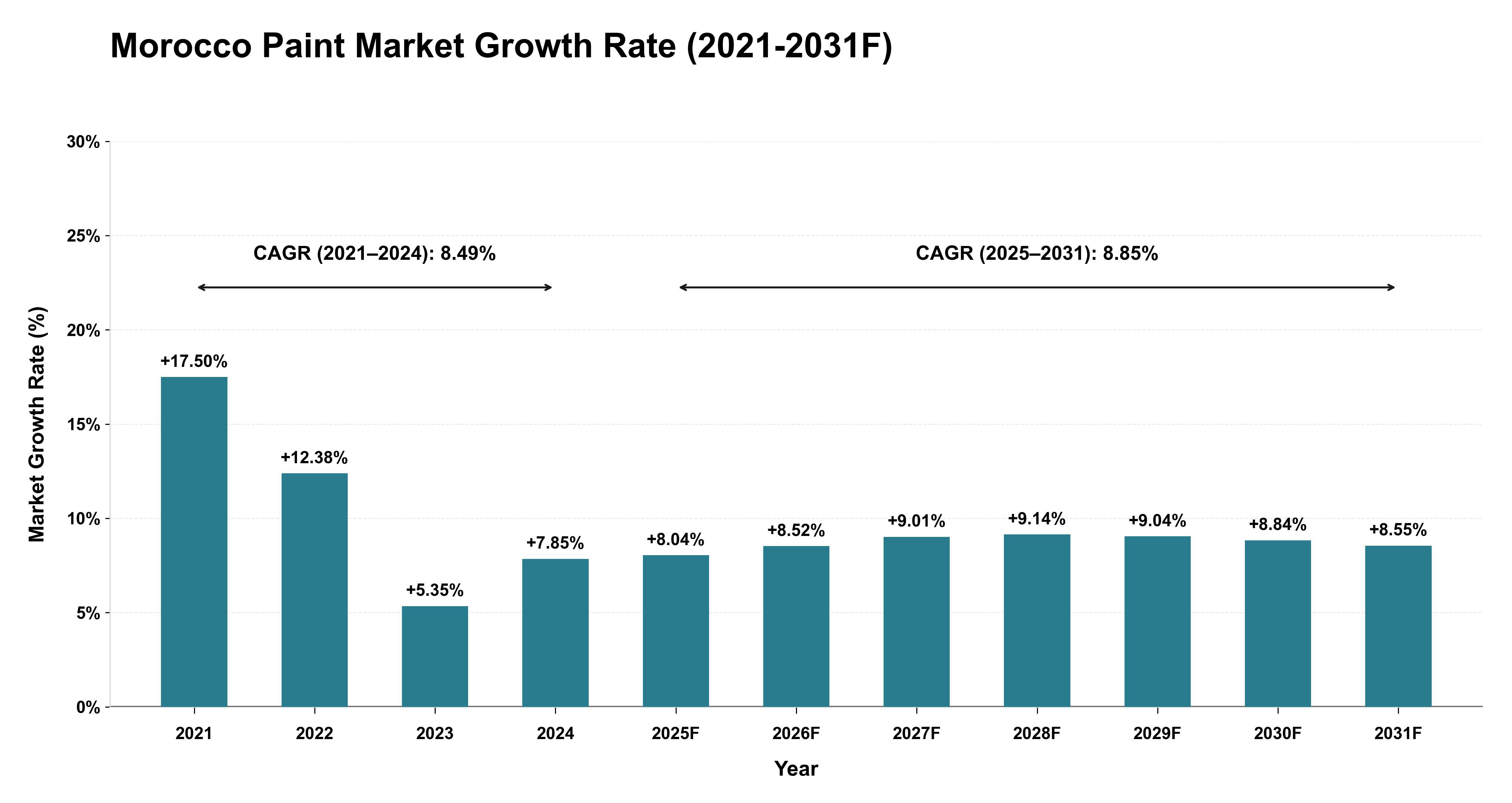
In the Morocco Paint Market, from 2021 to 2024, we witnessed a robust growth trajectory with varying annual growth rates, starting at a high of 17.50% in 2021, gradually stabilizing at 7.85% in 2024. This period was characterized by increased infrastructure projects and rising disposable incomes driving demand for paints across construction and renovation sectors. Looking ahead to 2025-2031, the forecasted CAGR of 8.85% indicates a continued positive momentum. The steady acceleration in growth rates from 8.04% in 2025 to 8.55% in 2031 signifies sustained market demand supported by ongoing construction activities, urbanization trends, and a shift towards eco-friendly paint solutions in line with regulatory standards. Overall, the Morocco Paint Market is poised for steady expansion driven by sector-specific demand dynamics and evolving consumer preferences.
Key Highlights of the Report:
- Morocco Paint Market Outlook
- Market Size of Morocco Paint Market,2024
- Forecast of Morocco Paint Market, 2031
- Historical Data and Forecast of Morocco Paint Revenues & Volume for the Period 2021-2031
- Morocco Paint Market Trend Evolution
- Morocco Paint Market Drivers and Challenges
- Morocco Paint Price Trends
- Morocco Paint Porter's Five Forces
- Morocco Paint Industry Life Cycle
- Historical Data and Forecast of Morocco Paint Market Revenues & Volume By Type for the Period 2021-2031
- Historical Data and Forecast of Morocco Paint Market Revenues & Volume By Water-Based for the Period 2021-2031
- Historical Data and Forecast of Morocco Paint Market Revenues & Volume By Oil-Based for the Period 2021-2031
- Historical Data and Forecast of Morocco Paint Market Revenues & Volume By Latex for the Period 2021-2031
- Historical Data and Forecast of Morocco Paint Market Revenues & Volume By Enamel for the Period 2021-2031
- Historical Data and Forecast of Morocco Paint Market Revenues & Volume By Finish Type for the Period 2021-2031
- Historical Data and Forecast of Morocco Paint Market Revenues & Volume By Matte for the Period 2021-2031
- Historical Data and Forecast of Morocco Paint Market Revenues & Volume By Glossy for the Period 2021-2031
- Historical Data and Forecast of Morocco Paint Market Revenues & Volume By Satin for the Period 2021-2031
- Historical Data and Forecast of Morocco Paint Market Revenues & Volume By Semi-Gloss for the Period 2021-2031
- Historical Data and Forecast of Morocco Paint Market Revenues & Volume By End User for the Period 2021-2031
- Historical Data and Forecast of Morocco Paint Market Revenues & Volume By Residential for the Period 2021-2031
- Historical Data and Forecast of Morocco Paint Market Revenues & Volume By Automotive for the Period 2021-2031
- Historical Data and Forecast of Morocco Paint Market Revenues & Volume By Industrial for the Period 2021-2031
- Historical Data and Forecast of Morocco Paint Market Revenues & Volume By Marine for the Period 2021-2031
- Historical Data and Forecast of Morocco Paint Market Revenues & Volume By Application for the Period 2021-2031
- Historical Data and Forecast of Morocco Paint Market Revenues & Volume By Walls & Ceilings for the Period 2021-2031
- Historical Data and Forecast of Morocco Paint Market Revenues & Volume By Cars & Trucks for the Period 2021-2031
- Historical Data and Forecast of Morocco Paint Market Revenues & Volume By Machinery for the Period 2021-2031
- Historical Data and Forecast of Morocco Paint Market Revenues & Volume By Boats & Ships for the Period 2021-2031
- Morocco Paint Import Export Trade Statistics
- Market Opportunity Assessment By Type
- Market Opportunity Assessment By Finish Type
- Market Opportunity Assessment By End User
- Market Opportunity Assessment By Application
- Morocco Paint Top Companies Market Share
- Morocco Paint Competitive Benchmarking By Technical and Operational Parameters
- Morocco Paint Company Profiles
- Morocco Paint Key Strategic Recommendations






































