Morocco Potassium chlorate Market Size, Share & Growth Rate
The Morocco Potassium chlorate Market was estimated at USD 1331 Million in 2025 and is projected to reach USD 1942 Million by 2032, growing at a CAGR of 5.5% from 2026 to 2032. This growth trajectory is significantly driven by the surging demand from the agricultural sector, particularly for herbicides, as well as the increasing reliance on potassium chlorate in the manufacturing of fireworks and explosives. The market's expansion is further supported by advancements in production technologies and the emphasis on quality and safety standards across various applications.
Morocco Potassium chlorate Market Year-wise Growth Rate and Key Drivers
This graph highlights how the Morocco Potassium chlorate Market has steadily grown over the years, supported by major growth factors.
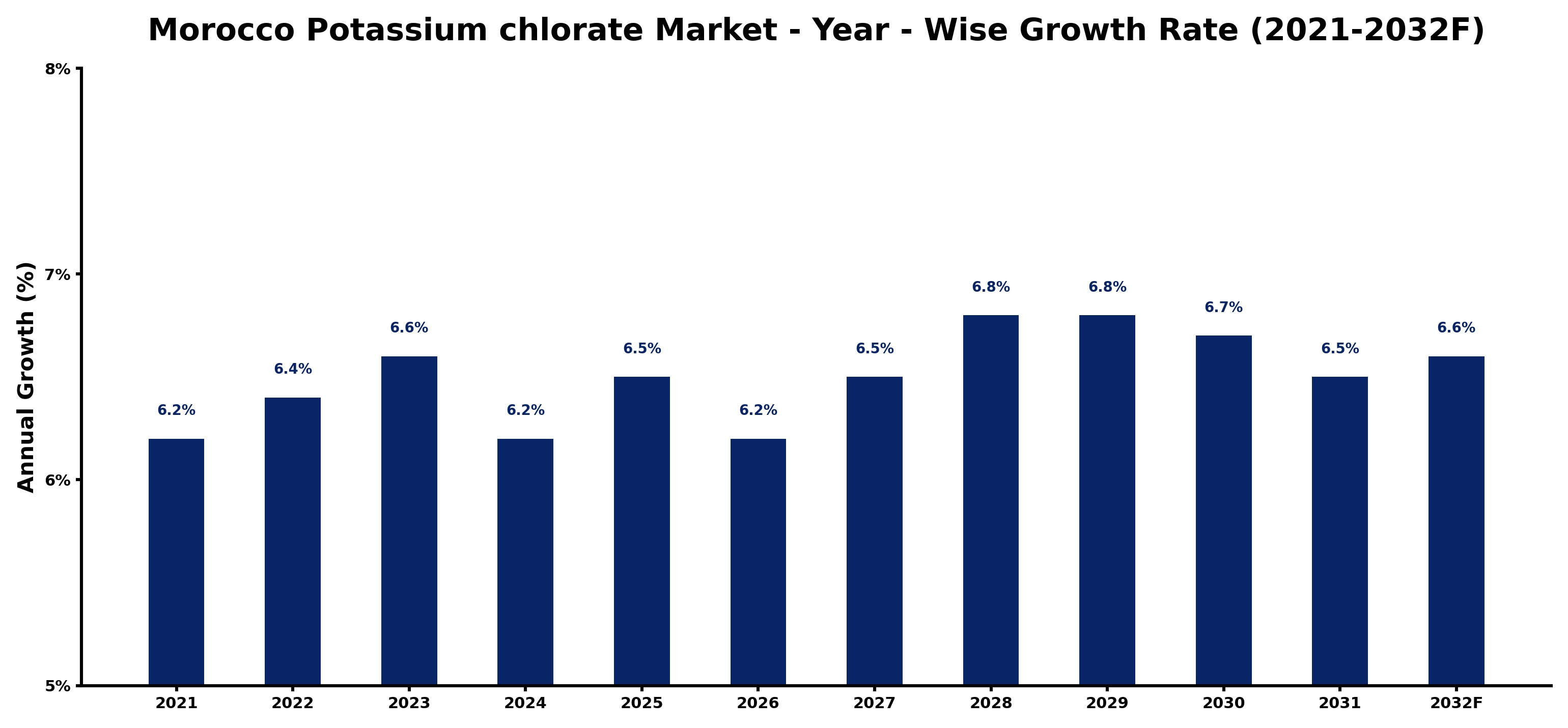
The table below presents the year‑wise growth rates along with the key drivers influencing the market
| Year | Growth Rate | Major Drivers |
| 2021 | 6.2% | Manufacturing investments in Morocco enhanced potassium chlorate production capacity |
| 2022 | 6.4% | Domestic production scale up drives potassium chlorate manufacturing efficiency |
| 2023 | 6.6% | Local chemical manufacturing upgrades boosted potassium chlorate output efficiency |
| 2024 | 6.2% | New manufacturing facilities drive local potassium chlorate production capabilities |
| 2025 | 6.5% | Export driven investments in chemical manufacturing bolster potassium chlorate production |
| 2026 | 6.2% | Advanced processing techniques enhanced potassium chlorate production efficiency |
| 2027 | 6.5% | Manufacturing investments in chemical facilities boost potassium chlorate output |
| 2028 | 6.8% | Potassium chlorate manufacturing investments boosted export capabilities significantly |
| 2029 | 6.8% | Export driven investments boosted local potassium chlorate production capabilities |
| 2030 | 6.7% | Upgraded processing facilities boost Morocco's potassium chlorate production capacity |
| 2031 | 6.5% | Export driven investments boosted Morocco's potassium chlorate production capacity |
| 2032 | 6.6% | Technology integration in mining enhances potassium chlorate production efficiency |
Note - Market size estimations and growth projections presented in this report are based on 6Wresearch's advanced forecasting approach, validated with industry datasets as of June 2026.
Morocco Potassium chlorate Market Synopsis
A primary force shaping the Morocco Potassium chlorate market is the burgeoning agricultural sector. The integration of potassium chlorate as an effective herbicide is revolutionizing farming practices, allowing for enhanced crop yields and sustainable farming solutions. This demand is concurrently buoyed by the rising popularity of potassium chlorate in pyrotechnics, which further solidifies its market position.
As Morocco continues to develop its chemical industry, the market for potassium chlorate is poised for further growth. There is a significant shift towards adopting more innovative applications of potassium chlorate across different sectors, reflecting a broader trend of industrial modernization and efficiency improvements. However, market players must navigate the intricate regulatory landscape that governs its production and use.
Morocco Potassium chlorate Market Key Takeaways
- The market is expanding due to increased agricultural and pyrotechnic applications.
- Morocco's strategic position as a major exporter enhances market viability.
- Technological advancements in production are improving product quality and safety.
- Regulatory challenges present both risks and opportunities for market participants.
- Future growth is likely to be driven by innovation and increased awareness of potassium chlorate benefits.
Evaluation of Restraints in Morocco Potassium chlorate Market
The Moroccan potassium chlorate market faces several notable restraints. Strict government regulations surrounding the production and usage of potassium chlorate complicate the operational landscape. These rules, aimed at ensuring safety and minimizing environmental risks, can result in increased compliance costs for manufacturers. Furthermore, fluctuating raw material prices pose significant challenges to profit margins, while competition from alternative chemical solutions may limit market opportunities. To thrive, companies must remain agile and informed about regulatory changes and market trends.
Morocco Potassium chlorate Market Trends
The current trends in the Morocco Potassium chlorate market highlight a growing inclination towards environmentally sustainable practices. More industries are seeking alternatives that align with stricter regulatory frameworks and consumer preferences for eco-friendly products. Additionally, advancements in production technology are enhancing the efficiency and safety of potassium chlorate applications. There's also an uptick in research initiatives focusing on diversifying its uses beyond traditional sectors, further broadening the market's horizons.
Morocco Potassium chlorate Market Opportunities
The opportunities within the Morocco Potassium chlorate market are ripe for exploration. The increasing reliance on potassium chlorate in agriculture for effective crop protection offers a significant avenue for growth. Moreover, the expanding pyrotechnics industry presents a lucrative investment opportunity, especially as Morocco enhances its production capabilities. As the global demand for potassium chlorate rises, investors are encouraged to consider strategic partnerships and technological investments that can bolster product offerings and market presence.
Government Initiatives in the Morocco Potassium chlorate Market
The Moroccan government has instituted a rigorous framework of regulations governing the potassium chlorate market. These measures are designed to ensure that the production, import, and distribution adhere to safety and quality standards. The government actively monitors compliance to curb potential misuse, particularly concerning the substance's association with explosives. These policies not only prioritize public safety but also aim to foster a more secure market environment for legitimate producers and users of potassium chlorate.
Future Insights of the Morocco Potassium chlorate Market
Looking ahead to 2026-2032, the Morocco Potassium chlorate market is expected to continue on a positive trajectory. With the agricultural sector at the forefront of demand, there's likely to be an ongoing need for effective herbicides that boost productivity. The anticipated growth in chemical manufacturing and the government's push for enhanced domestic production will further catalyze market expansion. While challenges persist, particularly from regulatory constraints and market competition, a focus on innovation and quality will be crucial for sustained progress.
Morocco Potassium chlorate Market Latest Developments (May 2025 - June 2026)
Recently, the Morocco Potassium chlorate market has seen a shift towards more environmentally conscious production methods. Developments in regulatory compliance have led to enhanced safety protocols for manufacturers. Additionally, the market is witnessing a rise in collaborative research efforts aimed at exploring new applications and improving efficiency. This momentum is indicative of a market in transition, focusing on not just growth, but responsible growth.
Morocco Potassium chlorate Market - Key Attractiveness of the Report
- 10 Years of Market Numbers
- Historical Data Starting from 2022 to 2025
- Base Year: 2025
- Forecast Data until 2032
- Key Performance Indicators Impacting the Market
- Major Upcoming Developments and Projects
Key Highlights of the Report:
- Morocco Potassium chlorate Market Outlook
- Market Size of Morocco Potassium chlorate Market, 2025
- Forecast of Morocco Potassium chlorate Market, 2032
- Historical Data and Forecast of Morocco Potassium chlorate Revenues & Volume for the Period 2022-2032F
- Morocco Potassium chlorate Market Trend Evolution
- Morocco Potassium chlorate Market Drivers and Challenges
- Morocco Potassium chlorate Price Trends
- Morocco Potassium chlorate Porter's Five Forces
- Morocco Potassium chlorate Industry Life Cycle
- Historical Data and Forecast of Morocco Potassium chlorate Market Revenues & Volume By Product type for the Period 2022-2032F
- Historical Data and Forecast of Morocco Potassium chlorate Market Revenues & Volume By Pharmaceutical Grade for the Period 2022-2032F
- Historical Data and Forecast of Morocco Potassium chlorate Market Revenues & Volume By Chemical Grade for the Period 2022-2032F
- Historical Data and Forecast of Morocco Potassium chlorate Market Revenues & Volume By End-use for the Period 2022-2032F
- Historical Data and Forecast of Morocco Potassium chlorate Market Revenues & Volume By Explosives for the Period 2022-2032F
- Historical Data and Forecast of Morocco Potassium chlorate Market Revenues & Volume By Matches for the Period 2022-2032F
- Historical Data and Forecast of Morocco Potassium chlorate Market Revenues & Volume By Disinfectants for the Period 2022-2032F
- Historical Data and Forecast of Morocco Potassium chlorate Market Revenues & Volume By Bleaches for the Period 2022-2032F
- Historical Data and Forecast of Morocco Potassium chlorate Market Revenues & Volume By Medical for the Period 2022-2032F
- Morocco Potassium chlorate Import Export Trade Statistics
- Market Opportunity Assessment By Product type
- Market Opportunity Assessment By End-use
- Morocco Potassium chlorate Top Companies Market Share
- Morocco Potassium chlorate Competitive Benchmarking By Technical and Operational Parameters
- Morocco Potassium chlorate Company Profiles
- Morocco Potassium chlorate Key Strategic Recommendations






































