Morocco Prepaid Cards Market Size, Share & Growth Rate
The Morocco Prepaid Cards Market was estimated at USD 699 Million in 2025 and is projected to reach USD 1191 Million by 2032, growing at a CAGR of 7.9% from 2026 to 2032. This impressive growth trajectory can be attributed to the increasing preference for digital payment solutions among consumers, coupled with the significant rise in financial inclusion initiatives targeting the unbanked and underbanked populations. As Moroccan society continues to embrace cashless transactions, prepaid cards are becoming a key player in the country's evolving financial landscape.
Morocco Prepaid Cards Market Year-wise Growth Rate and Key Drivers
This graph highlights how the Morocco Prepaid Cards Market has steadily grown over the years, supported by major growth factors.
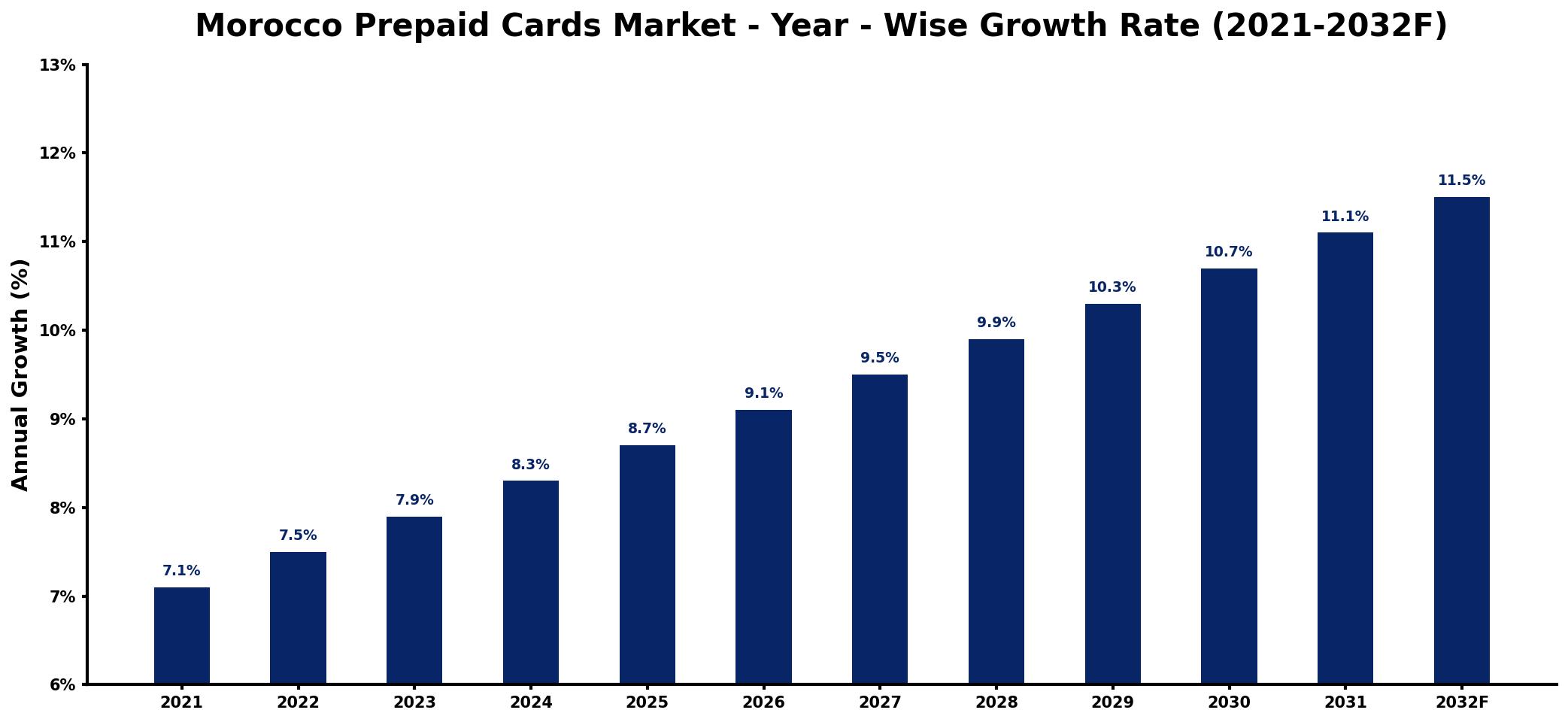
The table below presents the year‑wise growth rates along with the key drivers influencing the market
| Year | Growth Rate | Major Drivers |
| 2021 | 7.1% | Rising digital payment adoption |
| 2022 | 7.5% | Increased consumer spending behavior |
| 2023 | 7.9% | Expansion of e-commerce platforms |
| 2024 | 8.3% | Growth in fintech investments |
| 2025 | 8.7% | Enhanced mobile payment solutions |
| 2026 | 9.1% | Development of financial literacy programs |
| 2027 | 9.5% | Rising urban population density |
| 2028 | 9.9% | Government support for digitalization |
| 2029 | 10.3% | Increase in cross-border transactions |
| 2030 | 10.7% | Emergence of new payment technologies |
| 2031 | 11.1% | Growing acceptance among retailers |
| 2032 | 11.5% | expanding manufacturing base activity |
Note: Market size estimations and growth projections presented in this report are based on 6Wresearch's proprietary forecasting methodology, utilizing the latest available industry data, government publications, and primary research inputs.
Morocco Prepaid Cards Market Synopsis
In recent years, the Morocco prepaid cards market has witnessed remarkable momentum, transitioning from traditional payment methods to innovative digital solutions. This shift is fueled by a growing consumer base that values convenience and security in their transactions. However, the market is also on the cusp of transformation, with new functionalities and technological advancements poised to redefine user experiences.
As the market evolves, the focus is not just on expanding the customer base but also on enhancing the overall functionality of prepaid cards. Improved security features and seamless integration with mobile wallets and e-commerce platforms are critical elements driving this growth. The future outlook indicates a trend towards more versatile prepaid card offerings, positioning them as essential tools for modern financial management.
Morocco Prepaid Cards Market Key Takeaways
- The Morocco prepaid cards market is benefiting from the national drive towards digital payment solutions.
- Growing financial inclusion initiatives are broadening the market's reach among unbanked and underbanked consumers.
- Enhanced security features are increasingly crucial in fostering consumer trust and driving adoption.
- Integration with mobile wallets and e-commerce platforms is pivotal for expanding market potential.
- Government policies are actively supporting the growth of the prepaid card ecosystem in Morocco.
Evaluation of Restraints in Morocco Prepaid Cards Market
Despite the promising growth, several restraints hinder the full potential of the Morocco prepaid cards market. Concerns around security and fraud prevention remain paramount, creating hesitance among potential users. Moreover, the need for robust cardholder authentication methods and strong encryption protocols is critical for building consumer trust. Furthermore, the challenge of expanding acceptance networks and ensuring interoperability with existing payment systems poses obstacles to widespread market adoption, necessitating focused efforts from all stakeholders.
Morocco Prepaid Cards Market Trends
Current trends in the Morocco prepaid cards market reveal a growing consumer demand for not only payment flexibility but also enhanced functionalities. The incorporation of loyalty programs, budgeting tools, and financial management features within prepaid cards is becoming a significant trend. Additionally, the integration of artificial intelligence in fraud detection and risk management is gaining traction, enhancing the overall security of prepaid transactions and further driving user confidence.
Morocco Prepaid Cards Market Opportunities
The landscape of the Morocco prepaid cards market presents several genuine opportunities for growth and investment. The ongoing digital transformation in financial services creates openings for innovative prepaid card solutions tailored to niche markets. Collaborations between fintech startups and established financial institutions can spur new product developments, catering to specific consumer needs and expanding market penetration. Furthermore, the increasing reliance on e-commerce and mobile payments underscores the demand for adaptable prepaid cards that enhance transactional convenience.
Government Initiatives in the Morocco Prepaid Cards Market
The Moroccan government has enacted a series of initiatives aimed at fostering the growth of the prepaid cards market. These policies focus on promoting financial inclusion and the adoption of digital payment systems. The government supports regulatory frameworks that ensure transaction security and transparency while encouraging partnerships between financial institutions and technology providers. Additionally, awareness campaigns aimed at educating consumers about the benefits of prepaid cards are integral to modernizing the payment ecosystem and reducing cash dependency.
Future Insights of the Morocco Prepaid Cards Market
Looking ahead, the Morocco prepaid cards market is positioned for continued growth from 2026 to 2032. Innovations in technology, combined with increasing consumer acceptance, will likely drive the expansion of prepaid card functionalities. As financial inclusion efforts intensify, more individuals will access prepaid options, further embedding these cards into everyday transactions. The convergence of digital finance trends and evolving consumer expectations will shape a dynamic future for the market.
Morocco Prepaid Cards Market Latest Developments (2025 - 2026)
Recent developments in the Morocco prepaid cards market indicate a strong push towards enhancing user experience and security. Innovations in biometric authentication methods are being explored to bolster security measures, while new partnerships between fintechs and banks aim to diversify prepaid card offerings. Additionally, growing consumer interest in mobile payment solutions is driving further integration of prepaid cards with popular e-commerce platforms, facilitating smoother transactions for users.
Morocco Prepaid Cards Market - Key Attractiveness of the Report
- 10 Years of Market Numbers
- Historical Data Starting from 2022 to 2025
- Base Year: 2025
- Forecast Data until 2032
- Key Performance Indicators Impacting the Market
- Major Upcoming Developments and Projects
Key Highlights of the Report:
- Morocco Prepaid Cards Market Outlook
- Market Size of Morocco Prepaid Cards Market, 2025
- Forecast of Morocco Prepaid Cards Market, 2032
- Historical Data and Forecast of Morocco Prepaid Cards Revenues & Volume for the Period 2022-2032F
- Morocco Prepaid Cards Market Trend Evolution
- Morocco Prepaid Cards Market Drivers and Challenges
- Morocco Prepaid Cards Price Trends
- Morocco Prepaid Cards Porter's Five Forces
- Morocco Prepaid Cards Industry Life Cycle
- Historical Data and Forecast of Morocco Prepaid Cards Market Revenues & Volume By Offering for the Period 2022-2032F
- Historical Data and Forecast of Morocco Prepaid Cards Market Revenues & Volume By General Purpose Card for the Period 2022-2032F
- Historical Data and Forecast of Morocco Prepaid Cards Market Revenues & Volume By Gift Card for the Period 2022-2032F
- Historical Data and Forecast of Morocco Prepaid Cards Market Revenues & Volume By Government Benefit/Disbursement Card for the Period 2022-2032F
- Historical Data and Forecast of Morocco Prepaid Cards Market Revenues & Volume By Incentive/Payroll Card for the Period 2022-2032F
- Historical Data and Forecast of Morocco Prepaid Cards Market Revenues & Volume By Others for the Period 2022-2032F
- Historical Data and Forecast of Morocco Prepaid Cards Market Revenues & Volume By Card Type for the Period 2022-2032F
- Historical Data and Forecast of Morocco Prepaid Cards Market Revenues & Volume By Closed Loop Card for the Period 2022-2032F
- Historical Data and Forecast of Morocco Prepaid Cards Market Revenues & Volume By Open Loop Card for the Period 2022-2032F
- Historical Data and Forecast of Morocco Prepaid Cards Market Revenues & Volume By End User for the Period 2022-2032F
- Historical Data and Forecast of Morocco Prepaid Cards Market Revenues & Volume By Retail for the Period 2022-2032F
- Historical Data and Forecast of Morocco Prepaid Cards Market Revenues & Volume By Corporate for the Period 2022-2032F
- Historical Data and Forecast of Morocco Prepaid Cards Market Revenues & Volume By Government/Public Sector for the Period 2022-2032F
- Morocco Prepaid Cards Import Export Trade Statistics
- Market Opportunity Assessment By Offering
- Market Opportunity Assessment By Card Type
- Market Opportunity Assessment By End User
- Morocco Prepaid Cards Top Companies Market Share
- Morocco Prepaid Cards Competitive Benchmarking By Technical and Operational Parameters
- Morocco Prepaid Cards Company Profiles
- Morocco Prepaid Cards Key Strategic Recommendations






































