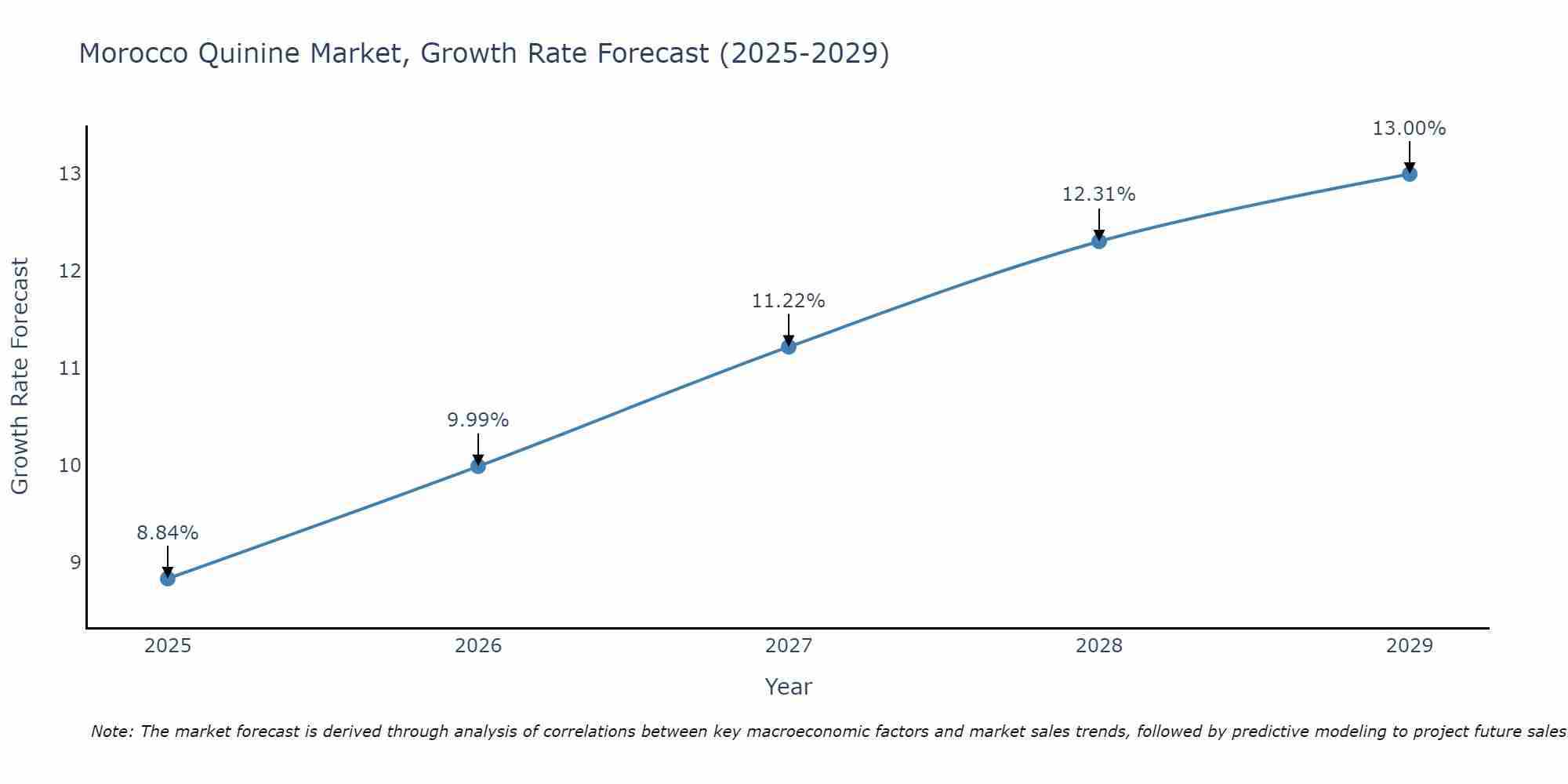
Morocco Quinine Market Size Growth Rate
The Morocco Quinine Market is likely to experience consistent growth rate gains over the period 2025 to 2029. From 8.84% in 2025, the growth rate steadily ascends to 13.00% in 2029.
Morocco Quinine Market Synopsis
The quinine market in Morocco is driven by its use in pharmaceuticals and the beverage industry. Quinine is an alkaloid with antimalarial properties, historically used to treat malaria. Its application extends to the production of tonic water and other beverages, providing a distinctive bitter flavor. The demand for quinine is influenced by the prevalence of malaria in certain regions and the beverage industry`s growth. Ongoing research into new therapeutic applications of quinine also contributes to market dynamics.
Drivers of the market
The Morocco quinine market is driven by the demand for effective treatment of malaria, a significant health concern in many regions. Quinine, being a well-established antimalarial drug, is essential in managing malaria cases. The continuous efforts to control malaria and the availability of quinine in various forms support market growth.
Challenges of the market
The quinine market in Morocco faces challenges associated with the supply chain and regulatory compliance. Quinine, primarily used for treating malaria, relies on a consistent supply of cinchona bark, which can be affected by environmental factors and geopolitical issues. The market also needs to comply with stringent pharmaceutical regulations to ensure the safety and efficacy of quinine products. Competition from synthetic antimalarial drugs and the need for ongoing research to address drug resistance in malaria parasites further complicate the market dynamics.
Government Policy of the market
The Morocco governments policies for the quinine market are primarily aimed at supporting the pharmaceutical industry. This includes offering tax incentives and subsidies for local production of quinine-based medications and ensuring that regulatory frameworks facilitate the approval and distribution of these drugs. Moreover, the government supports research and development efforts to improve the efficacy and production processes of quinine derivatives.
Key Highlights of the Report:
- Morocco Quinine Market Outlook
- Market Size of Morocco Quinine Market, 2024
- Forecast of Morocco Quinine Market, 2031
- Historical Data and Forecast of Morocco Quinine Revenues & Volume for the Period 2021-2031
- Morocco Quinine Market Trend Evolution
- Morocco Quinine Market Drivers and Challenges
- Morocco Quinine Price Trends
- Morocco Quinine Porter's Five Forces
- Morocco Quinine Industry Life Cycle
- Historical Data and Forecast of Morocco Quinine Market Revenues & Volume By Mode of Administration for the Period 2021-2031
- Historical Data and Forecast of Morocco Quinine Market Revenues & Volume By Oral Administration for the Period 2021-2031
- Historical Data and Forecast of Morocco Quinine Market Revenues & Volume By Intravenous Administration for the Period 2021-2031
- Historical Data and Forecast of Morocco Quinine Market Revenues & Volume By Intramuscular Administration for the Period 2021-2031
- Historical Data and Forecast of Morocco Quinine Market Revenues & Volume By Others for the Period 2021-2031
- Historical Data and Forecast of Morocco Quinine Market Revenues & Volume By Application for the Period 2021-2031
- Historical Data and Forecast of Morocco Quinine Market Revenues & Volume By Antimalarial for the Period 2021-2031
- Historical Data and Forecast of Morocco Quinine Market Revenues & Volume By Antipyretic for the Period 2021-2031
- Historical Data and Forecast of Morocco Quinine Market Revenues & Volume By Others for the Period 2021-2031
- Historical Data and Forecast of Morocco Quinine Market Revenues & Volume By End-user for the Period 2021-2031
- Historical Data and Forecast of Morocco Quinine Market Revenues & Volume By Hospitals for the Period 2021-2031
- Historical Data and Forecast of Morocco Quinine Market Revenues & Volume By Clinics for the Period 2021-2031
- Historical Data and Forecast of Morocco Quinine Market Revenues & Volume By Ambulatory Surgical Centers for the Period 2021-2031
- Historical Data and Forecast of Morocco Quinine Market Revenues & Volume By Others for the Period 2021-2031
- Morocco Quinine Import Export Trade Statistics
- Market Opportunity Assessment By Mode of Administration
- Market Opportunity Assessment By Application
- Market Opportunity Assessment By End-user
- Morocco Quinine Top Companies Market Share
- Morocco Quinine Competitive Benchmarking By Technical and Operational Parameters
- Morocco Quinine Company Profiles
- Morocco Quinine Key Strategic Recommendations






































