Morocco Refined Petroleum Products Market Size, Share & Growth Rate
The Morocco Refined Petroleum Products Market was estimated at USD 415 Million in 2025 and is projected to reach USD 544 Million by 2032, growing at a CAGR of 3.9% from 2026 to 2032. This growth is primarily fueled by the increasing demand for transportation fuels, driven by urbanization and industrial development across the country. As Morocco's economic landscape evolves, the need for high-quality refined products in sectors such as aviation and automotive is also on the rise.
Morocco Refined Petroleum Products Market Year-wise Growth Rate and Key Drivers
This graph highlights how the Morocco Refined Petroleum Products Market has steadily grown over the years, supported by major growth factors.
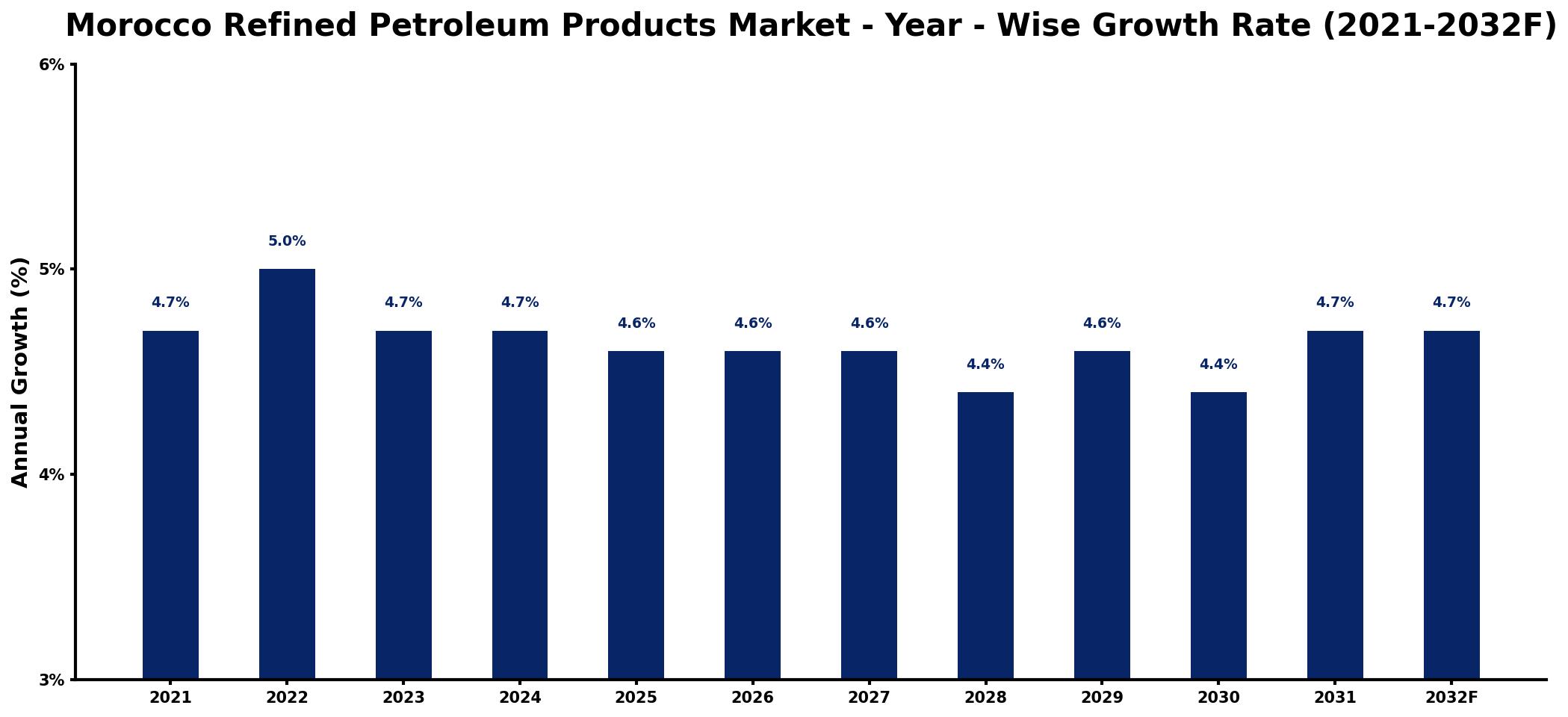
The table below presents the year‑wise growth rates along with the key drivers influencing the market
| Year | Growth Rate | Major Drivers |
| 2021 | 4.7% | Rising urbanization driving consumption |
| 2022 | 5.0% | Infrastructure projects boosting demand |
| 2023 | 4.7% | Increased vehicle ownership rates |
| 2024 | 4.7% | Growth in industrial activities |
| 2025 | 4.6% | Expansion of transportation networks |
| 2026 | 4.6% | Investment in energy sector |
| 2027 | 4.6% | Enhanced logistics capabilities emerging |
| 2028 | 4.4% | Growing tourism sector requirements |
| 2029 | 4.6% | Higher consumer spending levels |
| 2030 | 4.4% | Technological advancements in transportation |
| 2031 | 4.7% | Strengthened international trade relations |
| 2032 | 4.7% | Sustainable energy initiatives increasing |
Note: Market size estimations and growth projections presented in this report are based on 6Wresearch's proprietary forecasting methodology, utilizing the latest available industry data, government publications, and primary research inputs.
Morocco Refined Petroleum Products Market Synopsis
The demand for refined petroleum products is being shaped predominantly by Morocco's strategic positioning as a logistical hub connecting Europe to Africa. With urbanization accelerating, transportation fuels are increasingly in demand, supporting both consumer and industrial needs.
Additionally, the emphasis on sustainability and adherence to stringent environmental regulations are pushing local refineries to innovate and upgrade their processes. As Morocco prioritizes the development of cleaner fuel alternatives, these factors will redefine market dynamics and competitive strategies.
Morocco Refined Petroleum Products Market Key Takeaways
- The market is witnessing consistent growth driven by urbanization and industrialization.
- Government policies are increasingly favoring sustainable practices and emission reductions.
- Investment in infrastructure development is crucial for future market potential.
- The demand for high-quality refined products is particularly strong in aviation and automotive sectors.
- Challenges such as fluctuating global oil prices will impact market stability and investment strategies.
Evaluation of Restraints in Morocco Refined Petroleum Products Market
Despite the positive outlook, the Morocco Refined Petroleum Products Market faces several restraints. Chief among these are the fluctuations in global oil prices, which can adversely affect import costs and ultimately retail prices for consumers. Additionally, regulatory changes can create uncertainty for companies engaged in the import and export of petroleum products, potentially limiting market growth. Furthermore, infrastructure constraints, including limited storage and distribution capabilities, pose significant challenges that players must address to meet burgeoning demand effectively.
Morocco Refined Petroleum Products Market Trends
One of the most notable trends in the Morocco Refined Petroleum Products Market is the increasing emphasis on sustainability and compliance with environmental standards. Companies are making substantial investments in advanced refining technologies to enhance product quality and minimize environmental impact. Additionally, the adoption of cleaner fuel alternatives, such as biofuels and the integration of electric vehicles into the transportation sector, reflects changing consumer preferences and regulatory expectations.
Morocco Refined Petroleum Products Market Opportunities
The Morocco Refined Petroleum Products Market is rife with investment opportunities, particularly in infrastructure development aimed at enhancing storage and distribution capabilities. The strategic location of Morocco offers advantages for exporting refined products to neighboring regions, making investments in upgrading existing refineries or establishing new facilities a promising endeavor. Furthermore, renewable energy projects, including biofuels and solar-powered refineries, are emerging as sustainable avenues for investment, reflecting the government's commitment to diversify energy sources.
Government Initiatives in the Morocco Refined Petroleum Products Market
The Moroccan government plays a pivotal role in shaping the refined petroleum products market through various regulations and policies. These policies aim to stabilize the market by regulating pricing and ensuring the availability of essential products while safeguarding consumer interests. Incentives are offered to encourage investments in the petroleum sector, alongside initiatives promoting energy efficiency and the transition towards cleaner energy sources. Such frameworks are designed to facilitate a balance between market needs and environmental obligations.
Future Insights of the Morocco Refined Petroleum Products Market
Looking ahead to 2026-2032, the Morocco Refined Petroleum Products Market is positioned for substantial growth, underpinned by ongoing industrialization and urban development. As the government intensifies its focus on infrastructure enhancement and energy diversification, demand for refined petroleum products is set to rise. However, the market landscape may shift due to the increasing prominence of renewable energy sources, compelling traditional players to adapt their strategies to maintain competitiveness and relevance in a rapidly evolving sector.
Morocco Refined Petroleum Products Market Latest Developments (2025 - 2026)
Recent developments in the Morocco Refined Petroleum Products Market indicate a strong push towards innovation and sustainability. Companies are increasingly adopting advanced refining technologies and exploring collaborations with international partners to enhance product offerings and meet stringent environmental standards. There is also a notable increase in government-backed initiatives aimed at promoting the integration of renewable energy sources in petroleum production processes, signaling a progressive shift in the market's operational landscape.
Morocco Refined Petroleum Products Market - Key Attractiveness of the Report
- 10 Years of Market Numbers
- Historical Data Starting from 2022 to 2025
- Base Year: 2025
- Forecast Data until 2032
- Key Performance Indicators Impacting the Market
- Major Upcoming Developments and Projects
Key Highlights of the Report:
- Morocco Refined Petroleum Products Market Outlook
- Market Size of Morocco Refined Petroleum Products Market, 2025
- Forecast of Morocco Refined Petroleum Products Market, 2032
- Historical Data and Forecast of Morocco Refined Petroleum Products Revenues & Volume for the Period 2022-2032F
- Morocco Refined Petroleum Products Market Trend Evolution
- Morocco Refined Petroleum Products Market Drivers and Challenges
- Morocco Refined Petroleum Products Price Trends
- Morocco Refined Petroleum Products Porter's Five Forces
- Morocco Refined Petroleum Products Industry Life Cycle
- Historical Data and Forecast of Morocco Refined Petroleum Products Market Revenues & Volume By Product Type for the Period 2022-2032F
- Historical Data and Forecast of Morocco Refined Petroleum Products Market Revenues & Volume By Diesel for the Period 2022-2032F
- Historical Data and Forecast of Morocco Refined Petroleum Products Market Revenues & Volume By Gasoline for the Period 2022-2032F
- Historical Data and Forecast of Morocco Refined Petroleum Products Market Revenues & Volume By Fuel Oils for the Period 2022-2032F
- Historical Data and Forecast of Morocco Refined Petroleum Products Market Revenues & Volume By Kerosene for the Period 2022-2032F
- Historical Data and Forecast of Morocco Refined Petroleum Products Market Revenues & Volume By Others for the Period 2022-2032F
- Historical Data and Forecast of Morocco Refined Petroleum Products Market Revenues & Volume By Application for the Period 2022-2032F
- Historical Data and Forecast of Morocco Refined Petroleum Products Market Revenues & Volume By Fuel for the Period 2022-2032F
- Historical Data and Forecast of Morocco Refined Petroleum Products Market Revenues & Volume By Chemical for the Period 2022-2032F
- Historical Data and Forecast of Morocco Refined Petroleum Products Market Revenues & Volume By Others for the Period 2022-2032F
- Historical Data and Forecast of Morocco Refined Petroleum Products Market Revenues & Volume By Fraction for the Period 2022-2032F
- Historical Data and Forecast of Morocco Refined Petroleum Products Market Revenues & Volume By Light Distillates for the Period 2022-2032F
- Historical Data and Forecast of Morocco Refined Petroleum Products Market Revenues & Volume By Middle Distillates for the Period 2022-2032F
- Historical Data and Forecast of Morocco Refined Petroleum Products Market Revenues & Volume By Heavy Oils for the Period 2022-2032F
- Morocco Refined Petroleum Products Import Export Trade Statistics
- Market Opportunity Assessment By Product Type
- Market Opportunity Assessment By Application
- Market Opportunity Assessment By Fraction
- Morocco Refined Petroleum Products Top Companies Market Share
- Morocco Refined Petroleum Products Competitive Benchmarking By Technical and Operational Parameters
- Morocco Refined Petroleum Products Company Profiles
- Morocco Refined Petroleum Products Key Strategic Recommendations






































