Morocco Retail Market Size, Share & Growth Rate
The Morocco Retail Market was estimated at USD 436 Million in 2025 and is projected to reach USD 727 Million by 2032, growing at a CAGR of 7.6% from 2026 to 2032. This upward trajectory is fueled by an expanding middle class, increased urbanization, and higher disposable incomes among Moroccan consumers. Additionally, the rising popularity of e-commerce and modern retail formats is further contributing to this market's robust growth outlook.
Morocco Retail Market Year-wise Growth Rate and Key Drivers
This graph highlights how the Morocco Retail Market has steadily grown over the years, supported by major growth factors.
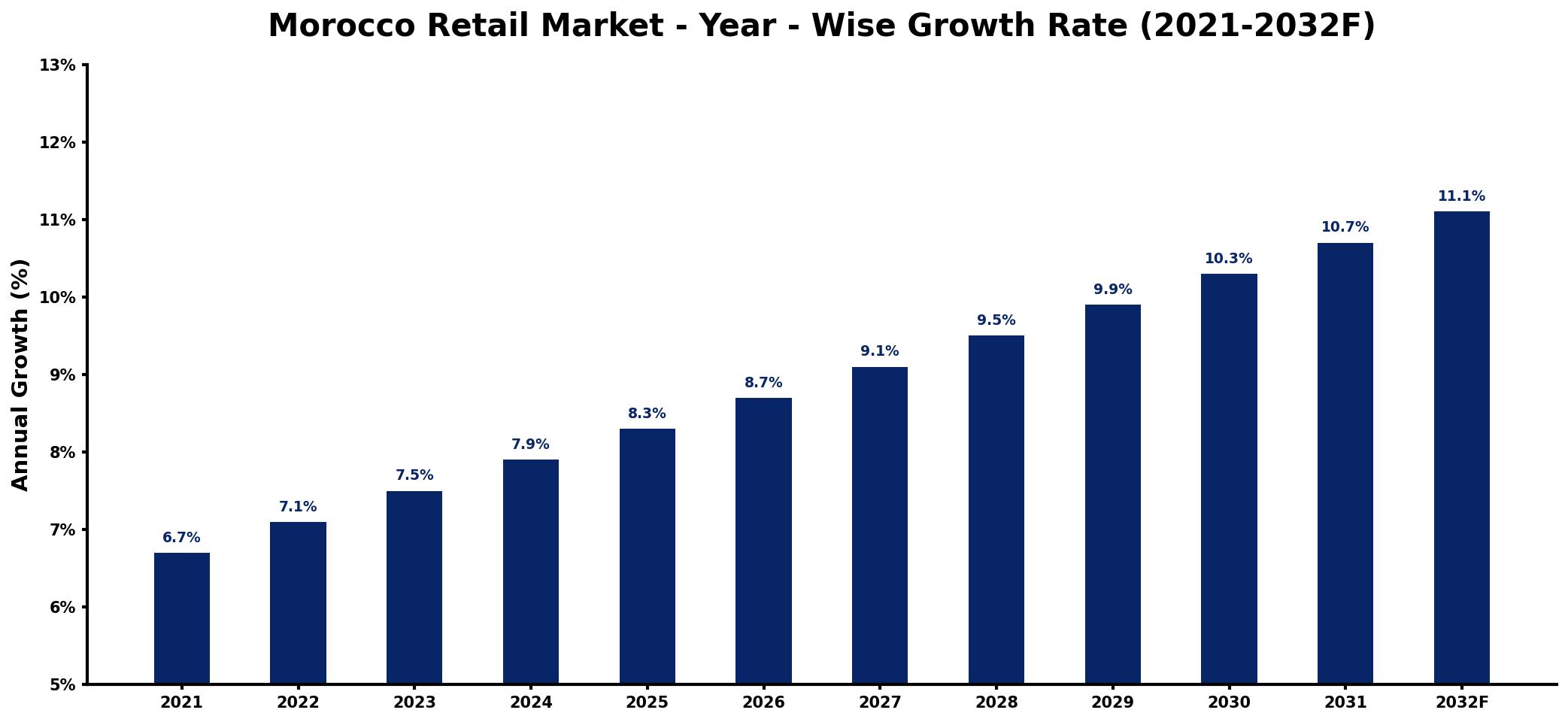
The table below presents the year‑wise growth rates along with the key drivers influencing the market
| Year | Growth Rate | Major Drivers |
| 2021 | 6.7% | increased consumer spending patterns |
| 2022 | 7.1% | expansion of e-commerce platforms |
| 2023 | 7.5% | growth in tourism sector investments |
| 2024 | 7.9% | rising urban population density |
| 2025 | 8.3% | enhanced logistics infrastructure development |
| 2026 | 8.7% | greater access to financing options |
| 2027 | 9.1% | surge in local brand popularity |
| 2028 | 9.5% | improvement in supply chain efficiency |
| 2029 | 9.9% | rising export shipment volumes |
| 2030 | 10.3% | increase in disposable income levels |
| 2031 | 10.7% | greater focus on sustainability initiatives |
| 2032 | 11.1% | advancements in digital payment solutions |
Note: Market size estimations and growth projections presented in this report are based on 6Wresearch's proprietary forecasting methodology, utilizing the latest available industry data, government publications, and primary research inputs.
Morocco Retail Market Synopsis
In recent years, Morocco's retail landscape has been undergoing a transformation characterized by the proliferation of modern shopping formats alongside traditional souks. Consumers are increasingly drawn to a blend of local and international retail experiences, which cater to diverse tastes and preferences.
E-commerce is surging in popularity, with urban consumers embracing online shopping due to its convenience. This shift indicates a significant evolution in consumer behavior, pushing retailers to adapt their strategies to capture this growing digital segment.
Morocco Retail Market Key Takeaways
- The market is projected to grow significantly, driven by urbanization and a growing middle class.
- Online shopping is becoming increasingly popular, reshaping the retail landscape.
- International retail chains are expanding, enhancing product variety for consumers.
- There is a rising demand for sustainable and ethically sourced products.
- Strategic investments in logistics and infrastructure are critical for market growth.
Evaluation of Restraints in Morocco Retail Market
Despite its growth potential, the Moroccan retail market faces certain restraints that could impede progress. High levels of competition from both established and emerging retailers pose challenges for new entrants. Moreover, limited purchasing power in rural areas restricts access to modern retail formats. The informal market remains a formidable competitor, as many consumers continue to prefer traditional shopping methods. Additionally, navigating complex regulations and bureaucratic processes can slow down business operations, making strategic adaptability essential for success.
Morocco Retail Market Trends
Several trends are currently influencing the Moroccan retail market. The accelerated growth of e-commerce is a major driver, as consumers increasingly seek convenience and a broader selection of products. Eco-consciousness among shoppers is rising, leading to a demand for sustainable and ethically sourced items, prompting retailers to innovate their offerings. Furthermore, the entry of international brands signifies a shift towards global consumerism, enriching the local market with new product choices.
Morocco Retail Market Opportunities
Investment opportunities abound within the Moroccan retail sector, especially in modern retail formats such as hypermarkets and shopping malls that appeal to urban consumers. The burgeoning e-commerce sector presents a vital area for growth, alongside advancements in logistics and distribution infrastructure. By tapping into local preferences in consumer goods—from fashion to electronics—retailers can align their strategies for heightened engagement with Moroccan shoppers.
Government Initiatives in the Morocco Retail Market
The Moroccan government has implemented various initiatives to foster a competitive retail environment, encouraging both local and foreign investments. Policies promoting consumer protection are in place to ensure fair competition and safeguard rights, thereby strengthening market integrity. Furthermore, incentives for international retailers aim to enhance market diversity and accessibility, driving economic growth across the sector.
Future Insights of the Morocco Retail Market
Looking ahead to 2026-2032, the Moroccan retail market is expected to sustain its growth momentum. Increasing urbanization and a youthful population with evolving consumption habits will be pivotal in shaping the markets future. The rising acceptance of e-commerce, combined with the government's infrastructure initiatives, will significantly impact the market's trajectory. However, attention to economic volatility and competition from both local and international retailers will be essential to navigate this dynamic landscape successfully.
Morocco Retail Market Latest Developments (2025 - 2026)
Recent developments in the Moroccan retail market highlight a continuing shift towards digitalization, with many retailers enhancing their online presence and services. Additionally, investments in logistics infrastructure are becoming more prominent, aiding in the distribution of goods across urban and rural areas. Consumer interest in eco-friendly products is also prompting retailers to rethink their sourcing and inventory strategies, further shaping the future landscape of retail in Morocco.
Morocco Retail Market - Key Attractiveness of the Report
- 10 Years of Market Numbers
- Historical Data Starting from 2022 to 2025
- Base Year: 2025
- Forecast Data until 2032
- Key Performance Indicators Impacting the Market
- Major Upcoming Developments and Projects
Key Highlights of the Report:
- Morocco Retail Market Outlook
- Market Size of Morocco Retail Market, 2025
- Forecast of Morocco Retail Market, 2032
- Historical Data and Forecast of Morocco Retail Revenues & Volume for the Period 2022-2032F
- Morocco Retail Market Trend Evolution
- Morocco Retail Market Drivers and Challenges
- Morocco Retail Price Trends
- Morocco Retail Porter's Five Forces
- Morocco Retail Industry Life Cycle
- Historical Data and Forecast of Morocco Retail Market Revenues & Volume By Product for the Period 2022-2032F
- Historical Data and Forecast of Morocco Retail Market Revenues & Volume By Food and Beverages for the Period 2022-2032F
- Historical Data and Forecast of Morocco Retail Market Revenues & Volume By Personal and Household Care for the Period 2022-2032F
- Historical Data and Forecast of Morocco Retail Market Revenues & Volume By Apparel for the Period 2022-2032F
- Historical Data and Forecast of Morocco Retail Market Revenues & Volume By Footwear and Accessories for the Period 2022-2032F
- Historical Data and Forecast of Morocco Retail Market Revenues & Volume By Furniture for the Period 2022-2032F
- Historical Data and Forecast of Morocco Retail Market Revenues & Volume By Toys for the Period 2022-2032F
- Historical Data and Forecast of Morocco Retail Market Revenues & Volume By Electronic and Household Appliances for the Period 2022-2032F
- Historical Data and Forecast of Morocco Food and Beverages Retail Market Revenues & Volume By Other Products for the Period 2022-2032F
- Historical Data and Forecast of Morocco Retail Market Revenues & Volume By Distribution Channel for the Period 2022-2032F
- Historical Data and Forecast of Morocco Retail Market Revenues & Volume By Supermarkets/Hypermarkets for the Period 2022-2032F
- Historical Data and Forecast of Morocco Retail Market Revenues & Volume By Convenience Stores for the Period 2022-2032F
- Historical Data and Forecast of Morocco Retail Market Revenues & Volume By Department Stores for the Period 2022-2032F
- Historical Data and Forecast of Morocco Retail Market Revenues & Volume By Specialty Stores for the Period 2022-2032F
- Historical Data and Forecast of Morocco Retail Market Revenues & Volume By Online for the Period 2022-2032F
- Historical Data and Forecast of Morocco Retail Market Revenues & Volume By Other Distribution Channels for the Period 2022-2032F
- Morocco Retail Import Export Trade Statistics
- Market Opportunity Assessment By Product
- Market Opportunity Assessment By Distribution Channel
- Morocco Retail Top Companies Market Share
- Morocco Retail Competitive Benchmarking By Technical and Operational Parameters
- Morocco Retail Company Profiles
- Morocco Retail Key Strategic Recommendations






































