Morocco Smart Doorbell Market Size, Share & Growth Rate
The Morocco Smart Doorbell Market was estimated at USD 1106 Million in 2025 and is projected to reach USD 1991 Million by 2032, growing at a CAGR of 8.8% from 2026 to 2032. This impressive trajectory is being driven by a combination of rising urbanization, increased disposable incomes, and a growing awareness of home security solutions among consumers. As Moroccan households increasingly seek advanced technology for enhanced safety and convenience, the demand for smart doorbells is set to soar.
Morocco Smart Doorbell Market Year-wise Growth Rate and Key Drivers
This graph highlights how the Morocco Smart Doorbell Market has steadily grown over the years, supported by major growth factors.
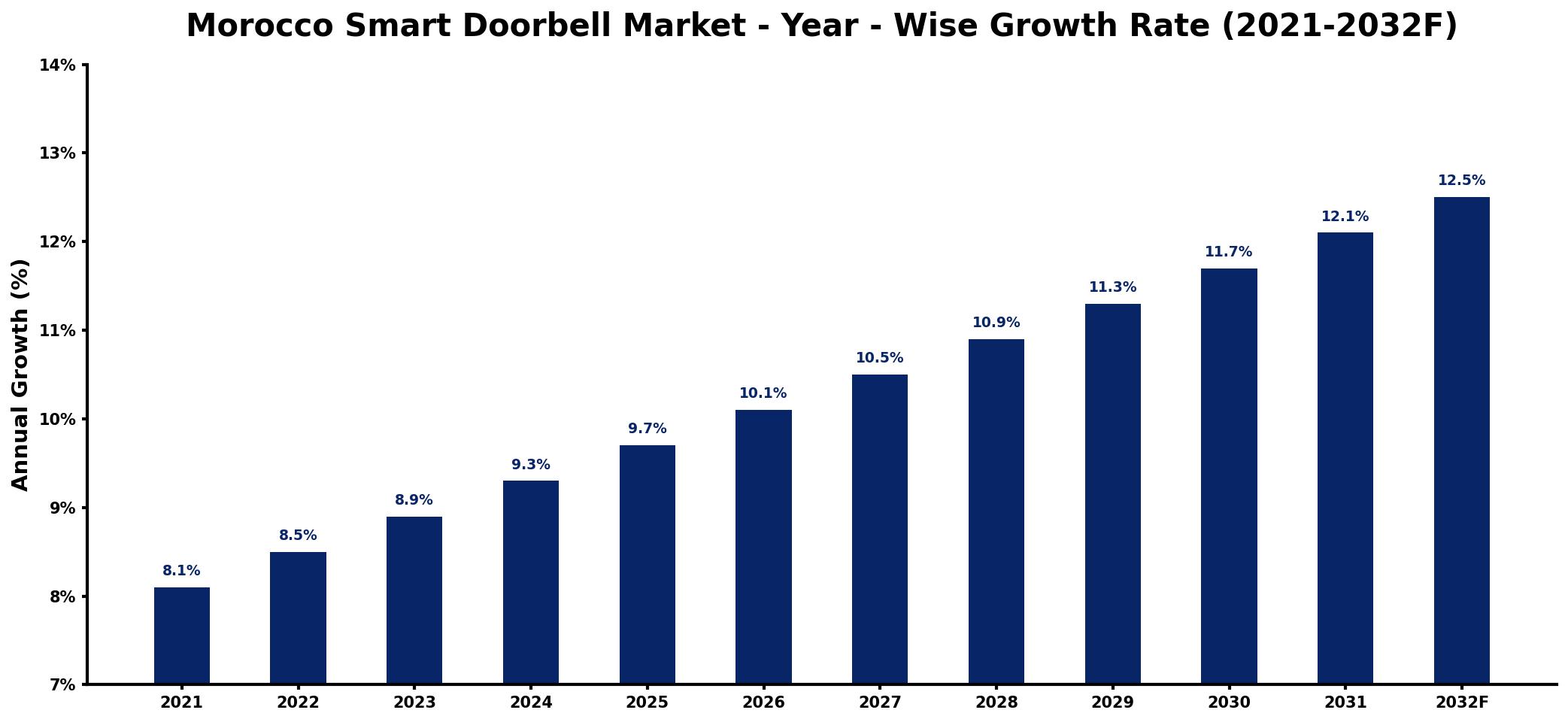
The table below presents the year‑wise growth rates along with the key drivers influencing the market
| Year | Growth Rate | Major Drivers |
| 2021 | 8.1% | Rising consumer interest in technology |
| 2022 | 8.5% | Increased investments in home security |
| 2023 | 8.9% | rising export shipment volumes |
| 2024 | 9.3% | Expansion of IoT applications |
| 2025 | 9.7% | Enhanced connectivity in urban areas |
| 2026 | 10.1% | Development of advanced security features |
| 2027 | 10.5% | Surge in online retail platforms |
| 2028 | 10.9% | Integration with home automation systems |
| 2029 | 11.3% | Focus on energy-efficient solutions |
| 2030 | 11.7% | Emerging trends in remote monitoring |
| 2031 | 12.1% | Increased awareness of personal safety |
| 2032 | 12.5% | Rising popularity of subscription services |
Note: Market size estimations and growth projections presented in this report are based on 6Wresearch's proprietary forecasting methodology, utilizing the latest available industry data, government publications, and primary research inputs.
Morocco Smart Doorbell Market Synopsis
The Morocco Smart Doorbell Market is gaining momentum, fueled by a notable shift towards smart home technologies. Currently, the market is expanding as consumers discover the unique benefits of smart doorbells, which offer video monitoring and real-time communication features. Looking ahead, this growth trajectory is expected to accelerate significantly as more Moroccans adopt comprehensive smart home systems that integrate these devices.
Consumers are increasingly prioritizing home security, leading to a surge in demand for smart doorbells equipped with advanced functionalities. As the market evolves, innovations such as AI-driven features and enhanced compatibility with existing smart home devices will play a critical role in shaping consumer preferences and driving future growth in the Morocco Smart Doorbell Market.
Morocco Smart Doorbell Market Key Takeaways
- The market is experiencing a notable upswing due to rising disposable incomes and urbanization.
- Innovative features such as AI integration and video communication are enhancing product appeal.
- Consumer awareness around home security is a key driver of market growth.
- Infrastructure improvements are facilitating wider adoption of smart home technologies.
- The local market landscape is becoming increasingly competitive as new players enter.
Evaluation of Restraints in Morocco Smart Doorbell Market
Despite the robust growth, several limitations continue to impact the Morocco Smart Doorbell Market. A significant portion of the population remains unaware of the benefits that smart home technologies can provide, which slows down overall adoption rates. Additionally, privacy concerns related to data protection are prevalent, with potential users hesitant to invest in devices perceived as intrusive. Lastly, varying levels of internet connectivity across different regions create disparities in the functionality and reliability of smart doorbell systems, inhibiting growth in less urbanized areas.
Morocco Smart Doorbell Market Trends
Current trends indicate a strong consumer preference for smart doorbells that integrate seamlessly with existing smart home systems. Features such as cloud storage for video recordings and advanced motion detection capabilities are particularly sought after. Moreover, the integration of AI technologies, including facial recognition, is on the rise, providing added security and user convenience. The overall trend points towards consumers valuing both functionality and ease of use, reinforcing the necessity for manufacturers to innovate continually.
Morocco Smart Doorbell Market Opportunities
Investment opportunities abound in the Morocco Smart Doorbell Market as the shift towards smart home solutions gathers pace. Manufacturers can benefit from targeting niche segments with customized products tailored to local cultural preferences. Furthermore, establishing partnerships with local distribution networks can enhance market penetration, thereby expanding reach to a broader customer base. The emergence of new technology and features also presents avenues for differentiation, paving the way for innovative players to capture market share.
Government Initiatives in the Morocco Smart Doorbell Market
The Moroccan government has demonstrated a commitment to fostering growth in the Smart Doorbell Market through various initiatives. These include tax incentives for companies investing in smart technologies and efforts to bolster infrastructure that supports technological adoption. Additionally, regulatory frameworks focused on data privacy and security are being established to build consumer trust in smart devices. Collectively, these initiatives aim to create an environment conducive to innovation and market expansion.
Future Insights of the Morocco Smart Doorbell Market
The outlook for the Morocco Smart Doorbell Market from 2026 to 2032 is promising, characterized by increased consumer awareness around security and convenience. The anticipated rise in the urban middle class will drive further adoption of smart doorbells, as these households increasingly seek solutions that combine safety with technological innovation. Moreover, as interoperability with other smart devices improves, the likelihood of widespread acceptance of smart doorbells will increase, further solidifying their presence in Moroccan households.
Morocco Smart Doorbell Market Latest Developments (2025 - 2026)
Recent developments in the Morocco Smart Doorbell Market indicate a growing interest from international brands eager to tap into local demand. Additionally, manufacturers are increasingly focusing on enhancing the functionality of their products, such as integrating cloud services and advanced security features. This evolving landscape is witnessing more retailers offering smart doorbells as part of broader smart home packages, signaling a shift towards holistic home automation solutions.
Morocco Smart Doorbell Market - Key Attractiveness of the Report
- 10 Years of Market Numbers
- Historical Data Starting from 2022 to 2025
- Base Year: 2025
- Forecast Data until 2032
- Key Performance Indicators Impacting the Market
- Major Upcoming Developments and Projects
Key Highlights of the Report:
- Morocco Smart Doorbell Market Outlook
- Market Size of Morocco Smart Doorbell Market, 2025
- Forecast of Morocco Smart Doorbell Market, 2032
- Historical Data and Forecast of Morocco Smart Doorbell Revenues & Volume for the Period 2022-2032F
- Morocco Smart Doorbell Market Trend Evolution
- Morocco Smart Doorbell Market Drivers and Challenges
- Morocco Smart Doorbell Price Trends
- Morocco Smart Doorbell Porter's Five Forces
- Morocco Smart Doorbell Industry Life Cycle
- Historical Data and Forecast of Morocco Smart Doorbell Market Revenues & Volume By Product Type for the Period 2022-2032F
- Historical Data and Forecast of Morocco Smart Doorbell Market Revenues & Volume By Wired Doorbell for the Period 2022-2032F
- Historical Data and Forecast of Morocco Smart Doorbell Market Revenues & Volume By Wireless Doorbell for the Period 2022-2032F
- Historical Data and Forecast of Morocco Smart Doorbell Market Revenues & Volume By Distribution Channel for the Period 2022-2032F
- Historical Data and Forecast of Morocco Smart Doorbell Market Revenues & Volume By Online for the Period 2022-2032F
- Historical Data and Forecast of Morocco Smart Doorbell Market Revenues & Volume By Offline for the Period 2022-2032F
- Historical Data and Forecast of Morocco Smart Doorbell Market Revenues & Volume By End User for the Period 2022-2032F
- Historical Data and Forecast of Morocco Smart Doorbell Market Revenues & Volume By Residential for the Period 2022-2032F
- Historical Data and Forecast of Morocco Smart Doorbell Market Revenues & Volume By Commercial for the Period 2022-2032F
- Morocco Smart Doorbell Import Export Trade Statistics
- Market Opportunity Assessment By Product Type
- Market Opportunity Assessment By Distribution Channel
- Market Opportunity Assessment By End User
- Morocco Smart Doorbell Top Companies Market Share
- Morocco Smart Doorbell Competitive Benchmarking By Technical and Operational Parameters
- Morocco Smart Doorbell Company Profiles
- Morocco Smart Doorbell Key Strategic Recommendations






































