Morocco Smart Waste Management Market Size & Growth Rate (2026-2032)
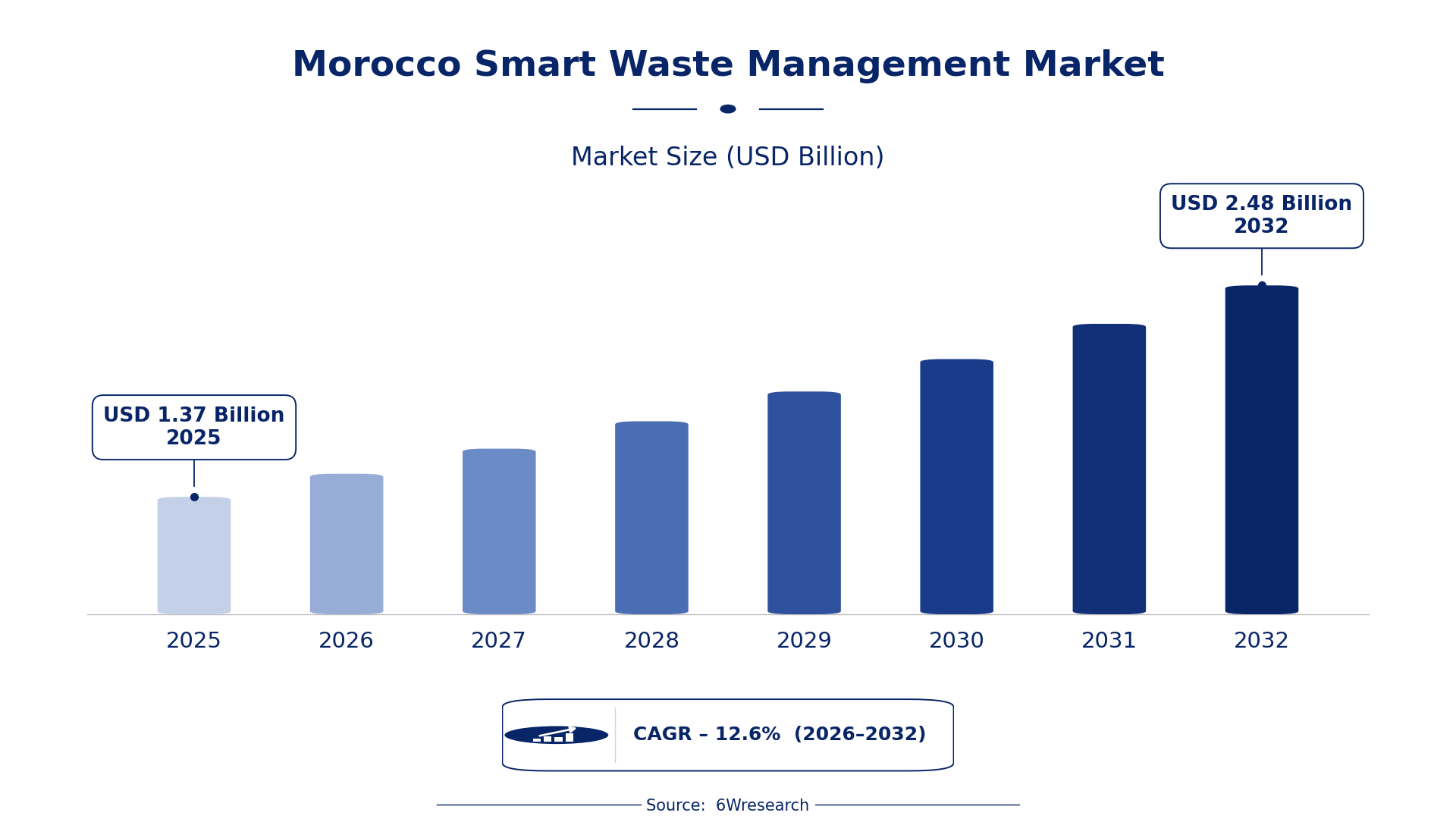
The Morocco Smart Waste Management Market was estimated at USD 1367 Million in 2025 and is projected to reach USD 2475 Million by 2032, growing at a CAGR of 12.6% from 2026 to 2032.
Morocco Smart Waste Management Market Synopsis
Morocco's rapid urbanization is leading to a surge in waste generation, creating an urgent demand for efficient waste management solutions. Municipalities are increasingly turning to smart technologies, such as IoT-enabled waste bins and data analytics platforms, to enhance waste collection and disposal processes.
This market is also shaped by rising environmental concerns, as local communities seek sustainable practices to manage waste. Government initiatives aimed at promoting smart waste management solutions further reinforce this trend, providing a conducive environment for innovation and investment.
Morocco Smart Waste Management Market Year-wise Growth Rate and Key Drivers
This graph illustrates the annual growth rates of the Morocco Smart Waste Management Market from 2021 to 2032, highlighting a steady upward trajectory and projected expansion over the forecast period.
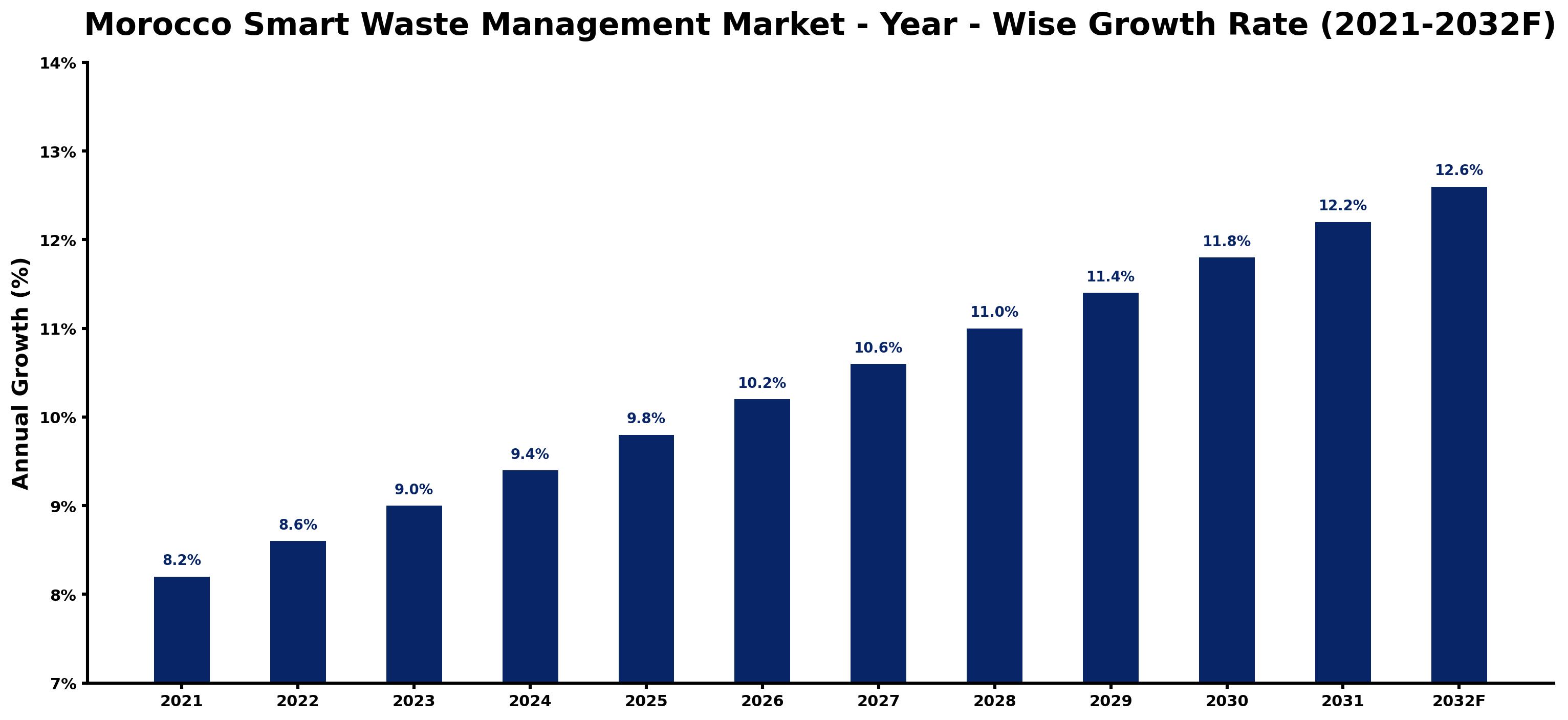
The table below presents the year‑wise growth rates along with the key drivers influencing the market
| Year | Growth Rate | Major Drivers |
| 2021 | 8.2% | National Waste Management Strategy supports smart solutions |
| 2022 | 8.6% | Partnerships with local startups enhance waste tech innovation |
| 2023 | 9.0% | Increased urbanization drives demand for waste management tech |
| 2024 | 9.4% | Government incentives for recycling boost smart waste initiatives |
| 2025 | 9.8% | Growing consumer awareness on sustainable waste practices |
| 2026 | 10.2% | International funding for waste management technology projects |
| 2027 | 10.6% | Local pollution control regulations enhance smart solutions demand |
| 2028 | 11.0% | Public-private partnerships expand smart waste collection services |
| 2029 | 11.4% | Rising municipal budgets allocated for technology in waste |
| 2030 | 11.8% | Integration of IoT in smart waste systems increases efficiency |
| 2031 | 12.2% | Adoption of AI in sorting processes improves recycling rates |
| 2032 | 12.6% | Increased tourism necessitates efficient waste management solutions |
Note: Market size estimations and growth projections presented in this report are based on 6Wresearch's proprietary forecasting methodology, utilizing the latest available industry data, government publications, and primary research inputs.
Morocco Smart Waste Management Market Key Takeaways
Below are some of the specific key takeaways from the market, including:
- The market is fueled by urbanization and the need for sustainable waste management practices.
- Smart technologies, including IoT and data analytics, are becoming standard in waste management operations.
- Government policies are actively promoting innovative waste management solutions.
- Partnerships between public and private sectors are essential for addressing infrastructure challenges.
- Investment opportunities are expanding in waste-to-energy and smart landfill projects.
Evaluation of Restraints in Morocco Smart Waste Management Market
Several limitations are stifling growth in the Morocco Smart Waste Management Market. One primary issue is the insufficient infrastructure for waste collection and disposal, which hinders effective implementation of smart solutions. Additionally, public awareness regarding waste management practices is low, affecting community participation. The high costs associated with adopting advanced technologies, coupled with a shortage of skilled professionals to operate these systems, further complicate the market dynamics.
Morocco Smart Waste Management Market Trends
Current trends in the Morocco Smart Waste Management Market highlight the increasing integration of IoT technology for real-time monitoring of waste levels. The adoption of smart bins equipped with sensors is gaining traction, streamlining collection processes. Additionally, municipalities are leveraging data analytics to optimize collection routes and improve operational efficiency. As environmental consciousness grows, waste-to-energy initiatives are also emerging as a promising area for investment.
Morocco Smart Waste Management Market Opportunities
The market presents several growth opportunities for businesses willing to innovate. The expansion of waste-to-energy projects could lead to substantial investments, enhancing the sustainability of waste management practices. There is also potential for developing smart landfill solutions that utilize technology for better waste tracking and management. Collaborations between government entities and private firms can facilitate improvements in waste processing and recycling efforts.
Government Initiatives in the Morocco Smart Waste Management Market
The Moroccan government is actively shaping the smart waste management sector through a series of initiatives aimed at improving waste collection and recycling practices. With a focus on sustainability, these policies are crucial for fostering a clean environment. The government's regulatory posture encourages innovation and public awareness, which is essential for the growth of this market.
- A recently completed National Waste Management Strategy that enhances waste collection and recycling practices across major cities.
- A currently ongoing program promoting the installation of smart waste bins equipped with IoT technology to optimize waste collection routes.
- A planned public-private initiative set to launch in the next two years, aimed at enhancing waste recovery and valorization techniques.
- New regulations introduced to mandate waste sorting at the source to improve recycling rates.
- Efforts to increase public awareness campaigns on the importance of waste reduction and responsible disposal methods.
Future Insights of the Morocco Smart Waste Management Market
Looking ahead to 2026-2032, the Morocco Smart Waste Management Market is expected to witness substantial growth. As urbanization continues to rise, the demand for innovative waste management solutions will only intensify. The integration of digital technologies and real-time data analytics will enhance operational efficiencies, leading to reduced costs and improved service delivery. on top of that, the government's commitment to sustainability and smart city initiatives will further propel market expansion.
Morocco Smart Waste Management Market Latest Developments
Recent activity in the Morocco Smart Waste Management Market indicates a shift towards greater technological adoption. Companies are increasingly investing in advanced solutions that promote environmental sustainability and operational efficiency. This trend is likely to shape the future of waste management in the country.
- A major technology vendor launched an IoT-enabled waste monitoring system in Q1 2025, enhancing real-time data collection.
- An initiative to deploy smart waste bins in Casablanca began in mid-2025 and is currently underway.
- A partnership between local municipalities and a private sector firm is expected to roll out a waste-to-energy project by late 2026.
- A pilot program for automated waste collection systems was completed in early 2025, showcasing potential efficiency gains.
- Upcoming regulations are set to be introduced in 2026 to promote the use of biodegradable waste solutions across urban centers.
Morocco Smart Waste Management Market - Key Attractiveness of the Report
- 10 Years of Market Numbers
- Historical Data Starting from 2022 to 2025
- Base Year: 2025
- Forecast Data until 2032
- Key Performance Indicators Impacting the Market
- Major Upcoming Developments and Projects
Key Highlights of the Report:
- Morocco Smart Waste Management Market Outlook
- Market Size of Morocco Smart Waste Management Market, 2025
- Forecast of Morocco Smart Waste Management Market, 2032
- Historical Data and Forecast of Morocco Smart Waste Management Revenues & Volume for the Period 2022-2032F
- Morocco Smart Waste Management Market Trend Evolution
- Morocco Smart Waste Management Market Drivers and Challenges
- Morocco Smart Waste Management Price Trends
- Morocco Smart Waste Management Porter's Five Forces
- Morocco Smart Waste Management Industry Life Cycle
- Historical Data and Forecast of Morocco Smart Waste Management Market Revenues & Volume By Solution for the Period 2022-2032F
- Historical Data and Forecast of Morocco Smart Waste Management Market Revenues & Volume By Optimization Solutions for the Period 2022-2032F
- Historical Data and Forecast of Morocco Smart Waste Management Market Revenues & Volume By Analytics and Reporting Solutions for the Period 2022-2032F
- Historical Data and Forecast of Morocco Smart Waste Management Market Revenues & Volume By Asset Management for the Period 2022-2032F
- Historical Data and Forecast of Morocco Smart Waste Management Market Revenues & Volume By Network Management for the Period 2022-2032F
- Historical Data and Forecast of Morocco Smart Waste Management Market Revenues & Volume By Others for the Period 2022-2032F
- Historical Data and Forecast of Morocco Smart Waste Management Market Revenues & Volume By Service for the Period 2022-2032F
- Historical Data and Forecast of Morocco Smart Waste Management Market Revenues & Volume By Professional Services for the Period 2022-2032F
- Historical Data and Forecast of Morocco Smart Waste Management Market Revenues & Volume By Managed Services for the Period 2022-2032F
- Historical Data and Forecast of Morocco Smart Waste Management Market Revenues & Volume By Application for the Period 2022-2032F
- Historical Data and Forecast of Morocco Smart Waste Management Market Revenues & Volume By Food & Retail for the Period 2022-2032F
- Historical Data and Forecast of Morocco Smart Waste Management Market Revenues & Volume By Construction for the Period 2022-2032F
- Historical Data and Forecast of Morocco Smart Waste Management Market Revenues & Volume By Manufacturing & Industrial for the Period 2022-2032F
- Historical Data and Forecast of Morocco Smart Waste Management Market Revenues & Volume By HealthCare for the Period 2022-2032F
- Historical Data and Forecast of Morocco Smart Waste Management Market Revenues & Volume By Municipalities for the Period 2022-2032F
- Historical Data and Forecast of Morocco Smart Waste Management Market Revenues & Volume By Colleges & Universities for the Period 2022-2032F
- Morocco Smart Waste Management Import Export Trade Statistics
- Market Opportunity Assessment By Solution
- Market Opportunity Assessment By Service
- Market Opportunity Assessment By Application
- Morocco Smart Waste Management Top Companies Market Share
- Morocco Smart Waste Management Competitive Benchmarking By Technical and Operational Parameters
- Morocco Smart Waste Management Company Profiles
- Morocco Smart Waste Management Key Strategic Recommendations






































