Morocco Structural Steel Fabrication Market Size, Share & Growth Rate
The Morocco Structural Steel Fabrication Market was estimated at USD 462 Million in 2025 and is projected to reach USD 649 Million by 2032, growing at a CAGR of 5.0% from 2026 to 2032. This growth trajectory is fueled by significant government investment in infrastructure and an upsurge in construction activities, including residential, commercial, and industrial projects. Urbanization and increasing industrial output further amplify the demand for structural steel, marking this market as a dynamic component of Morocco's economic landscape.
Morocco Structural Steel Fabrication Market Year-wise Growth Rate and Key Drivers
This graph highlights how the Morocco Structural Steel Fabrication Market has steadily grown over the years, supported by major growth factors.
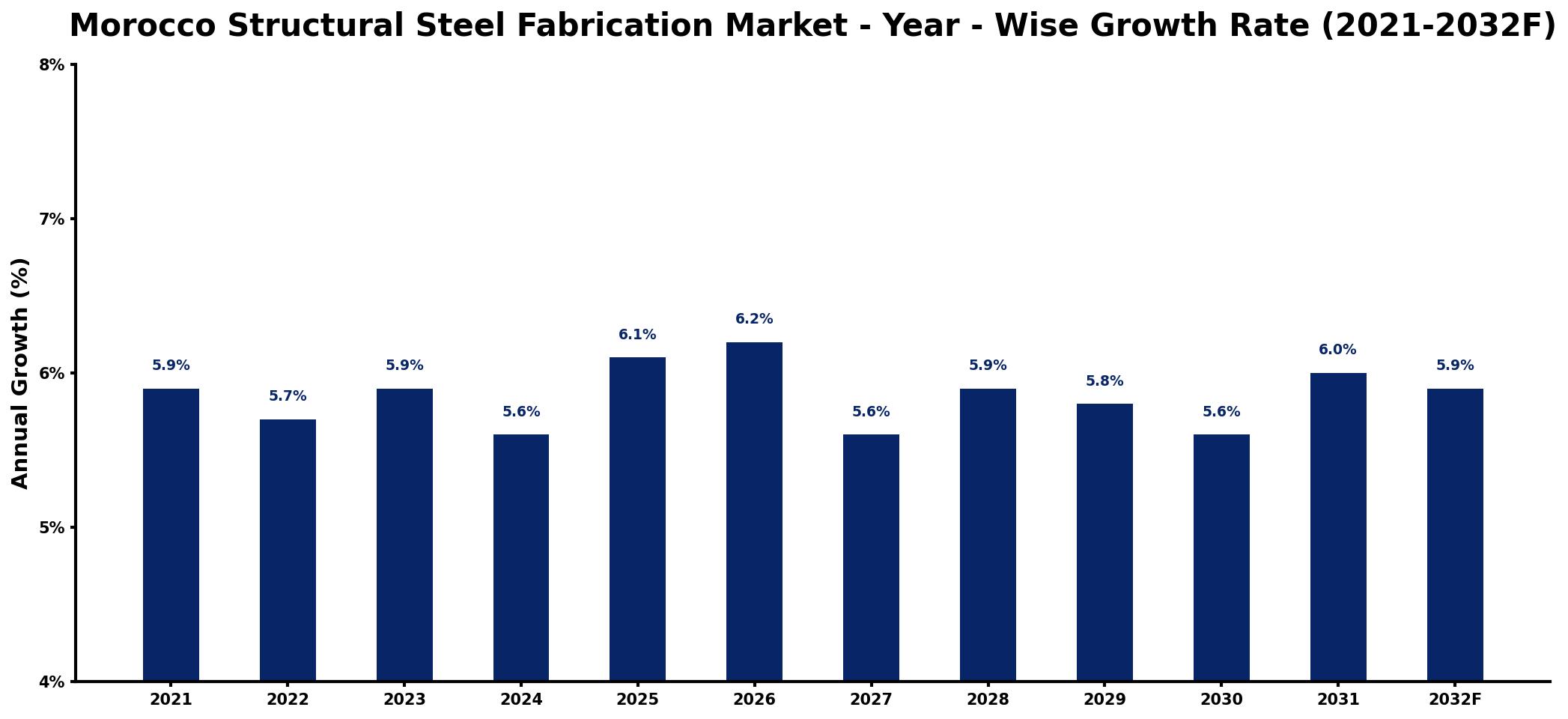
The table below presents the year‑wise growth rates along with the key drivers influencing the market
| Year | Growth Rate | Major Drivers |
| 2021 | 5.9% | Rising infrastructure development projects |
| 2022 | 5.7% | Growing real estate sector investments |
| 2023 | 5.9% | Increased demand from construction industry |
| 2024 | 5.6% | Expansion of renewable energy initiatives |
| 2025 | 6.1% | Government incentives for urbanization |
| 2026 | 6.2% | Boost in commercial building activities |
| 2027 | 5.6% | Higher residential construction rates |
| 2028 | 5.9% | Demand from transportation infrastructure |
| 2029 | 5.8% | Investment in industrial facilities growth |
| 2030 | 5.6% | Emergence of smart city projects |
| 2031 | 6.0% | Focus on sustainable construction practices |
| 2032 | 5.9% | Increased public-private partnership projects |
Note: Market size estimations and growth projections presented in this report are based on 6Wresearch's proprietary forecasting methodology, utilizing the latest available industry data, government publications, and primary research inputs.
Morocco Structural Steel Fabrication Market Synopsis
The primary force currently shaping the Morocco Structural Steel Fabrication Market is the robust government commitment to infrastructure development. Initiatives aimed at modernizing transportation networks and public utilities are propelling demand for fabricated steel components, thereby creating substantial opportunities for growth in this sector.
In addition, urbanization is driving a surge in construction activities, which further supports the structural steel fabrication industry. Companies are responding by enhancing their product offerings, focusing on sustainable practices, and incorporating advanced technologies to ensure competitive advantage in a rapidly evolving marketplace.
Morocco Structural Steel Fabrication Market Key Takeaways
- The market is on a growth path, bolstered by government-led infrastructure projects.
- Technological advancements in fabrication processes are enhancing efficiency and reducing costs.
- Demand for sustainable and eco-friendly construction solutions is on the rise.
- Customized and prefabricated structural steel solutions are increasingly favored in construction projects.
- Morocco's strategic location enables export potential to neighboring African markets.
Evaluation of Restraints in Morocco Structural Steel Fabrication Market
Despite the encouraging growth outlook, the Morocco Structural Steel Fabrication Market faces several restraints. Increasing competition from international suppliers, who often offer lower pricing, poses a challenge to local firms striving for market share. Moreover, fluctuations in raw material prices can significantly impact profit margins, creating an uncertain environment for manufacturers. A shortage of skilled labor also contributes to project delays, undermining operational efficiency. Additionally, navigating a complex regulatory landscape can impede swift project execution, requiring firms to invest additional resources to ensure compliance.
Morocco Structural Steel Fabrication Market Trends
The market is witnessing a pronounced shift towards sustainable construction materials, with an increasing emphasis on the recyclability and durability of structural steel. Automation in fabrication processes is emerging as a key trend, leading to reduced production times and enhanced overall efficiency. There is also a growing preference for prefabricated and customized steel solutions tailored to specific project requirements, reflecting a demand for innovation and versatility in construction methodologies.
Morocco Structural Steel Fabrication Market Opportunities
Investment opportunities abound within the Morocco Structural Steel Fabrication Market, particularly as the construction sector continues to expand. Increased government investment in infrastructure is creating a favorable environment for local manufacturers. There is an emerging demand for high-quality steel structures across various sectors, including commercial and residential developments. Furthermore, Morocco's geographic position as a gateway to Africa provides significant export opportunities for fabricated steel products, enhancing the potential for substantial returns on investment.
Government Initiatives in the Morocco Structural Steel Fabrication Market
The Moroccan government is actively fostering an environment conducive to the growth of the Structural Steel Fabrication Market. Policies aimed at promoting local production and job creation are complemented by incentives for investments in steel fabrication facilities. There are also subsidies available for training programs designed to develop a skilled workforce. Recent government initiatives focus on launching large-scale infrastructure projects requiring structural steel components, further opening avenues for local manufacturers to engage in substantial construction opportunities.
Future Insights of the Morocco Structural Steel Fabrication Market
The Morocco Structural Steel Fabrication Market is poised for positive growth between 2026 and 2032. Continued urbanization, coupled with significant infrastructural development projects, will sustain demand for structural steel fabrication services. The shift towards sustainable construction practices is likely to bolster the adoption of steel structures, as the industry adapts to meet these new demands. With the rising need for diverse residential, commercial, and industrial spaces, opportunities for market participants to expand their offerings and strengthen their positions are abundant.
Morocco Structural Steel Fabrication Market Latest Developments (2025 - 2026)
In the recent months, the structural steel fabrication industry in Morocco has seen a marked focus on technological advancements, particularly in automation and efficiency improvements. Companies are increasingly adopting cutting-edge fabrication techniques to reduce lead times and enhance product quality. Concurrently, there is a growing emphasis on sustainable practices, with firms striving to align their operations with environmentally friendly standards. The government continues to roll out infrastructural projects, further indicating a commitment to the growth of the market.
Morocco Structural Steel Fabrication Market - Key Attractiveness of the Report
- 10 Years of Market Numbers
- Historical Data Starting from 2022 to 2025
- Base Year: 2025
- Forecast Data until 2032
- Key Performance Indicators Impacting the Market
- Major Upcoming Developments and Projects
Key Highlights of the Report:
- Morocco Structural Steel Fabrication Market Outlook
- Market Size of Morocco Structural Steel Fabrication Market, 2025
- Forecast of Morocco Structural Steel Fabrication Market, 2032
- Historical Data and Forecast of Morocco Structural Steel Fabrication Revenues & Volume for the Period 2022-2032F
- Morocco Structural Steel Fabrication Market Trend Evolution
- Morocco Structural Steel Fabrication Market Drivers and Challenges
- Morocco Structural Steel Fabrication Price Trends
- Morocco Structural Steel Fabrication Porter's Five Forces
- Morocco Structural Steel Fabrication Industry Life Cycle
- Historical Data and Forecast of Morocco Structural Steel Fabrication Market Revenues & Volume By End-user Industry for the Period 2022-2032F
- Historical Data and Forecast of Morocco Structural Steel Fabrication Market Revenues & Volume By Manufacturing for the Period 2022-2032F
- Historical Data and Forecast of Morocco Structural Steel Fabrication Market Revenues & Volume By Power and Energy for the Period 2022-2032F
- Historical Data and Forecast of Morocco Structural Steel Fabrication Market Revenues & Volume By Construction for the Period 2022-2032F
- Historical Data and Forecast of Morocco Structural Steel Fabrication Market Revenues & Volume By Oil and Gas for the Period 2022-2032F
- Historical Data and Forecast of Morocco Structural Steel Fabrication Market Revenues & Volume By Other for the Period 2022-2032F
- Historical Data and Forecast of Morocco Structural Steel Fabrication Market Revenues & Volume By Product Type for the Period 2022-2032F
- Historical Data and Forecast of Morocco Structural Steel Fabrication Market Revenues & Volume By Heavy Sectional Steel for the Period 2022-2032F
- Historical Data and Forecast of Morocco Structural Steel Fabrication Market Revenues & Volume By Light Sectional Steel for the Period 2022-2032F
- Historical Data and Forecast of Morocco Structural Steel Fabrication Market Revenues & Volume By Other for the Period 2022-2032F
- Morocco Structural Steel Fabrication Import Export Trade Statistics
- Market Opportunity Assessment By End-user Industry
- Market Opportunity Assessment By Product Type
- Morocco Structural Steel Fabrication Top Companies Market Share
- Morocco Structural Steel Fabrication Competitive Benchmarking By Technical and Operational Parameters
- Morocco Structural Steel Fabrication Company Profiles
- Morocco Structural Steel Fabrication Key Strategic Recommendations






































