Morocco Sulphur Market Size, Share & Growth Rate
The Morocco Sulphur Market was estimated at USD 356 Million in 2025 and is projected to reach USD 486 Million by 2032, growing at a CAGR of 4.5% from 2026 to 2032. This growth trajectory is primarily driven by the surging demand from the agriculture sector, particularly for sulphur-based fertilizers, essential for enhancing crop yields. Additionally, the country's prominent position as a leading phosphate producer fosters an integrated supply chain that further stimulates sulphur consumption across various industries.
Morocco Sulphur Market Year-wise Growth Rate and Key Drivers
This graph highlights how the Morocco Sulphur Market has steadily grown over the years, supported by major growth factors.
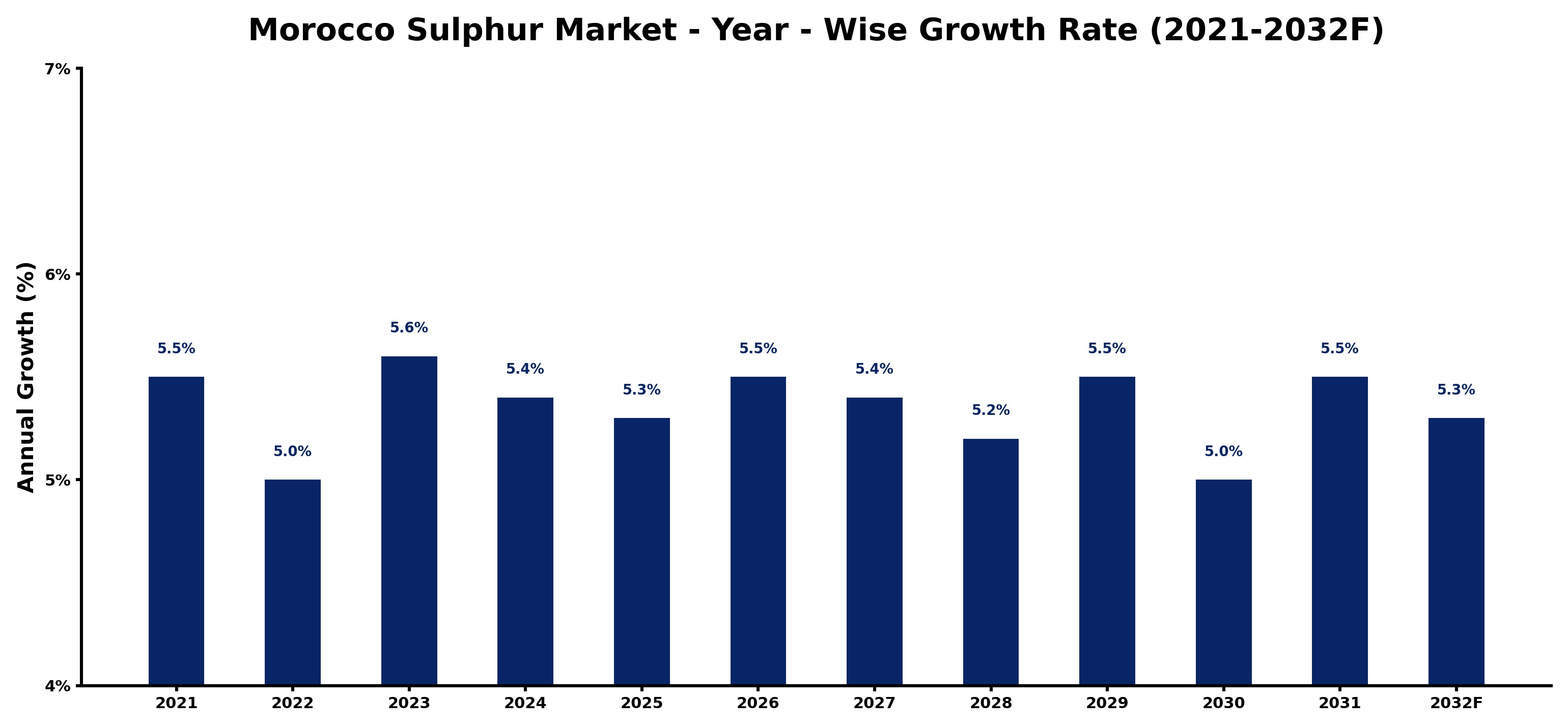
The table below presents the year‑wise growth rates along with the key drivers influencing the market
| Year | Growth Rate | Major Drivers |
| 2021 | 5.5% | Increased agricultural production demand |
| 2022 | 5.0% | Infrastructure development enhanced logistics |
| 2023 | 5.6% | Industrial applications expanded significantly |
| 2024 | 5.4% | Fertilizer usage drove market growth |
| 2025 | 5.3% | Energy sector investments surged forward |
| 2026 | 5.5% | Chemical manufacturing expanded operations |
| 2027 | 5.4% | Export opportunities increased profitability |
| 2028 | 5.2% | Technological advancements improved efficiency |
| 2029 | 5.5% | Sustainable practices gained traction |
| 2030 | 5.0% | Regulatory support enhanced compliance |
| 2031 | 5.5% | Market diversification opened new avenues |
| 2032 | 5.3% | Consumer awareness promoted eco-friendly options |
Note - Market size estimations and growth projections presented in this report are based on 6Wresearch's advanced forecasting approach, validated with industry datasets as of June 2026.
Morocco Sulphur Market Synopsis
The Morocco Sulphur Market is currently in an expansion phase, with increasing applications spanning agriculture, chemicals, and pharmaceuticals. The growing awareness of sustainable practices is particularly pertinent, as farmers and manufacturers seek to optimize the nutrient quality of their products through sulphur-enhanced solutions.
Moreover, the market landscape is influenced by Morocco's rich natural resources, primarily phosphates, which serve as the foundation for sulphur-based fertilizers. This synergy not only boosts local agricultural productivity but also positions Morocco strategically within the global sulphur supply chain.
Morocco Sulphur Market Key Takeaways
- Increasing agricultural demand is a primary driver for sulphur use in fertilizers.
- Morocco's phosphate production enhances the local sulphur market's growth potential.
- Investment in sulphur processing facilities represents a significant opportunity for new entrants.
- Government initiatives aim to bolster local production while ensuring environmental sustainability.
- Emerging applications in industrial sectors like chemicals and pharmaceuticals will fuel future growth.
Evaluation of Restraints in Morocco Sulphur Market
Despite the optimistic growth outlook, the Morocco Sulphur Market faces notable constraints. Limited domestic production capacity presents a challenge, as a significant portion of sulphur must be imported. This reliance on external suppliers makes the market vulnerable to global price fluctuations, affecting overall profitability. Furthermore, environmental regulations concerning sulphur emissions necessitate investment in advanced technologies, which could constrain operational scalability for local producers.
Morocco Sulphur Market Trends
Recent trends in the Morocco Sulphur Market indicate a robust shift towards sustainable agricultural practices. Farmers are increasingly adopting sulphur-based fertilizers that enhance soil quality and reduce environmental impact. The rising use of sulphur in industrial applications, including metal processing and water treatment, also reflects a broader understanding of its benefits across multiple sectors. Additionally, technological advancements in sulphur extraction and processing methods are paving the way for more efficient production.
Morocco Sulphur Market Opportunities
Investment opportunities in the Morocco Sulphur Market are promising, particularly for businesses looking to capitalize on the growing demand in agriculture, chemicals, and pharmaceuticals. Establishing local processing facilities or enhancing existing infrastructures can significantly benefit from Morocco's strategic geographic position. By tapping into the burgeoning need for high-quality sulphur-based products, investors can effectively penetrate both African and European markets.
Government Initiatives in the Morocco Sulphur Market
The Moroccan government has introduced several initiatives to bolster the sulphur market, focusing on sustainable mining and extraction practices to protect the environment. Policies include import tariffs designed to support local production while balancing domestic demand. Additionally, quality standards for sulphur products ensure consumer safety and reliability, fostering trust in local markets. The government also offers incentives for investments in sulphur production, aiming to enhance the sector's competitiveness.
Future Insights of the Morocco Sulphur Market
Looking ahead to 2026-2032, the Morocco Sulphur Market is anticipated to experience sustained growth, propelled by the increasing demand for sulphur across diverse industries. With efforts focused on boosting domestic production and reducing import reliance, the market stands poised for stability and expansion. However, stakeholders will need to navigate the ongoing challenges related to price volatility and environmental regulations to fully capitalize on growth opportunities.
Morocco Sulphur Market Latest Developments (May 2025 - June 2026)
Recent developments in the Morocco Sulphur Market highlight a shift towards innovation, with several players exploring advanced extraction techniques aimed at increasing efficiency and sustainability. Collaborative initiatives between local producers and international partners have emerged to enhance sulphur processing capabilities, ensuring that Morocco remains competitive on the global stage. Additionally, educational programs focused on sustainable agricultural practices are gaining traction, further embedding sulphur's role in local farming communities.
Morocco Sulphur Market - Key Attractiveness of the Report
- 10 Years of Market Numbers
- Historical Data Starting from 2022 to 2025
- Base Year: 2025
- Forecast Data until 2032
- Key Performance Indicators Impacting the Market
- Major Upcoming Developments and Projects
Key Highlights of the Report:
- Morocco Sulphur Market Outlook
- Market Size of Morocco Sulphur Market, 2025
- Forecast of Morocco Sulphur Market, 2032
- Historical Data and Forecast of Morocco Sulphur Revenues & Volume for the Period 2022-2032F
- Morocco Sulphur Market Trend Evolution
- Morocco Sulphur Market Drivers and Challenges
- Morocco Sulphur Price Trends
- Morocco Sulphur Porter's Five Forces
- Morocco Sulphur Industry Life Cycle
- Historical Data and Forecast of Morocco Sulphur Market Revenues & Volume By Product Type for the Period 2022-2032F
- Historical Data and Forecast of Morocco Sulphur Market Revenues & Volume By Natural Gas for the Period 2022-2032F
- Historical Data and Forecast of Morocco Sulphur Market Revenues & Volume By Crude Oil for the Period 2022-2032F
- Historical Data and Forecast of Morocco Sulphur Market Revenues & Volume By Others for the Period 2022-2032F
- Historical Data and Forecast of Morocco Sulphur Market Revenues & Volume By End Users for the Period 2022-2032F
- Historical Data and Forecast of Morocco Sulphur Market Revenues & Volume By Sulfuric Acid (Fertilizers) for the Period 2022-2032F
- Historical Data and Forecast of Morocco Sulphur Market Revenues & Volume By Sulfuric Acid (Metal Manufacturing) for the Period 2022-2032F
- Historical Data and Forecast of Morocco Sulphur Market Revenues & Volume By Chemical Processing for the Period 2022-2032F
- Morocco Sulphur Import Export Trade Statistics
- Market Opportunity Assessment By Product Type
- Market Opportunity Assessment By End Users
- Morocco Sulphur Top Companies Market Share
- Morocco Sulphur Competitive Benchmarking By Technical and Operational Parameters
- Morocco Sulphur Company Profiles
- Morocco Sulphur Key Strategic Recommendations






































