Morocco Toys and Hobby Goods Market Summary
The morocco toys and hobby goods market was estimated at USD 444 Million in 2025 and is projected to reach USD 589 Million by 2032, growing at a CAGR of 4.8% from 2026 to 2032.
Morocco Toys and Hobby Goods Market Year-wise Growth Rate and Key Drivers
This graph highlights how the Morocco Toys and Hobby Goods Market has steadily grown over the past five years, supported by major growth factors.
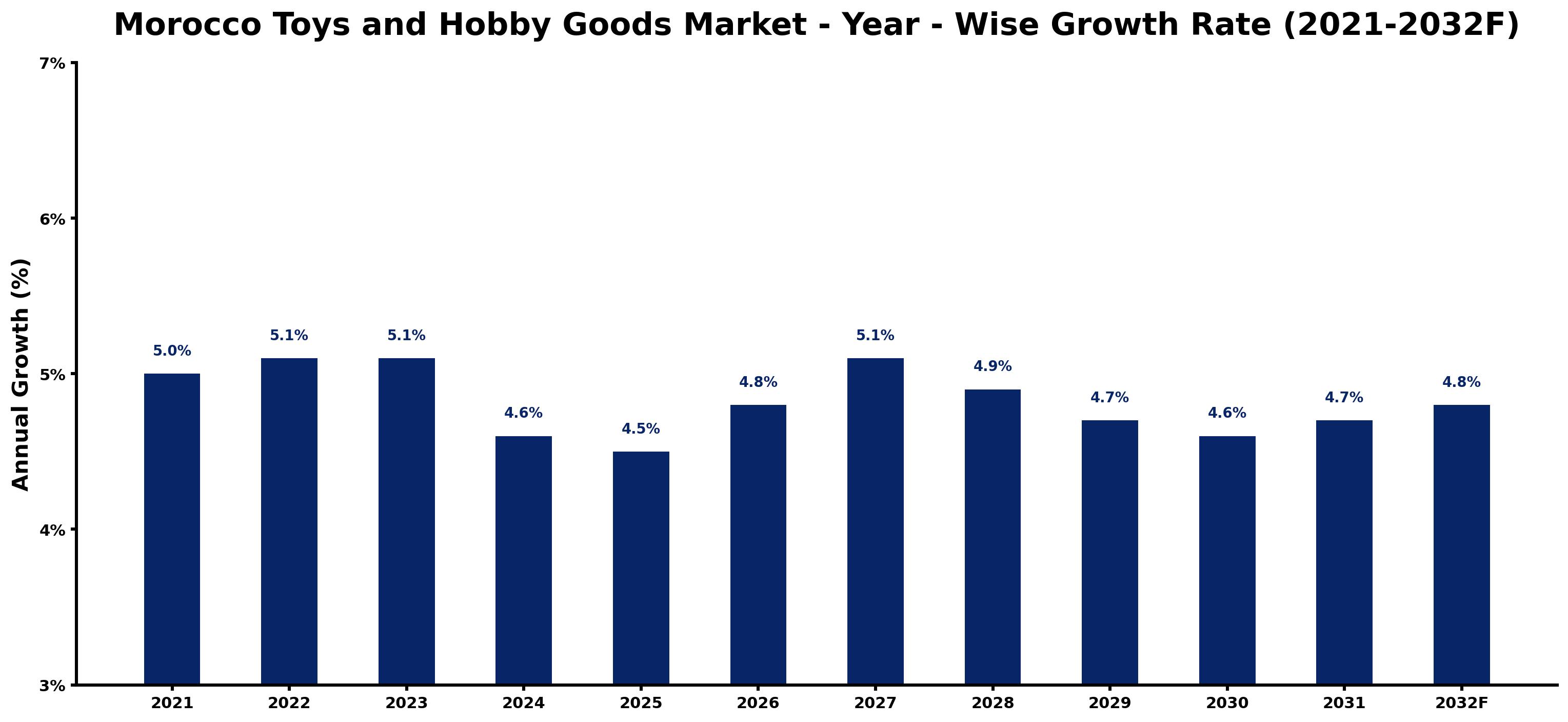
The table below presents the year wise growth rates along with the key drivers influencing the market
| Year | Growth Rate | Major Drivers |
| 2021 | 5.0% | Retail resilience during the pandemic showcased the adaptability of toy businesses in Morocco. |
| 2022 | 5.1% | Increased online shopping options expanded reach for both local and international toy brands. |
| 2023 | 5.1% | Cultural interests shifted towards educational toys, enhancing parental engagement in learning. |
| 2024 | 4.6% | Expansion of local manufacturers improved supply chains and reduced dependency on imports. |
| 2025 | 4.5% | Emerging middle-class families contributed to a sustainable increase in discretionary spending. |
| 2026 | 4.8% | Enhanced distribution networks ensured wider availability of diverse hobby goods across Morocco. |
| 2027 | 5.1% | Children's entertainment preferences evolved, driving demand for interactive and tech-driven toys. |
| 2028 | 4.9% | Sustainability trends pushed manufacturers towards eco-friendly materials and production processes. |
| 2029 | 4.7% | Urbanization's rapid pace led to increased urban family structures, boosting toy consumption. |
| 2030 | 4.6% | Collaboration between schools and toy manufacturers fostered educational toy integration into curricula. |
| 2031 | 4.7% | Digital marketing strategies became crucial, enhancing brand visibility among younger demographics. |
| 2032 | 4.8% | International brands recognized Morocco's potential, increasing investments in local toy markets. |
Note - Market size estimations and growth projections presented in this report are based on 6Wresearch's advanced forecasting approach, validated with industry datasets as of June 2026.
Morocco Toys and Hobby Goods Market Synopsis
The Morocco Toys and Hobby Goods Market is projected to reach 4.8% and witness significant growth during the forecast period (2026-2032). With an estimated market value of USD 1,056.8 million anticipated by 2026, the sector is expected to register a compound annual growth rate (CAGR) of 5.1%. This growth is fueled by various factors, including rising disposable incomes and evolving lifestyle patterns among Moroccan consumers, particularly in urban areas. Increasing exposure to international trends plays a crucial role in driving the willingness to invest in leisure activities, such as hobbies and toys.
Morocco Toys and Hobby Goods Market Growth Drivers
Several key drivers are propelling the Morocco Toys and Hobby Goods Market towards robust growth. Firstly, the rise in disposable incomes across the Moroccan population enables families to allocate more resources towards leisure activities. This financial flexibility leads to enhanced spending on both toys and hobby goods. Additionally, the shift in lifestyle patterns—characterized by an increasing emphasis on educational play—has reshaped consumer preferences, favoring products that combine fun with learning.
Furthermore, the digital revolution plays an essential role in redefining the toy market landscape. A growing interest in electronic products has created significant opportunities for producers who can innovate and offer efficient and interactive toys. The younger generation is particularly inclined towards technology-driven products, leading to an increased demand for such items.
Lastly, government initiatives promoting early childhood education are impacting the adoption of toys among families. Educational, play-based learning programs are encouraging parents to invest in toys that support their children's development, further driving market growth.
Morocco Toys and Hobby Goods Market Challenges and Restraints
Despite the positive outlook, the Morocco Toys and Hobby Goods Market faces substantial challenges. One of the primary restraints is the high cost associated with certain types of toys, which can limit access for lower-income families. This factor may hinder overall market penetration, especially in rural areas where spending capacity is lower.
Moreover, the prevalent high penetration rate of basic toys leads to market saturation, restricting opportunities for growth. Companies may struggle to differentiate their products in a highly competitive environment, exacerbating the difficulties associated with market expansion.
Additionally, the intense competition observed in the market has resulted in an aggressive pricing strategy among vendors. While this approach may make toys more affordable for consumers, it exerts downward pressure on profit margins, affecting the overall sustainability of firms operating within the sector.
Morocco Toys and Hobby Goods Market Opportunities
The Morocco Toys and Hobby Goods Market presents considerable opportunities for businesses willing to innovate. The introduction of technologically driven products that offer interactive experiences is poised to attract the interest of consumers. As children increasingly gravitate towards electronic and interactive toys, manufacturers can capitalize on this trend by creating engaging and educational products.
Moreover, leveraging digital platforms for marketing and sales can enhance reach and accessibility, especially in urban areas where e-commerce is gaining traction. Companies that adopt a multi-channel distribution strategy can tap into a broader market segment, driving sales while lowering operational costs.
Finally, partnership opportunities with educational institutions and childcare centers can further bolster brand visibility and consumer trust. By aligning products with educational objectives, manufacturers can enhance the perceived value of their offerings, ultimately fostering brand loyalty within the Moroccan consumer base.
Morocco Toys and Hobby Goods Market Government Investment and Initiatives
The Moroccan government plays a pivotal role in supporting the Toys and Hobby Goods Market through various investments and initiatives. Notably, there has been a concerted effort towards enhancing early childhood education, which is intrinsically linked to the demand for educational toys. The government's focus on incorporating play-based learning in educational curricula has created an environment conducive for toy manufacturers to thrive.
Public spending on educational programs is gradually increasing, which indirectly supports the toys sector by driving consumer interest in educational products. Furthermore, government policies aimed at improving the overall economic landscape, such as enhancing infrastructure for better distribution networks, indirectly benefit the toys market.
Incentives for businesses focusing on innovation and technology adoption are also evident. The government encourages companies to invest in research and development to create products that resonate with the evolving preferences of consumers, thus bolstering the market's long-term growth trajectory.
Morocco Toys and Hobby Goods Market Latest Developments (May 2025 - June 2026)
Recent developments in the Morocco Toys and Hobby Goods Market indicate a shift towards more interactive and technologically advanced products. During the period between May 2025 and June 2026, there has been a noticeable increase in the introduction of electronic toys that incorporate educational content, reflecting the growing consumer demand for multifunctional products.
Additionally, the expansion of e-commerce platforms has made it easier for businesses to reach consumers, particularly in urban centers. More brands have begun to utilize digital marketing strategies to engage with tech-savvy consumers, further accelerating market growth.
Moreover, collaborations between educational institutions and toy manufacturers have emerged, aimed at promoting educational toys and enriching curriculum-based activities. Such partnerships are expected to enhance brand loyalty among consumers who value educational content in play products.
Morocco Toys and Hobby Goods Market - Key Attractiveness of the Report
- 10 Years of Market Numbers
- Historical Data Starting from 2022 to 2025
- Base Year: 2025
- Forecast Data until 2032
- Key Performance Indicators Impacting the Market
- Major Upcoming Developments and Projects
Key Highlights of the Report:
- Morocco Toys and Hobby Goods Market Outlook
- Market Size of Morocco Toys and Hobby Goods Market, 2025
- Forecast of Morocco Toys and Hobby Goods Market, 2032F
- Historical Data and Forecast of Morocco Toys and Hobby Goods Revenues & Volume for the Period 2022-2032F
- Morocco Toys and Hobby Goods Market Trend Evolution
- Morocco Toys and Hobby Goods Market Drivers and Challenges
- Morocco Toys and Hobby Goods Price Trends
- Morocco Toys and Hobby Goods Porter's Five Forces
- Morocco Toys and Hobby Goods Industry Life Cycle
- Historical Data and Forecast of Morocco Toys and Hobby Goods Market Revenues & Volume By Type for the Period 2022-2032F
- Historical Data and Forecast of Morocco Toys and Hobby Goods Market Revenues & Volume By Sports Toys for the Period 2022-2032F
- Historical Data and Forecast of Morocco Toys and Hobby Goods Market Revenues & Volume By Intellectual Toys for the Period 2022-2032F
- Historical Data and Forecast of Morocco Toys and Hobby Goods Market Revenues & Volume By Education Toys for the Period 2022-2032F
- Historical Data and Forecast of Morocco Toys and Hobby Goods Market Revenues & Volume By Decorative Toys for the Period 2022-2032F
- Historical Data and Forecast of Morocco Toys and Hobby Goods Market Revenues & Volume By Other for the Period 2022-2032F
- Historical Data and Forecast of Morocco Toys and Hobby Goods Market Revenues & Volume By Application for the Period 2022-2032F
- Historical Data and Forecast of Morocco Toys and Hobby Goods Market Revenues & Volume By Online Sales for the Period 2022-2032F
- Historical Data and Forecast of Morocco Toys and Hobby Goods Market Revenues & Volume By Offline Sales for the Period 2022-2032F
- Historical Data and Forecast of Morocco Toys and Hobby Goods Market Revenues & Volume By Others for the Period 2022-2032F
- Morocco Toys and Hobby Goods Import Export Trade Statistics
- Market Opportunity Assessment By Type
- Market Opportunity Assessment By Application
- Morocco Toys and Hobby Goods Top Companies Market Share
- Morocco Toys and Hobby Goods Competitive Benchmarking By Technical and Operational Parameters
- Morocco Toys and Hobby Goods Company Profiles
- Morocco Toys and Hobby Goods Key Strategic Recommendations






































