Morocco Urea Market Size, Share & Growth Rate
The Morocco Urea Market was estimated at USD 248 Million in 2025 and is projected to reach USD 342 Million by 2032, growing at a CAGR of 4.7% from 2026 to 2032. This growth trajectory is primarily fueled by the rising demand for urea as a cost-effective nitrogen fertilizer among Moroccan farmers, as they seek to enhance agricultural productivity to meet the increasing food requirements of a growing population. Additionally, government initiatives to boost domestic production are playing a significant role in shaping the market dynamics.
Morocco Urea Market Growth Rate Analysis (2021-2032)
The Morocco urea market has exhibited stable growth, with annual increases of 5.6% in 2021 and 5.9% in 2022, largely driven by rising agricultural demands and enhanced fertilizer applications. While growth slightly moderated to 5.3% in both 2023 and 2024, a resurgence is expected with projections of 5.5% growth through 2027, as investments in infrastructure and sustainable agricultural practices are prioritized. The country's energy transition efforts further enhance urea's relevance, given its agricultural significance. The market is anticipated to stabilize at around 5.5% through 2032, with digitalization in farming practices contributing to more efficient urea utilization, ensuring sustained demand moving forward.
Morocco Urea Market Year-wise Growth Rate and Key Drivers
This graph highlights how the Morocco Urea Market has steadily grown over the past five years, supported by major growth factors.
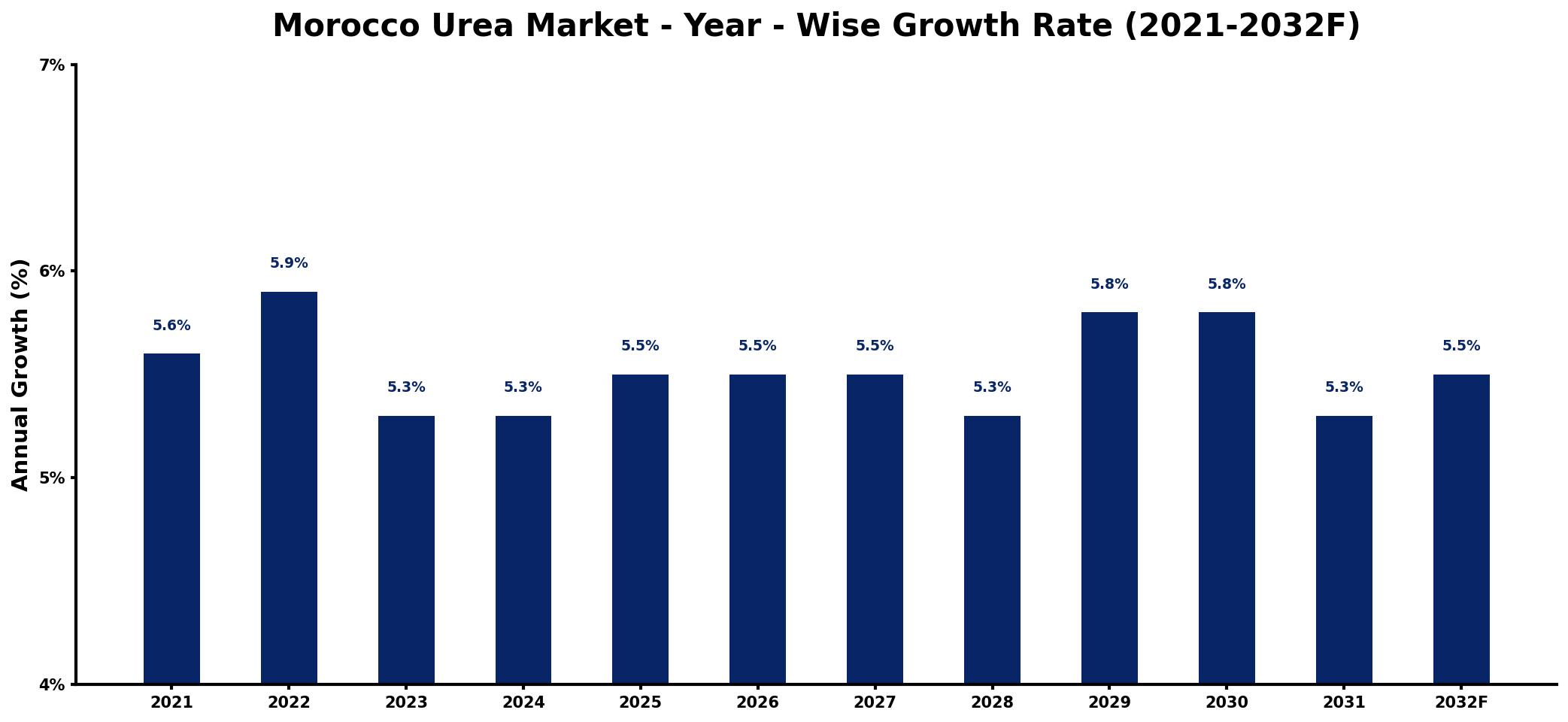
The table below presents the year‑wise growth rates along with the key drivers influencing the market
| Year | Growth Rate | Major Drivers |
| 2021 | 5.6% | Increased agricultural production efforts |
| 2022 | 5.9% | Rising global fertilizer demand |
| 2023 | 5.3% | Expansion of irrigation infrastructure |
| 2024 | 5.3% | Growing awareness of soil health |
| 2025 | 5.5% | Increased investment in agriculture |
| 2026 | 5.5% | Development of advanced farming techniques |
| 2027 | 5.5% | growing downstream application demand |
| 2028 | 5.3% | Technological advancements in fertilizers |
| 2029 | 5.8% | Rising population food requirements |
| 2030 | 5.8% | Government support for agriculture |
| 2031 | 5.3% | Enhanced distribution network efficiency |
| 2032 | 5.5% | Sustainable farming practices adoption |
Note: Market size estimations and growth projections presented in this report are based on 6Wresearch's proprietary forecasting methodology, utilizing the latest available industry data, government publications, and primary research inputs.
Morocco Urea Market Synopsis
In Morocco, urea serves as a pivotal component in agricultural practices, supporting farmers in improving crop yields while ensuring soil fertility. Its high nitrogen content makes it an attractive option for those looking to maximize their productivity without incurring substantial costs.
The countrys agricultural sector is increasingly reliant on efficient fertilizers like urea to meet rising food demands, particularly in the face of climate challenges. This dependency positions urea not only as a fertilizer but also as a crucial contributor to national food security strategies.
Morocco Urea Market Key Takeaways
- Urea is the leading nitrogen fertilizer in Morocco, essential for improving crop yields and soil health.
- The market's growth is significantly influenced by government policies aiming to enhance domestic production capabilities.
- Demand for urea is propelled by the agricultural sector's efforts to meet increasing food production needs.
- Fluctuating prices and environmental concerns remain ongoing challenges for the urea production landscape.
- Investment in sustainable production technologies is becoming a focal point for future market development.
Evaluation of Restraints in Morocco Urea Market
Despite the promising outlook for the Morocco Urea Market, several key restraints hinder its growth potential. The volatility of urea prices can create uncertainty for farmers and stakeholders, making it challenging to maintain stable production costs. Furthermore, environmental regulations and the need for sustainable practices are pushing the industry to adapt. Ensuring efficient supply chain logistics also poses a significant barrier, as delays and inefficiencies can impact market accessibility and ultimately crop yields.
Morocco Urea Market Trends
Current trends in the Morocco Urea Market showcase a significant shift towards sustainable agricultural practices. Many farmers are now adopting advanced manufacturing technologies and practices aimed at reducing the environmental footprint of urea production. Furthermore, there is a growing emphasis on precision farming, where targeted application of fertilizers, including urea, optimizes resource use and enhances productivity. This trend is expected to drive the demand for more efficient fertilizer solutions in the upcoming years.
Morocco Urea Market Opportunities
The potential for growth within the Morocco Urea Market is notably significant, particularly in the realm of domestic production expansion. The governments focus on reducing import dependency offers avenues for local manufacturers to enhance their operational capacities. Investments in innovative urea production technologies, coupled with the development of comprehensive training programs for farmers on optimal usage, present valuable opportunities. Moreover, increasing interest in organic farming could spur the development of urea formulations that cater to the sustainability preferences of modern consumers.
Government Initiatives in the Morocco Urea Market
The Moroccan government has implemented various initiatives to support the urea market, emphasizing the importance of boosting local production. Policies are geared towards providing subsidies for urea production facilities, which are designed to encourage investment in modern manufacturing technologies. Additionally, the government is supporting research into efficient and sustainable production methods, ensuring that the agricultural sector remains both productive and environmentally conscious.
Future Insights of the Morocco Urea Market
Looking ahead to the 2026-2032 period, the Morocco Urea Market is poised for steady growth. With anticipated advancements in agricultural technology and increasing focus on sustainability, farmers are likely to adopt urea more extensively as a key component of their fertilizer strategy. Furthermore, the proactive government policies aimed at supporting domestic production will continue to mitigate import dependency, ensuring that the market is well-positioned to meet the rising demands of the agricultural sector.
Morocco Urea Market Latest Developments (2025 - 2026)
In recent months, the Morocco Urea Market has witnessed a series of initiatives aimed at enhancing production capabilities and supply chain efficiencies. Investments in new technologies and modern manufacturing processes have been prioritized, reflecting an industry-wide commitment to improving sustainability. Additionally, the government has continued to roll out support programs to aid farmers in transitioning to more efficient fertilizer usage, aligning with the global movement towards sustainable agriculture.
Morocco Urea Market - Key Attractiveness of the Report
- 10 Years of Market Numbers
- Historical Data Starting from 2022 to 2025
- Base Year: 2025
- Forecast Data until 2032
- Key Performance Indicators Impacting the Market
- Major Upcoming Developments and Projects
Key Highlights of the Report:
- Morocco Urea Market Outlook
- Market Size of Morocco Urea Market, 2025
- Forecast of Morocco Urea Market, 2032
- Historical Data and Forecast of Morocco Urea Revenues & Volume for the Period 2022-2032F
- Morocco Urea Market Trend Evolution
- Morocco Urea Market Drivers and Challenges
- Morocco Urea Price Trends
- Morocco Urea Porter's Five Forces
- Morocco Urea Industry Life Cycle
- Historical Data and Forecast of Morocco Urea Market Revenues & Volume By Grade for the Period 2022-2032F
- Historical Data and Forecast of Morocco Urea Market Revenues & Volume By Fertilizer for the Period 2022-2032F
- Historical Data and Forecast of Morocco Urea Market Revenues & Volume By Feed for the Period 2022-2032F
- Historical Data and Forecast of Morocco Urea Market Revenues & Volume By Technical for the Period 2022-2032F
- Historical Data and Forecast of Morocco Urea Market Revenues & Volume By End-user Industry for the Period 2022-2032F
- Historical Data and Forecast of Morocco Urea Market Revenues & Volume By Agriculture for the Period 2022-2032F
- Historical Data and Forecast of Morocco Urea Market Revenues & Volume By Chemical for the Period 2022-2032F
- Historical Data and Forecast of Morocco Urea Market Revenues & Volume By Automotive for the Period 2022-2032F
- Historical Data and Forecast of Morocco Urea Market Revenues & Volume By Medical for the Period 2022-2032F
- Historical Data and Forecast of Morocco Urea Market Revenues & Volume By Others for the Period 2022-2032F
- Morocco Urea Import Export Trade Statistics
- Market Opportunity Assessment By Grade
- Market Opportunity Assessment By End-user Industry
- Morocco Urea Top Companies Market Share
- Morocco Urea Competitive Benchmarking By Technical and Operational Parameters
- Morocco Urea Company Profiles
- Morocco Urea Key Strategic Recommendations






































