Morocco Vegetable Seed Market Year-wise Growth Rate (2021-2031F)
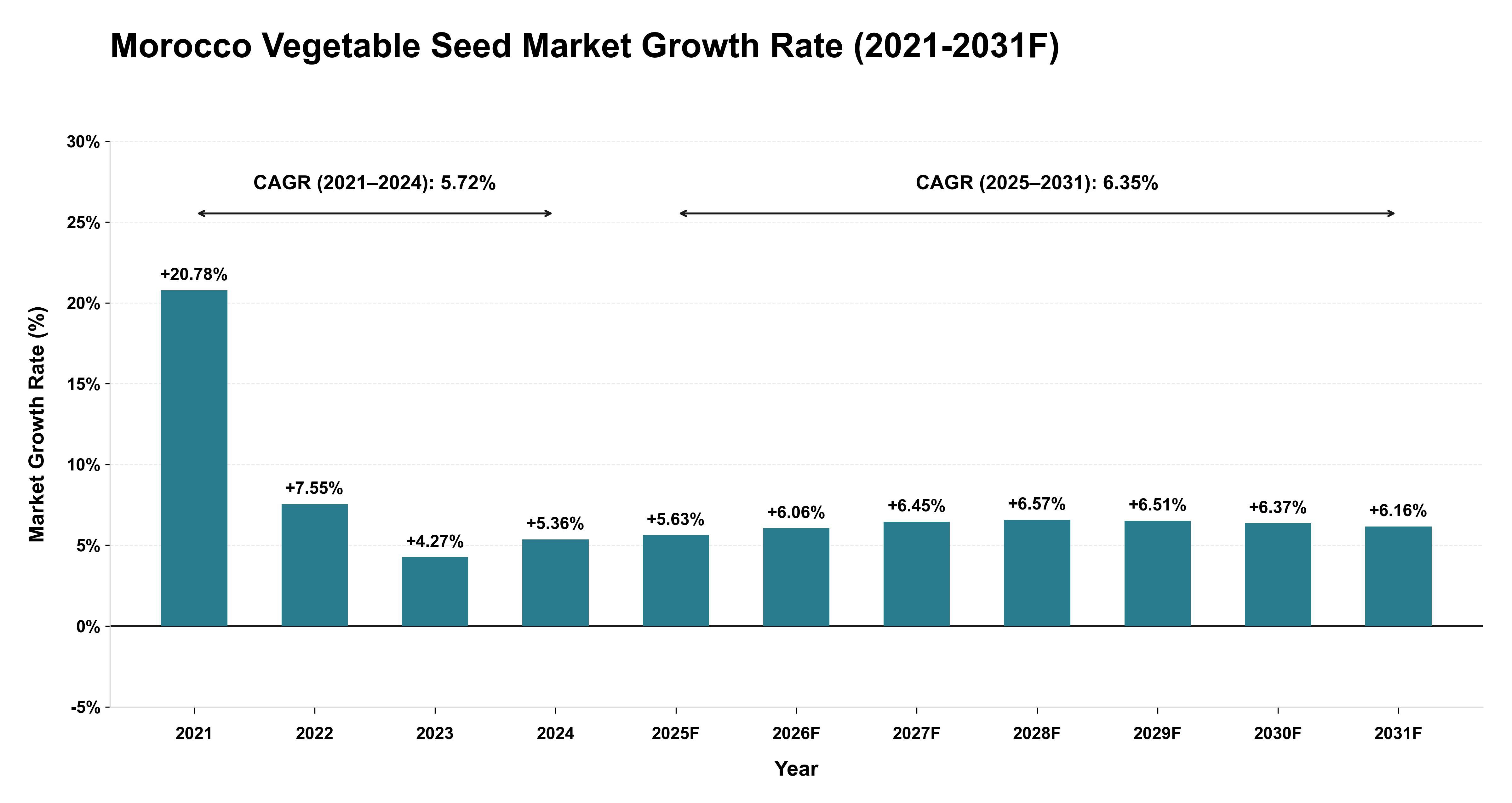
The Morocco Vegetable Seed Market experienced robust growth from 2021 to 2024, with a notable CAGR of 5.72%. This period saw a significant acceleration in 2021 at 20.78%, driven by increasing demand for high-quality seeds. Subsequent years witnessed steady growth, reflecting stable demand from local farmers seeking improved crop yields. Looking ahead to 2025-2031, the forecasted CAGR of 6.35% indicates a continued upward trajectory. The market is expected to maintain momentum, supported by advancements in seed technology, growing awareness of sustainable agricultural practices, and government initiatives promoting agriculture. With consistent year-on-year growth rates surpassing historical levels, the Morocco Vegetable Seed Market is poised for sustained expansion in the coming years.
Key Highlights of the Report:
- Morocco Vegetable Seed Market Outlook
- Market Size of Morocco Vegetable Seed Market, 2024
- Forecast of Morocco Vegetable Seed Market, 2031
- Historical Data and Forecast of Morocco Vegetable Seed Revenues & Volume for the Period 2021- 2031
- Morocco Vegetable Seed Market Trend Evolution
- Morocco Vegetable Seed Market Drivers and Challenges
- Morocco Vegetable Seed Price Trends
- Morocco Vegetable Seed Porter's Five Forces
- Morocco Vegetable Seed Industry Life Cycle
- Historical Data and Forecast of Morocco Vegetable Seed Market Revenues & Volume By Type for the Period 2021- 2031
- Historical Data and Forecast of Morocco Vegetable Seed Market Revenues & Volume By Solanaceae for the Period 2021- 2031
- Historical Data and Forecast of Morocco Vegetable Seed Market Revenues & Volume By Cucurbit for the Period 2021- 2031
- Historical Data and Forecast of Morocco Vegetable Seed Market Revenues & Volume By Root&bulb for the Period 2021- 2031
- Historical Data and Forecast of Morocco Vegetable Seed Market Revenues & Volume By Brassica for the Period 2021- 2031
- Historical Data and Forecast of Morocco Vegetable Seed Market Revenues & Volume By Leafy for the Period 2021- 2031
- Historical Data and Forecast of Morocco Vegetable Seed Market Revenues & Volume By Others for the Period 2021- 2031
- Historical Data and Forecast of Morocco Vegetable Seed Market Revenues & Volume By Application for the Period 2021- 2031
- Historical Data and Forecast of Morocco Vegetable Seed Market Revenues & Volume By Farmland for the Period 2021- 2031
- Historical Data and Forecast of Morocco Vegetable Seed Market Revenues & Volume By Greenhouse for the Period 2021- 2031
- Morocco Vegetable Seed Import Export Trade Statistics
- Market Opportunity Assessment By Type
- Market Opportunity Assessment By Application
- Morocco Vegetable Seed Top Companies Market Share
- Morocco Vegetable Seed Competitive Benchmarking By Technical and Operational Parameters
- Morocco Vegetable Seed Company Profiles
- Morocco Vegetable Seed Key Strategic Recommendations






































