Morocco Vision Screeners Market Size, Share & Growth Rate
The Morocco Vision Screeners Market was estimated at USD 413 Million in 2025 and is projected to reach USD 582 Million by 2032, growing at a CAGR of 5.0% from 2026 to 2032. This growth trajectory is propelled by an increasing prevalence of vision disorders, alongside a heightened public consciousness regarding the importance of eye health. Additionally, the expansion of healthcare infrastructure and supportive government initiatives are creating an environment conducive to investment and innovation in vision screening technologies.
Morocco Vision Screeners Market Year-wise Growth Rate and Key Drivers
This graph highlights how the Morocco Vision Screeners Market has steadily grown over the years, supported by major growth factors.
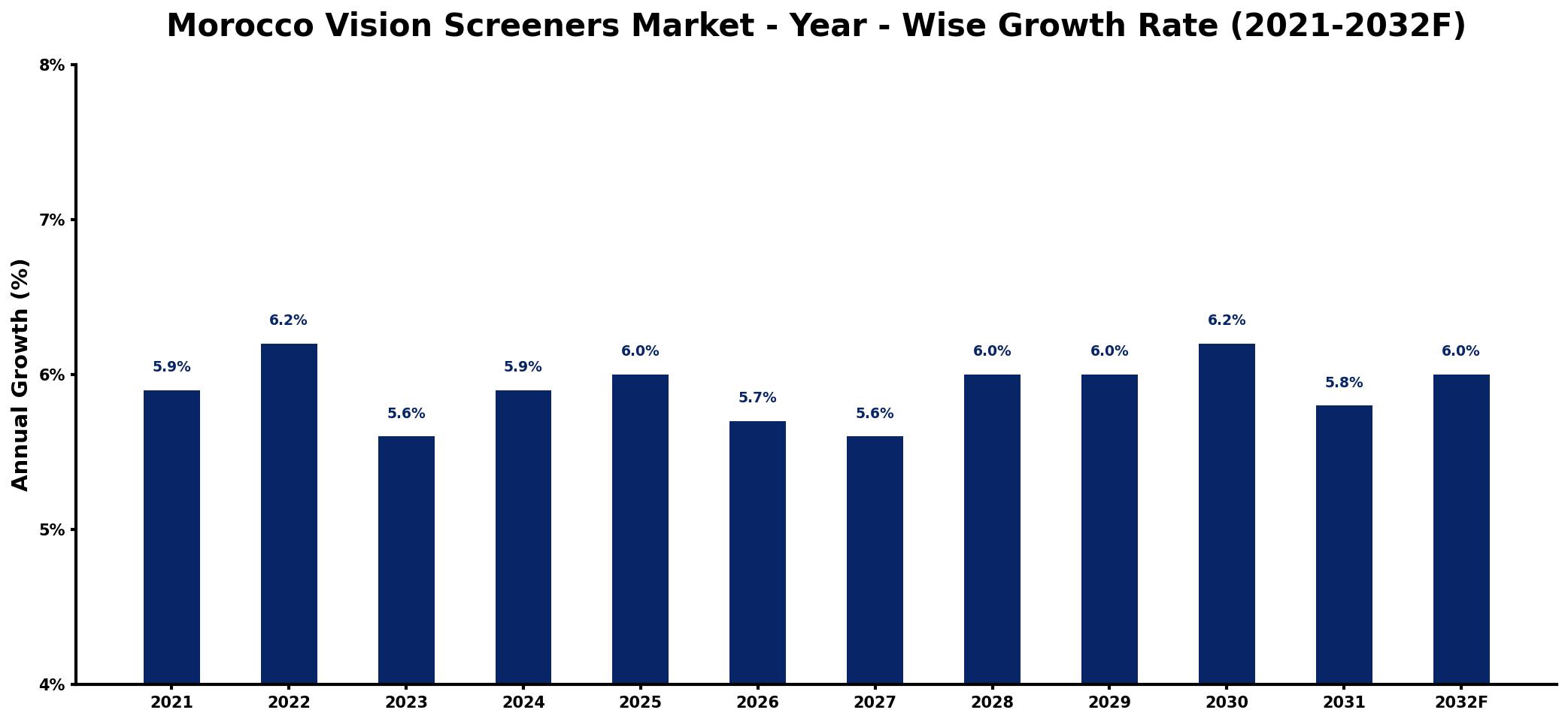
The table below presents the year‑wise growth rates along with the key drivers influencing the market
| Year | Growth Rate | Major Drivers |
| 2021 | 5.9% | Rising healthcare expenditure in region |
| 2022 | 6.2% | Increased awareness of eye health |
| 2023 | 5.6% | Growing demand for preventive care |
| 2024 | 5.9% | Expansion of healthcare infrastructure |
| 2025 | 6.0% | Technological advancements in diagnostics |
| 2026 | 5.7% | Surge in population aging demographics |
| 2027 | 5.6% | Investment in healthcare innovation initiatives |
| 2028 | 6.0% | Enhanced government health programs |
| 2029 | 6.0% | Growing prevalence of visual disorders |
| 2030 | 6.2% | Increase in telehealth service adoption |
| 2031 | 5.8% | Development of affordable healthcare solutions |
| 2032 | 6.0% | Rising importance of early detection |
Note: Market size estimations and growth projections presented in this report are based on 6Wresearch's proprietary forecasting methodology, utilizing the latest available industry data, government publications, and primary research inputs.
Morocco Vision Screeners Market Synopsis
The Morocco Vision Screeners Market is currently witnessing a paradigm shift as the population becomes increasingly aware of the significance of early detection of vision-related issues. This awareness is particularly vital given the rising numbers of aging individuals prone to various eye disorders. The market showcases a range of devices, including autorefractors and retinal cameras, aimed at addressing this growing need.
In tandem with technological advancements, such as automated measurements and improved connectivity features, the market is evolving to meet the demands of both clinical and non-clinical settings. Efforts are further bolstered by government policies that emphasize the accessibility and affordability of eye care services throughout the country.
Morocco Vision Screeners Market Key Takeaways
- The market is expected to grow steadily due to rising awareness about eye health and increasing prevalence of vision disorders.
- Technological advancements are leading to a surge in demand for portable and automated vision screening devices.
- The integration of telemedicine in vision screening processes is enhancing remote accessibility.
- Government initiatives are focused on improving healthcare infrastructure and promoting public-private partnerships in eye care.
- Investment opportunities exist in advanced, portable vision screening technologies, especially in underserved areas.
Evaluation of Restraints in Morocco Vision Screeners Market
Despite its promising growth, the Morocco Vision Screeners Market faces significant restraints that could impede its progress. One major issue is the limited access to eye care services in rural areas, where awareness and availability of screening facilities are alarmingly low. This lack of infrastructure often leads to late detection of vision disorders, ultimately complicating treatment and contributing to poor eye health outcomes. Moreover, the high cost of advanced vision screening devices restricts their adoption, particularly in resource-limited settings. The shortage of trained healthcare professionals further exacerbates these challenges, as a qualified workforce is crucial for accurate screenings and effective management of vision disorders.
Morocco Vision Screeners Market Trends
The current trends in the Morocco Vision Screeners Market indicate a robust shift towards the adoption of innovative technologies. Automated vision screening devices that offer portability and ease of use are gaining traction across various healthcare settings. The rise of telemedicine is also influencing how screenings are conducted, allowing for remote evaluations and data management, which is particularly beneficial in areas with limited access to healthcare resources. Furthermore, there is a growing emphasis on educational campaigns aimed at improving public awareness of eye health, driving demand for regular screening.
Morocco Vision Screeners Market Opportunities
The Morocco Vision Screeners Market is rich with investment opportunities, especially in the realm of advanced technologies designed for efficient eye health monitoring. With an increasing focus on preventive care, the demand for high-quality vision screening devices—such as digital autorefractors and visual acuity testers—is on the rise. Potential investors can explore partnerships with local healthcare providers to enhance distribution networks and expand market reach. Furthermore, tapping into underserved rural regions can yield significant returns as accessibility improves and awareness campaigns take root.
Government Initiatives in the Morocco Vision Screeners Market
The Moroccan government is actively implementing policies aimed at enhancing healthcare services, including vision screening. These initiatives focus on increasing the accessibility and affordability of eye care, particularly for populations in rural areas. The government promotes public-private partnerships to improve service delivery and ensure that high-quality standards are met across the board. Additionally, awareness campaigns are being rolled out to educate the public on the importance of routine vision screenings, fostering a culture of proactive eye health management.
Future Insights of the Morocco Vision Screeners Market
Looking ahead to 2026-2032, the Morocco Vision Screeners Market is set to experience notable growth, driven by a combination of demographic factors and technological advancements. The aging population is expected to increase the demand for regular eye health monitoring. Moreover, as healthcare infrastructure continues to evolve, particularly with increased government support, the accessibility of vision screening services is likely to improve. This, coupled with advancements in screening technology, suggests a promising future for both domestic and international players in this sector.
Morocco Vision Screeners Market Latest Developments (2025 - 2026)
Recent developments in the Morocco Vision Screeners Market reflect a commitment to enhancing eye health through innovative solutions. Various healthcare providers have begun to adopt portable vision screening devices, making screenings more accessible in community health programs. Additionally, partnerships between government entities and private companies are being established to facilitate the distribution of advanced technologies in rural areas. There is also a noticeable increase in public awareness initiatives aimed at educating citizens about the benefits of early vision screening, ultimately contributing to better eye health outcomes.
Morocco Vision Screeners Market - Key Attractiveness of the Report
- 10 Years of Market Numbers
- Historical Data Starting from 2022 to 2025
- Base Year: 2025
- Forecast Data until 2032
- Key Performance Indicators Impacting the Market
- Major Upcoming Developments and Projects
Key Highlights of the Report:
- Morocco Vision Screeners Market Outlook
- Market Size of Morocco Vision Screeners Market, 2025
- Forecast of Morocco Vision Screeners Market, 2032
- Historical Data and Forecast of Morocco Vision Screeners Revenues & Volume for the Period 2022-2032F
- Morocco Vision Screeners Market Trend Evolution
- Morocco Vision Screeners Market Drivers and Challenges
- Morocco Vision Screeners Price Trends
- Morocco Vision Screeners Porter's Five Forces
- Morocco Vision Screeners Industry Life Cycle
- Historical Data and Forecast of Morocco Vision Screeners Market Revenues & Volume By Product for the Period 2022-2032F
- Historical Data and Forecast of Morocco Vision Screeners Market Revenues & Volume By Table-Top Vision Screeners for the Period 2022-2032F
- Historical Data and Forecast of Morocco Vision Screeners Market Revenues & Volume By Portable/Handheld Vision Screeners for the Period 2022-2032F
- Historical Data and Forecast of Morocco Vision Screeners Market Revenues & Volume By Vision Screening Software for the Period 2022-2032F
- Historical Data and Forecast of Morocco Vision Screeners Market Revenues & Volume By Technology for the Period 2022-2032F
- Historical Data and Forecast of Morocco Vision Screeners Market Revenues & Volume By Digital Vision Screeners for the Period 2022-2032F
- Historical Data and Forecast of Morocco Vision Screeners Market Revenues & Volume By Computer-Based Vision Screeners for the Period 2022-2032F
- Historical Data and Forecast of Morocco Vision Screeners Market Revenues & Volume By Application for the Period 2022-2032F
- Historical Data and Forecast of Morocco Vision Screeners Market Revenues & Volume By Vision Screening Tests for the Period 2022-2032F
- Historical Data and Forecast of Morocco Vision Screeners Market Revenues & Volume By Color Vision Test for the Period 2022-2032F
- Historical Data and Forecast of Morocco Vision Screeners Market Revenues & Volume By Binocular Testing for the Period 2022-2032F
- Historical Data and Forecast of Morocco Vision Screeners Market Revenues & Volume By Others for the Period 2022-2032F
- Historical Data and Forecast of Morocco Vision Screeners Market Revenues & Volume By End Users for the Period 2022-2032F
- Historical Data and Forecast of Morocco Vision Screeners Market Revenues & Volume By Hospitals for the Period 2022-2032F
- Historical Data and Forecast of Morocco Vision Screeners Market Revenues & Volume By Homecare Settings for the Period 2022-2032F
- Historical Data and Forecast of Morocco Vision Screeners Market Revenues & Volume By Specialized Clinics for the Period 2022-2032F
- Historical Data and Forecast of Morocco Vision Screeners Market Revenues & Volume By Rehabilitation Centers for the Period 2022-2032F
- Historical Data and Forecast of Morocco Vision Screeners Market Revenues & Volume By Ambulatory Surgical Centers for the Period 2022-2032F
- Morocco Vision Screeners Import Export Trade Statistics
- Market Opportunity Assessment By Product
- Market Opportunity Assessment By Technology
- Market Opportunity Assessment By Application
- Market Opportunity Assessment By End Users
- Morocco Vision Screeners Top Companies Market Share
- Morocco Vision Screeners Competitive Benchmarking By Technical and Operational Parameters
- Morocco Vision Screeners Company Profiles
- Morocco Vision Screeners Key Strategic Recommendations






































